States move to legalize CBD to end confusion over US rules

Advertisement

Advertise with us

SAN FRANCISCO - CBD oil-infused gummy bears, lattes and other food, drinks and dietary supplements are selling quickly even though the U.S. government says they're illegal and local authorities have forced some retailers to pull products. The confusion has the nation's two largest states and others moving to legalize the cannabis compound that many see as beneficial to their health.

Read this article for free:


or

Already have an account? Log in here »

To continue reading, please subscribe:

Subscribe and receive a limited-edition Free Press branded hat or tote.

Digital Subscription

One year of digital access for only $205*

  • Enjoy unlimited reading on winnipegfreepress.com
  • Read the E-Edition, our digital replica newspaper
  • Access News Break, our award-winning app
  • Play interactive puzzles

*First annual payment billed as $205.00 + GST for one year. This annual subscription will automatically renew at $233.00 + GST every 52 weeks (10% off the regular annual price of $259.35). Offer available to new and qualified returning subscribers only. Cancel any time.

To continue reading, please subscribe:

Add Free Press access to your Brandon Sun subscription for only an additional

$1 for the first 4 weeks*

  • Enjoy unlimited reading on winnipegfreepress.com
  • Read the E-Edition, our digital replica newspaper
  • Access News Break, our award-winning app
  • Play interactive puzzles
Start now

*Your next Brandon Sun subscription payment will increase by $1.00 and you will be charged $17.95 plus GST for four weeks. After four weeks, your payment will increase to $24.95 plus GST every four weeks.

Hey there, time traveller!
This article was published 04/04/2019 (2736 days ago), so information in it may no longer be current.

SAN FRANCISCO – CBD oil-infused gummy bears, lattes and other food, drinks and dietary supplements are selling quickly even though the U.S. government says they’re illegal and local authorities have forced some retailers to pull products. The confusion has the nation’s two largest states and others moving to legalize the cannabis compound that many see as beneficial to their health.

Lawmakers in Texas and California are often in opposition, but they’re both pushing bipartisan legislation to sidestep federal law and allow sales of the compound found in hemp and marijuana. Republicans and Democrats in Congress also are urging the U.S. Food and Drug Administration to change its stance.

The FDA announced Tuesday that it will hold a public hearing in May to gather more information.
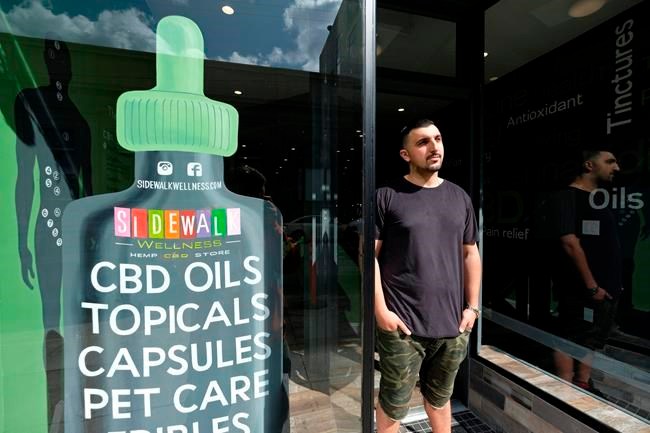
In this photo taken Thursday, March 21, 2019, Gus Dabais stands outside his Sidewalk Wellness store in San Francisco. CBD oil-infused food, drinks and dietary supplements are popular even though the U.S. government says they're illegal and some local authorities have forced retailers to pull products. The confusion has California, Texas and other states moving to legalize the cannabis compound that many see as beneficial to their health. (AP Photo/Eric Risberg)

Resolving the confusion can’t come quick enough for Jonathan Eppers, who makes Vybes, a popular CBD oil-infused beverage. California health inspectors raided his Los Angeles warehouse in January and impounded $100,000 worth of the drink.

Eppers said about 50 California retailers have since dropped his product and he’s moved production to Texas. He estimates lost sales, legal costs and relocation expenses have cost him at least $500,000.

“What is going on is unbelievable and asinine,” Eppers said. “They put us in this state of limbo that’s costing us.”

Eppers and CBD fans are mystified by the legal insecurity. After all, they say, retailers in California and nine other states that have broadly legalized marijuana sell edibles and other products that get people high, though pot is illegal under federal law. U.S. officials generally have taken a hands-off approach in states where pot is legal.

The FDA has oversight of CBD because it is the active ingredient in an approved prescription drug to treat two rare seizure disorders. The agency says CBD can’t be added to food or sold as a dietary supplement because officials haven’t determined if it’s safe or effective for other conditions.

FDA Commissioner Scott Gottlieb told Congress last week that enforcement is being limited to sellers who make false health claims. He says the agency recently sent warning letters to three companies touting CBD as a treatment for cancer, Alzheimer’s disease, fibromyalgia and drug addiction.

“But there are products on the market right now that, given our enforcement priorities and our limited resources, we haven’t taken action against,” he said.

Short for cannabidiol, CBD is a non-intoxicating molecule found in hemp and marijuana. Both are cannabis plants, but only marijuana has enough of the compound THC to get users high.

CBD oil is extracted when the plant is processed. While hemp derivatives are essentially THC-free, CBD oil from marijuana may have very little or enough to produce a high.

Sellers and users say CBD helps with pain, anxiety and inflammation, though limited scientific research supports those claims. It’s turning up in products ranging from lotions, cosmetics and soap to diet pills, juices, cocktails, candy and drinks.

State and local officials are taking nearly all the enforcement actions against CBD. Health officials in California, which has the nation’s largest legal marijuana marketplace, warned retailers last summer that anything edible containing CBD is illegal until lawmakers or regulators say otherwise.

The warning was largely ignored until earlier this year, when state and local health officials began forcing some small businesses to pull products after receiving complaints.

San Francisco health officials recently barred two small operators from selling CBD-infused food and drink, while authorities in rural Grass Valley, 140 miles (308 kilometres) away, did the same to a small, co-operatively owned grocery store.

“It caught us way off guard,” said Gus Dabais, owner of Sidewalk Wellness, one of the stores targeted.
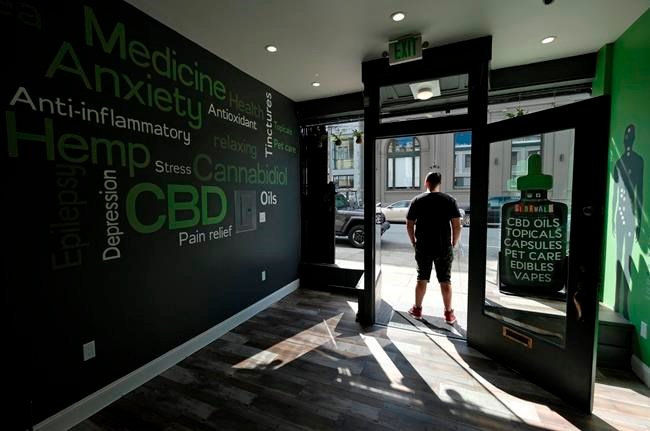
In this photo taken Thursday, March 21, 2019, Gus Dabais stands in the entry to his Sidewalk Wellness store in San Francisco. CBD oil-infused food, drinks and dietary supplements are popular even though the U.S. government says they're illegal and some local authorities have forced retailers to pull products. The confusion has California, Texas and other states moving to legalize the cannabis compound that many see as beneficial to their health. (AP Photo/Eric Risberg)

The San Francisco Health Department sent warning letters to 1,900 businesses last year, spokeswoman Veronica Vien said. She said inspectors are not looking for CBD but responding to complaints.

She said that’s how they ended up “red tagging” products at Dabais’ business and Steap Tea Bar, a popular Chinatown stop that sold CBD-infused bubble tea.

Similar scenarios are playing out in Ohio, where authorities in January ordered a Cincinnati grocery store to remove CBD from two outlets. The following month, New York City health inspectors removed CBD products from a number of restaurants. Police in March raided two Fort Worth, Texas, retailers and seized CBD products after the local district attorney declared the compound illegal.

In Texas, one of a handful of states that outlaws all forms of marijuana, lawmakers are pushing a measure that would legalize hemp oil-infused edibles. It sailed through its first committee in the House this week.

In California, a similar CBD measure has moved on to the full Assembly.

“A number of people have been using it for years, and you can find it on retail shelves all over the place, but now people are surprised to find it’s against the law,” said Assemblywoman Cecilia Aguiar-Curry, a Napa-area Democrat who introduced the measure. “What this bill will do is clear up the confusion.”

She said the legislation would stop state and local enforcement of the FDA’s ban and hopes it becomes law by August.

“This would lift a legal cloud from a legitimate California business,” said Jim Gross of the U.S. Hemp Roundtable, an industry association.

A growing number of federal lawmakers, including Senate Majority Leader Mitch McConnell and Democratic Sen. Ron Wyden of Oregon, are urging the FDA to approve CBD. They backed a measure taking hemp off the U.S. government’s list of banned substances.

“Hemp is a versatile crop with many uses and applications,” McConnell and Wyden wrote to the FDA in February. “We are hopeful that by working with you on the implementation of our legislation, we can help ensure that hemp can be a new cash crop for farmers across the country.”
Report Error Submit a Tip

More Stories

Manitoba PC leader Khan survives confidence vote

Carol Sanders 3 minute read Preview

Manitoba PC leader Khan survives confidence vote

Carol Sanders 3 minute read Updated: Yesterday at 8:33 PM CDT

Manitoba Progressive Conservative Leader Obby Khan survived a confidence vote last week.

Caucus communications director Alison Sutherland confirmed the vote was held Friday and that Khan still has “the full confidence” of the PC caucus.

She did not provide further details.

The party under Khan’s leadership is floundering, a recent poll suggests.

Read
Updated: Yesterday at 8:33 PM CDT

Expert urges food, drink makers to look to foreign markets

Gabrielle Piché 5 minute read Preview

Expert urges food, drink makers to look to foreign markets

Gabrielle Piché 5 minute read 5:04 PM CDT

Canada’s slowing population growth could restrict business expansion, a top economist for Farm Credit Canada warned Manitoba manufacturers.

Craig Johnston, the federal Crown corporation’s chief economist, addressed Prairie businesses at Farm Credit Canada’s Food and Beverage Summit Tuesday.

“There could be some modest growth in Canadian consumption of food and beverage,” Johnston said, relaying population numbers inside a Victoria Inn Hotel conference room.

Still, per-person spending on food is “stagnant, if not somewhat rising,” Johnson later told reporters.

Read
5:04 PM CDT

Orange Shirt Day project fits students to a tee

Maggie Macintosh 5 minute read Preview

Orange Shirt Day project fits students to a tee

Maggie Macintosh 5 minute read Yesterday at 6:57 PM CDT

On the eve of Orange Shirt Day, hundreds of black T-shirts will be handed out to teenagers at Elmwood High School — and there wasn’t a mixup in the clothing procurement process.

The student-run business behind the initiative wanted to make a statement about “truth and reconciliation” being a year-round activity, said Daniel Concepcion, a Grade 12 student.

Daniel said given that black is a staple in the wardrobe of teenagers, he hopes these shirts won’t sit on hangers for 364 days of the year.

“Every child matters, every part of the day, every day,” the 17-year-old said.

Read
Yesterday at 6:57 PM CDT

Hydro reports $446-M loss in 2025-26, points to fourth drought year in past five

Scott Billeck 3 minute read Preview

Hydro reports $446-M loss in 2025-26, points to fourth drought year in past five

Scott Billeck 3 minute read 6:38 PM CDT

Manitoba Hydro posted a $446-million loss in 2025-26, as drought conditions slashed hydroelectric generation, forcing the Crown corporation to buy more power while leaving it with less electricity to sell outside the province.

The loss was $666 million worse than the $220-million profit Hydro had budgeted. The utility posted a $63-million loss the previous year, according to the utility’s annual report released Tuesday.

Hydro said the 2025-26 fiscal year, which ended on March 31, marked its fourth low-water year in the past five years, among the worst stretches of water-flow conditions in its recorded history.

Hydroelectric generation fell 23 per cent to 24 billion kilowatt-hours from 31 billion the previous year, leaving Hydro a net importer of electricity.

Read
6:38 PM CDT

Billions of dollars spent on health, but scattershot financial reporting leaves decision-makers, Manitobans in the dark, auditor general says

Nicole Buffie 3 minute read Preview

Billions of dollars spent on health, but scattershot financial reporting leaves decision-makers, Manitobans in the dark, auditor general says

Nicole Buffie 3 minute read 5:20 PM CDT

Manitoba’s auditor general says significant gaps in health-sector financial reporting make it difficult to understand how billions of dollars in public funds are spent.

Auditor General Tyson Shtykalo is calling for clearer, more transparent reporting in his latest report, titled Observations on Health Sector Financial Reporting and Accountability in Manitoba.

“Manitoba spends nearly $10 billion annually on health care, but current financial reporting does not provide a clear picture of how that money is spent, what services cost, or the financial pressures facing the system,” Shtykalo said in a news release.

While some financial information is available, the reports do not provide a “complete, consistent, or easily understood” picture of how health-care funds are spent, the report said.

Read
5:20 PM CDT

In a smart-device world, some families keep phone jacked into the wall

Sheldon Birnie 8 minute read Preview

In a smart-device world, some families keep phone jacked into the wall

Sheldon Birnie 8 minute read 4:20 PM CDT

When the phone rings in Kristin Shiach and Jordan Sobkowicz’s Riverview home, their three daughters race to see who can be the first to answer.

“It depends who is closest,” says 13-year-old Emily. “If I’m sitting in my room, I can get to it quickest.”

“That’s because it’s always in your room,” Anna, 10, replies. “You never put it back!”

“Usually, when the phone rings,” explains Sobkowicz, “someone yells really loudly —”

Read
4:20 PM CDT