Brain scans may reveal concussion damage in living athletes

Advertisement

Advertise with us

Researchers may be closing in on a way to check athletes while they're alive for signs of a degenerative brain disease that's been linked to frequent head blows. Experimental scans found higher levels of an abnormal protein tied to the disease in a study of former National Football League players who were having mood and thinking problems.

Read this article for free:


or

Already have an account? Log in here »

To continue reading, please subscribe:

Subscribe and receive a limited-edition Free Press branded hat or tote.

Digital Subscription

One year of digital access for only $205*

  • Enjoy unlimited reading on winnipegfreepress.com
  • Read the E-Edition, our digital replica newspaper
  • Access News Break, our award-winning app
  • Play interactive puzzles

*First annual payment billed as $205.00 + GST for one year. This annual subscription will automatically renew at $233.00 + GST every 52 weeks (10% off the regular annual price of $259.35). Offer available to new and qualified returning subscribers only. Cancel any time.

To continue reading, please subscribe:

Add Free Press access to your Brandon Sun subscription for only an additional

$1 for the first 4 weeks*

  • Enjoy unlimited reading on winnipegfreepress.com
  • Read the E-Edition, our digital replica newspaper
  • Access News Break, our award-winning app
  • Play interactive puzzles
Start now

*Your next Brandon Sun subscription payment will increase by $1.00 and you will be charged $17.95 plus GST for four weeks. After four weeks, your payment will increase to $24.95 plus GST every four weeks.

Hey there, time traveller!
This article was published 10/04/2019 (2683 days ago), so information in it may no longer be current.

Researchers may be closing in on a way to check athletes while they’re alive for signs of a degenerative brain disease that’s been linked to frequent head blows. Experimental scans found higher levels of an abnormal protein tied to the disease in a study of former National Football League players who were having mood and thinking problems.

It’s the first time a major study has tested these scans for detecting chronic traumatic encephalopathy, or CTE, which is only diagnosed now after death, with brain autopsies.

Doctors are searching for a way to tell when players, veterans or others with concussions or other head injuries are at risk for permanent damage. It’s too soon to know if the scans will enable that — so far they only show that these athletes are different as a group; they can’t be used to say a particular player does or does not have CTE.
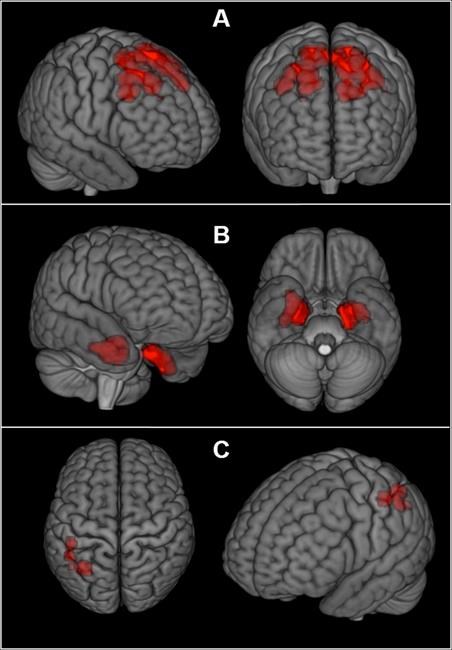
This image provided by The New England Journal of Medicine in April 2019 shows an illustration based on brain scans from former NFL players. As a group, they were found to have higher levels of an abnormal protein than a comparison group of healthy men, indicated by red patches. The protein is a hallmark of a degenerative brain disease that's been linked to repeated head blows. (The New England Journal of Medicine via AP)

“We’re not there yet,” said Boston University neuroscientist Robert Stern. “It is not ready to be used for individual diagnosis in the clinic.”

He led the study, published Wednesday by the New England Journal of Medicine.

“It’s an encouraging advance. It looks like they have detected CTE in living players,” said Dr. Gil Rabinovici, a neurologist and imaging expert at the University of California, San Francisco, who is doing other research using the scans.

“It’s hugely important to be able to detect the disease in living people” to know how common it is and to research treatments, he said.

The study was done in Massachusetts and Arizona and involved 26 former NFL players with thinking, mood or behaviour problems, and 31 similarly aged men without these symptoms or head injuries.

They were given positron emission tomography, or PET scans, in which a radioactive tracer is injected that binds to various substances and makes them visible on the scans. Several of these tracers are used now to look for a protein called beta amyloid in the brains of people with Alzheimer’s disease. An experimental tracer that doctors are testing binds to another protein, tau, which is the key one that’s been implicated in CTE.

Men in the study had both types of tracers. Tau levels were higher in the players compared to the others, but their amyloid levels were similar, confirming that CTE is a different disease than Alzheimer’s.

Researchers also saw a relationship to years of play.

“The more years of play in tackle football across all levels, the greater the amount of tau detected,” Stern said.

However, there was no relationship between tau levels and the severity of mood and thinking symptoms. Researchers think the study may have been too small to detect a difference or that tau may not be the only factor involved.

“There’s a lot more work to be done to develop a diagnostic” tool using these scans, said Dr. Michael Weiner an imaging expert at UCSF who is involved in other CTE research.

Government grants and Avid Radiopharmaceuticals, which makes the tracers, funded the study. Some authors work or consult for the company.

FILE - In this Thursday, Jan. 25, 2018 file photo, former Chicago Bears running back Mike Adamle stands in support of the Dave Duerson Act to Prevent CTE as Illinois state Rep. Carol Sente, left, and Tregg Duerson, listen during a news conference in Chicago. The Dave Duerson Act would ban tackle football for Illinois children younger than 12 years old. Last year, Adamle said he was diagnosed with dementia, and that his doctor saw signs of chronic traumatic encephalopathy. He believes this and the past 19 years of epileptic seizures resulted from his concussions in football. (AP Photo/Charles Rex Arbogast)

A larger study of former NFL and college football players is underway; first results are expected early next year.

Mike Adamle, a former running back for the Chicago Bears and sports announcer, has been told he has symptoms consistent with CTE, and has been evaluated by Stern at the Boston research centre though he was not part of the current study.

“I had more than a few” concussions, Adamle said. “If you were running, everybody kind of led with their head. Back then, it was a test of your macho man stuff.”

The illness has been devastating, said his wife, Kim. “He couldn’t remember his lunch or he couldn’t remember his lines on the air,” and lost multiple jobs, she said.

If a test could have shown he was at risk and given him a chance to consider quitting play, “I would have definitely taken note,” Mike Adamle said.

___

Marilynn Marchione can be followed on Twitter: @MMarchioneAP

___

The Associated Press Health and Science Department receives support from the Howard Hughes Medical Institute’s Department of Science Education. The AP is solely responsible for all content.


Report Error Submit a Tip

More Stories

Wyatt vows to ‘absolutely’ continue serving as city councillor despite latest sex-crime charges

Joyanne Pursaga 5 minute read Preview

Wyatt vows to ‘absolutely’ continue serving as city councillor despite latest sex-crime charges

Joyanne Pursaga 5 minute read Updated: Yesterday at 5:35 PM CDT

Transcona Coun. Russ Wyatt vowed Thursday to continue doing his job after more criminal charges were laid against him this week, while the mayor called for “better tools” to address elected officials who face serious allegations.

Wyatt, 56, was charged Monday with sexual assault and administering a noxious substance in an October 2023 incident. He was previously charged with sexual assault and administering a noxious substance in March, based on allegations tied to a 2025 gathering.

On Thursday, Wyatt arrived at city hall and quickly walked to his office at 10:20 a.m., nearly an hour after the East Kildonan-Transcona community committee meeting he planned to attend was scheduled to begin.

He answered few questions from reporters.

Read
Updated: Yesterday at 5:35 PM CDT

Inman launching new album at WECC

Ben Waldman 5 minute read Preview

Inman launching new album at WECC

Ben Waldman 5 minute read 2:01 AM CDT

Give Richard Inman a moment and a surface, and he’ll cover it with a story.

“I’ve scribbled down lyrics on paper plates, McDonald’s bags — whatever you got,” says Inman, who grew up in southern Manitoba but now lives in a three-bedroom ranch house near Twin Butte, Alta., so close to the American border that he says he can spit into Montana from his backyard.

“The other day I had a line in my head for seven hours before I wrote it down,” says the songwriter, who managed to remember the phrasing after driving home from a music festival in Idaho. “That certainly was lucky.”

Though Inman, 35, first starting sharing his Americana concoctions with crowds at Winnipeg’s Times Change(d) High & Lonesome Club in the late 2000s, learning how to play his compositions with his band, the Mad Trappers, he has spent the bulk of the past decade out west, splitting time between the stage and the sale barn.

Read
2:01 AM CDT

It’s one thing to climb aboard rail-relocation train, quite another to pay for the ride

Dan Lett 5 minute read Preview

It’s one thing to climb aboard rail-relocation train, quite another to pay for the ride

Dan Lett 5 minute read Wednesday, Aug. 12, 2026

Anyone who wants a brighter, safer, healthier future for the city of Winnipeg should really want the renewed hopes of rail relocation to finally become reality. And the sooner, the better.

Premier Wab Kinew announced Wednesday the province was going to forge a plan to relocate the Canadian Pacific Kansas City central yards and many of other the lines that run through Winnipeg to a bypass that runs around the city.

This “plan to design a plan” strategy was devised by a task force headed up by former federal MP and cabinet minister Lloyd Axworthy, who in 2024 was given a two-year mandate to find the best way to rid the city of some or all of its rail infrastructure.

For the record, Kinew and Axworthy said a relocation would likely take 20 years to complete, which makes this week’s announcement an important statement of intent, but little more. The sobering reality is that this promising idea has been proposed by political leaders, and then abandoned, for decades.

Read
Wednesday, Aug. 12, 2026

Europe anxious as ever about immigration

Kyle Volpi Hiebert 5 minute read 2:00 AM CDT

It was only a matter of time before immigration would again panic Europe. The issue has roiled the continent’s politics ever since its 2015 migrant crisis, when 1.3 million unauthorized migrants crossed its borders that summer. They exposed a broken immigration system in the process, triggering a populist backlash that hasn’t dimmed.

All those same tensions were reignited in late July, when 72,000 migrants converged on the Spanish exclave of Ceuta in just 24 hours. The city — a holdover from Spain’s colonial era — is Europe’s only land border with Africa, nestled next to Morocco. It was almost instantly overrun.

Dozens of people died in the chaos, while the reasons for the sudden influx remain unknown. However, virtually all the arrivals were sent back to Morocco almost immediately; some spent a few days in makeshift holding centres. None were recorded as finding their way to mainland Europe.

Still, the episode inflamed divisions in a region caught in existential limbo. Ultranationalist political parties are ascendant — yet low birth rates and stagnant productivity mean Europe’s future largely hinges on accepting more newcomers.

Fusion pop-up coming to street food festival

Tiago Resko 3 minute read Preview

Fusion pop-up coming to street food festival

Tiago Resko 3 minute read 2:01 AM CDT

After surviving breast cancer and watching her husband live through a brain tumour, Marilyn Magtoto decided it was time to take a chance.

Read
2:01 AM CDT

Making the right move on rail lines

Editorial 4 minute read Preview

Making the right move on rail lines

Editorial 4 minute read 2:01 AM CDT

It’s a familiar sound in Winnipeg. It’s the 3 a.m. distant and lonesome train horn, the sound of a train crew working through the night hours, the horn giving its warning at level crossings. Some Winnipeggers hear far more: when the night is still enough, they can hear the rhythmic “tap-tap, tap-tap” of rail wheels on the tracks as long trains thread through the city.

Read
2:01 AM CDT