In a first, Bedouin women lead tours in Egypt’s Sinai

Advertisement

Advertise with us

ABU ZENIMA, Egypt - Amid a stunning vista of desert mountains, a Bedouin woman, Umm Yasser, paused to point out a local plant, and she began to explain how it was used in medicine to the group of foreign tourists she was guiding.

Read this article for free:


or

Already have an account? Log in here »

To continue reading, please subscribe:

Subscribe and receive a limited-edition Free Press branded hat or tote.

Digital Subscription

One year of digital access for only $205*

  • Enjoy unlimited reading on winnipegfreepress.com
  • Read the E-Edition, our digital replica newspaper
  • Access News Break, our award-winning app
  • Play interactive puzzles

*First annual payment billed as $205.00 + GST for one year. This annual subscription will automatically renew at $233.00 + GST every 52 weeks (10% off the regular annual price of $259.35). Offer available to new and qualified returning subscribers only. Cancel any time.

To continue reading, please subscribe:

Add Free Press access to your Brandon Sun subscription for only an additional

$1 for the first 4 weeks*

  • Enjoy unlimited reading on winnipegfreepress.com
  • Read the E-Edition, our digital replica newspaper
  • Access News Break, our award-winning app
  • Play interactive puzzles
Start now

*Your next Brandon Sun subscription payment will increase by $1.00 and you will be charged $17.95 plus GST for four weeks. After four weeks, your payment will increase to $24.95 plus GST every four weeks.

Hey there, time traveller!
This article was published 10/04/2019 (2733 days ago), so information in it may no longer be current.

ABU ZENIMA, Egypt – Amid a stunning vista of desert mountains, a Bedouin woman, Umm Yasser, paused to point out a local plant, and she began to explain how it was used in medicine to the group of foreign tourists she was guiding.

Umm Yasser is breaking new ground among the deeply conservative Bedouin of Egypt’s Sinai Peninsula. Women among the Bedouin almost never work outside the home, and even more rarely do they interact with outsiders. But Umm Yasser is one of four women from the community who for the first time are working as tour guides.

“It is against our culture, but women need jobs,” the 47-year-old Umm Yasser said. “People will make fun of us, but I don’t care. I’m a strong woman.”
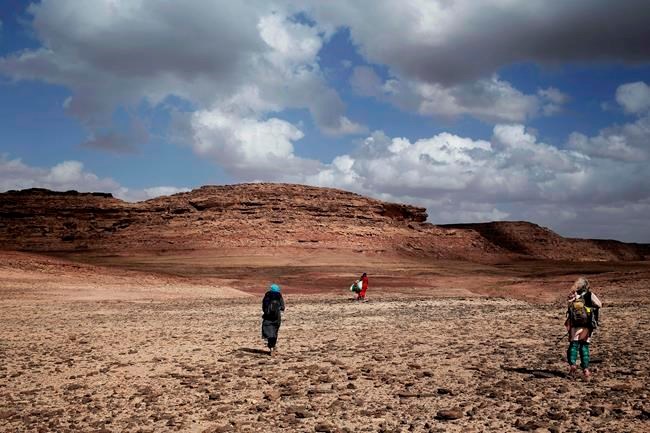
ADVANCE FOR PUBLICATION ON WEDNESDAY, APR. 10, AND THEREAFTER - In this March 30, 2019 photo, Umm Yasser, center, leads women on a trek in the mountains, near Wadi Sahw, Abu Zenima, in South Sinai, Egypt. Umm Yasser is breaking new ground among the deeply conservative Bedouin of Egypt’s Sinai Peninsula. Women among the Bedouin almost never work outside the home, and even more rarely do they interact with outsiders. But Umm Yasser is one of four women from the community who for the first time are working as tour guides. (AP Photo/Nariman El-Mofty)

They are part of Sinai Trail, a unique project in which local Bedouin tribes came together aiming to develop their own tourism. Founded in 2015, the project has set up a 550-kilometre (330-mile) trail through the remote mountains of the peninsula, a42-day trek through the lands of eight different tribes, each of which contributes guides. The project has been successful in bringing some income to the tribes, who often complain of being left out of the major tourism development of the southern Sinai, home to beach resorts and desert safaris.

Until now, all the project’s guides were men. Ben Hoffler, the British co-founder of the Sinai Trail, felt it was not enough. “How can we be credible calling this the ‘Sinai Trail’ if the women aren’t involved?”

But even after years of trying by Hoffler, almost all the tribes still reject women guides. Only one of the smallest, oldest and poorest tribes, the Hamada, accepted the idea.

There are some conditions. The tourists can only be women, and the tours can’t go overnight. Each day before the sun sets, the group returns to the Hamada’s home village in Wadi Sahu, a narrow desert valley. The organizers also urge the tourists to photograph the guides only when they are wearing a full veil over the face that covers even the eyes with mesh.

Umm Yasser was the first to join. She said she started hiking when she was a child and knows the mountains and the valley by heart. She convinced the families of three other women to allow them to work as guides.

Their tribe is a poor one, living in small concrete houses strung along the Wadi Sahu. Electricity runs no more than five hours a night and there is no running water. It is isolated deep in the mountains of south Sinai, far from the tourism centres in Sinai along the Red Sea coast or near the famed Saint Catherine’s Monastery. The men often leave the village to find work, either at resorts or in mines further south.

“We need money to help support our families for basic necessities,” Umm Yasser said. “We need blankets, clothes for the children, washing machines, fridges, books for school.”
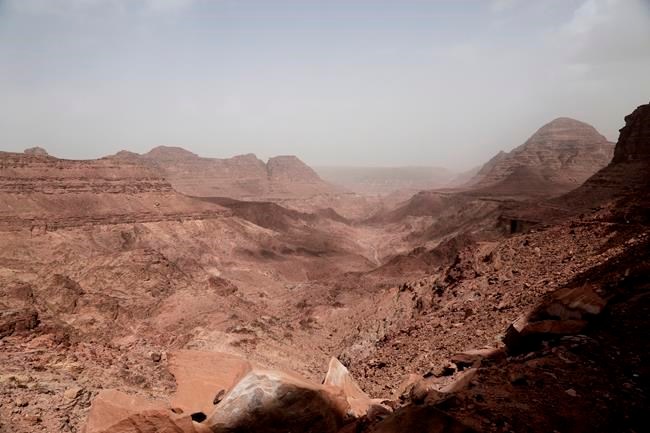
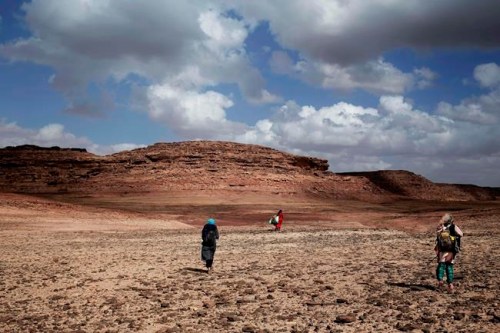
ADVANCE FOR PUBLICATION ON WEDNESDAY, APR. 10, AND THEREAFTER - This March 30, 2019 photo, shows the scenery on a trek led by beduin women, near Wadi Sahw, Abu Zenima, in South Sinai, Egypt. Four Bedouin women are for the first time leading tours in Egypt’s Sinai Peninsula, breaking new ground in their deeply conservative community, where women almost never work outside the home or interact with outsiders. They are part of Sinai Trail, a unique project in which local Bedouin tribes came together aiming to develop their own tourism. (AP Photo/Nariman El-Mofty)

The Sinai Trail came together in some of the hardest years for tourism. It was launched as an Islamic State group-linked insurgency intensified in the northern part of Sinai and a year after a Russian passenger plane crashed, killing all 224 passengers on board in a likely militant bombing. The violence has stayed far from southern Sinai, where tourist resorts are located — but the industry has had to push hard to win tourists back.

On a recent tour joined by the Associated Press, 16 female tourists — from Korea, New Zealand, Europe, Lebanon and Egypt — were led by Umm Yasser and the other three women guides, Umm Soliman, Aicha, and Selima, through the rugged landscape in and around Wadi Sahu.

“I think south Sinai is safe especially when you are in the care of Bedouins. … This is where I feel at home. Every corner there is scenery and another beautiful view,” said Marion Salwegter, a 68-year-old Dutch woman who travels to southern Sinai every year alone to escape the winters in Holland.

During the two-day tour, the group hiked across an endlessly broad landscape of mountain peaks and valleys of dry riverbeds. While male Bedouin guides range far from home, the women tend to move closer, with an exceptionally rich knowledge of the surrounding mountains. The guides talked about the local plants and herbs, the history and legends of the area and pointed out the borders of the area’s tribes.

In the evening, the group returned to the Hamada tribe’s village. The women sat on the floor of Umm Yasser’s home and the tourists asked the guide about life in the village, marriage and divorce.

Umm Yasser is skeptical other Bedouin women will join her as a guide or in working in general any time soon. But, she said, “There is no shame in working. This is what I believe in, and it makes me strong.”
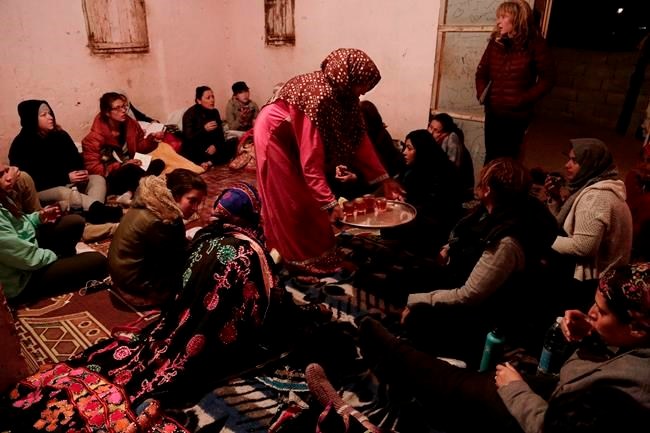
ADVANCE FOR PUBLICATION ON WEDNESDAY, APR. 10, AND THEREAFTER - In this March 30, 2019 photo, Umm Yasser offers tea to during a women's only circle of tourists and Bedouin from the Hamada tribe, at her home in Wadi Sahw, Abu Zenima, in South Sinai, Egypt. Four Bedouin women are for the first time leading tours in Egypt’s Sinai Peninsula, breaking new ground in their deeply conservative community, where women almost never work outside the home or interact with outsiders. The women guide groups of female tourists through the stunning mountain landscapes, part of a Bedouin-led project of hiking tours in southern Sinai. (AP Photo/Nariman El-Mofty)

Some attitudes are changing. Mohammed Salman, an elderly man from the Aligat tribe, said he thought the guides project was a great step for women. “If a woman wants to work, she should be able to have the right to,” he said. “Many men say no, a woman’s place is at home. But I’m sick of this ideology. She’s a human being.”

Younger Bedouin girls tagged along with the group and talked about wanting to be female guides in the future.

“This trip is going down in history and will be talked about,” said Julie Paterson, a facilitator for Sinai Trail who often works with Bedouin women. “It might also go into Bedouin oral history.”


Report Error Submit a Tip

More Stories

Gordon Bell rings in a century

Maggie Macintosh 13 minute read Preview

Gordon Bell rings in a century

Maggie Macintosh 13 minute read Updated: Yesterday at 8:06 PM CDT

Mischka Valencia had gotten used to the hum of heavy machinery at Gordon Bell High School.

“Ever since I’ve been here, it’s all been under construction,” the Grade 12 student said, standing on the sidelines of the brightly painted revamped outdoor basketball court. “I had no idea this was a court.”

The Filipina teenager landed in Winnipeg several months after the inner-city campus had transformed into a construction site.

It was the fall of 2023 and Mischka’s priorities were fitting in, befriending classmates and learning a third language via first-period French.

Read
Updated: Yesterday at 8:06 PM CDT

Gillingham talks trash, pledges big bin boost

Joyanne Pursaga 4 minute read Preview

Gillingham talks trash, pledges big bin boost

Joyanne Pursaga 4 minute read Yesterday at 2:01 AM CDT

Scott Gillingham says he would add hundreds of locked garbage bins downtown to prevent unsightly trash piles if re-elected as mayor.

Read
Yesterday at 2:01 AM CDT

Sisters relieved hospital takes accountability after mother’s death

Scott Billeck 5 minute read Preview

Sisters relieved hospital takes accountability after mother’s death

Scott Billeck 5 minute read Thursday, Oct. 1, 2026

Eight months after losing their mother, two Winnipeg sisters say an internal hospital review has finally given them something they had been seeking since her death: accountability.

Chelsea Mann and Samantha Burns said St. Boniface Hospital officials acknowledged mistakes were made in the care of their mother, Judy Burns, during a recent meeting to discuss the findings of a critical incident review into her death.

The acknowledgement marked a significant departure from an earlier meeting with hospital officials, when they felt their concerns were largely dismissed.

Burns, 68, died on Jan. 21, three days after being admitted, after experiencing rectal bleeding.

Read
Thursday, Oct. 1, 2026

Puzzles Palace

1 minute read Monday, Jul. 27, 2026

To solve our puzzles, please subscribe with this special offer: |

Clock ticks down on destruction of records documenting residential school abuses

Marsha McLeod 13 minute read Preview

Clock ticks down on destruction of records documenting residential school abuses

Marsha McLeod 13 minute read Yesterday at 12:49 PM CDT

In less than a year, a private company is set to destroy the largest cache of records detailing the widespread abuse of Indigenous children at residential schools in Canada.

The destruction, which was ordered by an Ontario court in 2014 and later upheld by the Supreme Court, is set to take place on Sept. 19, 2027.

This countdown is igniting emotional conversations that seek to balance the immense historical value of the records alongside the confidentiality survivors were promised as part of the process of providing detailed testimony about abuses they’d suffered.

The records were created as part of the Indian Residential Schools Settlement Agreement, a class-action settlement stemming from survivors who began suing the federal government in the late 1990s over the harm they’d been subjected to at residential schools.

Read
Yesterday at 12:49 PM CDT

In a first, Bedouin women lead tours in Egypt's Sinai

Nariman El-Mofty, The Associated Press 7 minute read Preview

In a first, Bedouin women lead tours in Egypt's Sinai

Nariman El-Mofty, The Associated Press 7 minute read Wednesday, Apr. 10, 2019

ABU ZENIMA, Egypt - Amid a stunning vista of desert mountains, a Bedouin woman, Umm Yasser, paused to point out a local plant, and she began to explain how it was used in medicine to the group of foreign tourists she was guiding.

Umm Yasser is breaking new ground among the deeply conservative Bedouin of Egypt's Sinai Peninsula. Women among the Bedouin almost never work outside the home, and even more rarely do they interact with outsiders. But Umm Yasser is one of four women from the community who for the first time are working as tour guides.

"It is against our culture, but women need jobs," the 47-year-old Umm Yasser said. "People will make fun of us, but I don't care. I'm a strong woman."

They are part of Sinai Trail, a unique project in which local Bedouin tribes came together aiming to develop their own tourism. Founded in 2015, the project has set up a 550-kilometre (330-mile) trail through the remote mountains of the peninsula, a42-day trek through the lands of eight different tribes, each of which contributes guides. The project has been successful in bringing some income to the tribes, who often complain of being left out of the major tourism development of the southern Sinai, home to beach resorts and desert safaris.

Read
Wednesday, Apr. 10, 2019