Recipient in rare paired living liver donation thanks “angel” donor

Advertisement

Advertise with us

TORONTO - One of the recipients of what's believed to be North America's first paired living liver donation is calling the stranger who saved his life "an angel."

Read this article for free:


or

Already have an account? Log in here »

To continue reading, please subscribe:

Subscribe and receive a limited-edition Free Press branded hat or tote.

Digital Subscription

One year of digital access for only $205*

  • Enjoy unlimited reading on winnipegfreepress.com
  • Read the E-Edition, our digital replica newspaper
  • Access News Break, our award-winning app
  • Play interactive puzzles

*First annual payment billed as $205.00 + GST for one year. This annual subscription will automatically renew at $233.00 + GST every 52 weeks (10% off the regular annual price of $259.35). Offer available to new and qualified returning subscribers only. Cancel any time.

To continue reading, please subscribe:

Add Free Press access to your Brandon Sun subscription for only an additional

$1 for the first 4 weeks*

  • Enjoy unlimited reading on winnipegfreepress.com
  • Read the E-Edition, our digital replica newspaper
  • Access News Break, our award-winning app
  • Play interactive puzzles
Start now

*Your next Brandon Sun subscription payment will increase by $1.00 and you will be charged $17.95 plus GST for four weeks. After four weeks, your payment will increase to $24.95 plus GST every four weeks.

Hey there, time traveller!
This article was published 16/04/2019 (2730 days ago), so information in it may no longer be current.

TORONTO – One of the recipients of what’s believed to be North America’s first paired living liver donation is calling the stranger who saved his life “an angel.”

Fifty-four-year-old Muhammad Khan of Mississauga, Ont., is sharing his gratitude nearly one year after 38-year-old Kelly Bryan of Peterborough, Ont., gave him more than half of her liver.

In turn, Khan’s wife, Hina, donated more than half of her liver to another stranger.
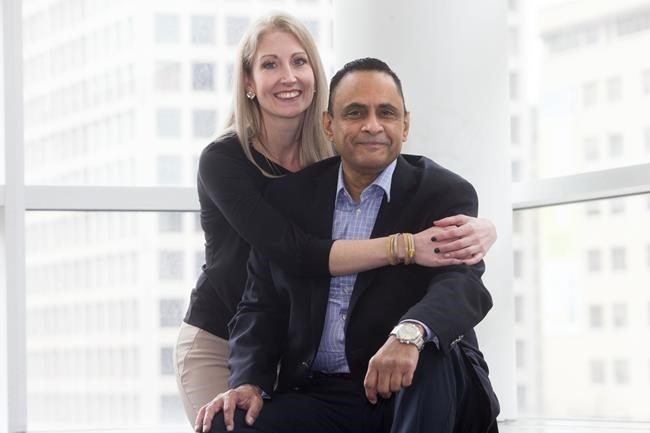
Muhammad Khan poses with Kelly Bryan at Toronto General Hospital, on Tuesday April, 16, 2019. Khan received a liver donation from Bryan, who donated 70 per cent of her liver, in what is believed to be North America's first paired living liver donation. THE CANADIAN PRESS/Chris Young

The feat was revealed at Toronto General Hospital where patients and doctors touted the potential that the carefully orchestrated “swap” has to save lives.

“Kelly was an angel to me,” Khan said Tuesday as details of the four simultaneous surgeries were made public for the first time.

“It is the biggest gift to me that I could have ever received, someone saving my life that I never knew of.”

Officials with the University Health Network Transplant Program say the multiple procedures took place July 9, 2018 and took 12 hours, four operating rooms and 28 staff and surgeons. About 100 staff and doctors looked after the pairs before, during and after the surgeries. They add that all four patients are now doing well.

Khan was diagnosed with non-alcoholic liver cirrhosis in 2017, and he suspects he would not have survived if Bryan had not come forward. Her blood type is the rare universal 0-negative, allowing her to donate blood to anyone.

Hina was not a match for her husband, so she was paired by the medical team with another, compatible recipient. That person chose to remain private.

The procedures required incredible resources, with many weeks of planning that UHN transplant surgeon Dr. David Grant likened to “training for a marathon.”

“Very few institutions have the capacity to staff four operating rooms to do a surgery like this,” notes Grant, who served as Bryan’s surgeon during the procedure. “And of course there still aren’t that many people that step forward to be an anonymous donor.”

Bryan experienced complications — transient intestinal blockage required her to stay in hospital longer than expected. But she returned to work as a paramedic three months after her operation and says she has no regrets.

The liver returns to about 75 per cent of its size within six weeks after surgery, says Grant, and continues growing slowly until it reaches its full volume in about a year.

“The risks and the recovery are hardly even a sacrifice when it comes to saving someone’s life,” says Bryan, who donated 70 per cent of her liver.

“And I think it’s important that people know that living donation is a possibility; it’s not just deceased organs that people receive and the need for it is so great.”

An anonymous living donor — someone who chooses to donate to a recipient they don’t know — can help two dying patients, by effectively creating two new compatible pairs, says Grant. It also allows those remaining on the deceased donors’ list to move up two places.

He notes that 50 to 100 people a year die while waiting for a liver transplant in Ontario. Almost 300 people are on the waiting list for a liver in the province.

But determining who should receive Bryan’s gift required serious ethical considerations.

Khan suspects he never would have received a liver if his wife had not been paired with a very ill person who also needed a transplant.

“It’s a very long list,” says Khan, a family physician who teaches medicine at the University of Toronto.

“I was sick, but not that sick at the same time. But my liver was going into a state of failure and I could notice that I was getting very weak, I was not able to eat properly.”

For Grant, the challenge was to “balance organs going to the sickest versus organs going to the greatest benefit.”

“In this case, because it meant taking two people off the deceased donor waiting list, our ethicist advised us that this was a reasonable choice,” he says, noting “Hina’s recipient was very sick.”

And although Khan received Bryan’s liver in part because of his wife’s willingness to help another person, Grant says that doesn’t mean Khan wasn’t a legitimate recipient.

“Everyone on our waiting list is at risk of death, that’s why they’re on our waiting list,” he says. “It’s just a question of how sick you are relative to the other unwell people on the waiting list.”

A huge factor in the struggle for liver donations remains the fact that there are not enough deceased donors, he adds.

“In an ideal world we wouldn’t have to operate on Kelly,” says Grant, who is eyeing Nova Scotia’s recent adoption of a law that presumes consent for organ donation.

“If we had more deceased donors then we would never operate on a healthy person and put their life at risk to help others.”

The transplant program says paired liver exchanges have been performed in South Korea and Hong Kong, but there are no published reports of them being done in Europe or North America.

Similar paired exchanges involving kidneys have been performed for 15 years, but liver exchanges are far more rare, and riskier.

“That’s why Kelly is such a hero,” says Grant.

“We all hear of things that are needed, that we need to do and often think in our minds, ‘oh yeah, I’d like to do that or help in that way.’ It really takes an extraordinary person to step forward and say, ‘I’m not just going to think about it, I’m going to act on this and do something about it.'”


Report Error Submit a Tip

More Stories

Hydro Québec faces issue we should avoid

Editorial 4 minute read Preview

Hydro Québec faces issue we should avoid

Editorial 4 minute read Yesterday at 2:01 AM CDT

You might be tempted to call it a canary in an electric power generation coal mine.

Read
Yesterday at 2:01 AM CDT

Seven Wilsons, one regional spirit

Hersh Seth 5 minute read Preview

Seven Wilsons, one regional spirit

Hersh Seth 5 minute read 2:00 AM CDT

In Dryden, Ont., a 34-metre suspension bridge crosses the Wabigoon River rapids. It is named after a man who paid for a quarter of the bridge himself. A plaque recognizes Roy Wilson’s “many contributions to City Revitalization” and mentions his 40 years in the Rotary Club, whose motto is “service above self”.

My father sold business machines from the 1970s through the ’90s, during the shift from carbon copy machines and typewriters to photocopiers, fax machines, and early office computers and printers. His sales territory — which he covered mostly by car but also by propeller plane — was Saskatchewan, the Northwest Territories, Manitoba, and northwestern Ontario, though much of it really belonged to the Wilsons.

In business machines, selling the machine was only half the job — the other half was ensuring a technician would fix it in January. Wilson’s set the standard for dealers across most of my dad’s regions. My father worked with Roy’s son Greg (who would later go on to become mayor of Dryden) but really respected Roy for teaching Greg to run the company with the towns they served as the priority.

Wilson’s service routes went beyond where roads stopped. Even if customers lived north of the highway system, Wilson’s still found a way to help, using three company planes based at the Dryden airport. As a result, a stationery shop from a paper mill town served all of northwestern Ontario and later northern Manitoba. Imagine a photocopier strapped into a small plane, a technician beside it, and a gravel runway waiting at the other end.

Read
2:00 AM CDT

Real journalists matter in an AI world

Paul Deegan 4 minute read Preview

Real journalists matter in an AI world

Paul Deegan 4 minute read 2:00 AM CDT

An algorithm can decide what you see, but it doesn’t report the news. Nunatsiaq News, an award-winning newspaper in Nunavut, recently reported that a so-called “news” website was posting AI-generated articles about the north by stealing real news stories produced by real journalists.

The articles were supposedly written by Nunavut correspondent Leah Qammaniq — a fake journalist, with a fake photo and a fake bio.

Governor General Louise Arbour warned us of fake news in her installation speech in June. She said, “We must continue to protect the public space in which our national debates take place: from schools and universities to the media, political parties, unions and civil society organizations …With instant access to vast amounts of information, it is very tempting to pay little attention to the reliability of sources. The lines between knowledge and belief, between truth and falsehood, between facts and assumptions, are increasingly blurred. AI could be threatening not only the way we live and work, but also the control we exercise over our own destiny.”

The Government of Canada has recognized the problem as well. Its recent discussion paper, Enhancing trust in artificial intelligence through increased transparency, stated, “Canadians encounter news reporting, product reviews, and audio-visual content across the internet, often without any indication of whether it was written by a person, generated by an AI system, or produced through some combination of both … A particular concern within this broader landscape is that generative AI greatly enables the creation and dissemination of deceptive or misleading content.”

Read
2:00 AM CDT

Clocks stay in daylight saving, but analysis backs permanent standard time

Ashley Joannou, The Canadian Press 6 minute read Preview

Clocks stay in daylight saving, but analysis backs permanent standard time

Ashley Joannou, The Canadian Press 6 minute read Updated: Yesterday at 6:15 AM CDT

VANCOUVER - Ralph Mistlberger's light is adjustable, allowing him to have the full spectrum of options depending on what his internal clock needs.

"You want cool in the morning. You want warm in the evening or warm in the afternoon," he said.

"And so, it goes from being more bluish in the morning to more reddish in the evenings. Both of those are important because artificial light affects your clock."

Mistlberger knows real sunlight is better than a lamp, but after more than 40 years as a neuroscientist studying sleep and the body's circadian rhythms, he's preparing for what's to come Nov. 1.

Read
Updated: Yesterday at 6:15 AM CDT

‘Amazing honour’: Winnipeg distribution centre continues award-winning ways for McKesson Canada

Aaron Epp 5 minute read Preview

‘Amazing honour’: Winnipeg distribution centre continues award-winning ways for McKesson Canada

Aaron Epp 5 minute read Yesterday at 6:00 AM CDT

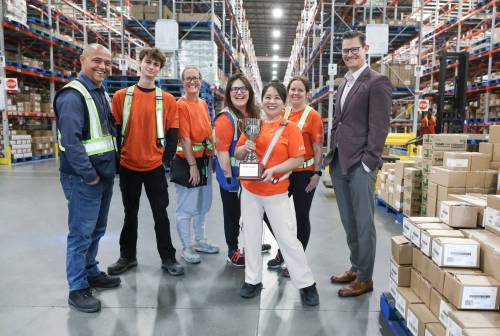
After a three-year absence, the trophy is back in Winnipeg.

Last week, McKesson Canada named its 120,000-square-foot pharmaceutical distribution centre in the northwest part of the Manitoba capital its Distribution Centre of the Year. The award recognizes the facility’s role in helping essential medications reach communities across the province and some of Canada’s remote regions.

This is the fourth time the Winnipeg facility has earned the company-wide award since it opened five years ago. McKesson previously honoured the centre in 2021, 2022 and 2023. The recognition comes with a trophy, as well as a banner that was hung from the rafters on Thursday.

More than 100 employees work across the centre’s day-and-night operations, processing between 80,000 and 100,000 medication units daily. Last year, the centre distributed more than 21 million medication units while maintaining more than 99 per cent accuracy.

Read
Yesterday at 6:00 AM CDT

Connor powers Jets past Red Wings for first win of season

Ken Wiebe 8 minute read Preview

Connor powers Jets past Red Wings for first win of season

Ken Wiebe 8 minute read Updated: Yesterday at 6:11 AM CDT

DETROIT — Kyle Connor is on a mission.

Whether it’s the baby bump from the birth of his second child or his constant mission to elevate his game and find new ways to score, the Winnipeg Jets left-winger is flying out of the gate and seemingly notching goals at will.

After scoring in the season opener for an NHL record ninth consecutive time, Connor delivered a pair of goals and added an assist in his home state to lead the Jets to a 3-2 victory over the Detroit Red Wings on Sunday afternoon at Little Caesars Arena.

“The sheer amount of volume that he gets and how he gets himself in a good spot, he’s able to get that release off from anywhere,” said Jets forward Cole Perfetti. “His first one was just all skill. What a finish that was and then his second one, just reading the play so well. (Coming) off the pads like that, kind of in front of him and he put it in a small little window top shelf that no goalie could ever save. He doesn’t panic when he gets into those spots, obviously.

Read
Updated: Yesterday at 6:11 AM CDT