AP-NORC Poll: Many blame drug firms for opioid crisis
Advertisement
Read this article for free:
or
Already have an account? Log in here »
To continue reading, please subscribe:

Digital Subscription
One year of digital access for only $205*
- Enjoy unlimited reading on winnipegfreepress.com
- Read the E-Edition, our digital replica newspaper
- Access News Break, our award-winning app
- Play interactive puzzles
*First annual payment billed as $205.00 + GST for one year. This annual subscription will automatically renew at $233.00 + GST every 52 weeks (10% off the regular annual price of $259.35). Offer available to new and qualified returning subscribers only. Cancel any time.
To continue reading, please subscribe:
Add Free Press access to your Brandon Sun subscription for only an additional
$1 for the first 4 weeks*
- Enjoy unlimited reading on winnipegfreepress.com
- Read the E-Edition, our digital replica newspaper
- Access News Break, our award-winning app
- Play interactive puzzles
*Your next Brandon Sun subscription payment will increase by $1.00 and you will be charged $17.95 plus GST for four weeks. After four weeks, your payment will increase to $24.95 plus GST every four weeks.
Read unlimited articles for free today:
or
Already have an account? Log in here »
Hey there, time traveller!
This article was published 25/04/2019 (2722 days ago), so information in it may no longer be current.
NEW YORK – About two-thirds of Americans believe drug companies are to blame for the opioid crisis, although nearly as many hold drug users themselves responsible, a new poll finds.
The Associated Press-NORC Center for Public Affairs Research poll showed many people also fault doctors who prescribed opioid pain pills and government officials who haven’t done enough to expand addiction treatment and arrest drug dealers.
“All of the above,” said Anna Marie Davis, a casino security supervisor from Norwood, Pennsylvania. She said she has had to deal with overdoses at work and that her 27-year-old nephew, who used heroin and fentanyl, died of a drug overdose last year.
“It’s pretty bad,” she said of the drug overdose problem. “I honestly don’t think they’re doing enough” to stop it, she added.
The United States is in the midst of the deadliest drug overdose crisis in the nation’s history. More than 70,000 people died from drug overdoses in 2017. Nearly 48,000 involved some type of opioid, a category that includes heroin, fentanyl and prescription opioid painkillers.
Experts say the overdose epidemic is rooted in a boom in opioid painkiller prescriptions that began more than 20 years ago, which they say fostered addictions that later shifted into use of heroin and other drugs.
The AP-NORC poll was conducted this month amid a legal storm: About 2,000 lawsuits have been filed in the past few years seeking to hold the drug industry responsible for the nation’s drug overdose crisis.
Some of the people participating in the poll said they were following the news and felt manufacturers should be held accountable.
But many also expressed strong feelings that people taking drugs are to blame. Among them was Pamela Williams of New York City, who said she was addicted to cocaine and other drugs until she stopped about 25 years ago.
“Nobody’s forcing them to take drugs. Nobody puts it in their hand and puts a gun to the head and says; ‘Here, take this,” said Williams, who lives in the Bronx.
Dr. Daniel Ciccarone, a drug policy expert at the University of California at San Francisco, noted that the survey doesn’t explain why people are turning to drugs and alcohol. He said people seem to be “self-medicating” as they struggle with depression, lack of money or other issues.
Carmen Amato, a 52-year-old retired teacher from Frankfort, Kentucky, echoed that.
“People can’t make a living in some parts of our state and don’t seem to have any other prospects besides use drugs,” Amato said. “It’s terrible.”
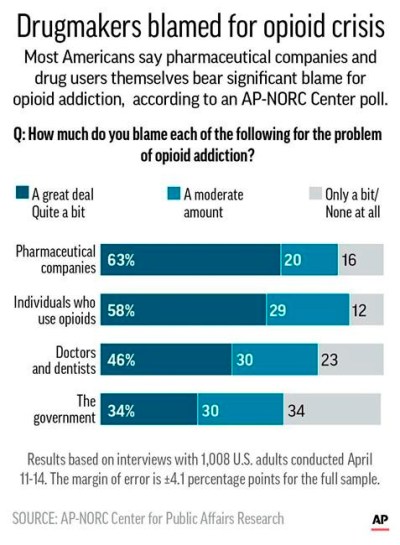
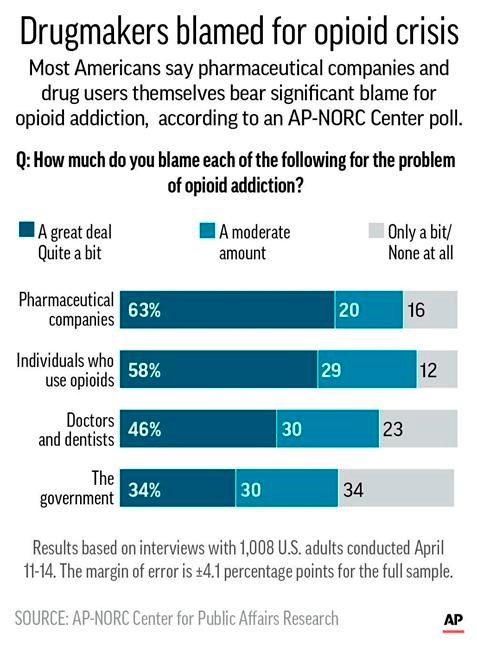
According to the poll, 63% of Americans think pharmaceutical companies are quite a bit or a great deal to blame for the problem of opioid addiction, while 58% say the same about people abusing opioids. Slightly less than half — 46% — think doctors and dentists are significantly to blame, and about a third — 34% — say that about the government.
The poll shows 35% say they or someone close to them has been addicted to prescription painkillers or heroin.
White Americans were more likely than black Americans to say they’ve known someone who was addicted, 39% to 20%. Americans under 30 were more likely than older people to say they’ve known someone who was addicted, 44% to 32%.
People who have personally been close to someone addicted to opioids were more likely than others to blame pharmaceutical companies, 70% to 59%. They were also somewhat more likely to blame doctors and dentists (52% to 43 and the government (41% to 31%), but not significantly more or less likely to blame opioid users themselves.
The poll also detected a partisan divide.
Democrats are more likely than Republicans to blame pharmaceutical companies (72% to 53 and the government (42% to 26%). Republicans were more likely than Democrats to blame users (69% to 51%).
___
The AP-NORC poll of 1,108 adults was conducted April 11-14 using a sample drawn from NORC’s probability-based AmeriSpeak Panel, which is designed to be representative of the U.S. population. The margin of sampling error for all respondents is plus or minus 4.1 percentage points. Respondents were first selected randomly using address-based sampling methods, and later interviewed online or by phone.
___
Swanson reported from Washington.
___
Online:
AP-NORC Center: http://www.apnorc.org/