Utah event celebrates Transcontinental Railroad anniversary

Advertisement

Advertise with us

PROMONTORY, Utah - Music, bells and cannon fire rang out Friday at a remote spot in the Utah desert where the final spikes of the Transcontinental Railroad were hammered 150 years ago, uniting a nation long separated by vast expanses of desert, mountains and forests and fresh off the Civil War.

Read this article for free:


or

Already have an account? Log in here »

To continue reading, please subscribe:

Subscribe and receive a limited-edition Free Press branded hat or tote.

Digital Subscription

One year of digital access for only $205*

  • Enjoy unlimited reading on winnipegfreepress.com
  • Read the E-Edition, our digital replica newspaper
  • Access News Break, our award-winning app
  • Play interactive puzzles

*First annual payment billed as $205.00 + GST for one year. This annual subscription will automatically renew at $233.00 + GST every 52 weeks (10% off the regular annual price of $259.35). Offer available to new and qualified returning subscribers only. Cancel any time.

To continue reading, please subscribe:

Add Free Press access to your Brandon Sun subscription for only an additional

$1 for the first 4 weeks*

  • Enjoy unlimited reading on winnipegfreepress.com
  • Read the E-Edition, our digital replica newspaper
  • Access News Break, our award-winning app
  • Play interactive puzzles
Start now

*Your next Brandon Sun subscription payment will increase by $1.00 and you will be charged $17.95 plus GST for four weeks. After four weeks, your payment will increase to $24.95 plus GST every four weeks.

Hey there, time traveller!
This article was published 10/05/2019 (2683 days ago), so information in it may no longer be current.

PROMONTORY, Utah – Music, bells and cannon fire rang out Friday at a remote spot in the Utah desert where the final spikes of the Transcontinental Railroad were hammered 150 years ago, uniting a nation long separated by vast expanses of desert, mountains and forests and fresh off the Civil War.

An estimated 20,000 people swarmed to the celebration at Golden Spike National Historic Park northwest of Salt Lake City — the signature event of several days of festivities marking the railroad’s anniversary. Visitors came from as far as China, many decked out in old-fashioned dresses, top hats, bonnets and scarves.

The 1869 completion of the 1,800-mile (2,900 kilometre) rail line shortened cross-county travel from as long as six months in wagons and stagecoaches to about 10 days on the rails and served as a unifying moment for the nation. It became a pivotal moment in United States history that dramatically changed how people travelled and did business.
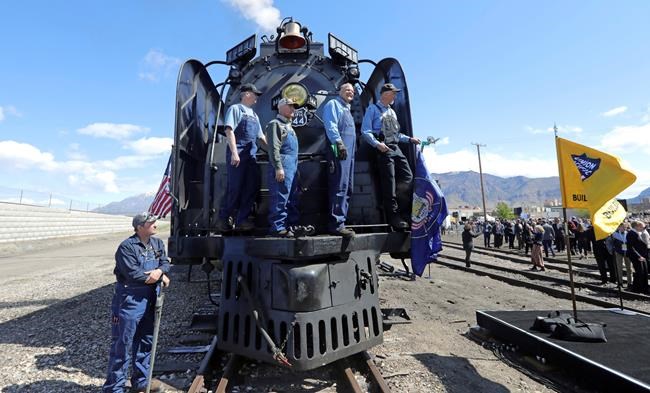
The crew from the Living Legend, No. 844 pose for a photograph during the commemoration of the 150th anniversary of the Transcontinental Railroad completion at Union Station Thursday, May 9, 2019, in Ogden, Utah. (AP Photo/Rick Bowmer)

“It psychologically and symbolically bound the country,” said Brad Westwood, Utah’s senior public historian.

Interior Secretary David Bernhardt marveled at how engineering, courage and risk-taking came together to make it possible.

“The story of this site says so much about our country,” Bernhardt said at the event, which included a reenactment of an iconic “champagne toast” photo of railroad workers perched atop facing stream locomotives giving cheers to the epic feat. “The joining of the two rail lines created a new sense of connectedness that helped form a common national identity.”

The festivities featured many moments and remarks that highlighted the vital contribution of the Chinese workers who put in long hours in brutal conditions and haven’t always received their proper due throughout history.

The ceremony started with a Chinese “lion dance,” and the first speaker was Chinese historian Connie Young Yu. She lamented that descendants of Chinese workers were hardly a part of the 100th anniversary celebration in 1969.

“Today we take this opportunity at the 150th to reclaim our place in history,” Young Yu said. “To honour the courage, fortitude and sacrifice of the Chinese railroad workers and their legacy in America.”

U.S. Transportation Secretary Elaine Chao commended the estimated 12,000 Chinese workers who “risked everything” to build what she called “one of the greatest infrastructure projects” in U.S. history that unleashed explosive economic growth.

Freeman Lee came from his home in Sacramento, California, to “feel the presence” of his great-grandfather, who was among the Chinese workers who helped build the railroad. He proudly pointed out a page dedicated to his great-grandfather in a souvenir magazine for the event.
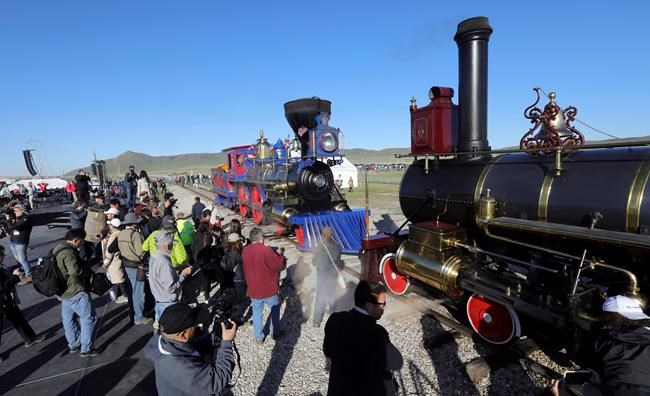
Jupiter, left, and Union Pacific No. 119, are shown as people gather during the commemoration of the 150th anniversary of the Transcontinental Railroad completion at the Golden Spike National Historical Park Friday, May 10, 2019, in Promontory, Utah. People from all over the country are gathering at a remote spot in Utah to celebrate Friday's 150th anniversary of the completion of the Transcontinental Railroad. (AP Photo/Rick Bowmer)

“It’s long overdue,” Lee said about the recognition.

Bill Hanmer drove with his wife from their Middletown, Virginia, home to check off a bucket list item. The 73-year-old pilot and train enthusiast said he desperately wanted to attend the 100th anniversary event but couldn’t afford it.

The couple woke up before dawn to be at the site by 6 a.m. to avoid getting stuck in long lines of cars that stretched for miles on a two-lane country highway that was the only way in and out.

“I’ve been waiting for 50 years to come back,” Hanmer said. “It’s a special event. It was a history-changing event.”

The laying of the final rails in 1869 triggered a famous telegraph that set off celebrations around the nation: “The last rail is laid. The last spike is driven. The Pacific railroad is completed. The point of junction is 1,086 miles west of the Missouri River and 690 miles east of Sacramento City.”

The bells at Philadelphia’s Independence Hall rang in celebration, a hundred guns were fired in New York, and American flags were hung in cities across the nation.

The golden spike included an inscription: “May God continue the unity of our country as this railroad unites the two great oceans of the world.”
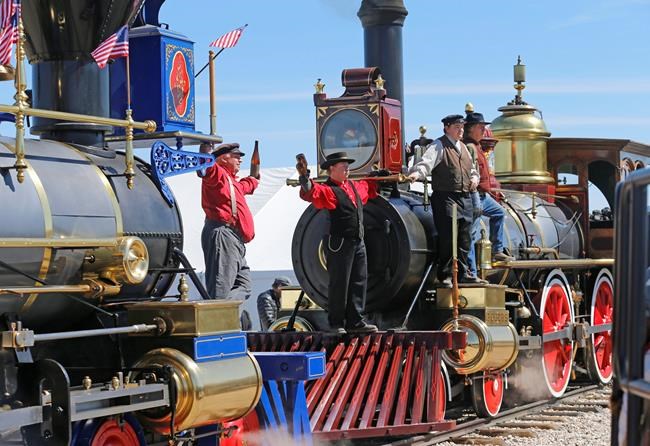
People re-created the historic photo of the meeting of the rails from May 10, 1869, during the commemoration of the 150th anniversary of the Transcontinental Railroad completion at the Golden Spike National Historical Park Friday, May 10, 2019, in Promontory, Utah. (AP Photo/Rick Bowmer)

The railroad was built using horses, oxen, hand carts, wagons and the “brawn” of mostly Irish immigrants working on the Union Pacific portion that came from the East and mostly Chinese workers on the Central Pacific part that came from the West, said Westwood, the public historian. They worked day and night and risked their lives blasting through rocks and shovelling snow on frigid mountain peaks.

Westwood said the railroad was built by the “most discriminated and least appreciated people in America.”

The epic construction project had a dark side, leading to the near annihilation of the bison, eventual loss of land for Native American tribes and the deaths of several hundred railroad workers, he added.

“It was a grand engineering feat,” Westwood said. “It was a grand gesture to bind the nation after the Civil War, but it was also a story of human capital and what it took.”

Report Error Submit a Tip

More Stories

Fallis’s comic thriller infiltrates book club

Ben Sigurdson 3 minute read Preview

Fallis’s comic thriller infiltrates book club

Ben Sigurdson 3 minute read Yesterday at 6:00 AM CDT

The Free Press Book Club and McNally Robinson Booksellers are pleased to welcome Toronto author Terry Fallis to the next virtual meeting on Tuesday, September 29 at 7 p.m. to read from and discuss his novel The Marionette.

Fallis, a former lawyer, bureaucrat and political consultant, is the author of 10 bestselling novels and the two-time winner of the Stephen Leacock Medal for Humour (in 2015 for No Relation and in 2008 for The Best Laid Plans, which also won CBC’s Canada Reads in 2011).

His 11th novel, An End In Itself, will be published in November by McClelland & Stewart, who also published The Marionette in October 2025 (and which was also longlisted for the Leacock medal).

The Marionette follows James Norval, bestselling author of a series of thrillers featuring fictional CIA agent Hunter Chase. While in Tajikistan researching his next Hunter Chase novel, Norval is detained by local officials and subsequently freed and ferried away by the Canadian Security Intelligence Service (CSIS).

Read
Yesterday at 6:00 AM CDT

Highway-safety upgrades in progress after tragic Interlake crash

Chris Kitching 5 minute read Preview

Highway-safety upgrades in progress after tragic Interlake crash

Chris Kitching 5 minute read Friday, Sep. 11, 2026

Provincial workers have started to update or install safety measures at a rural Interlake intersection where four teenage friends died in a crash on Labour Day weekend.

Pavement markings were repainted at Highway 8 and Provincial Road 229, just west of Winnipeg Beach, ahead of work to refresh worn-down rumble strips, starting Monday, and install flashing lights atop two stop signs, following an assessment earlier this week.

“They will also need to incorporate any information from the RCMP report that might be helpful if we were to consider any additional safety measures at this intersection,” Transportation and Infrastructure Minister Lisa Naylor said of department staff.

“The most important thing is safety, and any kinds of changes we make at any intersection actually have to make it safer.”

Read
Friday, Sep. 11, 2026

Bjorck ready to rock Prospect Challenge

Mike McIntyre 6 minute read Preview

Bjorck ready to rock Prospect Challenge

Mike McIntyre 6 minute read Friday, Sep. 11, 2026

Viggo Bjorck isn’t getting ahead of himself, nor is he taking anything for granted.

A spot in the opening night lineup for the Winnipeg Jets?

Whoa, there.

The 18-year-old apparently isn’t even assuming he has an invitation to the NHL team’s main training camp when it starts next week.

Read
Friday, Sep. 11, 2026

The port of Churchill — but done right

Editorial 4 minute read Preview

The port of Churchill — but done right

Editorial 4 minute read Yesterday at 2:00 AM CDT

The seagoing grain carrier wasn’t christened with a champagne bottle. There was no confetti or streamers. Nevertheless, the Aug. 31 event marking the first shipment of grain to be loaded at the Port of Churchill since 2020 was celebrated like the launch of a brand new vessel.

The presence of the federal minister of northern and arctic affairs, provincial cabinet ministers and leaders and elders from several northern First Nations signalled that the fast-tracked process of refurbishing and buffing up Manitoba’s deep-water seaport gem is gaining momentum.

For OneNorth, the partnership of 29 First Nations and 12 northern communities which owns the Port of Churchill and the Hudson Bay Railway (both operated by the Arctic Gateway Group) the event heralded a new beginning. It’s been eight years since OneNorth purchased the port and railroad, and six years since grain was moved by rail through Manitoba and then by ship to European markets. Two more grain shipments, plus shipments of potash and critical minerals, will continue through the fall.

When Prime Minister Mark Carney solicited the premiers to suggest “nation-building” projects following his election in 2025, Premier Wab Kinew pitched a Manitoba trade corridor that would move wheat, critical minerals, potash and energy (oil or liquid natural gas) through the Port of Churchill.

Read
Yesterday at 2:00 AM CDT

Tory health critic ‘disappointed’ after being rebuffed by health officials

Carol Sanders 4 minute read Preview

Tory health critic ‘disappointed’ after being rebuffed by health officials

Carol Sanders 4 minute read Yesterday at 11:53 AM CDT

The health critic for the Progressive Conservative party says her ability to get information about the accelerated reopening of Dauphin’s emergency department was stymied by Prairie Mountain Health officials because they refused to meet with her.

“I wanted to meet with PMH staff to discuss the status of the facility and the challenges they’re facing and getting services back online,” Kathleen Cook said Friday.

“I was very disappointed that Prairie Mountain Health declined me that opportunity.”

Cook said she asked for a meeting a few days after the Sept. 7 reopening of a temporary ER at the hospital, that was severely damaged by flooding.

Read
Yesterday at 11:53 AM CDT

Utah event celebrates Transcontinental Railroad anniversary

Brady McCombs, The Associated Press 5 minute read Preview

Utah event celebrates Transcontinental Railroad anniversary

Brady McCombs, The Associated Press 5 minute read Friday, May. 10, 2019

PROMONTORY, Utah - Music, bells and cannon fire rang out Friday at a remote spot in the Utah desert where the final spikes of the Transcontinental Railroad were hammered 150 years ago, uniting a nation long separated by vast expanses of desert, mountains and forests and fresh off the Civil War.

An estimated 20,000 people swarmed to the celebration at Golden Spike National Historic Park northwest of Salt Lake City — the signature event of several days of festivities marking the railroad's anniversary. Visitors came from as far as China, many decked out in old-fashioned dresses, top hats, bonnets and scarves.

The 1869 completion of the 1,800-mile (2,900 kilometre) rail line shortened cross-county travel from as long as six months in wagons and stagecoaches to about 10 days on the rails and served as a unifying moment for the nation. It became a pivotal moment in United States history that dramatically changed how people travelled and did business.

"It psychologically and symbolically bound the country," said Brad Westwood, Utah's senior public historian.

Read
Friday, May. 10, 2019