Using a smartphone to sound out sign of kids’ ear infections

Advertisement

Advertise with us

WASHINGTON - Researchers have created a way for a smartphone to "hear" a warning sign of ear infections — fluid buildup behind the eardrum.

Read this article for free:


or

Already have an account? Log in here »

To continue reading, please subscribe:

Subscribe and receive a limited-edition Free Press branded hat or tote.

Digital Subscription

One year of digital access for only $205*

  • Enjoy unlimited reading on winnipegfreepress.com
  • Read the E-Edition, our digital replica newspaper
  • Access News Break, our award-winning app
  • Play interactive puzzles

*First annual payment billed as $205.00 + GST for one year. This annual subscription will automatically renew at $233.00 + GST every 52 weeks (10% off the regular annual price of $259.35). Offer available to new and qualified returning subscribers only. Cancel any time.

To continue reading, please subscribe:

Add Free Press access to your Brandon Sun subscription for only an additional

$1 for the first 4 weeks*

  • Enjoy unlimited reading on winnipegfreepress.com
  • Read the E-Edition, our digital replica newspaper
  • Access News Break, our award-winning app
  • Play interactive puzzles
Start now

*Your next Brandon Sun subscription payment will increase by $1.00 and you will be charged $17.95 plus GST for four weeks. After four weeks, your payment will increase to $24.95 plus GST every four weeks.

Hey there, time traveller!
This article was published 15/05/2019 (2699 days ago), so information in it may no longer be current.

WASHINGTON – Researchers have created a way for a smartphone to “hear” a warning sign of ear infections — fluid buildup behind the eardrum.

If it pans out, parents might one day check their tots’ ears at home simply using a phone app and “stuff you have around the house — paper, tape and scissors,” said one of the lead researchers, Dr. Sharat Raju of the University of Washington.

Ear infections are one of the most common reasons for pediatrician visits. Even if there’s no infection, fluid that builds up in the middle ear still can be painful and sometimes can muffle hearing enough to affect speech development.
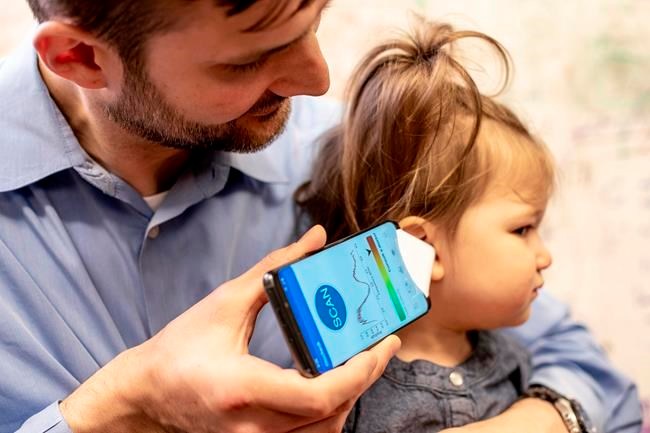
In this undated photo provided by the University of Washington in May 2019, Dr. Randall Bly uses a uses a phone app and a paper funnel to focus the sound, to check his daughter for an ear infection, at the UW School of Medicine in Seattle. Bly and other researchers at the school have developed the system to “hear” a warning sign of ear infections _ fluid build-up behind the eardrum. (Dennis Wise/University of Washington via AP)

Diagnosis is difficult. Usually a pediatrician will peek into the child’s ear to see if the eardrum is inflamed, and parents can buy devices that use cameras to do the same thing. But ear specialists tend to use pricier, more complex tests that measure if the eardrum is pliable enough to vibrate correctly in response to sound, or is stiff from the pressure of fluid behind it.

A team of engineers and doctors at the University of Washington developed a simple smartphone approach for acoustic testing: Cut a piece of paper, fold it into a funnel shape and tape it around the phone’s microphone and speakers. Aim the funnel at the ear canal to focus sound. An experimental app beams in birdlike chirps, at a specific frequency. The microphone detects sound waves bouncing off the eardrum.

The app analyzes that echo, a broad-spectrum vibration from a healthy eardrum. Pus or uninfected fluid alters the eardrum’s mobility and changes the reflected sound. The app sends a text saying whether it’s likely that middle-ear fluid is present — one piece of information, along with other symptoms, that might be used for diagnosis.

“This type of technology could potentially avoid needless doctor visits,” said Dr. Justin Golub, a Columbia University ear specialist who wasn’t involved with the research. Golub often sees patients with suspected ear infections who don’t actually have one. He called the tool’s accuracy “quite impressive.”

Researchers tested the system on 98 ears, in children older than 18 months who were about to undergo surgery at Seattle Children’s Hospital. Half were having ear tubes implanted, so doctors could tell exactly how much fluid was present to compare with the smartphone results. The system detected fluid as well or better than specialized acoustic testing devices, the team reported Wednesday in the journal Science Translational Medicine.

A smaller test showed similar results as young as 9 months. And in a separate experiment involving 25 kids’ ears, parents used the smartphone to check for fluid just as well as doctors did.

“Examining ears is difficult,” and better tools are needed for doctors, too, said Dr. Alejandro Hoberman, pediatrics chief at UPMC Children’s Hospital of Pittsburgh, who also wasn’t part of the research.

But just because there’s fluid present doesn’t mean it’s infected — and Hoberman worried that at-home use of such a device “may alarm parents” and pressure doctors to prescribe unnecessary antibiotics.

Dr. Randall Bly, a University of Washington ear specialist and study co-author, says the smartphone approach is a bit like using a thermometer in deciding when to call a doctor. If it finds no sign of fluid, “then you can be pretty confident the fever or whatever is probably not related to an ear infection,” he explained.

But lots of children have persistent ear fluid without infections — and they’re supposed to be tracked for months in deciding if they need ear tubes. At-home monitoring would be easier and cheaper than repeated doctor visits just for an ear test, added Raju, a surgical resident.

That’s one reason the American Academy of Otolaryngology in 2016 called for development of at-home strategies to detect fluid buildup in the ears.

The research was funded in part by the National Science Foundation and National Institutes of Health. The university filed for a patent, and the researchers are seeking Food and Drug Administration approval to sell the app.

___

The Associated Press Health and Science Department receives support from the Howard Hughes Medical Institute’s Department of Science Education. The AP is solely responsible for all content.


Report Error Submit a Tip

More Stories

Mayoral candidate Vogiatzakis criticized for living outside Winnipeg

Malak Abas 4 minute read Preview

Mayoral candidate Vogiatzakis criticized for living outside Winnipeg

Malak Abas 4 minute read Friday, Oct. 2, 2026

A mayoral hopeful took heat from other candidates Friday for living outside Winnipeg while running in the civic election.

Mike Vogiatzakis’s primary residence is in the Rural Municipality of St. Andrews, about 25 kilometres north of Winnipeg — a community with its own mayor and councillors.

But the funeral director said he owns a home in Winnipeg where he divides his time, and he would move to the city full-time if elected mayor.

“It doesn’t matter where a person lives. Why are we dividing St. Andrews and Manitoba and Winnipeg? I’ve met the criteria to run for mayor,” Vogiatzakis said Friday morning.

Read
Friday, Oct. 2, 2026

May be whiff of truth to ex’s odour ardour

Maureen Scurfield 5 minute read Yesterday at 2:01 AM CDT

DEAR MISS LONELYHEARTS: I ran into an old boyfriend I used to curl on a team with, and we went for drinks. We’ve been almost eight years apart, and I couldn’t remember why we broke up, as we always had such a great time together.

It wasn’t until the second date — this time on a weekend — that it came back to me, with a jolt. Pee-yew! I remembered he doesn’t use deodorant on weekends. Why? He enjoys his own body odour. I recalled that a bit too late, and it was just as awful as ever! I went home early.

Tonight, he called and I refused him another date. I said, “Think back. You remember why we broke up?” Then he said, “Oh yeah, you hated my no-deodorant weekend policy. Well, guess what? Some women don’t mind!” I said I really doubted that, and that ended the conversation. Miss L., wouldn’t any women find stinky underarms offensive?

— Sensitive Nose, Fort Richmond

Winnipeggers witness unveiling of Japanese Canadian monument in B.C.

Morgan Modjeski 6 minute read Preview

Winnipeggers witness unveiling of Japanese Canadian monument in B.C.

Morgan Modjeski 6 minute read Yesterday at 8:39 PM CDT

As Miki Stewart gathered with her family at the Japanese Cultural Association of Manitoba on Saturday afternoon, she was thinking of her parents, Yoshimaru and Yoshi Abe.

Both Stewart, 80, and her sister Yumi Falk, 81, alongside an older brother, were born in the Tashme internment camp in British Columbia. They were among more than 2,600 Japanese Canadians who were forcefully removed and interred at the camp following the bombing of Pearl Harbour and Canada’s declaration of war on Japan in 1941.

“They didn’t talk much about how they suffered,” Stewart said of her parents. “But they did.”

She was amongst a group of more than 150 people who gathered at the association’s McPhillips headquarters on Saturday afternoon to watch the unveiling of the Japanese Canadian Monument in Victoria B.C.

Read
Yesterday at 8:39 PM CDT

Blown lead spoils Jets opener

Mike McIntyre 7 minute read Preview

Blown lead spoils Jets opener

Mike McIntyre 7 minute read Friday, Oct. 2, 2026

Younger. Faster. Stronger.

They may still be a long ways from a finished product, but it’s safe to say the new-look Winnipeg Jets made a mostly favourable first impression on Friday night in front of a sold-out crowd at Canada Life Centre.

Sure, a 4-3 overtime loss to a hard-nosed Boston Bruins outfit is going to sting a little, especially since the home team was just 98 seconds away from a regulation victory.

But if the Jets can bottle up this kind of energy and effort, they should enjoy plenty of success over the course of the 84-game campaign.

Read
Friday, Oct. 2, 2026

Six high school hockey programs ceased operations following new Hockey Manitoba policy

Joshua Frey-Sam 7 minute read Preview

Six high school hockey programs ceased operations following new Hockey Manitoba policy

Joshua Frey-Sam 7 minute read Friday, Oct. 2, 2026

She lived the best of both worlds.

For the last three years, the 17-year-old wore a sweater for two different hockey programs — her high school team and AAA club in the Manitoba Female Hockey League — and was preparing to flourish in both colours again this winter.

Recently, however, the blue-liner was disappointed to learn she is no longer eligible to play her Grade 12 season with her school owing to a new policy imposed by Hockey Manitoba that bans players from participating in the Manitoba Women’s High School Hockey League if they are rostered on a U18 AAA team.

The rule applies to all athletes who play for both Winnipeg-based and rural AAA teams.

Read
Friday, Oct. 2, 2026

’Disgusting’ posters being investigated by police

Morgan Modjeski 4 minute read Yesterday at 2:22 PM CDT

The Winnipeg Police Service major crimes unit is investigating what some have labelled offensive and hateful posters on full-display at a Winnipeg home.

One of the people irked by the display is Gracie Garrett. She’s has lived on Ashburn Street in Winnipeg’s Minto neighbourhood for almost ten years. She’s never felt unsafe in the neighbourhood before, but now, a set of posters plastered on a nearby house are making her feel uneasy.

The five signs, posted facing the street prominently on a front window, contain a slur, refer to Nazis as “heroes” and call Muslims, Christians and other groups “evil.”

Learning of the signs Friday, Garrett said she’ll be reporting the posters to police, as she worries they incite and promote violence.