Topiary tips: When you want shrubs to double as sculpture

Advertisement

Advertise with us

Topiary is the art of growing trees and shrubs as living sculptures — cubes, spheres, obelisks, animal shapes or combinations of these.

Read this article for free:


or

Already have an account? Log in here »

To continue reading, please subscribe:

Subscribe and receive a limited-edition Free Press branded hat or tote.

Digital Subscription

One year of digital access for only $205*

  • Enjoy unlimited reading on winnipegfreepress.com
  • Read the E-Edition, our digital replica newspaper
  • Access News Break, our award-winning app
  • Play interactive puzzles

*First annual payment billed as $205.00 + GST for one year. This annual subscription will automatically renew at $233.00 + GST every 52 weeks (10% off the regular annual price of $259.35). Offer available to new and qualified returning subscribers only. Cancel any time.

To continue reading, please subscribe:

Add Free Press access to your Brandon Sun subscription for only an additional

$1 for the first 4 weeks*

  • Enjoy unlimited reading on winnipegfreepress.com
  • Read the E-Edition, our digital replica newspaper
  • Access News Break, our award-winning app
  • Play interactive puzzles
Start now

*Your next Brandon Sun subscription payment will increase by $1.00 and you will be charged $17.95 plus GST for four weeks. After four weeks, your payment will increase to $24.95 plus GST every four weeks.

Hey there, time traveller!
This article was published 30/07/2019 (2568 days ago), so information in it may no longer be current.

Topiary is the art of growing trees and shrubs as living sculptures — cubes, spheres, obelisks, animal shapes or combinations of these.

The tradition has flourished in various places at different times, but in modern gardens, topiary is rare, unless you count our foundation plantings of clipped yews and junipers — “gumdrop” or “dot-dash” landscaping along home foundations.

SUGGESTED PLANTS
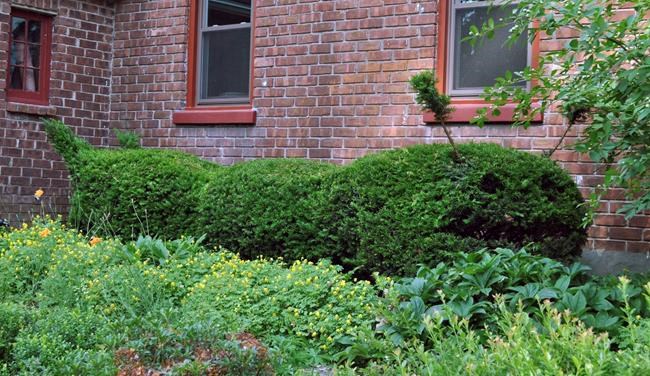
This undated photo shows a row of yews along a house foundation in New Paltz, N.Y. With dense, small leaves and readiness to resprout from pruning cuts, yews are easily pruned as a topiary — in this case as a giant caterpillar. (Lee Reich via AP)

Only certain plants are suitable for pruned topiary. (Topiaries created with wire frames “plugged” with hens-and-chicks plants or embraced by vining plants are a different story, for another time.) The ideal topiary plant is slow-growing, tolerant of repeated pruning, and able to re-sprout from older wood. Especially for smaller topiaries viewed at close range, small leaves are needed to create a surface with a crisp edge.

If possible, select a species or variety whose natural shape approximates its intended shape: Densa yew for a low sphere, or Pyramidalis yew for an obelisk, as examples.

Evergreens generally are used for topiary, but occasionally a deciduous plant such as English hawthorn or European beech is used. A drawback to a deciduous topiary, of course, is that it is bare in winter (although beech does not shed its dead leaves until spring). Deciduous plants generally grow more exuberantly than do evergreens, so also require more diligence to keep growth in check.

Many species of evergreens have been used for topiary. The quintessential ones are yew and boxwood. Some other suitable plants include arborvitae, hemlock, holly and rosemary.

DEVELOPING YOUR SHAPE

In most cases, begin shaping your plant while it is young. You could, however, carve a shape out of an old overgrown yew, much as you would out of wood or stone, because yew grows so densely and sprouts so freely from old wood.

Or maybe a growing plant will suggest a form that you could then develop. You might even juxtapose two plants, or let one grow up through the other to create, for example, a pedestal on which sits a verdant animal.

In any case, topiary lends itself more to bold shapes than to intricate designs whose details are swallowed up between prunings. Site your topiary so that it receives good light on all sides, for dense growth throughout.

Most young topiary plants that are still in their formative stage need nothing more than frequent shearing or clipping off of the ends of stems in order to encourage dense branching. Clipping individual stems is the preferred method for plants with large leaves because shearing would mangle individual leaves. Obviously, where a stem protrudes in the direction where you want growth, leave it.

KEEPING IN SHAPE

Once a topiary is fully grown and shaped, it needs pruning at least once a year, two or three times a year in some cases. Where a plant needs only once-a-year pruning and is reliably cold-hardy, prune just after midsummer. By then, the spring flush of growth has ceased, and there is less chance that pruning will stimulate regrowth before the following spring.

Cut freehand, or use a guide to make sure your topiary is not gradually changing shape over the years. A guide is also useful when you have more than one matching topiary. If you cut freehand, step back frequently to check and admire your work.

What is to be done with a neglected topiary? Severe cuts may be needed to stimulate growth within the plant. Repair a leafless hole by widening it, cutting old wood around the hole back to healthy wood. If severe cuts are needed, renovation is possible only if the plant is one capable of sprouting from old, perhaps leafless, wood. Otherwise, start again with a new plant.

___

Online:

http://www.leereich.com/blog

http://leereich.com

Report Error Submit a Tip

More Stories

Main Street restaurant Boujee burns for the second time in one week

Aaron Epp 2 minute read Preview

Main Street restaurant Boujee burns for the second time in one week

Aaron Epp 2 minute read Saturday, Aug. 8, 2026

A former restaurant on Main Street is set to be demolished after a fire broke out for the second time in less than a week.

Winnipeg Fire Paramedic Service crews responded to reports of a fire at Boujee Restaurant and Bar, a vacant, single-storey building on the 100 block of Main Street shortly before 6 a.m. Saturday. The same building was most recently damaged in a fire last Sunday.

At the scene, crews found heavy smoke coming from the building. After attacking the fire using aerial ladders that sprayed water from above, firefighters arranged an emergency demolition of the building. Demolition is expected to be completed today, the WFPS said in a news release.

No injuries were reported and the fire is under investigation.

Read
Saturday, Aug. 8, 2026

Suspension upheld for teen hockey player involved in hazing

Free Press staff 3 minute read Preview

Suspension upheld for teen hockey player involved in hazing

Free Press staff 3 minute read Yesterday at 2:10 PM CDT

A high school hockey player who was found to have been involved in sexualized hazing of rookie teammates lost his suspension appeal.

The youth player was barred from Hockey Canada-sanctioned activities. He was handed the four-year and nine-month suspension from sanctioned hockey after an interim ban issued in March 2024.

He appealed his suspension late last year to the Sport Dispute Resolution Centre of Canada, an independent conflict tribunal, but the centre upheld the youth’s suspension, according to a written decision issued earlier this year.

An independent investigator who probed the hockey player’s actions described the youth as a veteran player who both participated in and co-ordinated the “assigning” of rookie team members to veteran players to perform tasks for them. He himself was “assigned” a rookie, the decision said.

Read
Yesterday at 2:10 PM CDT

Memories of East Selkirk evoked on Zoon Monkman’s new album

Ben Waldman 4 minute read Preview

Memories of East Selkirk evoked on Zoon Monkman’s new album

Ben Waldman 4 minute read 6:00 AM CDT

At the dawn of the MP3 era, an adolescent Zoon Monkman didn’t have the money for an iPod or a Microsoft Zune, the short-lived competitor to Apple’s revolutionary personal-listening device.

What the recording artist from Brokenhead Ojibway Nation did have in his backpack was the catalogue for the Scholastic Book Club, where only one product demanded attention: an AM-FM radio pen that scoured the airwaves for connection with every click.

For Monkman — a Polaris Music Prize-nominated musician who records as Zoon and pioneered the “moccasingaze” genre, which blends the dreamy textures of shoegaze with the rhythms and energies of Indigenous song — his mother’s gift of the ballpoint pen was a means of both self-discovery and the development of his musical taste.

During lonely days as an elementary student at East Selkirk’s Happy Thought School, the device was also a recess-hour tether to distant worlds, where artists such as Feist, Avril Lavigne and Broken Social Scene were introduced by the enthusiastic voice of a man who called himself Ace Burpee.

Read
6:00 AM CDT

Kinder, gentler drug crackdown finds support, tempered expectations in Main Street area

Chris Kitching 9 minute read Preview

Kinder, gentler drug crackdown finds support, tempered expectations in Main Street area

Chris Kitching 9 minute read Friday, Aug. 7, 2026

Drawing a lighter from his pocket, a shirtless man perched on a concrete wall outside United Way Winnipeg’s Main Street headquarters heats a substance in a glass pipe and moves the tube toward his mouth.

Read
Friday, Aug. 7, 2026

Puzzles Palace

1 minute read Monday, Jul. 27, 2026

To solve our puzzles, please subscribe with this special offer: |

Topiary tips: When you want shrubs to double as sculpture

Lee Reich, The Associated Press 4 minute read Preview

Topiary tips: When you want shrubs to double as sculpture

Lee Reich, The Associated Press 4 minute read Tuesday, Jul. 30, 2019

Topiary is the art of growing trees and shrubs as living sculptures — cubes, spheres, obelisks, animal shapes or combinations of these.

The tradition has flourished in various places at different times, but in modern gardens, topiary is rare, unless you count our foundation plantings of clipped yews and junipers — "gumdrop" or "dot-dash" landscaping along home foundations.

SUGGESTED PLANTS

Only certain plants are suitable for pruned topiary. (Topiaries created with wire frames "plugged" with hens-and-chicks plants or embraced by vining plants are a different story, for another time.) The ideal topiary plant is slow-growing, tolerant of repeated pruning, and able to re-sprout from older wood. Especially for smaller topiaries viewed at close range, small leaves are needed to create a surface with a crisp edge.

Read
Tuesday, Jul. 30, 2019