California to build largest wildlife crossing in world

Advertisement

Advertise with us

LOS ANGELES - Like many urban singles, the mountain lion P-22 lives a solitary life in a too-small habitat. And he has a hard time finding a mate in the big city.

Read this article for free:


or

Already have an account? Log in here »

To continue reading, please subscribe:

Subscribe and receive a limited-edition Free Press branded hat or tote.

Digital Subscription

One year of digital access for only $205*

  • Enjoy unlimited reading on winnipegfreepress.com
  • Read the E-Edition, our digital replica newspaper
  • Access News Break, our award-winning app
  • Play interactive puzzles

*First annual payment billed as $205.00 + GST for one year. This annual subscription will automatically renew at $233.00 + GST every 52 weeks (10% off the regular annual price of $259.35). Offer available to new and qualified returning subscribers only. Cancel any time.

To continue reading, please subscribe:

Add Free Press access to your Brandon Sun subscription for only an additional

$1 for the first 4 weeks*

  • Enjoy unlimited reading on winnipegfreepress.com
  • Read the E-Edition, our digital replica newspaper
  • Access News Break, our award-winning app
  • Play interactive puzzles
Start now

*Your next Brandon Sun subscription payment will increase by $1.00 and you will be charged $17.95 plus GST for four weeks. After four weeks, your payment will increase to $24.95 plus GST every four weeks.

Hey there, time traveller!
This article was published 20/08/2019 (2599 days ago), so information in it may no longer be current.

LOS ANGELES – Like many urban singles, the mountain lion P-22 lives a solitary life in a too-small habitat. And he has a hard time finding a mate in the big city.

Famous for travelling across two freeways and making a huge Los Angeles park his home, the lonesome big cat has become a symbol of the shrinking genetic diversity of wild animals that must remain all but trapped by sprawling development or risk becoming roadkill.

Hoping to fend off the extinction of mountain lions and other species that require room to roam, transportation officials and conservationists will build a mostly privately funded wildlife crossing over a major Southern California highway. It will give big cats, coyotes, deer, lizards, snakes and other creatures a safe route to open space and better access to food and potential mates.
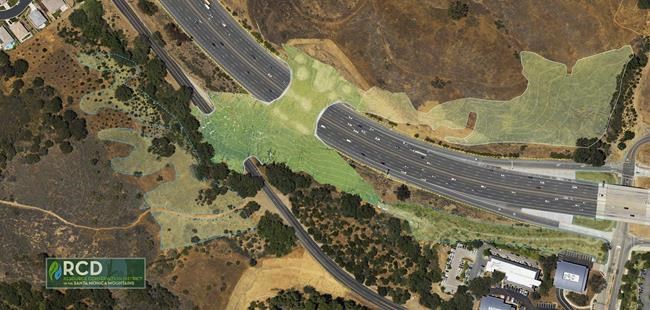
This undated artist's rendering provided by the Resource Conservation District of the Santa Monica Mountains shows a planned wildlife crossing over U.S. Highway 101 in Agoura Hills, Calif. Hoping to fend off the extinction of mountain lions and other species that require room to roam, transportation officials and conservationists will build a mostly privately funded wildlife crossing over the freeway. (Clark Stevens, Architect/Raymond Garcia, Illustration/RCD of the Santa Monica Mountains via AP)

The span along U.S. 101 will only be the second animal overpass in a state where tunnels are more common. Officials say it will be the first of its kind near a major metropolis and the largest in the world, stretching 200 feet (61 metres) above 10 lanes of busy highway and a feeder road just 35 miles (56 kilometres) northwest of downtown LA.

“When the freeway went in, it cut off an ecosystem. We’re just now seeing impacts of that,” Beth Pratt of the National Wildlife Federation told The Associated Press.

Scientists tracking mountain lions fitted with GPS collars found that roadways are largely trapping animals in the Santa Monica Mountains, which run along the Malibu coast and across the middle of Los Angeles to Griffith Park, where P-22 settled.

“They can’t get out of here to get dates, and cats can’t get in to get dates. … For those of us in LA, having a romance prospect quashed by traffic is something we can all relate to,” Pratt said.

The result of that isolation, researchers say, is imminent genetic collapse for mountain lions. Habitat loss has driven the populations to inbreeding that could lead to extinction within 15 years unless the big cats regularly connect with other populations to increase their diversity, according to a study published this year by the University of California, Los Angeles; University of California, Davis; and the National Park Service.

The $87 million bridge last month entered its final design phase. It’s on track for groundbreaking within two years and completion by 2023, according to engineer Sheik Moinuddin, project manager with the California Department of Transportation. Construction will take place mostly at night and won’t require any lengthy shutdowns of the 101 freeway, officials said.

Moinuddin said Caltrans considers it a “special” project that the agency hopes will inspire others like it across the state.

One of the reasons it’s special is that 80% of the money to build it will come from private sources, Pratt said. She’s in charge of fundraising and is using P-22 — “the Brad Pitt of the cougar world” — as the poster cat for the campaign.

“He is world famous, handsome, everybody loves him,” she said about the cougar that’s been photographed in his park home with the Hollywood sign as a backdrop.

Despite being the face of the project, P-22 is unlikely to use the bridge because he’s confined to the park many miles away. But many of his relatives could benefit, Pratt said.
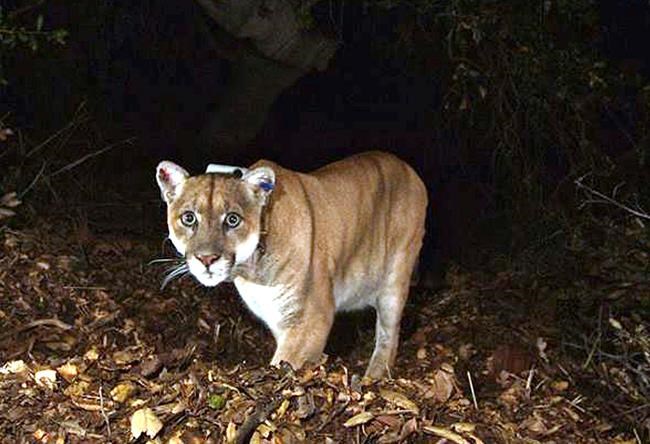
FILE - This November 2014 file photo provided by the U.S. National Park Service shows a mountain lion known as P-22, photographed in the Griffith Park area near downtown Los Angeles. Hoping to fend off the extinction of mountain lions and other species that require room to roam, California is building a mostly privately funded wildlife crossing over U.S. Highway 101 in Agoura, Calif. It will give big cats, coyotes, deer, snakes and other creatures a safe route to open space and better access to food and potential mates. The span will be the only animal overpass in a state where tunnels are more common. (National Park Service, via AP, File)

More than $13.5 million in private funding has already been raised, Pratt said. Officials are considering offering naming rights to the bridge if an entity or individual — perhaps a Hollywood studio or star — ponies up a significant donation, she said.

The remaining 20% will come from public funds already allocated toward conservation projects, officials said.

Some 300,000 cars a day travel that stretch of the 101 in Agoura Hills, a small city surrounded by a patchwork of protected wildland that the new crossing will connect. Residents regularly spot tarantulas, coyotes and bobcats in their yards and enjoy a short walk to hiking and biking trails that offer sweeping views of the Pacific Ocean.

Drivers on the busy freeway in the Liberty Canyon area might do a double-take as they speed under a bridge 165 feet (50 metres) wide with brush and trees growing on top, seamlessly joining hillsides on both sides of the lanes.

“And who knows, you might see an animal peeking over as it’s crossing,” Pratt said.

From the perspective of that animal meandering to or from the Santa Monica Mountains, the topography will hopefully be indistinguishable from the scenery on either side, said architect Clark Stevens. His design will total about 8 acres of landscape — of which the bridge top occupies about an acre.

He’s working with biologists and engineers to design berms and hollows with high edges that will block sound and light from the lanes below.

“Ideally the animals will never know they’re on a bridge,” said Stevens, with the Resource Conservation District of the Santa Monica Mountains. “It’s landscape flowing over a freeway. It’s putting back a piece of the ecosystem that was lost.”

Wildlife crossings — bridges and tunnels — are common in western Europe and Canada. A famous one in Banff National Park in Alberta spans the Trans-Canada Highway and is frequently used by bears, moose and elk. The first one in California opened with little fanfare last October near Temecula, about 60 miles (97 kilometres) north of San Diego.

The Los Angeles-area bridge has enjoyed nearly universal support, unusual for a public works project. The draft environmental impact document received nearly 9,000 comments — with only 15 opposed, according to the NWF.
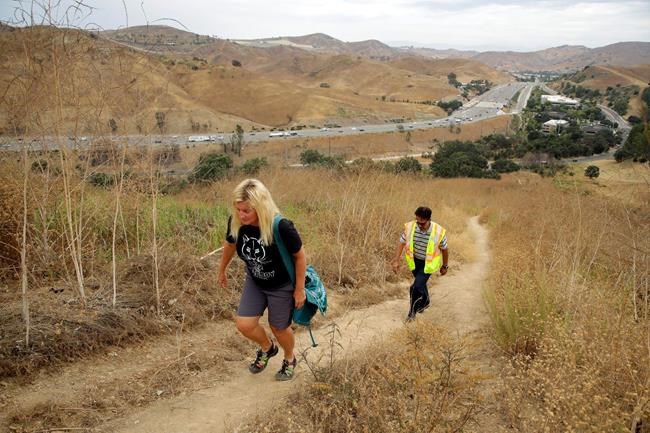
In this July 25, 2019, photo, Beth Pratt, California director for the National Wildlife Federation, left, and Cal Trans project manager Sheik Moinuddin walk along a hiking trail near a proposed wildlife crossing over U.S. Highway 101, background, in Agoura Hills, Calif. Pratt has been an advocate for the wildlife crossing, hoping for wildlife to have wider roaming spaces. (AP Photo/Marcio Jose Sanchez)

Agoura Hills resident Fran Pavley, a retired state senator, said one of her neighbours was initially concerned about cost.

“He came on board after learning it would be funded privately,” she said.

Stevens said he’s encouraged by Caltrans’ devotion to the project and its promise to consider more like it.

“Every hole in the freeway ought to be exploited. It’s a game of odds,” he said. “The more options animals have, the better off they’ll be.”

___

Follow Weber at https://twitter.com/WeberCM
Report Error Submit a Tip

More Stories

Netminder no stranger to heavy workload as Jets new No. 1 readies for regular-season start

Ken Wiebe 8 minute read Preview

Netminder no stranger to heavy workload as Jets new No. 1 readies for regular-season start

Ken Wiebe 8 minute read Yesterday at 2:42 PM CDT

Stuart Skinner is quick to admit that he wasn’t always wired this way.

As the Winnipeg Jets new starting goalie prepares for his fifth NHL season, Skinner conceded that the accountability aspect that is now synonymous with his character took some time to build up.

“As I grew up and got older, you go through certain things in life that either build character or make things worse for you. It depends on your choice and your decision,” Skinner said during a recent conversation with the Free Press. “I learned it through trial and error. I learned that, sometimes, it’s hard to get honest with yourself… For me, it’s definitely been a road for me to get to a place like this.

“It definitely is one of my pillars. Accountability is so important because that brings you into a spot of what you’re going to do next. It’s easy to let yourself off the hook. I’m more in the business of putting myself on the hook.”

Read
Yesterday at 2:42 PM CDT

What’s up

5 minute read Preview

What’s up

5 minute read Updated: 8:22 AM CDT

Connection: Recent Work from Artist Moms 2.0Community Art Gallery at the Pavilion, Assiniboine Park, 55 Pavilion Cres.Artist talk Saturday, 2 p.m.FreeWhat does it mean to mother in a time of global, social and environmental uncertainty? What does it mean to be the village?

This group exhibition featuring 20 Winnipeg artist mothers affiliated with Mentoring Artists for Women’s Art connects the individual experiences of motherhood with broader concerns, exploring themes of memory, nostalgia, grief, loss and care through embroidery, painting, printmaking, poetry, sculpture, installation and mixed media.

“My work is both personal and political, concerned not only with our responsibilities to our own families but also with what it means to be a caregiver in a world threatened by greed, violence and environmental harm,” said artist and group organizer Allison Moore in a release.

The gallery will host a series of artist talks on Saturdays, Oct. 3, 17 and 24, from 2 to 4 p.m. Connection is on view until Nov. 22.

Read
Updated: 8:22 AM CDT

Work aims to share Jordan River Anderson’s heroic legacy with young audiences

Ben Waldman 4 minute read Preview

Work aims to share Jordan River Anderson’s heroic legacy with young audiences

Ben Waldman 4 minute read 5:04 PM CDT

It isn’t often that Yvette Nolan is brought to tears by her own work.

But at the Montreal premiere of Jordan, the playwright found herself weeping in the aisles.

“I was a mess,” she recalls.

But all around her, the audience of children at Montreal’s Geordie Theatre were cheering at the conclusion of Nolan’s latest work, a fable centred on the heroic influence of Jordan River Anderson, a Norway House boy who spent two years living in hospital because the federal and provincial governments couldn’t agree on which level of elected office should pay for his at-home care.

Read
5:04 PM CDT

Who has been invited to the table?

Stephen Borys 6 minute read Preview

Who has been invited to the table?

Stephen Borys 6 minute read 2:01 AM CDT

Last Friday, I spoke at Booth University College’s inaugural Honour and Hope Harvest Dinner in support of Shelter U. I had been asked to speak about the power of art in the community, a subject I have spent much of my professional life thinking about — as a museum director, writer and teacher, and now through my consulting work with Civic Muse.

What continues to interest me is not simply what museums, universities and other public institutions do, but whether their work actually matters — whether they make a difference in the lives of the people and communities around them.

Preparing for the evening brought me back to an even more fundamental question: Who has been invited in?

One of my museum mentors used to remind me that institutions often begin the conversation about public engagement too late. Before engagement comes the welcome, and before the welcome comes the invitation. We can create extraordinary buildings, exhibitions and programs and say that everyone is welcome. But unless people believe that these places are also meant for them, many will never cross the threshold.

Read
2:01 AM CDT

Acquisition of former residential school grounds will help educate future generations: premier

Connor McDowell and Morgan Modjeski 6 minute read Preview

Acquisition of former residential school grounds will help educate future generations: premier

Connor McDowell and Morgan Modjeski 6 minute read Tuesday, Sep. 29, 2026

Premier Wab Kinew says a former Brandon-area campground acquired by the province will help educate future generations about the horrors of residential schools.

“We live in an era where people are trying to deny what happened in residential schools,” Kinew said during a Tuesday afternoon visit to Turtle Crossing Campground, near the former Brandon Indian Residential School. “It’s an important part of our national history, and keeping that truth alive.”

Kinew officially announced the province’s plan Tuesday, in partnership with the City of Brandon, to acquire and protect the site where the bodies of more than 50 Indigenous children are located.

The premier said the property has “huge national significance” for education about residential school history because it is one of the “most documented” in the country. He carried photographs, and some 20th century newspaper clippings from the Brandon Sun around the site Tuesday.

Read
Tuesday, Sep. 29, 2026

In a smart-device world, some families keep phone jacked into the wall

Sheldon Birnie 8 minute read Preview

In a smart-device world, some families keep phone jacked into the wall

Sheldon Birnie 8 minute read Tuesday, Sep. 29, 2026

When the phone rings in Kristin Shiach and Jordan Sobkowicz’s Riverview home, their three daughters race to see who can be the first to answer.

“It depends who is closest,” says 13-year-old Emily. “If I’m sitting in my room, I can get to it quickest.”

“That’s because it’s always in your room,” Anna, 10, replies. “You never put it back!”

“Usually, when the phone rings,” explains Sobkowicz, “someone yells really loudly —”

Read
Tuesday, Sep. 29, 2026