From minstrel shows to campus firestorms, Canada’s long history of blackface
Advertisement
Read this article for free:
or
Already have an account? Log in here »
To continue reading, please subscribe:

Digital Subscription
One year of digital access for only $205*
- Enjoy unlimited reading on winnipegfreepress.com
- Read the E-Edition, our digital replica newspaper
- Access News Break, our award-winning app
- Play interactive puzzles
*First annual payment billed as $205.00 + GST for one year. This annual subscription will automatically renew at $233.00 + GST every 52 weeks (10% off the regular annual price of $259.35). Offer available to new and qualified returning subscribers only. Cancel any time.
To continue reading, please subscribe:
Add Free Press access to your Brandon Sun subscription for only an additional
$1 for the first 4 weeks*
- Enjoy unlimited reading on winnipegfreepress.com
- Read the E-Edition, our digital replica newspaper
- Access News Break, our award-winning app
- Play interactive puzzles
*Your next Brandon Sun subscription payment will increase by $1.00 and you will be charged $17.95 plus GST for four weeks. After four weeks, your payment will increase to $24.95 plus GST every four weeks.
Read unlimited articles for free today:
or
Already have an account? Log in here »
Hey there, time traveller!
This article was published 19/09/2019 (2553 days ago), so information in it may no longer be current.
Justin Trudeau’s political fate hangs in the balance as a series of images of the Liberal leader wearing blackface and brownface have roiled the federal election campaign. The scandal has shocked many Canadians and seized headlines across the globe. But blackface has a long, painful legacy in Canada. Here’s a look at the racist practice in history and contemporary culture:
Minstrel shows
While blackface minstrelsy is believed to have originated in the United States, it was also a popular form of entertainment in Canada in the 19th and early 20th century. These shows typically featured white performers donning dark makeup to enact racist caricatures of black people through music, dancing and comedy.

In a 2005 doctoral thesis, University of Toronto researcher Lorraine Elmire Louise Le Camp documented hundreds of minstrel performances across Canada from the 1840s to 1960s. These include shows mounted by charitable organizations, religious groups, schools and members of the military and law enforcement.
While many minstrel troupes hailed from the U.S., there were also homegrown acts such as the Saskatoon Minstrel Show and the Saint John Amateur Athletic Club.
One Canadian performer of note was Calixa Lavallee, the composer of “O Canada,” who spent much of his early career performing in blackface with American minstrel troupes, according to the biography “Song of a Nation” by Robert Harris.
Pop culture
Even as minstrel shows on stage and television fell out of favour, the impact of blackface continues to resonate in Canadian culture.
A Montreal theatre drew ire from local artists over a 2014 year-end skit in which a white actor wore blackface to portray then-Montreal Canadiens’ defenceman P. K. Subban.
Fellow Canadian hockey players Tyler Bozak and Raffi Torres faced criticism for separate incidents in 2012 and 2011 in which they wore blackface to dress up as black celebrities for Halloween.
Last year, rapper Pusha T revealed a photo of Toronto rival Drake in blackface, which the former actor explained was a publicity shot from a project about the struggles of getting roles as a young black performer.
The first Canadian competitor to be on “RuPaul’s Drag Race” came under fire recently for appearing in a photo alongside another drag queen wearing blackface. Brooke Lynn Hytes said she regretted sharing the image on Instagram in 2013, saying the post was “rooted in ignorance and came from a place of naivety and privilege.”
Schools
Classrooms have often been a flashpoint for blackface controversies committed by students and teachers alike, according to a timeline of Canadian incidents involving blackface compiled by the Arts Against Postracialism project led by McGill University assistant professor Philip Howard.
It lists several reports of high-school students wearing blackface for school events ranging from Christmas shows to a mock assembly of the United Nations.
A white teacher at a school in Charlottetown wore blackface for a video spoofing an African-Canadian coworker in 2007, according to the timeline. In 2013, Ontario’s Peel District Schoolboard launched an investigation after a vice-principal at a Caledon high school wore blackface to dress up as Mr. T on Halloween.
The timeline also found several blackface incidents at universities across the country, including a 2009 scandal in which five University of Toronto students wore blackface on Halloween for a group costume as the Jamaican bobsled team from the film “Cool Runnings.”
Earlier this year, a group of law professors at Dalhousie University urged the school’s top academic administrator take a clear stance on blackface due to concerns over statements he’d made suggesting there was a “lack of proportion” in the outrage on campuses over costume parties involving white students in blackface.
Politics
In 2013, a provincial politician in Nova Scotia tweeted, then deleted, a photo of himself sitting on the lap of a blackface Christmas character.
Liberal member Joachim Stroink initially defended the image of him posing with Zwarte Piet, or “Black Pete,” saying that to ignore the controversial Dutch character would fail to recognize his own heritage.
Shortly after, Stroink fought back tears as he discussed how difficult it has been to deal with the reaction to the photo, insisting there was no place for blackface in Nova Scotia or Dutch culture.

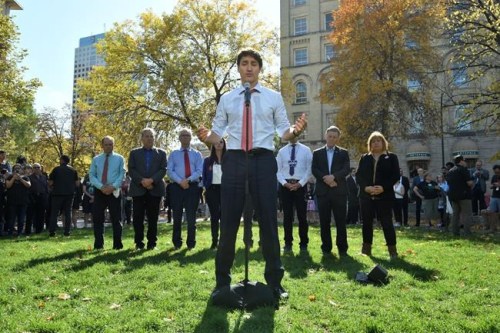
On Wednesday, the issue of blackface reached Canada’s highest office when Time magazine published a 2001 photo of Prime Minister Justin Trudeau wearing a turban with his face and hands coloured with dark makeup at an “Arabian Nights”-themed party at a Vancouver private school where he used to teach.
As the scandal upended his bid for re-election, Trudeau apologized for his actions and admitted to wearing blackface in a separate incident, for a high-school performance of Harry Belafonte’s “Banana Boat Song (Day O).”
An image of that incident surfaced, followed by a video of Trudeau wearing blackface at an event in the 1990s.
On Thursday, Trudeau said he deeply regretted his actions and the hurt they have caused.
“Darkening your face, regardless of the context or the circumstances, is always unacceptable because of the racist history of blackface. I should have understood that then, and I never should have done it,” Trudeau said.
Related Articles
Liberals win 4th mandate as NDP vote collapses and Singh announces he will resign








Advertisement Advertise With Us
Advertisement Advertise With Us