Canada’s Salvation Army testing out quicker tap-and-go option at kettle stations

Advertisement

Advertise with us

TORONTO - Canada's Salvation Army is testing out a new and faster way to allow cashless donations to its kettle stations via debit and credit card, making the process as quick and easy as dropping a toonie in the bubble.

Read this article for free:


or

Already have an account? Log in here »

To continue reading, please subscribe:

Subscribe and receive a limited-edition Free Press branded hat or tote.

Digital Subscription

One year of digital access for only $205*

  • Enjoy unlimited reading on winnipegfreepress.com
  • Read the E-Edition, our digital replica newspaper
  • Access News Break, our award-winning app
  • Play interactive puzzles

*First annual payment billed as $205.00 + GST for one year. This annual subscription will automatically renew at $233.00 + GST every 52 weeks (10% off the regular annual price of $259.35). Offer available to new and qualified returning subscribers only. Cancel any time.

To continue reading, please subscribe:

Add Free Press access to your Brandon Sun subscription for only an additional

$1 for the first 4 weeks*

  • Enjoy unlimited reading on winnipegfreepress.com
  • Read the E-Edition, our digital replica newspaper
  • Access News Break, our award-winning app
  • Play interactive puzzles
Start now

*Your next Brandon Sun subscription payment will increase by $1.00 and you will be charged $17.95 plus GST for four weeks. After four weeks, your payment will increase to $24.95 plus GST every four weeks.

Hey there, time traveller!
This article was published 15/11/2019 (2493 days ago), so information in it may no longer be current.

TORONTO – Canada’s Salvation Army is testing out a new and faster way to allow cashless donations to its kettle stations via debit and credit card, making the process as quick and easy as dropping a toonie in the bubble.

A pilot project starting Dec. 1 will allow donations at some kettle stations in the Greater Toronto Area to be made through a new tap-and-go machine that eliminates having to swipe a card or enter a cash amount or PIN.

The machine will be mounted on the side of kettle stands and have three discs to tap — one for a $5 donation, another for $10 and another for $20.
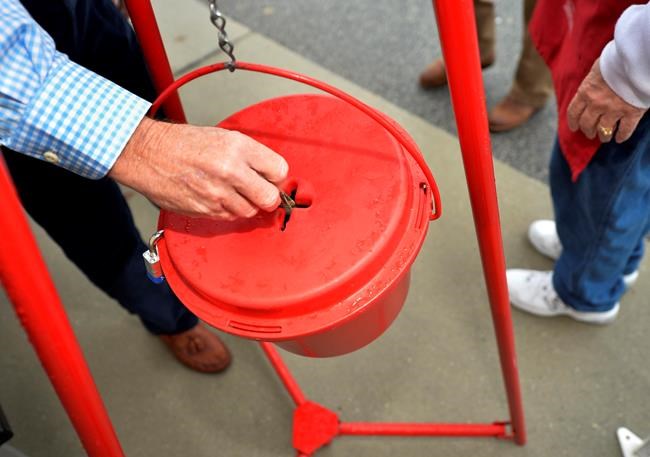
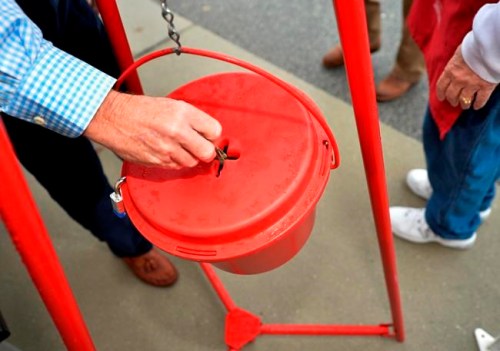
In this Nov. 9, 2018, file photo money gets dropped into the kettle during the Annual Salvation Army Red Kettle and Angel Tree Kick Off outside the Hobby Lobby store in Augusta, Ga. Canada's Salvation Army is testing out a new and faster way to allow cashless donations to its kettle stations via debit and credit card, making the process as quick and easy as dropping a toonie in the bubble. THE CANADIAN PRESS/AP-Michael Holahan/The Augusta Chronicle via AP, File

Those wanting to donate more can tap a disc up to 10 times.

The charitable organization has been offering debit and credit tap donation options during its annual Christmas Kettle Campaign for a couple of years across Canada now, but only through machines that require operator intervention.

Spokesman Maj. Rob Kerr says the new tap-and-go option will streamline the process and be as simple as walking up to the kettle, tapping, waiting for a beep confirming the transaction and leaving.

“We know of the folks who drop money in the kettle, one of the things that’s made it so appealing is that they can drop their cash in the bubble and just keep going,” Kerr said in a phone interview.

“It doesn’t slow them down from their busy day, and we just want to find technology that allows it to work that way, too.”

The new 30-by-30-centimetre tap-and-go machine is a red rectangle card mounted on the side of kettle stands.

It interfaces with Moneris Solutions Corp., a payments card processor.

Unlike the point-of-sale machines currently in use at kettle stations across Canada, the new tap-and-go option doesn’t require training or any action by those operating the stations.

The Salvation Army Christmas Kettle Campaign is already under way across Canada.

Kerr said the new pilot project will only be in certain locations in the GTA this year, but if successful, will expand to more locations next year.

Other cities in Canada can still donate at kettle stations via debit and credit on the regular point-of-sale machines this year.

And, of course, donors can still drop coins and bills into the kettle bubbles — a method Kerr said isn’t waning, despite our so-called cashless society.

“There’s some kind of a rewarding experience in dropping that cash in the bubble and seeing that happen,” Kerr said.

“So I’m not thinking we’re going to see a huge decline. We’re really hoping more and more that this is just going to enhance and augment those who are already giving cash.”

Kerr said Canada’s Salvation Army raised almost $23 million last year through the kettle campaign across the country.

He estimated that was up slightly over the year before. The Salvation Army has seen an increase in donations through the kettle campaign for the last couple of years now, he added.

This year’s donation goal for Canada is $23 million. Donations can also be made online.

“It’s amazing what people are giving to the Salvation Army still in cashless society,” Kerr said.

“They seem to have the loonies, toonies, fives and tens to drop in the bubble when they go by. And it continues to be a strong fundraiser for us.”

This report by The Canadian Press was first published Nov. 15, 2019.

Report Error Submit a Tip

More Stories

What do we elect a school trustee to do?

Laura Reimer 5 minute read 2:00 AM CDT

On Oct. 28, Manitobans will once again elect the people who serve on our local school boards. School trustee races rarely attract the attention given to other elections. Yet school boards are among our most immediate forms of representative democracy.

Before asking who should be a school trustee, perhaps we should ask a more basic question:

What, exactly, are we electing a school trustee to do?

Trustees are elected to govern a school division. They are not elected to run it.

Salvation Army testing tap-and-go donations

Victoria Ahearn, The Canadian Press 4 minute read Preview

Salvation Army testing tap-and-go donations

Victoria Ahearn, The Canadian Press 4 minute read Friday, Nov. 15, 2019

TORONTO - Canada's Salvation Army is testing out a new and faster way to allow cashless donations to its kettle stations via debit and credit card, making the process as quick and easy as dropping a toonie in the bubble.

A pilot project starting Dec. 1 will allow donations at some kettle stations in the Greater Toronto Area to be made through a new tap-and-go machine that eliminates having to swipe a card or enter a cash amount or PIN.

The machine will be mounted on the side of kettle stands and have three discs to tap — one for a $5 donation, another for $10 and another for $20.

Those wanting to donate more can tap a disc up to 10 times.

Read
Friday, Nov. 15, 2019

Artist’s inspired work brings Red River Métis story back to Portage and Main

Conrad Sweatman 8 minute read Preview

Artist’s inspired work brings Red River Métis story back to Portage and Main

Conrad Sweatman 8 minute read Updated: Yesterday at 2:47 PM CDT

Jennine Krauchi calls them the “grandmothers.” “They speak to you very silently. You never hear a word, but they speak,” Krauchi says, referring to the antique pieces of Métis needlework she’s carefully studied for years. But there are few precedents for her latest art project: a 85-foot-wide by 32-foot-high chain curtain of Métis needlework that drapes over the historic Bank of Montreal’s neoclassical facade.

Read
Updated: Yesterday at 2:47 PM CDT

Multiple factors add up to difficult harvest

Laura Rance-Unger 4 minute read Preview

Multiple factors add up to difficult harvest

Laura Rance-Unger 4 minute read 2:00 AM CDT

Earlier this month, farmers sent agriculture publications some heartbreaking photos showing how heavy rains across the Prairies had pummelled a promising harvest.

An idled combine up to its axles in a flooded Saskatchewan field, straw bales surrounded by water and field equipment stranded on the far side of a washed-out section told the obvious story.

The Sept. 6-7 event was just the latest in a series of heavy rainfall events that have plagued this year’s growing season. Similar deluges hit different regions July 15-17, Aug. 14, and Aug. 31 — some of which were accompanied by tornadoes.

“What’s made this season challenging is the intensity of these rainfalls,” said Manitoba Agriculture ag meteorology specialist Alison Sass as she reviewed the summer’s weather patterns on an extension webinar.

Read
2:00 AM CDT

Sunday-night auto aficionados work to steer away from unwelcome elements they say aren’t a part of their tradition

Zoe Pierce 12 minute read Preview

Sunday-night auto aficionados work to steer away from unwelcome elements they say aren’t a part of their tradition

Zoe Pierce 12 minute read Yesterday at 1:37 PM CDT

The red 1969 Dodge Coronet Super Bee out for a cruise on Portage Avenue draws admiring eyes from onlookers on a recent Sunday night, many of them seeing a specimen of the now-rare muscle car for the first time on a Winnipeg street. Or any other street, for that matter.

Longtime car enthusiast Bob Sudoma was behind the wheel, participating in the decades-old show-offy summer tradition.

The Sunday night cruise is built around a simple idea: proud car owners take their beloved vehicles for a spin to meet up with others of the same autophile ilk.

Less-fortunate appreciators, or just curious folks, also gather along the route to watch the highly-polished parade. Portage Avenue is one of cruise night’s best-known stretches.

Read
Yesterday at 1:37 PM CDT

Retired sportscaster Scott Oake determined as fundraising for women's addictions treatment facility enters home stretch

Melissa Martin 4 minute read Preview

Retired sportscaster Scott Oake determined as fundraising for women's addictions treatment facility enters home stretch

Melissa Martin 4 minute read Thursday, Sep. 10, 2026

For now, the patch of land just east of the Victoria Hospital doesn’t look like much: just a field of rocks, mounded dirt, and concrete piles driven into the earth. Yet when Scott Oake looks over the site, he can already imagine how it will look in just over a year’s time, when the new Anne Oake Family Recovery Centre is expected to open.

It’s easier to picture this time around. In 2020, when the recently-retired CBC sportscaster and his late wife, Anne, were building their first labour of intermingled grief and love, the Bruce Oake Recovery Centre for men, it was hard for him to wrap his mind around how a raw construction site could transform into a welcoming addictions treatment facility.

When that centre opened in 2021, Oake found it looked “almost identical” to the architect’s renderings. So it’s easy to hope the Anne Oake Centre will be the same. It will be the first facility of its kind, its founders believe, not only in Canada but in North America: a place where 50 to 70 women can pursue sobriety while staying with their children.

“At Bruce Oake there’s a culture of love, and most of all a culture of hope,” Oake said, speaking at the site Thursday after a media conference to announce the final push of the centre’s fundraising campaign. “I can feel it every time I walk into that building. And I know it will be the same here.”

Read
Thursday, Sep. 10, 2026