How Canadian researchers are using data to track the spread of the coronavirus

Advertisement

Advertise with us

TORONTO - Canadian researchers are making advances in tracking the trajectory of viral illnesses, like the emergent coronavirus, as they try to stay ahead of any potential threat to Canada.

Read this article for free:


or

Already have an account? Log in here »

To continue reading, please subscribe:

Subscribe and receive a limited-edition Free Press branded hat or tote.

Digital Subscription

One year of digital access for only $205*

  • Enjoy unlimited reading on winnipegfreepress.com
  • Read the E-Edition, our digital replica newspaper
  • Access News Break, our award-winning app
  • Play interactive puzzles

*First annual payment billed as $205.00 + GST for one year. This annual subscription will automatically renew at $233.00 + GST every 52 weeks (10% off the regular annual price of $259.35). Offer available to new and qualified returning subscribers only. Cancel any time.

To continue reading, please subscribe:

Add Free Press access to your Brandon Sun subscription for only an additional

$1 for the first 4 weeks*

  • Enjoy unlimited reading on winnipegfreepress.com
  • Read the E-Edition, our digital replica newspaper
  • Access News Break, our award-winning app
  • Play interactive puzzles
Start now

*Your next Brandon Sun subscription payment will increase by $1.00 and you will be charged $17.95 plus GST for four weeks. After four weeks, your payment will increase to $24.95 plus GST every four weeks.

Hey there, time traveller!
This article was published 23/01/2020 (2444 days ago), so information in it may no longer be current.

TORONTO – Canadian researchers are making advances in tracking the trajectory of viral illnesses, like the emergent coronavirus, as they try to stay ahead of any potential threat to Canada.

From global flight patterns to learning the names of individual patients, scientists say they have more ways to monitor infectious diseases than ever.

These insights are drawn from new data-driven technologies, improved communication across public-health agencies and increased transparency in reporting infections.
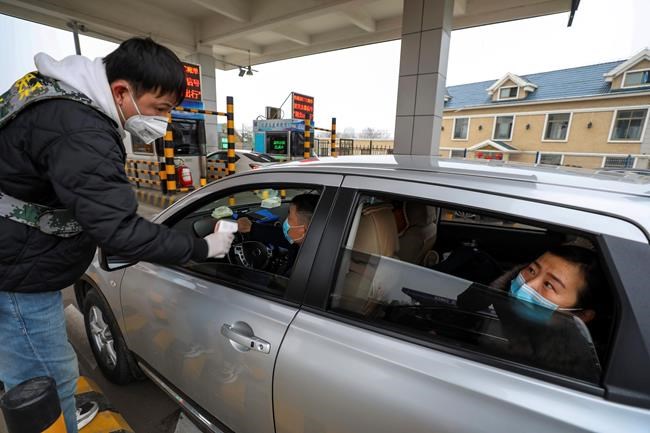
A militia member uses an thermometer gun to take a driver's temperature at a checkpoint at a highway toll gate in Wuhan in central China's Hubei Province, Thursday, Jan. 23, 2020. China closed off a city of more than 11 million people Thursday in an unprecedented effort to try to contain a deadly new viral illness that has sickened hundreds and spread to other cities and countries amid the Lunar New Year travel rush. (Chinatopix via AP)

But as our interconnected world has made it easier to share information, it has also multiplied the opportunities for viruses to spread, said Kamran Khan, a Toronto doctor who specializes in infectious disease.

“On one hand, the world is rapidly changing, where diseases are emerging and spreading faster,” said Khan, a scientist at St. Michael’s Hospital.

“On the other hand, we happen to have growing access to data we can use … to generate insights and spread them faster than the diseases spread themselves.”

The newly identified coronavirus has so far sickened close to 600 people in China and killed at least 17. Other cases have been reported in the United States, Japan, South Korea, Thailand, Singapore, Vietnam and Hong Kong.

Federal Health Minister Patty Hajdu said Thursday that several people in Canada are under observation for signs they may have contracted the pneumonia-like illness, but that the risk to Canadians remains low.

Meanwhile, the World Health Organization determined Thursday that it was “too early” to declare the outbreak a global health emergency, but cautioned that “it may yet become one.”

Khan, the founder and CEO of BlueDot, said his medical analytics company has been monitoring the virus since first detecting signs of an outbreak on Dec. 31 in the central Chinese city of Wuhan, where most of the early cases are concentrated.

Since the rise of commercial air travel, Khan said humans have become the key vectors, or virus carriers, driving the dispersion of diseases around the world.

BlueDot’s AI-powered system analyzes billions of data points, including airline ticket sales and online news reports, to map how viruses spread through the global transportation network and predict regions that are at the highest risk of an outbreak.

Khan said about 80 per cent of travellers from Wuhan to Canada are headed for Toronto and Vancouver, but he noted that there are no non-stop flights from the Chinese city, which means the volume of travel is relatively low.

BlueDot shares such insights with its clients across the private and public sector to keep them posted on the latest developments as an epidemic evolves, so they can co-ordinate their response, said Khan.

However, he admits that every prediction comes with some degree of uncertainty. For example, researchers are still piecing together the scale of the coronavirus outbreak, and how efficiently the virus is transmitted from person to person.

Meanwhile, laboratory networks across the country are working to make sure tests are available wherever cases may crop up, said Yoav Keynan, the scientific lead at the National Collaborating Centre for Infectious Diseases.

The coronavirus comes from same family that caused the 2003 outbreak of severe acute respiratory syndrome, or SARS, which killed at least 774 people worldwide, including 44 people in Canada.

Since then, Canada has taken steps to improve communication between provincial, federal and global public-health agencies, Keynan said.

“I think there’s a greater degree of knowledge-sharing across jurisdictions that allows us to track epidemics,” said Keynan, an associate professor in University of Manitoba’s medical microbiology department.

“Canadians should be encouraged by how much better the public-health infrastructure is compared to what it was 17 years ago.”

David Fisman, an epidemiologist at the University of Toronto’s Dalla Lana School of Public Health, who was part of Ontario’s response to the SARS outbreak, said the new coronavirus could serve as a “stress test” for the protocols that have been implemented since.

For example, the virus appears to be highly transmissible in health-care settings, but not outside of them.

That means overcrowded hospitals and emergency rooms could potentially become petri dishes for the infectious disease.

“We’ve seen this movie before,” said Fisman.

“Our infection-control game is better than it was. But we still have this problem with the physical plant of our hospitals, with our emergency rooms, where people are stuck together cheek-by-jowl, and that creates vulnerability.”

Report Error Submit a Tip

More Stories

Manitoba PCs choose Narth as interim leader; ‘deeply hurt’ Khan blasts former caucus colleagues

Carol Sanders 7 minute read Preview

Manitoba PCs choose Narth as interim leader; ‘deeply hurt’ Khan blasts former caucus colleagues

Carol Sanders 7 minute read Tuesday, Sep. 29, 2026

Manitoba’s Progressive Conservative caucus chose MLA Konrad Narth as interim party leader Tuesday to replace Obby Khan, who quit a day earlier after he said he was stabbed in the back by a small group of caucus members plotting in secret to oust him.

Read
Tuesday, Sep. 29, 2026

Port of Churchill signs agreement with Dutch port

Aaron Epp 2 minute read Preview

Port of Churchill signs agreement with Dutch port

Aaron Epp 2 minute read Tuesday, Sep. 29, 2026

Arctic Gateway Group, operator of the Port of Churchill, has signed an agreement with the Port of Rotterdam in the Netherlands to attract business and strengthen supply chains linking Western Canada and Europe.

The agreement enables the two ports to work together to develop new trade in critical minerals and energy products, connect Canadian producers with European buyers, and identify opportunities to improve the supply chain from Western Canadian resource projects through Churchill and into European markets.

The Port of Rotterdam is Europe’s largest port and home to more than 3,000 businesses across its industrial complex, serving as a major gateway for critical raw materials and energy.

Meanwhile, the Port of Churchill has been identified as a transformative national strategy for Canada and is emerging as a northern trade corridor connecting Western Canada’s resources to global markets.

Read
Tuesday, Sep. 29, 2026

J’accuse!: Kinew uses French to fry interim Tory leader over alleged caucus subterfuge

Chris Kitching and Maggie Macintosh 4 minute read Preview

J’accuse!: Kinew uses French to fry interim Tory leader over alleged caucus subterfuge

Chris Kitching and Maggie Macintosh 4 minute read 5:55 PM CDT

NDP Premier Wab Kinew took a dig at the Progressive Conservatives’ leadership change while facing off with Obby Khan’s short-term replacement for the first time in question period Thursday.

It came after interim Tory leader Konrad Narth accused the New Democrats of failing to implement “stronger” bail reform and enforcement measures as promised.

“Now we see there is less crime in Manitoba than there was when the Progressive Conservatives were in government. What are they doing now? Well, they found knives and chased their old leader out,” Kinew said, speaking in French.

“We don’t even know who’s going to be the PC leader next month… next year? We don’t know. What we know is that we’re working on making communities safer.”

Read
5:55 PM CDT

Storylines aplenty as Jets’ regular season set to begin

Ken Wiebe and Mike McIntyre 9 minute read Preview

Storylines aplenty as Jets’ regular season set to begin

Ken Wiebe and Mike McIntyre 9 minute read 6:25 PM CDT

If the Winnipeg Jets get their way over the course of the coming months, this 84-game redemption tour will extend beyond the regular season.

For the time being, the focus of this group is to leave the disappointment of a 26th-place finish in the rearview mirror and to get back to playing the style that allowed them to be in the Stanley Cup playoffs three consecutive springs before falling eight points short last April.

“We’re just ready for a fresh start where we’re looking ahead, and we’re excited to get the season underway,” captain Adam Lowry said Thursday. “Obviously, a short training camp but I feel like we got up to speed.”

The Boston Bruins will be Friday’s opponent (7 p.m.) in this 16th season opener for the Jets since the franchise relocated back in 2011, and the storylines surrounding the club are plentiful.

Read
6:25 PM CDT

How researchers are tracking the coronavirus

The Canadian Press 5 minute read Preview

How researchers are tracking the coronavirus

The Canadian Press 5 minute read Thursday, Jan. 23, 2020

TORONTO - Canadian researchers are making advances in tracking the trajectory of viral illnesses, like the emergent coronavirus, as they try to stay ahead of any potential threat to Canada.

From global flight patterns to learning the names of individual patients, scientists say they have more ways to monitor infectious diseases than ever.

These insights are drawn from new data-driven technologies, improved communication across public-health agencies and increased transparency in reporting infections.

But as our interconnected world has made it easier to share information, it has also multiplied the opportunities for viruses to spread, said Kamran Khan, a Toronto doctor who specializes in infectious disease.

Read
Thursday, Jan. 23, 2020

Netminder no stranger to heavy workload as Jets new No. 1 readies for regular-season start

Ken Wiebe 7 minute read Preview

Netminder no stranger to heavy workload as Jets new No. 1 readies for regular-season start

Ken Wiebe 7 minute read Yesterday at 2:42 PM CDT

Stuart Skinner is quick to admit that he wasn’t always wired this way.

As the Winnipeg Jets new starting goalie prepares for his fifth NHL season, Skinner conceded that the accountability aspect that is now synonymous with his character took some time to build up.

“As I grew up and got older, you go through certain things in life that either build character or make things worse for you. It depends on your choice and your decision,” Skinner said during a recent conversation with the Free Press. “I learned it through trial and error. I learned that, sometimes, it’s hard to get honest with yourself… For me, it’s definitely been a road for me to get to a place like this.

“It definitely is one of my pillars. Accountability is so important because that brings you into a spot of what you’re going to do next. It’s easy to let yourself off the hook. I’m more in the business of putting myself on the hook.”

Read
Yesterday at 2:42 PM CDT