COVID-19 deaths in Canada may be two times higher than reported: Study

Advertisement

Advertise with us

OTTAWA - A new study suggests Canada has vastly underestimated how many people have died from COVID-19 and says the number could be two times higher than reported.

Read this article for free:

or

Already have an account? Log in here »

To continue reading, please subscribe:

Subscribe and receive a limited-edition Free Press branded hat or tote.

Digital Subscription

One year of digital access for only $205*

  • Enjoy unlimited reading on winnipegfreepress.com
  • Read the E-Edition, our digital replica newspaper
  • Access News Break, our award-winning app
  • Play interactive puzzles

*First annual payment billed as $205.00 + GST for one year. This annual subscription will automatically renew at $233.00 + GST every 52 weeks (10% off the regular annual price of $259.35). Offer available to new and qualified returning subscribers only. Cancel any time.

To continue reading, please subscribe:

Add Free Press access to your Brandon Sun subscription for only an additional

$1 for the first 4 weeks*

  • Enjoy unlimited reading on winnipegfreepress.com
  • Read the E-Edition, our digital replica newspaper
  • Access News Break, our award-winning app
  • Play interactive puzzles
Start now

*Your next Brandon Sun subscription payment will increase by $1.00 and you will be charged $17.95 plus GST for four weeks. After four weeks, your payment will increase to $24.95 plus GST every four weeks.

Hey there, time traveller!
This article was published 29/06/2021 (1861 days ago), so information in it may no longer be current.

OTTAWA – A new study suggests Canada has vastly underestimated how many people have died from COVID-19 and says the number could be two times higher than reported.

Dr. Tara Moriarty, working group lead for the study commissioned by the Royal Society of Canada, said in an interview while most accounts have put the majority of deaths in long-term care, the new data analysis suggests the toll of COVID-19 was also heavily felt outside the homes in the community.

Many of those deaths likely occurred in lower income, racialized communities and affected essential workers, new immigrants and people living in multigenerational homes, as well as clinically frail seniors living at home, the study says.
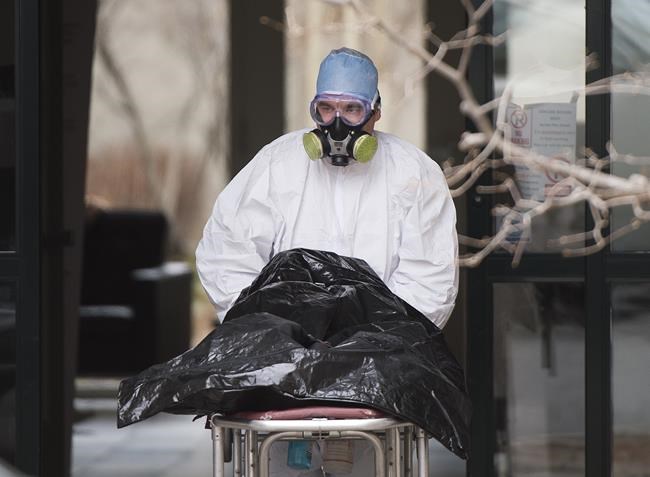
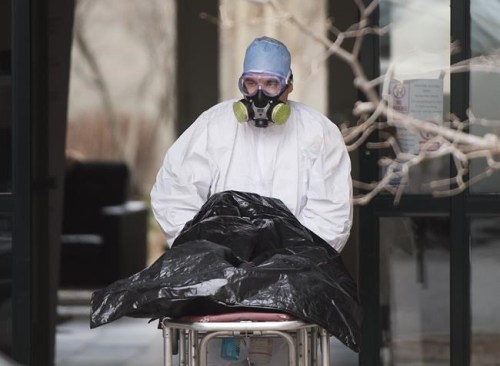
A body is removed from Residence Herron, a long-term care home in Dorval, Que., Saturday, April 11, 2020. A new study suggests Canada has vastly underestimated how many people have died from COVID-19 and says the number could be two times higher than reported. THE CANADIAN PRESS/Graham Hughes

“If we’d had some sense early on of who was dying where, if we had had a sense of just how many deaths were actually occurring … maybe people would have started looking sooner or listening sooner to people in communities who were saying, ‘It’s really really bad here, people are dying,'” Moriarty said.

“It might have provided support for those claims that might have caused some kind of action that would have saved lives.”

Moriarty said seeing Canada out of step with similar high-income countries on the proportion of long-term care deaths was a red flag that inspired the analysis by the society.

The new peer-reviewed analysis casts doubt on the widely accepted assumption that 80 per cent of Canada’s deaths due to COVID-19 occurred among older adult residents of long-term care homes.

Instead, it says at least two-thirds of deaths caused by COVID-19 in communities outside of long-term care may have been missed. That would put the proportion of deaths in long-term care at around 45 per cent, much closer to the average of 40 per cent reported by peer countries in the Organization for Economic Co-operation and Development.

The conclusion is based on a review of reports of excess deaths across Canada, the pattern of COVID-19 fatalities during the pandemic and cremation data showing a significant spike in deaths at homes versus hospitals in 2020. It also relies on antibody surveillance testing that collectively unmasked the likely broad scope of undetected COVID-19 infections.

The researchers adjusted the data to account for things like increased deaths due to the drug toxicity crisis and the expected drop in deaths linked to the pandemic because of things like reduced traffic accident rates.

The extent of “likely missed” fatalities varies by province and there are major data gaps in what was available, Moriarty said.

The knowledge gap is particularly acute in British Columbia, Saskatchewan, and Manitoba where cause-of-death data is only complete into February 2020, the report says. It was less of a problem in Quebec, where the virus accounted for all excess deaths, and Ontario.

Between Feb. 1 and Nov. 28, 2020, the study found COVID-19 deaths of about 6,000 people aged 45 and older appeared to have gone undetected, unreported or unattributed to the virus.

“This suggests that if Canada has continued to miss these fatalities at the same rate since last November, the pandemic mortality burden may be two times higher than reported,” the report says.

Eemaan Kaur Thind, a public health practitioner who looked at both detected and undetected COVID-19 deaths in racialized communities, said the results weren’t a shock given previous reports linking the communities and deaths or hospitalization rates.

The study suggests it’s likely many cases in those communities were never identified, and the resulting deaths were never counted.

“We know that a high-proportion of essential workers happen to be visible minorities,” she said.

“None of that surprised me, although it never really becomes any less hard to see the official numbers when you see something like this.”

Thind said she hopes the findings push policy-makers to listen to those most affected, many of whom raised alarms about things like the role language barriers played in access to COVID-19 testing and care.

“Data is very important but I think it’s more important to also listen to people and believe them.”

About 25 per cent of likely deaths occurred in people between 45 and 64, the study said.

The researchers make several recommendations, including mandating weekly preliminary reporting of deaths due to all causes to Statistics Canada, performing COVID-19 testing on all people who die in any setting, and immediately adopting methods used by the U.S. Centers for Disease Control for estimating excess mortality during the pandemic.

The group also calls for the creation of a national COVID-19 mortality task force with the provinces and territories, and independent advisers to investigate why so many Canadian COVID-19 cases and deaths have been missed or unreported, including examining demographic and employment data for those who died.

— By Amy Smart in Vancouver

This report by The Canadian Press was first published June 29, 2021.

Report Error Submit a Tip

More Stories

240 WestJet flight attendants picket in Winnipeg

Malak Abas 6 minute read Preview

240 WestJet flight attendants picket in Winnipeg

Malak Abas 6 minute read Updated: Yesterday at 3:21 PM CDT

Winnipeg’s WestJet flight attendants took to the picket line outside of Richardson International Airport on the first day of nationwide strikes Sunday, while inside, frustrated flyers scrambled to re-route cancelled long-weekend flights.

The Canadian Union of Public Employees’ Ontario arm and the airline announced the strike would commence after the strike deadline was passed without a deal early Sunday morning. WestJet attendants have been without a contract since Dec. 31, 2025.

Hours later, the 240 WestJet flight attendants based in Winnipeg had walked off the job and were marching outside of the airport terminal, some carrying signs with slogans including “Tired with WestJet? So are We!” and “Unpaid Work Won’t Fly.”

Key issues causing the stalemate are wages and pay for work on the ground: the union says flight attendants are not being paid for some of that work, while the company says they pay for the work through a “credit hour” system rather than an hourly rate.

Read
Updated: Yesterday at 3:21 PM CDT

Sea Bears’ Allen victim of downtown assault

1 minute read Updated: 12:41 PM CDT

Winnipeg Sea Bears' guard Teddy Allen is in hospital after being assaulted in downtown Winnipeg Sunday night.

The club issued a news release Monday stating head coach and general manager Mike Raimbault and chairman David Asper visited Allen at the hospital but didn't release more information about what happened.

"Our focus is on Teddy's health and supporting him and his family," the Sea Bears' news release stated, directing all questions to the Winnipeg Police Service.

Winnipeg Police Service spokesperson Const. Pat Saydak confirmed the police service is investigating but said no further information was available Monday afternoon.

Long journey to home ownership for Eritrean couple

Zoe Pierce 4 minute read Preview

Long journey to home ownership for Eritrean couple

Zoe Pierce 4 minute read Saturday, Aug. 1, 2026

Solomon Ghebru and his family have been building a life together in Winnipeg for the past three years after years of living apart in various countries. Now, they are working toward a new goal: owning a home.

Their story is the focus of this year’s Habitat for Humanity Manitoba Cycle of Hope fundraising ride, a seven-day cycling event through southern Manitoba that begins Monday. The ride aims to raise $150,000 to support Ghebru, his wife, Mehret Awate, and their two daughters as they work toward affordable homeownership.

The couple’s journey to Canada started in Eritrea, where they grew up and attended the same church together. They left Eritrea separately, hoping to build a better life together out of the country. Ghebru travelled through Sudan and Libya before reaching Malta, while Awate travelled to Sudan and then Uganda.

After he found work in Malta, he tried to have his family join him, but government policies prevented them from reuniting. The couple married in Uganda in 2016, and their first daughter, Peniel, was born there the following year.

Read
Saturday, Aug. 1, 2026

‘Good deal of synergy’ brewing in South Osborne

Gabrielle Piché 5 minute read Preview

‘Good deal of synergy’ brewing in South Osborne

Gabrielle Piché 5 minute read Friday, Jul. 31, 2026

Pub crawls could become the next South Osborne draw.

At least, that’s the hope of entrepreneurs in the area as three breweries build out locations in the Winnipeg neighbourhood.

Nonsuch Brewing Co. and Good Neighbour Brewing Co. have opened storefronts along the strip in the past three months. Dastardly Villain is creating a taproom and nanobrewery.

“I’m really excited to have these pubs and taprooms,” said Ben Shantz, board chair of the South Osborne Business Improvement Zone.

Read
Friday, Jul. 31, 2026

Kevin Gausman traded by Toronto Blue Jays to Chicago Cubs

The Canadian Press 3 minute read Preview

Kevin Gausman traded by Toronto Blue Jays to Chicago Cubs

The Canadian Press 3 minute read Updated: Yesterday at 11:01 PM CDT

TORONTO - Kevin Gausman's time with the Toronto Blue Jays has come to an end.

The veteran right-hander was traded by the Blue Jays to the Chicago Cubs on Sunday in return for outfielder Brett Bateman and infielder Ty Southisene.

Bateman, a 24-year-old outfielder, hit .312 with three homers, 20 steals and 33 RBIs in 82 games for triple-A Iowa this season. Southisene, a 21-year-old shortstop, hit .326 in 44 games for High-A South Bend.

Gausman signed a five-year, US$110-million deal with the Blue Jays on Dec. 21, 2021 and has been one of Toronto's most reliable starters for five seasons.

Read
Updated: Yesterday at 11:01 PM CDT

COVID-19 deaths may be twice that reported: Study

The Canadian Press 5 minute read Preview

COVID-19 deaths may be twice that reported: Study

The Canadian Press 5 minute read Tuesday, Jun. 29, 2021

OTTAWA - A new study suggests Canada has vastly underestimated how many people have died from COVID-19 and says the number could be two times higher than reported.

Dr. Tara Moriarty, working group lead for the study commissioned by the Royal Society of Canada, said in an interview while most accounts have put the majority of deaths in long-term care, the new data analysis suggests the toll of COVID-19 was also heavily felt outside the homes in the community.

Many of those deaths likely occurred in lower income, racialized communities and affected essential workers, new immigrants and people living in multigenerational homes, as well as clinically frail seniors living at home, the study says.

"If we'd had some sense early on of who was dying where, if we had had a sense of just how many deaths were actually occurring ... maybe people would have started looking sooner or listening sooner to people in communities who were saying, 'It's really really bad here, people are dying,'" Moriarty said.

Read
Tuesday, Jun. 29, 2021