EXPLAINER: What’s the history of the Olympics protest rule?

Advertisement

Advertise with us

TOKYO (AP) — The simple act of taking a knee felt like something more monumental when it happened on Olympic soccer pitches in Japan on the opening night of action.

Read this article for free:


or

Already have an account? Log in here »

To continue reading, please subscribe:

Subscribe and receive a limited-edition Free Press branded hat or tote.

Digital Subscription

One year of digital access for only $205*

  • Enjoy unlimited reading on winnipegfreepress.com
  • Read the E-Edition, our digital replica newspaper
  • Access News Break, our award-winning app
  • Play interactive puzzles

*First annual payment billed as $205.00 + GST for one year. This annual subscription will automatically renew at $233.00 + GST every 52 weeks (10% off the regular annual price of $259.35). Offer available to new and qualified returning subscribers only. Cancel any time.

To continue reading, please subscribe:

Add Free Press access to your Brandon Sun subscription for only an additional

$1 for the first 4 weeks*

  • Enjoy unlimited reading on winnipegfreepress.com
  • Read the E-Edition, our digital replica newspaper
  • Access News Break, our award-winning app
  • Play interactive puzzles
Start now

*Your next Brandon Sun subscription payment will increase by $1.00 and you will be charged $17.95 plus GST for four weeks. After four weeks, your payment will increase to $24.95 plus GST every four weeks.

Hey there, time traveller!
This article was published 22/07/2021 (1851 days ago), so information in it may no longer be current.

TOKYO (AP) — The simple act of taking a knee felt like something more monumental when it happened on Olympic soccer pitches in Japan on the opening night of action.

Players from the United States, Sweden, Chile, Britain and New Zealand women’s teams went to a knee before their games Wednesday night, anti-racism gestures the likes of which had not been seen before on the Olympic stage. They figured to be the first of many of these sort of demonstrations over the three-week stay in Tokyo.

The Olympic rule banning such demonstrations at the Games has been hotly debated and contested for decades, and those issues reached a flashpoint over the past two years. What resulted were changes in the rules, and the willingness of some sports organizations to enforce them.

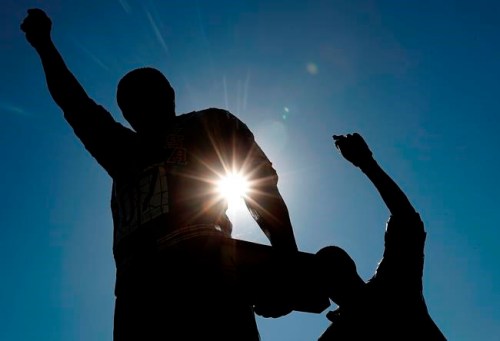
FILE - In this Oct. 17, 2018, file photo, a statue in honor of former Olympians Tommie Smith, left, and John Carlos is seen on the campus of San Jose State University in San Jose, Calif. Smith and Carlos raised their black-gloved fists while their national anthem played during the 200-meters medals ceremony at the Mexico City Olympics in 1968. Rule 50 of the IOC charter states: “No kind of demonstration or political, religious or racial propaganda is permitted in any Olympic sites, venues or other areas.” (AP Photo/Tony Avelar, File)

How have protests and demonstrations at the Games evolved over the years? Here’s a brief rundown.

WHAT: The Olympics have always billed themselves as a nonpolitical entity designed to bring countries together to celebrate sports and international unity. One of the best-recognized symbols of that nonpolitical ideal is a prohibition of “propaganda” at the Games. Rule 50 of the IOC charter states: “No kind of demonstration or political, religious or racial propaganda is permitted in any Olympic sites, venues or other areas.”

WHO: The ideals of the rule were most notably put to the test before it was officially enshrined in the Olympic charter. American sprinters Tommie Smith and John Carlos raised their black-gloved fists while their national anthem played during the 200-meters medals ceremony at the Mexico City Olympics in 1968. They would not only eventually be sent home for disregarding the ban on demonstrations, but ended up being ostracized from the Olympic movement for nearly a half century. Not until 2016 did the U.S. Olympic Committee bring them to an official event. Not until 2019 did it enshrine them in its hall of fame.

WHEN: The basic structure of Rule 50 was written into the Olympic charter in 1975. At that time, it was actually part of Rule 55 and it stated: “Every kind of demonstration or propaganda, whether political, religious or racial, in the Olympic areas is forbidden.” It would be refined and rewritten over the years. Only a few months ago, in the face of mounting pressure to do away with the rule, the IOC made its latest tweak, saying it would allow some demonstrations but only “prior to the start of competitions” and not on the medals podium. The IOC has also given discretion to the international agencies that run the individual sports on how — and whether — to enforce the bans.

WHERE: The rule became a sticking point two summers ago, a half a world away from Tokyo, in Lima, Peru. It was on the medals stands at the Pan-American Games that U.S. hammer thrower Gwen Berry raised her fist and U.S. fencer Race Imboden took a knee. They both received letters from the U.S. Olympic and Paralympic Committee that put them on a yearlong probation and, with the Tokyo Games scheduled for the following year, sent a message to other American athletes who were thinking of doing anything similar. The coronavirus pandemic pushed the Games back by 12 months, and the killing of George Floyd in the United States — and the activism that followed — prompted a thorough rethinking of the rule. The USOPC decided it would no longer sanction athletes who violated Rule 50, thus placing pressure on the IOC, which often depends on the national committees to enforce its rules at the Games.

WHY: While the USOPC was undergoing its review, the IOC also tasked its athletes commission to rethink the rule. The commission sent out a worldwide survey that found broad support for the rule as it was written. Following that lead, the IOC chose to keep the rule largely intact. It set up the possibility for tension throughout the Games in Tokyo, where, in addition to the soccer teams, Berry and U.S. sprinter Noah Lyles had telegraphed themselves as among the athletes to watch. Lyles wore a black glove and raised his fist at the starting line at Olympic trials, while Berry turned away from the flag during a playing of the national anthem.
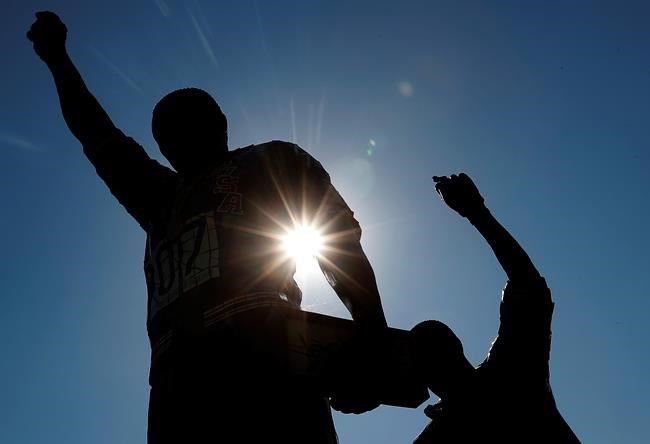
FILE - In this Oct. 17, 2018, file photo, a statue in honor of former Olympians Tommie Smith, left, and John Carlos is seen on the campus of San Jose State University in San Jose, Calif. Smith and Carlos raised their black-gloved fists while their national anthem played during the 200-meters medals ceremony at the Mexico City Olympics in 1968. Rule 50 of the IOC charter states: “No kind of demonstration or political, religious or racial propaganda is permitted in any Olympic sites, venues or other areas.” (AP Photo/Tony Avelar, File)

___

More AP Olympics: https://apnews.com/hub/2020-tokyo-olympics and https://twitter.com/AP_Sports

Report Error Submit a Tip

More Stories

Corroded Arlington overpass yields way for new hope of spanning urban chasm

Melissa Martin 6 minute read Preview

Corroded Arlington overpass yields way for new hope of spanning urban chasm

Melissa Martin 6 minute read Yesterday at 2:00 AM CDT

It’s an interesting quirk of timing, perhaps, that the end of two of Winnipeg’s most unlovely features are coming into view in the same few weeks. The rail lines that split the city in half, and the bridge that was built to tie it back together. The original problem, and the solution.

And in the confluence of those two ends, we have an opportunity to dream of what a better Winnipeg can be.

At a news conference on Wednesday, former federal transport minister Lloyd Axworthy laid out a vision for a rail line bypass that would remove more than 120 railway crossings from Winnipeg, route them through Crown and Manitoba Hydro corridor land south of the city, and reclaim 250 acres in the urban core for greenspace and development.

The next step is to focus on how to make it happen. Nothing of this scope comes easy. This new bypass plan emerged from a two-year feasibility study that Premier Wab Kinew had tasked Axworthy with back in 2024. Now, Axworthy will helm a new 90-day feasibility study zooming in on that route specifically.

Read
Yesterday at 2:00 AM CDT

Development turning long-vacant gas station in Selkirk into commercial hub

By Tiago Resko 2 minute read Preview

Development turning long-vacant gas station in Selkirk into commercial hub

By Tiago Resko 2 minute read Thursday, Aug. 13, 2026

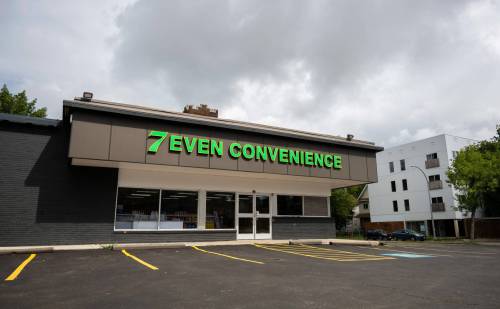
A plot of land that has sat vacant in Selkirk for 30 years is being redeveloped to host new businesses in the heart of the city.

The former gas station site on Main Street — between Rosser and Pacific avenues — will be turned into a commercial hub that will be home to six local businesses, and will be a big stepping stone for economic growth in Selkirk, Mayor Larry Johannson said Thursday.

“For decades this site has been a reminder of what once was. Today, it represents what is possible when investors see the potential of our community and choose to be a part of its future,” he said in a news release announcing the project and Thursday’s groundbreaking.

“This development reflects confidence in Selkirk, our economy and the direction we are heading.”

Read
Thursday, Aug. 13, 2026

Oliveira shines in win over Redblacks, Collaros rocked again

Taylor Allen 5 minute read Preview

Oliveira shines in win over Redblacks, Collaros rocked again

Taylor Allen 5 minute read Yesterday at 8:57 PM CDT

It wasn’t a stellar performance by any stretch.

But at this point, the Winnipeg Blue Bombers will take a win no matter what it looks like.

The Blue and Gold outlasted the winless Ottawa Redblacks 33-21 on a rainy Friday night at Princess Auto Stadium to improve to 5-4.

“It’s great to finally get a win at home for our fans and to go out and play a better game is very encouraging,” said right guard Patrick Neufeld.

Read
Yesterday at 8:57 PM CDT

Poilievre’s lips moving, but Canadians aren’t interested in what he’s saying

Tom Brodbeck 5 minute read Preview

Poilievre’s lips moving, but Canadians aren’t interested in what he’s saying

Tom Brodbeck 5 minute read Thursday, Aug. 6, 2026

Pierre Poilievre’s biggest political challenge right now isn’t Prime Minister Mark Carney’s popularity.

It’s the fact that he still seems to be campaigning against a political landscape that no longer exists.

More than a year after the 2025 federal election, the Conservative leader is still relying on the same message, the same themes and the same attacks that defined his party’s campaign before voters went to the polls.

And Canadians appear to be tuning it out.

Read
Thursday, Aug. 6, 2026

Men’s recovery home dedicated to ‘homeless hero’ Faron Hall’s memory

Scott Billeck 14 minute read Preview

Men’s recovery home dedicated to ‘homeless hero’ Faron Hall’s memory

Scott Billeck 14 minute read Friday, Aug. 14, 2026

Faron Hall never got the chance to begin recovery. Once heralded as Winnipeg’s “homeless hero” after twice plunging into the Red River to save strangers from drowning, Hall told St. Boniface Street Links executive director Marion Willis shortly before his death in 2014 that he wanted help for his alcoholism.

Read
Friday, Aug. 14, 2026

HSC weapons scanners effective, needed at other hospitals: nurses union

Carol Sanders 5 minute read Preview

HSC weapons scanners effective, needed at other hospitals: nurses union

Carol Sanders 5 minute read Yesterday at 9:57 AM CDT

The AI weapons scanners at Health Sciences Centre have detected close to 2,000 items since they were installed at Manitoba’s largest hospital.

From March 6, 2025 to the beginning of this month, a total of 1,973 items had been flagged by the scanners and identified for further review, Shared Health said this week.

Knives, Swiss army knives and other multi-tools, drugs, alcohol, box cutters, syringes and other injection devices were detected, it said. The technology set up at entrances to the adult and children’s emergency rooms and the crisis response centre is designed to identify a wide range of objects that may require review under site safety protocols.

But Manitoba Nurses Union president Darlene Jackson said the technology isn’t available everywhere at HSC, and a sawed-off rifle was discovered in the adult ER earlier this month.

Read
Yesterday at 9:57 AM CDT