Body composting a ‘green’ alternative to burial, cremation

Advertisement

Advertise with us

LAFAYETTE, Colo. (AP) — In a suburban Denver warehouse tucked between an auto repair shop and a computer recycling business, Seth Viddal is dealing with life and death.

Read this article for free:


or

Already have an account? Log in here »

To continue reading, please subscribe:

Subscribe and receive a limited-edition Free Press branded hat or tote.

Digital Subscription

One year of digital access for only $205*

  • Enjoy unlimited reading on winnipegfreepress.com
  • Read the E-Edition, our digital replica newspaper
  • Access News Break, our award-winning app
  • Play interactive puzzles

*First annual payment billed as $205.00 + GST for one year. This annual subscription will automatically renew at $233.00 + GST every 52 weeks (10% off the regular annual price of $259.35). Offer available to new and qualified returning subscribers only. Cancel any time.

To continue reading, please subscribe:

Add Free Press access to your Brandon Sun subscription for only an additional

$1 for the first 4 weeks*

  • Enjoy unlimited reading on winnipegfreepress.com
  • Read the E-Edition, our digital replica newspaper
  • Access News Break, our award-winning app
  • Play interactive puzzles
Start now

*Your next Brandon Sun subscription payment will increase by $1.00 and you will be charged $17.95 plus GST for four weeks. After four weeks, your payment will increase to $24.95 plus GST every four weeks.

Hey there, time traveller!
This article was published 16/09/2021 (1811 days ago), so information in it may no longer be current.

LAFAYETTE, Colo. (AP) — In a suburban Denver warehouse tucked between an auto repair shop and a computer recycling business, Seth Viddal is dealing with life and death.

He and one of his employees have built a “vessel” they hope will usher in a more environmentally friendly era of mortuary science that includes the natural organic reduction of human remains, also known as body composting.

“It’s a natural process where the body is returned to an elemental level over a short period of time,” said Viddal, who likened the practice to backyard composting of food scraps and yard waste. “This is the same process but done with a human body inside of a vessel, and in our case, in a controlled environment.”
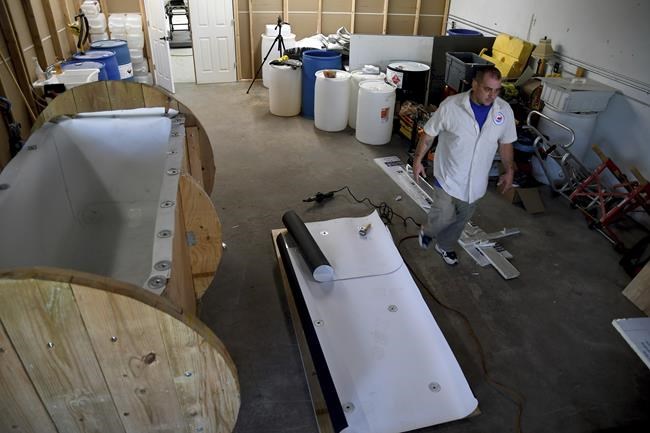
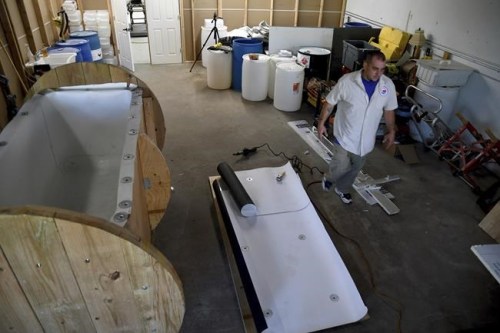
In this Wednesday, Aug. 11, 2021, photo, Chris Olachia walks past a nearly completed human body composting vessel in Arvada, Colo. On Sept. 7, Colorado became the second state after Washington to allow human body composting, and Oregon will allow the practice beginning next July. The vessel will be packed with wood chips and straw and will be able to compost a body in six months. About the size of a standard grave, the rectangular insulated wooden box is lined with waterproof roofing material and packed with wood chips and straw. Two large spool wheels on either end allow it to be rolled across the floor, providing the oxygenation, agitation and absorption required for a body to compost. (AP Photo/Thomas Peipert)

On Sept. 7, Colorado became the second state after Washington to allow human body composting. Oregon will allow the practice beginning next July. In Washington, the three businesses licensed to compost human remains have transformed at least 85 bodies since the law took effect in May 2020, and more than 900 people have signed up for the service as natural funerals become more popular.

Viddal, who co-owns The Natural Funeral in Lafayette, lobbied the Colorado Legislature for the option and started building a prototype vessel in an industrial area soon after the bipartisan bill was signed into law.

Based on a design being used in Washington, the insulated wooden box is about 7 feet long (2 meters), 3 feet wide and 3 feet deep, lined with waterproof roofing material and packed with wood chips and straw. Two large spool wheels on either end allow it to be rolled across the floor, providing the oxygenation, agitation and absorption required for a body to compost.

Viddal calls the process an “exciting ecological option,” and in death, he also sees life.

“Composting itself is a very living function and it’s performed by living organisms. … There are billions of microbial, living things in our digestive tracts and just contained in our body. And when our one life ceases, the life of those microbes does not cease,” he said.
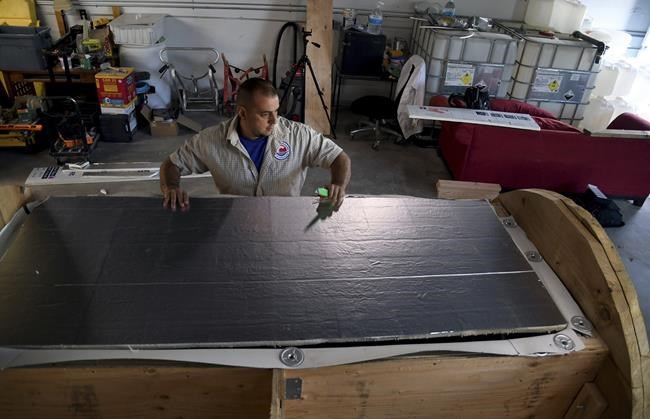
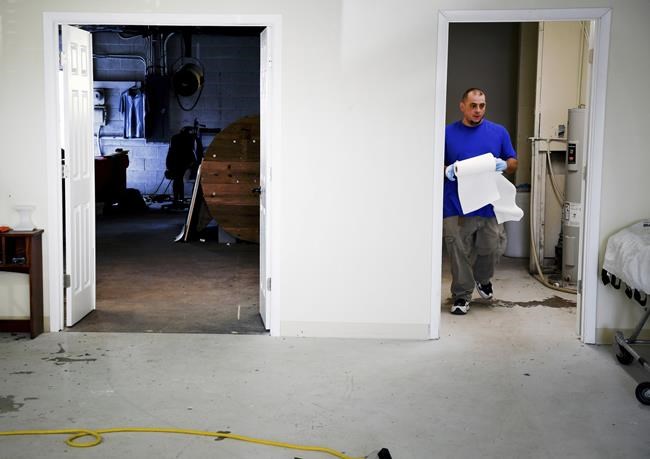
In this Wednesday, Aug. 11, 2021, photo, employee Chris Olachia works on a nearly completed human body composting vessel in Arvada, Colo. On Sept. 7, Colorado became the second state after Washington to allow human body composting, and Oregon will allow the practice beginning next July. The vessel will be packed with wood chips and straw and will be able to compost a body in six months. (AP Photo/Thomas Peipert)

After about three months, the vessel is opened and the “soil” is filtered for medical devices like prosthetics, pacemakers or joint replacements. The remaining large bones are then pulverized and returned to the vessel for another three months of composting. Teeth are removed to prevent contamination from mercury in fillings.

The vessel must reach 131 degrees Fahrenheit (55 Celsius) for 72 continuous hours to kill any bacteria and pathogens. The high temperature occurs naturally during the breakdown of the body in an enclosed box.

In six months, the body, wood chips and straw will transform into enough soil to fill the bed of a pickup truck. Family members can keep the soil to spread in their yards, but Colorado law forbids selling it and using it commercially to grow food for human consumption and only allows licensed funeral homes and crematories to compost human bodies.

“It accomplishes the conversion of the body back into a very beneficial substance — soil, earth,” said Viddal, who envisions building more than 50 body composting vessels.

The Natural Funeral charges $7,900 for body composting, compared with $2,200 for flame cremation, and Viddal notes that a traditional burial and service in the Denver area can run well north of $10,000. The company has not yet composted any bodies, but several people have signed up and paid for the service.
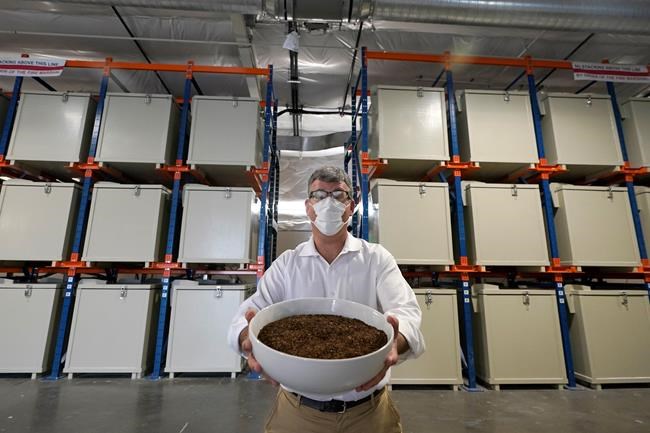
Micah Truman, CEO of Return Home, a company that composts human remains into soil, poses for a photo, Wednesday, Sept. 15, 2021, in Auburn, Wash., south of Seattle. Truman is holding a container of soil made with animal remains that is used to show what the product of their process looks like. Behind him are the metal vessels where bodies are kept during the first month of the two-month composing process. Earlier in September, Colorado became the second state after Washington to allow human body composting, and Oregon will allow the practice beginning next July. (AP Photo/Ted S. Warren)

AJ Killeen, 40, of Boulder, has already expressed interest in having his body composted when he dies, even though he is relatively young.

After a car accident a couple years ago, a doctor discovered Killeen had a heart condition. That got Killeen thinking about what would happen to his body after he dies, and composting seemed like a natural fit.

“It’s what’s going to happen anyway, right? I mean, we’re all going to turn to dust, basically. So this is just a little more natural,” he said. “They’re going to control the humidity. They’re going to control the soil amendments and hopefully some worms and some mushrooms find a good home in me for a few months. And, you know, at the other end of it, I’ll be just a few bags of dirt.”

Killeen, who manages commercial real estate, said his concern for the environment played a large role in considering the option. Flame cremation burns fossil fuels that can contribute to climate change, and the process also releases toxic, mercury-laden fumes into the atmosphere. Traditional burial takes up space in a cemetery that will use additional resources to keep the plot constantly watered and mowed.

“I always joke that I hope I expire on trash day if that’s just easier for my family,” said Killeen, who composts food scraps and yard waste through the city’s collection program.
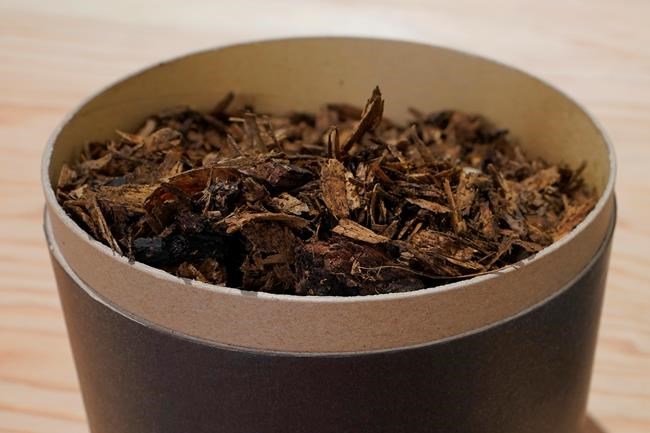
A container of compost produced from human remains is shown at Recompose, a company that composts human remains into soil, Wednesday, Sept. 15, 2021, in Kent, Wash., south of Seattle. Earlier in September, Colorado became the second state after Washington to allow human body composting, and Oregon will allow the practice beginning next July. (AP Photo/Ted S. Warren)

Killeen is among a growing number of people considering more natural funeral options, especially since the pandemic began, and he thinks the option will become more accepted once people get over “the ick factor.”

The Colorado Catholic Conference, a group of bishops aimed at molding public policy, opposed the bill, saying body composting “does not promote human dignity.” Some rabbis also are against body composting because they say it violates Jewish religious law. Other opponents are concerned there is not enough research on whether the compost contaminates soil and there is no way to prevent people from using it in home vegetable gardens.

“We don’t know what they’re going to do with it if they take it all home,” said Stacey Kleinman, a board member of the Colorado Funeral Directors Association. They helped craft the legislation, but the group’s stance is neutral.

Even with the opposition, several states are considering the option as Americans become more open to afterlife alternatives.

According to a Choice Mutual Insurance Agency survey of 1,500 Americans this summer, when many were burying loved ones killed by the coronavirus, 21% said the pandemic changed how they want their body disposed of. Traditional burial and cremation remained the front-runners, but 11% said they would opt for burial involving natural decomposition without a casket. Only 4% said they would choose that option in a similar survey conducted in 2020.

In this Friday, Aug. 27, 2021, photo, urns are displayed in a window at The Natural Funeral in Lafayette, Colo. The company is offering human body composting after Colorado became the second state after Washington to legalize the practice. (AP Photo/Thomas Peipert)

Choice Mutual, which specializes in burial insurance, did not specifically ask about body composting, but the survey highlights an increased interest in more natural and environmentally friendly options.

Micah Truman, CEO and founder of Return Home south of Seattle, runs an 11,500-square-foot (1,068-square-meter) facility that includes 74 vessels. So far, his company has composted 16 bodies in what he describes as an “extremely precise scientific operation” that takes only 60 days.

Truman said that because the composting option is so new, “it’s really a matter of changing hearts and minds right now.” But he has been surprised by how many young people are interested, including someone who recently signed up their 8-year-old child.

“Our young people are going to teach us how to die better. It’s been really powerful for us,” Truman said. “I think what’s happened is that the younger generation really genuinely understands that we have to make sure that our Earth can stay whole.”
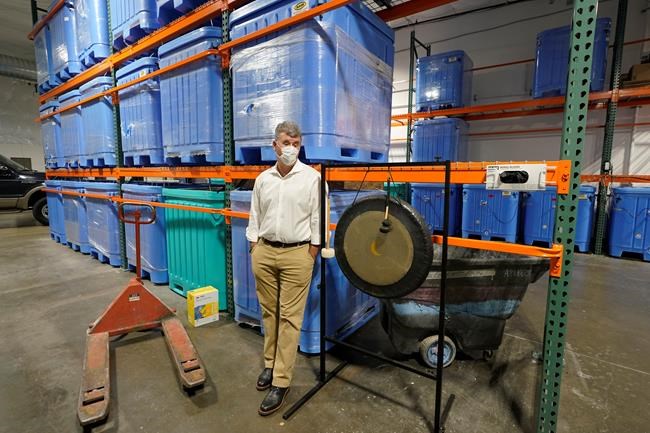
Micah Truman, CEO of Return Home, a company that composts human remains into soil, poses for a photo, Wednesday, Sept. 15, 2021, in Auburn, Wash., south of Seattle. At right is a gong that is struck by workers each time a body is placed into the vessel that holds it during the composing process, which is part of a ritual initiated by Truman to preserve the individual dignity of each person trusted to his company's care. Behind him are vessels where remains are kept during the second month of the two-month composing process. Earlier in September, Colorado became the second state after Washington to allow human body composting, and Oregon will allow the practice beginning next July. (AP Photo/Ted S. Warren)
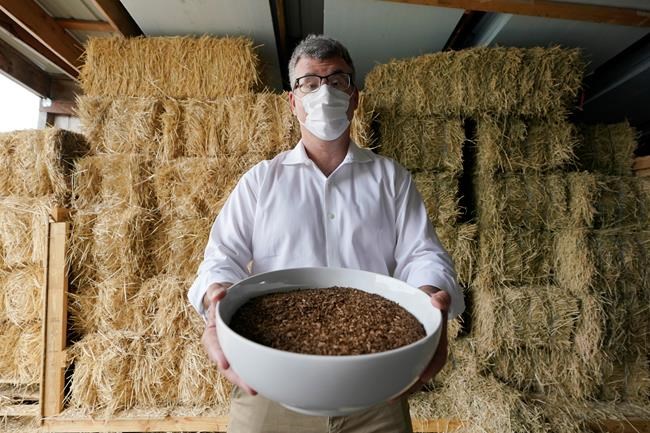
Micah Truman, CEO of Return Home, a company that composts human remains into soil, poses for a photo, Wednesday, Sept. 15, 2021, in Auburn, Wash., south of Seattle. Truman is holding a container of soil made with animal remains that is used to show what the product of their process looks like. Behind him are bales of straw, which is used in the two-month composing process. Earlier in September, Colorado became the second state after Washington to allow human body composting, and Oregon will allow the practice beginning next July. (AP Photo/Ted S. Warren)
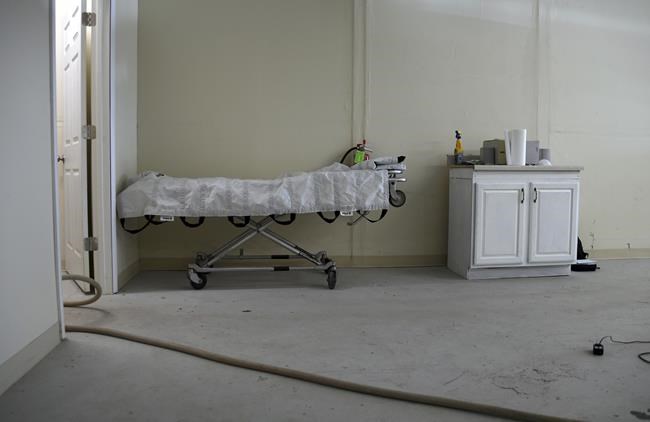
In this Wednesday, Aug. 11, 2021, photo, a gurney at The Natural Funeral's human body composting facility in Arvada, Colo. On Sept. 7, Colorado became the second state after Washington to allow human body composting, and Oregon will allow the practice beginning next July. Vessels will be packed with wood chips and straw and will compost a body in six months. By the end of the six-month process, the body, the wood chips and the straw will have broken down into enough soil to fill the bed of a pickup truck. Family members can keep the soil to spread in their yards, but Colorado law forbids selling it and using it commercially to grow food for human consumption. (AP Photo/Thomas Peipert)
In this Wednesday, Aug. 11, 2021, photo, employee Chris Olachia walks through The Natural Funeral's human body composting facility in Arvada, Colo. On Sept. 7, Colorado became the second state after Washington to allow human body composting, and Oregon will allow the practice beginning next July. Vessels will be packed with wood chips and straw and will be able to compost a body in six months. (AP Photo/Thomas Peipert)
Report Error Submit a Tip

The Free Press acknowledges the financial support it receives from members of the city’s faith community, which makes our coverage of religion possible.
More Stories

Affordable student housing is an education issue

Jamie Wilson 5 minute read 2:00 AM CDT

When we talk about barriers to education, what usually comes to mind are tuition, cost of books or access to technology.

Letters, Aug. 31

7 minute read Preview

Letters, Aug. 31

7 minute read Updated: Yesterday at 7:48 AM CDT

Connor Hellebuyck, as we know, backstopped the U.S.A. to Olympic gold. Shortly after winning, he was invited to the Oval Office and accepted the Presidential Medal of Freedom from his country, a medal that has been awarded to numerous famous athletes — Babe Ruth, Billie Jean King, Jackie Robinson, Muhammad Ali, Michael Jordan, to name a few.

Read
Updated: Yesterday at 7:48 AM CDT

School zones return Tuesday as lead-footed drivers risk steep fines

Maggie Macintosh 5 minute read Preview

School zones return Tuesday as lead-footed drivers risk steep fines

Maggie Macintosh 5 minute read Yesterday at 6:00 AM CDT

School crossing guards are preparing to resume their posts on busy corners across the Winnipeg School Division, but Luna Zúñiga isn’t one of them.

Zúñiga hung up her high-visibility vest about 30 months ago after she was struck by a motorist while escorting a child through a pedestrian crosswalk on Grant Avenue at Lanark Street.

Zúñiga protected the child, who wasn’t hurt, but the educational assistant at nearby J.B. Mitchell School suffered life-altering injuries, including nerve damage that limits her stamina, range of motion and makes her left leg “feel like it’s burning all the time.”

“I don’t know what needs to be done (to improve school-zone safety),” she said. “But I do know that when a six-year-old is crossing the street, a car needs to be fully stopped.”

Read
Yesterday at 6:00 AM CDT

Dangerous offender status sought for convicted killer

Erik Pindera 5 minute read Preview

Dangerous offender status sought for convicted killer

Erik Pindera 5 minute read 2:00 AM CDT

Crown prosecutors intend to apply to have a convicted killer, who also admitted his guilt in an assault on a stranger at The Forks and a robbery at a local beer vendor, designated as a dangerous offender.

Daniel Christopher Dumas, who is in his mid-30s, pleaded guilty to assault causing bodily harm and robbery in front of provincial court Judge Donovan Dvorak on Monday for the attacks on June 6 and 7, 2025. He will be sentenced at a later date.

Prosecutor Monique Cam said the Crown plans to apply for a dangerous offender designation for Dumas, which, if granted, could result in him being given an indefinite prison sentence.

“The Crown does intend to make an application at a future date … for a remand for assessment to have Mr. Dumas assessed by a court-ordered assessor for the purpose of pursuing a dangerous offender application,” Cam said.

Read
2:00 AM CDT

At last, some good news on homelessness

Editorial 4 minute read Preview

At last, some good news on homelessness

Editorial 4 minute read 2:00 AM CDT

There is no shortage of reasons to be frustrated about homelessness in Winnipeg. But the latest numbers provide something that has been increasingly difficult to find — evidence that at least some things are getting better.

Read
2:00 AM CDT

Naked man dies after jolt from police Taser

Scott Billeck 5 minute read Preview

Naked man dies after jolt from police Taser

Scott Billeck 5 minute read Updated: Yesterday at 6:49 PM CDT

A Transcona man says he was lucky to be awake early Sunday when, shortly after 4 a.m., a stranger smashed through his screen door and kicked in the front door of his home.

“It’s all I can think about, like what if I was sleeping?” said the man, whom the Free Press is not naming to protect his identity. “Being awake gave me just a couple of extra seconds to deal with him before he got his whole body in.”

He was sitting on his couch when he heard the glass shatter and saw someone trying to force his way inside.

“Glass flew in and this guy — he was a big guy — tried to climb through the screen door,” the man said. “I hopped off the couch and just remember screaming for help. Well, of course it’s four in the morning, so nobody’s going to help, right? I wasn’t thinking straight.”

Read
Updated: Yesterday at 6:49 PM CDT