Net gain for gardens
Gimli operation redirects fish-processing waste into composting

Advertisement
Read this article for free:
or
Already have an account? Log in here »
To continue reading, please subscribe:

Digital Subscription
One year of digital access for only $205*
- Enjoy unlimited reading on winnipegfreepress.com
- Read the E-Edition, our digital replica newspaper
- Access News Break, our award-winning app
- Play interactive puzzles
*First annual payment billed as $205.00 + GST for one year. This annual subscription will automatically renew at $233.00 + GST every 52 weeks (10% off the regular annual price of $259.35). Offer available to new and qualified returning subscribers only. Cancel any time.
To continue reading, please subscribe:
Add Free Press access to your Brandon Sun subscription for only an additional
$1 for the first 4 weeks*
- Enjoy unlimited reading on winnipegfreepress.com
- Read the E-Edition, our digital replica newspaper
- Access News Break, our award-winning app
- Play interactive puzzles
*Your next Brandon Sun subscription payment will increase by $1.00 and you will be charged $17.95 plus GST for four weeks. After four weeks, your payment will increase to $24.95 plus GST every four weeks.
Read unlimited articles for free today:
or
Already have an account? Log in here »
Hey there, time traveller!
This article was published 16/10/2021 (1816 days ago), so information in it may no longer be current.
Dave Grant is a retired Manitoba conservation officer who spent the last 14 years of his 34-year career in Gimli where he resides today. Gimli is home to many third- and fourth-generation fishermen and commercial fishing families. With Gimli’s large fishing industry — Lake Winnipeg is the 10th largest lake in the world — a substantial amount of fish waste from commercially processed fish is generated.
“Sometimes the fish waste would end up in the landfill, sometimes it might be dumped back in the lake, or dumped onto a farmer’s field,” said Grant when I visited him in Gimli in September.
Discarded fish waste can result in a range of issues so Grant became interested in finding a better solution to handle fish-processing waste materials. With retirement on the horizon, Grant, who is also a farmer, began exploring methods to compost fish waste on a large scale. Today his farm in Gimli is the site of his new business, Willow Creek Composting Ltd., which produces fish compost that consists of just two ingredients: fish waste and sawdust.
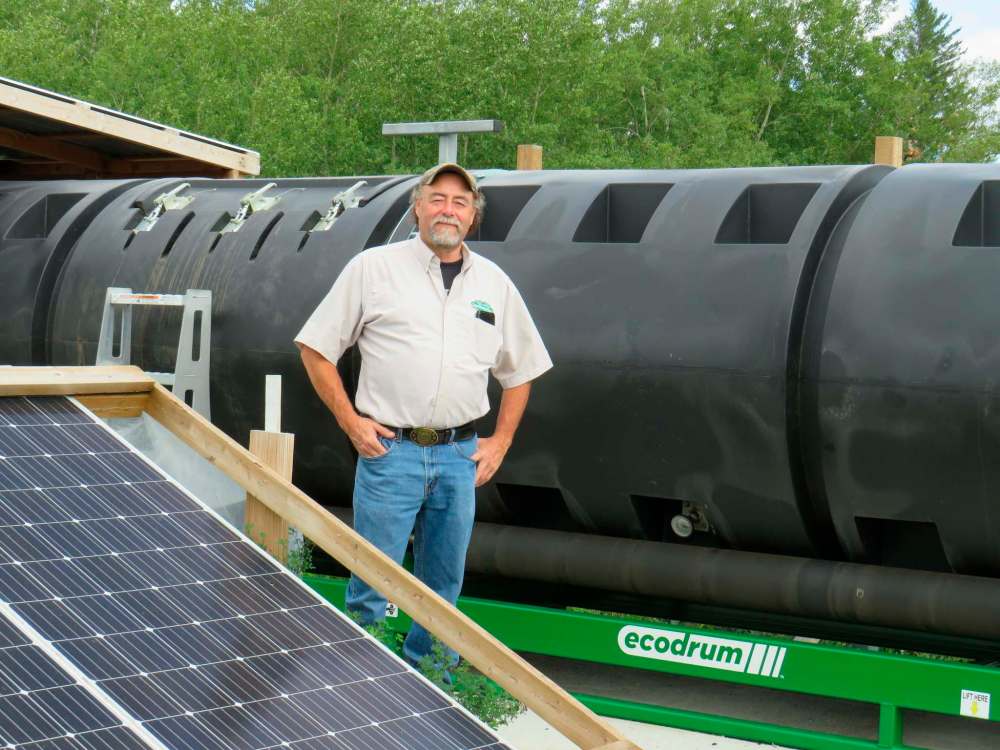
Grant’s all-natural fish compost is sold in 10-litre bags for $9.95 and was available this year at several rural garden centres in the Gimli area as well as through website goodlocal.ca.
On the day of my visit to Willow Creek Composting, the first thing I noticed was that the ground was alive with thousands of jumping, leaping crickets. This year’s hot, dry weather caused an explosion of crickets in Manitoba and that day they were clearly all congregating at Grant’s farm. Now, I am not overly fond of crickets and soon wished I had worn something other than sandals on my feet. Crickets aside, however, the second thing I noticed was a massive black barrel-like vessel called an Ecodrum composter.
The Ecodrum composter is a composting system developed at Tri-Form Poly Facilities in Morris. It is primarily used in the livestock industry and is designed to break down the carcasses of swine and poultry. “I talked to the folks at Tri-Form Poly Facilities and told them I was thinking about composting fish,” said Grant. He was assured the Ecodrum would be suitable. The unit cost $70,000.
At about the same time, Sean and Hanania Assor opened a commercial fish-packing plant called Interlake Freshwater Fisheries. Fishermen dress and process their fish directly at the plant and Grant uses the fish waste to produce compost. Assor called it a win-win solution and an environmentally friendly alternative to landfill disposal.
Grant mixes the fish waste with a locally available carbon source — sawdust — which he obtains from Spruce Wood Loggers, a rough lumber producer in the Interlake, just north of Arborg. It is important to Grant to keep every aspect of his operation local and to support other locally owned businesses.
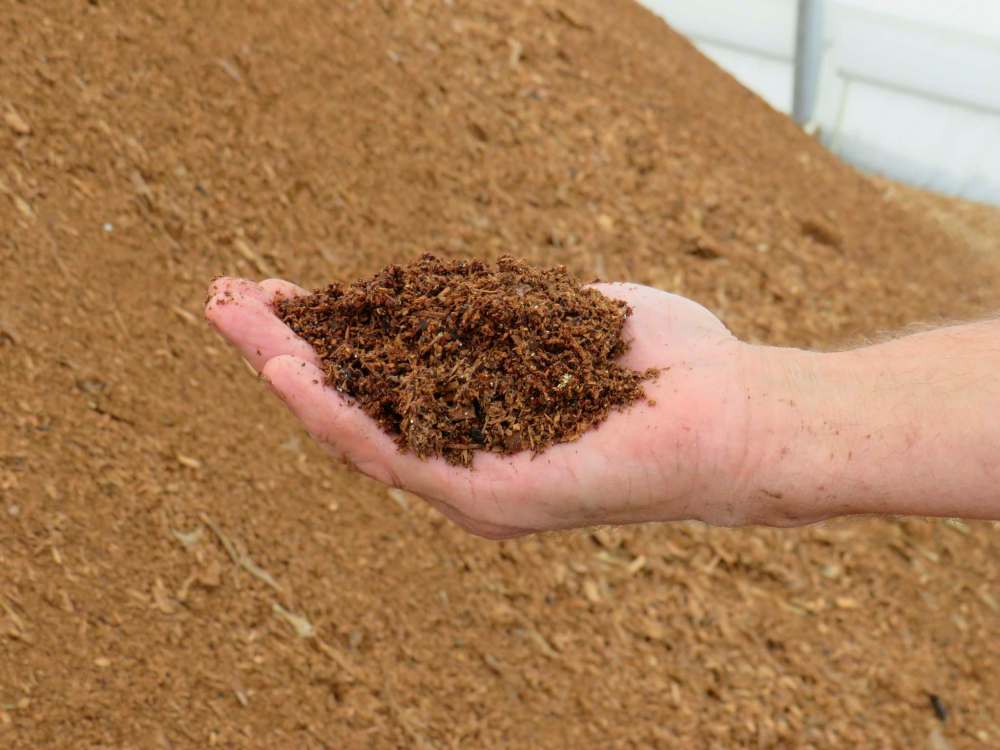
Inside the Ecodrum, the sawdust absorbs nutrients from the fish and the fish creates the heat, said Grant. The temperature inside reaches as high as 49-54 C. The hot temperature is critical in killing any pathogens that may exist.
“It takes approximately seven to 10 days for the fish to completely break down,” said Grant. It takes almost 15 minutes for the drum to complete one full rotation. Grant has been using solar power to operate the Ecodrum.
“I want to be as green as possible,” he said.
Not all the fish bones decompose completely during the composting process. I thought it was rather cool to see small bits and pieces of actual fish bones in the large pile of compost at Grant’s farm, but before it is packaged, Grant runs it through a hammer mill so the finished product is completely uniform without any fish bones in the mix. The finished product has no odour. The texture resembles very finely shredded wood chips.
Grant began composting fish waste in 2020 and over a 12-week span last summer he processed more than 13,000 kilograms of fish waste.
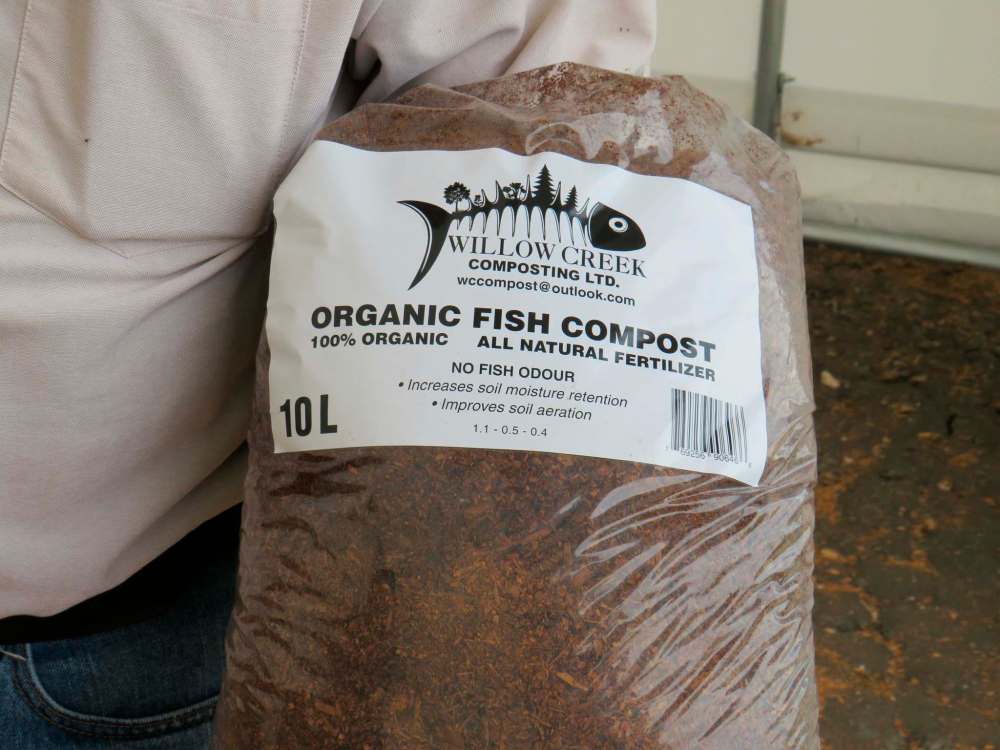
Grant’s fish compost is labelled organic, but it has not gone through an accredited certification process. The nutrient content has been tested at A & L Canada Laboratories in London, Ont. Total nitrogen is 1.1 per cent, available phosphoric acid is 0.5 and soluble potash is 0.4 per cent. The analysis also determined there are trace elements of sulphur, said Grant. “The nitrogen level is low,” said Grant, “but because it is absorbed all through the entire sawdust, it becomes very slow-release and is consistent throughout.”
He recommends mixing the fish compost with soil at a rate of 40 to 50 per cent and spreading it around the base of plants. “Fertilizing will occur as you water,” said Grant. It can also be used to top-dress container plants. “Just apply it to the top of the soil and water directly through it. When you water, the nutrients percolate into the soil directly to the roots of your plants.”

From Grant’s composting operation, we headed to Viking Park in Gimli where Fred West is the gardener. When West spotted Willow Creek Composting fish compost this spring at Solmundson’s garden centre, which is located just west of Winnipeg Beach, he was intrigued and added it to his shopping cart. West mixed the fish compost together with other soil amendments he incorporated into the flower beds at Viking Park and said he was pleased with the results. On my visit, the unblemished sweep of Canadian Shield roses at the entrance to Viking Park appeared exactly the way roses are supposed to look — at least in my dreams. Viking Park’s long, curved drifts of tall salvia with riveting deep-purple flower spikes were also in glorious bloom in September. West said he plans to use the fish compost from Willow Creek Composting again next spring.
Many local gardeners are familiar with Sea Soil, a certified organic product produced in Port McNeill, B.C. Sea Soil consists of 50 per cent fish and 50 percent forest fines (bark and forest soils). “I looked into Sea Soil quite extensively before I started,” says Grant. “My product is more like a concentrate because it doesn’t contain any soil.” Sea Soil comes in a much larger bag — 32 litres compared to Grant’s product which comes in a 10-litre bag. Grant is excited to have the opportunity to provide a local option that provides nutrients and utilizes fish waste that might otherwise end up in a landfill.
Recycling natural materials and diverting them from landfills is important. Many of us have an area in our gardens where we compost grass clippings, kitchen waste and yard waste. Gardeners add organic matter to their soil to improve soil fertility, control weeds, conserve moisture and promote good drainage. A four-inch (10-centimetre) layer of organic mulch added to the soil surface gradually breaks down and becomes food for beneficial soil micro-organisms which in turn release nutrients to be taken up by plants for their healthy growth.

If you would like to know more about Willow Creek Composting Ltd. and fish compost, Grant invites you to contact him directly at wccompost@outlook.com.
colleenizacharias@gmail.com
Colleen Zacharias
Gardening columnist
Colleen Zacharias writes about many aspects of gardening including trends, plant recommendations, and how-to information that is uniquely relevant to Prairie gardeners. She has written a column for the Free Press since 2010 and pens the monthly newsletter Winnipeg Gardener. Read more about Colleen.
Every piece of reporting Colleen produces is reviewed by an editing team before it is posted online or published in print — part of the Free Press‘s tradition, since 1872, of producing reliable independent journalism. Read more about Free Press’s history and mandate, and learn how our newsroom operates.
Our newsroom depends on a growing audience of readers to power our journalism. If you are not a paid reader, please consider becoming a subscriber.
Our newsroom depends on its audience of readers to power our journalism. Thank you for your support.
Colleen Zacharias
Gardening columnist
Colleen Zacharias writes about many aspects of gardening including trends, plant recommendations, and how-to information that is uniquely relevant to Prairie gardeners. She has written a column for the Free Press since 2010 and pens the monthly newsletter Winnipeg Gardener. Read more about Colleen.
Every piece of reporting Colleen produces is reviewed by an editing team before it is posted online or published in print — part of the Free Press‘s tradition, since 1872, of producing reliable independent journalism. Read more about Free Press’s history and mandate, and learn how our newsroom operates.
Our newsroom depends on a growing audience of readers to power our journalism. If you are not a paid reader, please consider becoming a subscriber.
Our newsroom depends on its audience of readers to power our journalism. Thank you for your support.
Advertisement Advertise With Us
Advertisement Advertise With Us