San Francisco’s vaunted tolerance dims amid brazen crimes

Advertisement

Advertise with us

SAN FRANCISCO (AP) — Caitlin Foster fell in love with San Francisco's people and beauty and moved to the city a dozen years ago. But after repeatedly clearing away used needles, other drug paraphernalia and human feces outside the bar she manages, and too many encounters with armed people in crisis, her affection for the city has soured.

Read this article for free:


or

Already have an account? Log in here »

To continue reading, please subscribe:

Subscribe and receive a limited-edition Free Press branded hat or tote.

Digital Subscription

One year of digital access for only $205*

  • Enjoy unlimited reading on winnipegfreepress.com
  • Read the E-Edition, our digital replica newspaper
  • Access News Break, our award-winning app
  • Play interactive puzzles

*First annual payment billed as $205.00 + GST for one year. This annual subscription will automatically renew at $233.00 + GST every 52 weeks (10% off the regular annual price of $259.35). Offer available to new and qualified returning subscribers only. Cancel any time.

To continue reading, please subscribe:

Add Free Press access to your Brandon Sun subscription for only an additional

$1 for the first 4 weeks*

  • Enjoy unlimited reading on winnipegfreepress.com
  • Read the E-Edition, our digital replica newspaper
  • Access News Break, our award-winning app
  • Play interactive puzzles
Start now

*Your next Brandon Sun subscription payment will increase by $1.00 and you will be charged $17.95 plus GST for four weeks. After four weeks, your payment will increase to $24.95 plus GST every four weeks.

Hey there, time traveller!
This article was published 11/12/2021 (1742 days ago), so information in it may no longer be current.

SAN FRANCISCO (AP) — Caitlin Foster fell in love with San Francisco’s people and beauty and moved to the city a dozen years ago. But after repeatedly clearing away used needles, other drug paraphernalia and human feces outside the bar she manages, and too many encounters with armed people in crisis, her affection for the city has soured.

“It was a goal to live here, but now I’m here and I’m like, ‘Where am I going to move to now?’ I’m over it,’” said Foster, who manages Noir Lounge in the trendy Hayes Valley neighborhood.

A series of headline-grabbing crime stories — mobs of people smashing windows and grabbing luxury purses in the downtown Union Square shopping district and daytime shootings in the touristy Haight-Ashbury — has only exacerbated a general feeling of vulnerability. Residents wake up to news of attacks on Asian American seniors, burglarized restaurants, and boarded-up storefronts in the city’s once-vibrant downtown.
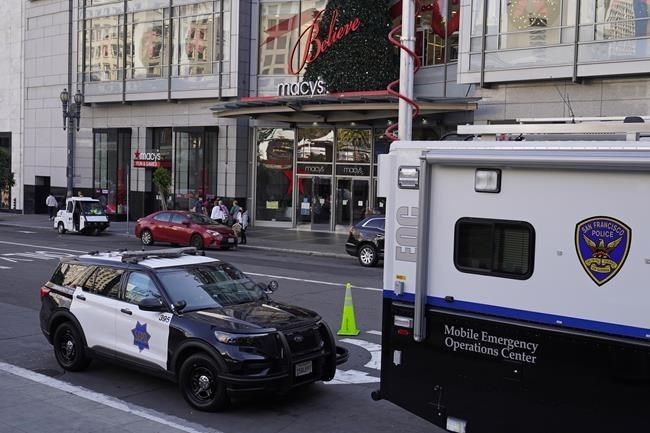
Police vehicles are stationed at Union Square following recent robberies in San Francisco, Thursday, Dec. 2, 2021. In San Francisco, homeless tents, open drug use, home break-ins and dirty streets have proliferated during the pandemic. The quality of life crimes and a laissez-faire approach by officials to brazen drug dealing have given residents a sense the city is in decline.(AP Photo/Eric Risberg)

San Franciscans take pride in their liberal political bent and generously approve tax measures for schools and the homeless. They accept that trashy streets, tent encampments and petty crime are the price to pay to live in an urban wonderland.

But the frustration felt by Foster, who moved from Seattle in search of more sunshine, is growing among residents who now see a city in decline. There are signs that the city famous for its tolerance is losing patience.

The pandemic emptied parts of San Francisco and highlighted some of its drawbacks: human and dog feces smeared across sidewalks, home and vehicle break-ins, overflowing trash cans, and a laissez-faire approach by officials to brazen drug dealing. Parents despaired as public schools stayed closed for most of last year as nearby districts welcomed children back to the classroom.

Meanwhile, residents and visitors scurry past scenes of lawlessness and squalor. Just steps from the Opera House and Symphony Hall, drug dealers carry translucent bags filled with crystal-like rocks or stand outside the public library’s main branch, flashing wads of cash while peddling heroin and methamphetamine.

“There’s a widespread sense that things are on the wrong track in San Francisco,” said Patrick Wolff, 53, a retired professional chess player from the Boston area who has lived in the city since 2005.

In a sign of civic frustration, San Franciscans will vote in June on whether to recall District Attorney Chesa Boudin, a former public defender elected in 2019 whose critics say he’s too lenient on crime. His supporters say there’s no crime surge, and that corporate wage theft is a more pressing issue than cases like that of a San Francisco woman finally arrested after stealing more than $40,000 in goods from a Target over 120 visits. She was released by a judge and arrested again on suspicion of shoplifting after she failed to show up to get her court-ordered ankle monitor.
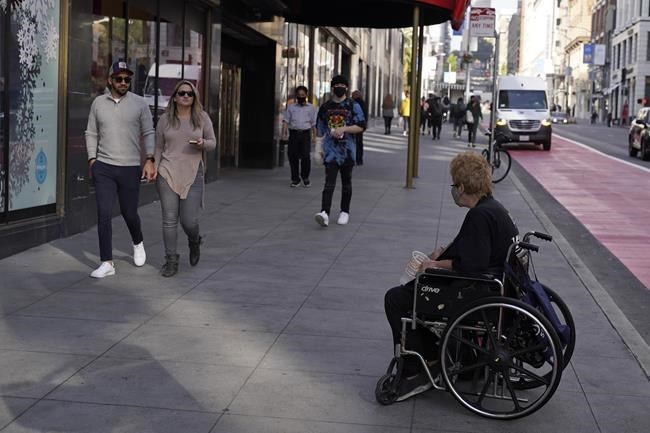
People pass by a woman in a wheelchair panhandling near Union Square in San Francisco, Thursday, Dec. 2, 2021. In San Francisco, homeless tents, open drug use, home break-ins and dirty streets have proliferated during the pandemic. The quality of life crimes and a laissez-faire approach by officials to brazen drug dealing have given residents a sense the city is in decline. (AP Photo/Eric Risberg)

“Where’s the progress? If you say you’re progressive, let’s get the homeless off the street, and let’s get them mental health care,” said Brian Cassanego, a San Francisco native who owns the lounge where Foster works. He moved to wine country five months ago, tired of seeing dealers sell drugs with impunity and worrying about his wife being alone outside at night.

The day before he moved, Cassanego stepped out to walk his dogs and saw a man who “looked like a zombie,” with his pants down to his knees and bleeding from where a syringe was stuck on his hip. A woman cried out nearby in shock.

“I went upstairs, and I told my wife, ‘We’re leaving now! This city is done!’” he said.

Reports of larceny theft — shoplifting from a person or business — are up nearly 17% to more than 28,000 from the same time last year. They remain lower than the more than 40,000 larceny theft cases reported in 2019. Requests to clean dirty streets and sidewalks are the majority of calls to 311, the city’s services line.

Overall, though, crime has been trending down for years. More than 45,000 incidents have been reported so far this year, up from last year when most people were shut indoors, but below the roughly 60,000 complaints in previous years.
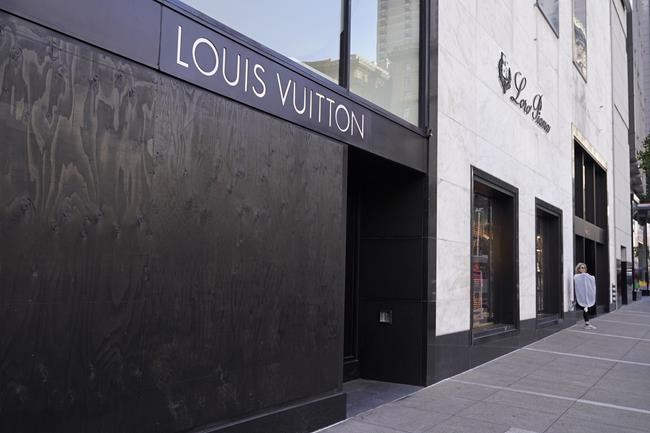
A large window of the Louis Vuitton store is seen boarded up following a recent robbery at Union Square in San Francisco, Thursday, Dec. 2, 2021. In San Francisco, homeless tents, open drug use, home break-ins and dirty streets have proliferated during the pandemic. (AP Photo/Eric Risberg)

San Francisco’s well-publicized problems have served as fodder for conservative media outlets. Former President Donald Trump jumped in again recently, releasing a statement saying the National Guard should be sent to San Francisco to deter smash-and-grab robberies.

Elected officials say they’re grappling with deep societal pains common to any large U.S. city.

A high percentage of an estimated 8,000 homeless people in San Francisco are struggling with chronic addiction or severe mental illness, usually both. Some people rant in the streets, nude and in need of medical help. Last year, 712 people died of drug overdoses, compared with 257 people who died of COVID-19.

LeAnn Corpus, an administrative assistant who enjoys figure skating, avoids the downtown rinks and won’t take her 8-year-old son there after dark because of all the open drug use. Still, the city’s urban ills have crept into her Portola neighborhood far from downtown.

A homeless man set up a makeshift tent outside her home using a bike and a bed sheet, and relieved himself on the sidewalk. She called the police, who came after two hours and cleared him out, but at her aunt’s home, a homeless person camped out against the backyard for six months despite attempts to get authorities to remove him.
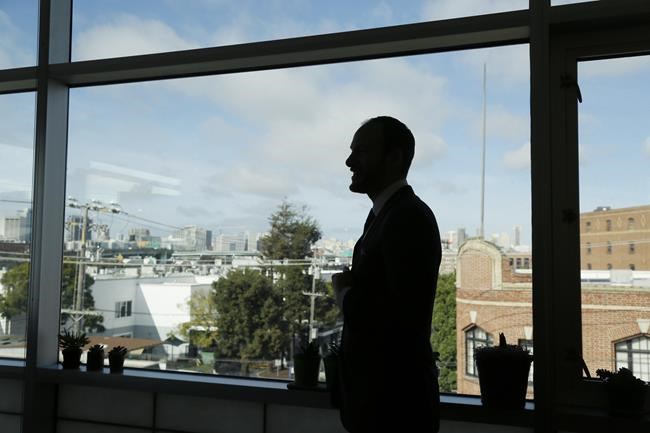
FILE - San Francisco District Attorney Chesa Boudin is silhouetted looking out at the skyline from his office in San Francisco on Jan. 30, 2020. In San Francisco, homeless tents, open drug use, home break-ins and dirty streets have proliferated during the pandemic. The quality of life crimes and a laissez-faire approach by officials to brazen drug dealing have given residents a sense the city is in decline. In a sign of civic frustration, San Franciscans will vote in June on whether to recall Boudin, a former public defender and politically progressive politician elected in 2019 whose critics say he's too lenient on crime. (AP Photo/Eric Risberg, File)

“This city just doesn’t feel the same anymore,” said Corpus, a third-generation native.

San Francisco residents who are generally uncomfortable with government surveillance have installed security cameras and deadbolts to prevent break-ins, and they have started eyeing outsiders with suspicion.

The other night, Joya Pramanik’s husband spotted someone wearing a ski mask on what was an otherwise warm evening on their quiet street. She worried the masked man was up to no good — and it pains her to say that, since what she loves about San Francisco is its easy embrace of all types of characters.

Pramanik, a project manager who moved to the U.S. from India in her teens, cheered Trump’s failed reelection bid but says she realized too late that Democratic activists have hijacked her city.

“If I say I want laws enforced, I’m racist,” she said. “I’m like, ‘No, I’m not racist. There’s a reason I live in San Francisco.’”

Last year, Wolff, the retired chess player, helped launch a new political organization that aims to elect local officials focused on solving pressing problems. Families for San Francisco will elect Democrats, but it’s organized outside the city’s powerful Democratic Party establishment, he said.
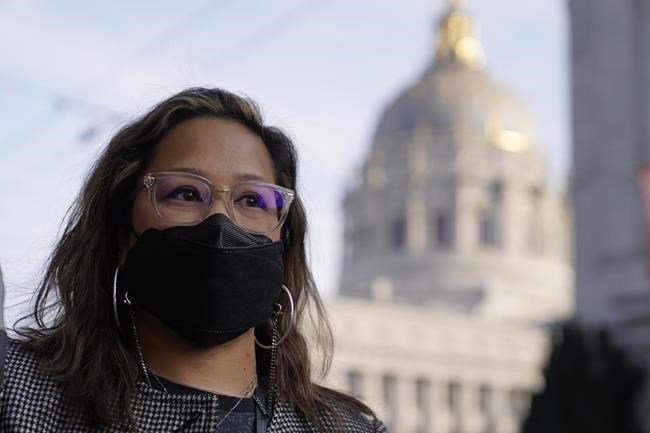
Administrative assistant LeAnn Corpus stands near City Hall in San Francisco, Thursday, Dec. 2, 2021. In San Francisco, homeless tents, open drug use, home break-ins and dirty streets have proliferated during the pandemic. Corpus, who enjoys figure skating, avoids the downtown rinks and won't take her 8-year-old son there after dark because of all the open drug use.
Administrative assistant LeAnn Corpus stands near City Hall in San Francisco, Thursday, Dec. 2, 2021. In San Francisco, homeless tents, open drug use, home break-ins and dirty streets have proliferated during the pandemic. Corpus, who enjoys figure skating, avoids the downtown rinks and won't take her 8-year-old son there after dark because of all the open drug use. "This city just doesn't feel the same anymore," said Corpus, a third-generation native. (AP Photo/Eric Risberg)

Wolff hopes to change a civic mindset that no longer expects much in the way of basic public services.

In hip Hayes Valley, for example, business owners tired of seeing garbage strewn about and the city not doing anything to address the issue banded together to lease enclosed trash cans from a private company, said Jennifer Laska, president of the neighborhood association. After the lease expired, the association managed to get the city to agree to buy and install new public garbage cans designed to keep trash in and pilferers out.

That was four months ago.

“We’re still struggling just to get the trash cans actually purchased,” Laska said.

In the Marina, a wealthy neighborhood with stunning views of the bay and Golden Gate Bridge, dozens of residents recently hired private security after an increase in auto burglaries.
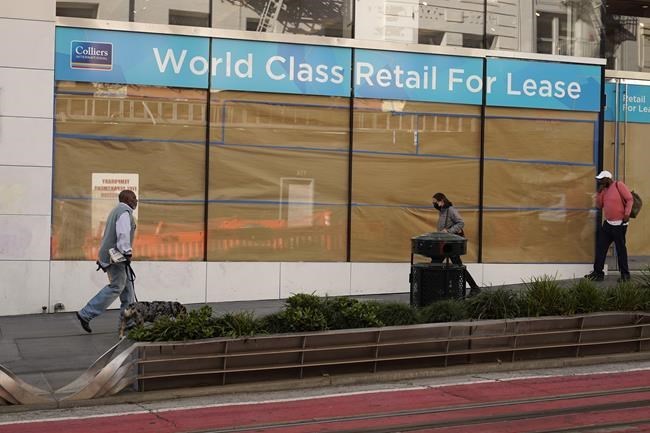
People walk past a large retail space for lease at Union Square in San Francisco, Thursday, Dec. 2, 2021. In San Francisco, homeless tents, open drug use, home break-ins and dirty streets have proliferated during the pandemic. The quality of life crimes and a laissez-faire approach by officials to brazen drug dealing have given residents a sense the city is in decline. (AP Photo/Eric Risberg)

Lloyd Silverstein, a San Francisco native and president of the Hayes Valley Merchants Association, said businesses are considering hiring security guards and installing high-definition security cameras. He rejects the idea that any one city official is to blame for the situation, and he’s optimistic the city will recover.

“We have been through big earthquakes and depressions and lots of stuff, but we have a pretty good bounce-back attitude. We’ve got some problems, but we’ll fix them,” he said. “It may just take some time.”
Report Error Submit a Tip

More Stories

Kinew delivered what most of us wanted; now we’ll have to deal with the consequences

Dan Lett 5 minute read Preview

Kinew delivered what most of us wanted; now we’ll have to deal with the consequences

Dan Lett 5 minute read Yesterday at 4:35 PM CDT

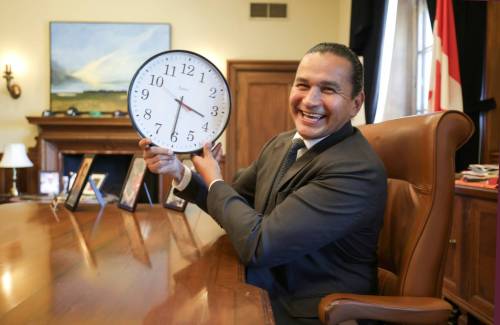
Premier Wab Kinew has decided to adopt permanent daylight savings time, which means a permanent end to the spring forward, fall back tradition of adjusting our clocks. And absolutely no one is surprised.

Read
Yesterday at 4:35 PM CDT

‘A new future’: city dentist Cholakis donates $2M to school of dental hygiene

Melissa Martin 3 minute read Preview

‘A new future’: city dentist Cholakis donates $2M to school of dental hygiene

Melissa Martin 3 minute read Updated: Yesterday at 3:25 PM CDT

Dental hygienist training in Manitoba is getting a big boost, after a major gift from a local dentist.

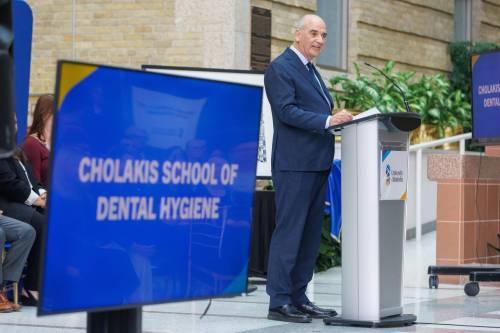
On Thursday, the dental hygiene school at the University of Manitoba’s Dr. Gerald Niznick College of Dentistry unveiled a new $2-million donation from Dr. Ernest Cholakis. It’s the largest gift the program has ever received, and in honour of the funding, the school will be named the Cholakis School of Dental Hygiene.

The gift was unveiled at a ceremony Thursday morning at the U of M’s Brodie Centre in the Health Sciences Centre complex. The benefactor and other dignitaries, including Premier Wab Kinew, were in attendance, as well as the three-year program’s current students.

Cholakis, who graduated from the U of M’s dentistry school in 1982, had high praise for the dental hygiene profession.

Read
Updated: Yesterday at 3:25 PM CDT

Canada-U.S. trade relationship is broken, but the damage can — and will — be repaired

Tom Brodbeck 5 minute read Preview

Canada-U.S. trade relationship is broken, but the damage can — and will — be repaired

Tom Brodbeck 5 minute read Yesterday at 1:35 PM CDT

Canada needs to get serious about diversifying its trade beyond the United States. But at the same time, Canadians should expect relations with the U.S. to normalize after Donald Trump is no longer in the White House.

For generations, Canada-U.S. trade was considered almost a fact of geography. The two countries share the world’s longest undefended border, deeply integrated supply chains and a century of commercial relationships.

Canadian manufacturers depend on American customers. American manufacturers depend on Canadian suppliers. Energy, agriculture, automotive production and countless other industries operate across the border as though it barely exists.

That isn’t going to change dramatically, even in the midst of a bitter trade war unleashed by the U.S. president.

Read
Yesterday at 1:35 PM CDT

Jets suspend goaltender Hellebuyck for failure to report to training camp

The Canadian Press 2 minute read Preview

Jets suspend goaltender Hellebuyck for failure to report to training camp

The Canadian Press 2 minute read Updated: Yesterday at 4:20 PM CDT

WINNIPEG - The Winnipeg Jets suspended goaltender Connor Hellebuyck on Wednesday night for failing to report to training camp.

The team said general manager Kevin Cheveldayoff would address the media Thursday morning. It did not specify the length of the suspension for the U.S. Olympic star.

Hellebuyck, a three-time Vezina Trophy winner and 2025 Hart Trophy winner as NHL MVP, publicly requested a trade from the team on Aug. 27.

In a statement posted on X by his agent, Ray Petkau, Hellebuyck said he had privately requested a trade “several months ago” and that he gave the organization time to address it “quietly and respectfully.”

Read
Updated: Yesterday at 4:20 PM CDT

What to watch as puck drops on Jets training camp

Mike McIntyre and Ken Wiebe 10 minute read Preview

What to watch as puck drops on Jets training camp

Mike McIntyre and Ken Wiebe 10 minute read Wednesday, Sep. 16, 2026

Welcome to a Winnipeg Jets training camp like no other — one where the on-ice storylines and battles threaten to be trumped by what’s happening away from the rink.

Yes, the dark cloud that is the Connor Hellebuyck situation looms over the organization as it prepares to try and turn the page on a terrible 2025-26 campaign which ended with a 26th-overall finish.

It’s not going to be easy, especially in a highly competitive Central Division and Western Conference and with such a major unresolved issue.

But the work starts now, and Free Press hockey writers Mike McIntyre and Ken Wiebe get you set for what to expect ahead of the 84-game regular season, which begins Oct. 2.

Read
Wednesday, Sep. 16, 2026

Manitobans mostly optimistic about time change

Nicole Buffie 5 minute read Preview

Manitobans mostly optimistic about time change

Nicole Buffie 5 minute read Yesterday at 6:47 PM CDT

Turning the page on turning back the clocks in Manitoba was met with enthusiasm — and some hesitation — Thursday.

Calling the move “perfect,” the general manager of Larters at St. Andrews Golf & Country Club said a switch to permanent standard time would have hurt men’s and women’s golf leagues.

The course could have tried to open an hour earlier, but some after-work leagues may have been forced to cancel owing to not enough daylight.

“It would get dark too early and people can’t leave work early to go play an hour earlier,” said Geoff Kehler. “It would have been really bad for the business.”

Read
Yesterday at 6:47 PM CDT