In one small U.S. prairie town, two warring visions of America
Advertisement
Read this article for free:
or
Already have an account? Log in here »
To continue reading, please subscribe:

Digital Subscription
One year of digital access for only $205*
- Enjoy unlimited reading on winnipegfreepress.com
- Read the E-Edition, our digital replica newspaper
- Access News Break, our award-winning app
- Play interactive puzzles
*First annual payment billed as $205.00 + GST for one year. This annual subscription will automatically renew at $233.00 + GST every 52 weeks (10% off the regular annual price of $259.35). Offer available to new and qualified returning subscribers only. Cancel any time.
To continue reading, please subscribe:
Add Free Press access to your Brandon Sun subscription for only an additional
$1 for the first 4 weeks*
- Enjoy unlimited reading on winnipegfreepress.com
- Read the E-Edition, our digital replica newspaper
- Access News Break, our award-winning app
- Play interactive puzzles
*Your next Brandon Sun subscription payment will increase by $1.00 and you will be charged $17.95 plus GST for four weeks. After four weeks, your payment will increase to $24.95 plus GST every four weeks.
Read unlimited articles for free today:
or
Already have an account? Log in here »
Hey there, time traveller!
This article was published 27/01/2022 (1710 days ago), so information in it may no longer be current.
BENSON, Minn. (AP) — The newspaper hit the front porches of the wind-scarred prairie town on a Thursday afternoon: Coronavirus numbers were spiking in the farming communities of western Minnesota.
“Covid-19 cases straining rural clinics, hospitals, staff,” read the front-page headline. Vaccinate to protect yourselves, health officials urged.
But ask around Benson, stroll its three-block business district, and some would tell a different story: The Swift County Monitor-News, the tiny newspaper that’s reported the news here since 1886, is not telling the truth. The vaccine is untested, they say, dangerous. And some will go further: People, they’ll tell you, are being killed by COVID-19 vaccinations.
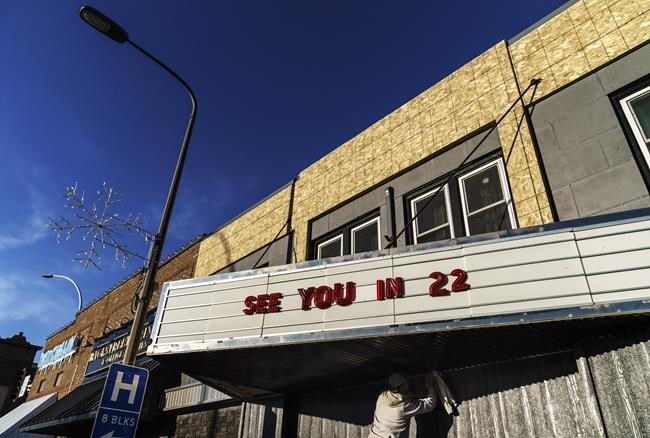
One little town. Three thousand people. Two starkly different realities.
It’s another measure of how, in an America increasingly split by warring visions of itself, division doesn’t just play out on cable television, or in mayhem at the U.S. Capitol.
It has seeped into the American fabric, all the way to Benson’s 12th Street, where two neighbors — each in his own well-kept, century-old home — can live in different worlds.
In one house is Reed Anfinson, publisher, editor, photographer and reporter for the Monitor-News. Most weeks, he writes every story on the paper’s front page. He wrote that story on clinics struggling with COVID-19.
He’s not the most popular man in the county. Lots of people disagree with his politics. He deals with the occasional veiled threat. Sometimes, he grudgingly worries about his safety.
While his editorials lean left, he works hard to report the news straight. But in an America of competing visions, some here say he has taken sides.
Nowhere in the Monitor-News, for example, will you find reports that local people are dying because they’ve been inoculated.
“There are no alternative facts,” Anfinson says. “There is just the truth.”
But whose truth?
His neighbor, Jason Wolter, is a thoughtful, broad-shouldered Lutheran pastor who reads widely and measures his words carefully. He also suspects Democrats are using the coronavirus pandemic as a political tool, doubts President Joe Biden was legitimately elected and is certain that COVID-19 vaccines kill people.
He hasn’t seen the death certificates and hasn’t contacted health authorities, but he’s sure the vaccine deaths occurred: “I just know that I’m doing their funerals.”
He’s also certain that information “will never make it into the newspaper.”
Wolter’s frustration boils over during a late breakfast in a town cafe. Seated with a reporter, he starts talking as if Anfinson is there.
“You’re lying to people,” he says. “You flat-out lie about things.”
____
“In rural Minnesota we still have a work ethic, and I’ll call them Christian values, and that’s not reflected in our local newspaper,” said Al Saunders, a farmer and friend of Wolter’s who graduated from Benson High School a couple years after Anfinson.
“I just can’t stomach it anymore,” said Saunders, whose family settled on part of his sprawling farm more than a century ago, and who speaks almost lovingly about the rich brown soil. Anfinson’s editorials on farm subsidies and politics leave him fuming. “Trash gets thrown at you so many times and eventually you just give up.”
He grudgingly subscribes to the Monitor-News, which has a circulation of roughly 2,000. But just to follow local politics.
Anfinson does cover Swift County intensely — the city council, the county commissioners, the school board and nearly every other gathering of consequence. He’s there for school concerts, community fund-raisers, elections and livestock judging at the county fair. His white Jeep is often spattered with mud from the county’s dirt roads.
He works relentlessly. Wednesday afternoons, after he gets that week’s edition ready for printing the next morning, often count as his weekend.
Anfinson is 67 but looks at least a decade younger. A contemplative man who casually quotes Voltaire, he loves newspapers deeply, and mourns the hundreds of small-town papers that have gone under in recent years.
Still, Anfinson sometimes is surprised to find himself in Benson.
Family is a powerful force here, and this town is knitted together in ways that few Americans understand anymore. His grandfather, a poetry-loving plumber and child of Norwegian immigrants, came to Benson as a child. His father came home from World War II, became a reporter at the Monitor-News and eventually bought the newspaper with a partner.
Anfinson grew up planning on a journalism career somewhere beyond small-town Minnesota. But he found those plans upended when his father’s health began declining in the late 1970s.
“I thought I’d come back here just for a little while,” he said. “It turned into the rest of my life.”
Not that he regrets it.
He’s proud that his reporting means something here, whether it’s a high-school student getting an award or an expensive building project the community rejected after he wrote about it.
Still, there are times when it’s exhausting. And expensive. With declining circulation and ads, he estimates his three little local newspapers are worth at least $1 million less than a decade ago.
“The easy part is speaking truth to power. The hard part is speaking truth to your community. That can cost you advertisers. That can cost you subscribers,” he said.
___
It can be easy, looking around Benson, to think it is a land that time forgot.
Bartenders often greet customers by name. The town’s cafes feel like high school lunchrooms, with people wandering between tables to say hello. Those in search of solitude go to the Burger King, where they sit alone at plastic tables, staring out the windows.
Benson was built in the 1870s as railways reached this part of the prairies, and trains remain the town’s background music. In the cafes, people barely look up when mile-long trains roar through downtown. Few people stop talking. They’ve been hearing those trains for generations.
Many farms and businesses have been owned by the same families for decades: through the droughts of the 1930s; through the thriving years around World War II; to the population decline that began in the 1950s.
But plenty has changed.
Stores closed. Little farms were bought up by more successful farmers. Families left. Swift County’s population has dropped about 30 percent since 1960, and now has about 10,000 residents. Meanwhile, a county that was 98% white in 1990 has seen a stream of new minority residents, particularly Latinos. The county is now 87% white – far whiter than much of America, but far more diverse than a generation ago.
Today, longtime locals can sometimes feel unmoored.
“There are a lot of people coming through that I don’t recognize,” said Terri Collins, Benson’s cheerful mayor, whose family has been in Benson for five generations. “I used to know all of my neighbors and now that’s different. And I don’t know what to blame for that.”
Once, neighborliness and good manners were near-commandments here. Now anger is on the rise.
Neighborhood shouting matches are more common, a local official’s car was vandalized, and a “F— Biden” flag now flies along a school bus route. Collins and the town police chief both say they sometimes worry about Anfinson’s safety.
“Ten years ago I don’t think anything like this would happen,” she said.
But that was then. Travel across the plains of western Minnesota and you’ll find plenty of people who are bestirred by a new and often dark vision of America.
They are not on the fringes, at least by current standards. They are, for the most part, mainstream conservatives who see a nation that barely exists in traditional newspapers and mainstream TV news broadcasts.
People like the store manager, sitting at an American Legion bar drinking $3 cocktails, who calls the billionaire financier George Soros, a Jewish survivor of the Nazis and a powerful backer of liberal causes, “one of the most evil men I’ve ever heard of.” And the semi-retired nurse who fears teams of sex traffickers she says operate freely in countless small towns.
But it would be a mistake to think they can be categorized easily.
Some desperately want Trump to run again; others pray he won’t. One farmer quietly admits he worries about the growing numbers of racial minorities; another enjoys hearing new accents at the grocery store. Many are nearly as dismissive of conservative media as they are of traditional news outlets.
While social conservatism has long run deep in Swift County — even the former, longtime Democratic congressman was anti-abortion and pro-gun rights — many say the presidency of Barack Obama marked a change.
Gay marriage was legalized and identity politics took hold. Growing calls for transgender rights seemed like an issue from another planet. The sometimes-violent racial justice protests that followed police killings of Black men had some here stocking up on ammunition.
Trump’s cries that he loved America resonated in an area where new approaches to teaching U.S. history, with an increased focus on race, were confounding.
So in a county where Obama won with 55% of the vote in 2008, Trump won with 64% percent in 2020.
“We’ve seen a shift here in Swift County,” said Al Saunders. “But you won’t see that in the newspaper.”
____
Anfinson’s weekly column, where he writes about everything from political divisions to rural housing shortages, is a local lightning rod.
He sighed: “That editorial page will have people hate me.”
Across the U.S., many smaller newspapers, already facing economic decline with the rise of the internet, have cut back or completely stopped running editorials, trying to hold onto conservative readers who increasingly see them as local arms of a fake news universe.
But Anfinson won’t consider that, even if sometimes he feels like he’s tilting at angry, small-town windmills. He says it’s his duty to expose people to new ideas, even unpopular ideas like stricter gun control.
The editorial page is, he says “the soul of a newspaper in a way.”
“I would be a traitor to the cause of journalism, of community newspapers,” by giving up on editorials, he said. “I would be cowardly.”
Some would call him stubborn, and his wife and business partner, Shelly, would not disagree. It can be complicated being married to Reed Anfinson.
Like the day last spring, when Anfinson was in the bar next to the office and a man loudly told a friend that Anfinson was a communist and “somebody should do something about that guy.”
Anfinson knows the man. So does Shelly. A longtime dental hygienist, she cleaned his teeth for 20 years. She still says hello when she passes the man on the street.
“I try not to create a bigger divide,” said Shelly, who, after a series of intensive classes on the newspaper business, began running another of the couple’s weekly papers two years ago.
“I’ve definitely lost sleep over some confrontations that he’s had,” she said. “But do you let that stand in the way of reporting the facts?”
Shelly is warm and gregarious and easy to like. And when it comes to politics, she’s not who you’d expect to be married to the man often tagged as Benson’s best-known liberal.
She’s a pro-life Republican who voted for Trump, at least the first time. It annoys her when news outlets talk down to conservatives. She worries that there are too few Republican journalists.
She and Reed married 20 years ago, after both had been divorced. She moved in across the street and soon he was walking her home.
She is often torn between support for Reed and worries over subscriber loss.
Still, she’s been pressing him to tone down the politics.
“It is a struggle. I can tell these things to my business partner. It’s harder to tell them to my husband.”
___
In the custom of small-town Minnesota, the Anfinson and Wolter families get along, at least outwardly. They wave when they see each other. When one family is out of town, the other will sometimes watch their home.
“We’re still personable,” Wolter says. “I just don’t trust him.”
“He’s not going to come to church and I’m not going to buy his newspaper. But we can still treat each other as neighbors.”
While he believes Anfinson is sincere in what he publishes, he does not believe his neighbor has a monopoly on truth.
Wolter also knows that plenty of people would write him off as just another conspiracy monger. But he’s far more complicated.
He worries his conservative opinions color what he believes: “There are times when I’ve thought: ‘Well, what if all my angst over this is misplaced?’” he said. “Maybe everyone else is right?”
But he worries more about America: “This is a dark time.”
He criticizes conservative politicians for trying to make it illegal to burn the American flag, but worries about far-right accusations that that U.S. soldiers are hunting down American conservatives.
“Maybe five or 10 years ago, I would have said ‘That’s crazy!’” he said. “Now I acknowledge it might be possible. I’m not saying I think it’s happening, but at least I don’t dismiss it the way that I would have.”
Wolter, whose home library includes everything from Sophocles to “The Grapes of Wrath,” is a careful reader, in his own way. He’s wary of conservative news sites like Breitbart, believing it shapes its reporting to please conservative readers. Instead, he finds his news farther off the beaten path, like on Gab, a Twitter-like social media platform that has become home to many on America’s far right.
“For better or for worse I don’t really trust anything I read,” he says. The answer, he said, is research, probing the farthest corners of the internet.
The answers are not to be found, he insists, in the Swift Country Monitor-News.
Anfinson, for his part, doesn’t want to talk about Wolter, at least not directly. He’s watched Benson’s fragile web of community fray too much.

Instead, he talks proudly about the Monitor-News: how it prints letters to the editor that are harshly critical of it; how he reports the truth even if it costs him; how his coverage of the pandemic goes to the heart of journalists’ responsibility to keep their communities safe.
He mourns how some people see him as an enemy. His newspaper should bind people together, he says. Instead, America and Benson are growing angrier. Contentious midterm elections loom.
“It’s kind of sad,” he said. “But it would be foolish of me not to be aware of (my safety) with the sentiments out there.”
Does he carry a weapon? This soft-spoken man says he does not.
“But I know where one is if I need it.”