Suds in the sanctuary: breweries populate vacant US churches

Advertisement

Advertise with us

(RNS) — Bruce Lindsay never expected to own a church. But when his mother died shortly before the pandemic, he wanted to use his inheritance to do something extraordinary.

Read this article for free:


or

Already have an account? Log in here »

To continue reading, please subscribe:

Subscribe and receive a limited-edition Free Press branded hat or tote.

Digital Subscription

One year of digital access for only $205*

  • Enjoy unlimited reading on winnipegfreepress.com
  • Read the E-Edition, our digital replica newspaper
  • Access News Break, our award-winning app
  • Play interactive puzzles

*First annual payment billed as $205.00 + GST for one year. This annual subscription will automatically renew at $233.00 + GST every 52 weeks (10% off the regular annual price of $259.35). Offer available to new and qualified returning subscribers only. Cancel any time.

To continue reading, please subscribe:

Add Free Press access to your Brandon Sun subscription for only an additional

$1 for the first 4 weeks*

  • Enjoy unlimited reading on winnipegfreepress.com
  • Read the E-Edition, our digital replica newspaper
  • Access News Break, our award-winning app
  • Play interactive puzzles
Start now

*Your next Brandon Sun subscription payment will increase by $1.00 and you will be charged $17.95 plus GST for four weeks. After four weeks, your payment will increase to $24.95 plus GST every four weeks.

Hey there, time traveller!
This article was published 04/02/2022 (1656 days ago), so information in it may no longer be current.

(RNS) — Bruce Lindsay never expected to own a church. But when his mother died shortly before the pandemic, he wanted to use his inheritance to do something extraordinary.

“My mother, if she were alive today, I think would have a great chuckle at what I’ve purchased,” said Lindsay. “I found myself surrounded by a church when it was the last place on earth I wanted to go to as a kid.”

In August, after purchasing a 900-square-foot-Methodist church built in 1876, Lindsay and his business partner, Anna Cronin, opened Dirt Church Brewing Co. in East Haven, Vermont. It’s one of at least eight church breweries that have opened in the U.S. since 2020.
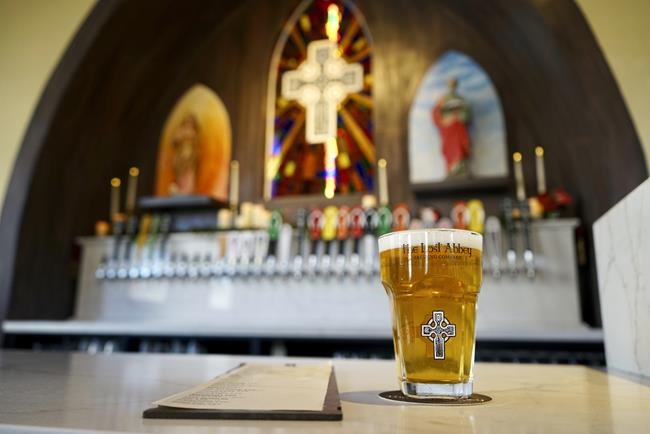
This photo provided by Adam Martinez shows inside The Lost Abbey in San Diego. The Lost Abbey brewing company opened a new location in December 2021 inside the shell of a Mexican Presbyterian church built in 1906. The brewery added pews, chandeliers, tapestries and even stained-glass windows to accentuate its slightly irreverent brand. (Courtesy of The Lost Abbey via AP)

___

This content is written and produced by Religion News Service and distributed by The Associated Press. RNS and AP partner on some religion news content. RNS is solely responsible for this story.

___

Today, the U.S. has roughly 30 breweries based in once-vacant churches. Though some church breweries have faced pushback for offering suds in a once sacred space, the move has precedent. Monks have been brewing beer in monasteries for centuries, offering it to visitors and often imbibing it themselves at a time when it was safer to drink beer than water.

Dirt Church Brewing Co. originally intended to open a brewery inside the church, but Cronin and Lindsay found it lacked running water, a septic tank and heat. Rather than tearing open the building to add the required services, they built the taproom next door, where the town’s former meetinghouse once stood. The church, now used as an art gallery and event space, remains integral to the brewery’s identity.

The name “dirt church” is both a nod to the 19th-century building as well as lingo used by the cycling community that Lindsay and Cronin belong to. “It’s kind of our little cheeky nickname for the Sunday morning long ride that was usually on mountain bikes or gravel bikes,” said Cronin. “Instead of going to ‘church-church,’ we would say, ‘Hey, are you going to dirt church?’”

Today, the brewery hosts “dirt church” for its patrons once a month via Sunday bike rides, runs or hikes — followed by a few celebratory beers at the taproom, of course.

Across the country in San Diego, The Lost Abbey brewing company opened a new location in December inside the shell of a Mexican Presbyterian church built in 1906. The brewery added pews, chandeliers, tapestries and even stained-glass windows to accentuate its slightly irreverent brand.

“This building fell into massive disrepair and probably would have been demolished were it not for the developers that saved it,” said Tomme Arthur, co-founder of The Lost Abbey. This is the brewery’s first location in a former house of worship.

The Lost Abbey was founded in 2006 to offer beers inspired by Belgian monastic brewing traditions, as well as some “nondenominational” beers brewed in no particular style. Per the company’s slogan, it offers brews to “sinners and saints alike” — a motto it’s embraced wholeheartedly.

The new location, appropriately dubbed “The Church,” is split into two sides, one for sinners and one for saints. The sections are marked by corresponding décor: A St. Peter statue presides over the saints area, and Mary Magdalene — who is often misidentified as a prostitute — occupies the sinners side.

The Lost Abbey’s beers play off of similar tropes, with “saintly” names such as “10 Commandments” or “Gift of the Magi” juxtaposed with names like “Judgment Day” or “Serpent’s Stout.” The next addition will be a beer featuring Baby Moses, a wink at the popular “Mandalorian” character Baby Yoda.
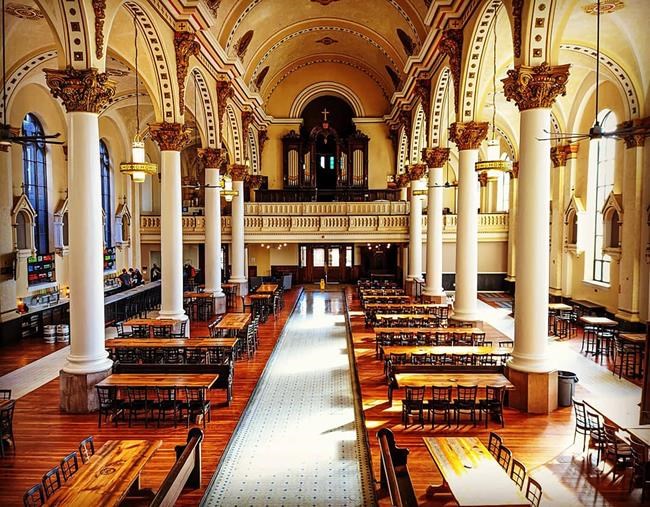
This photo provided by Jon Holley shows the Ministry of Brewing, housed in what was once St. Michael the Archangel Church in Baltimore. The church reopened to the public as a brewery in January 2020, featuring a dazzling interior with soaring columns and a mural-painted barrel ceiling. The brewery also hosts events, fundraisers and even local delegate debates. (Courtesy of Ministry of Brewing via AP)

“We’ve always taken our beers more seriously than a lot of other things,” said Arthur, who grew up attending Catholic school. “What’s great is that every time that we need some sort of inspiration, we’re able to open up the Bible.”

The Ministry of Brewing, located in what was once St. Michael the Archangel Church in Baltimore, makes it a point to avoid religious themes in its marketing.

“All of our names of our beers are typically Baltimore references or something about the neighborhood,” said Jon Holley, the brewery’s general manager. “As far as religious terms, imagery, things like that, we already know that being in a church is a sensitive thing for a lot of people, so we’re not trying to touch that at all.”

The church was built in 1857 and was home to a German Catholic congregation and, later, a Spanish-speaking congregation before closing due to the cost of upkeep. In 2018, the Ministry of Brewing began a full renovation to preserve and restore many of the original elements of the building, which is on the National Register of Historic Places.

The church reopened to the public as a brewery in January 2020, featuring a dazzling interior with soaring columns and a mural-painted barrel ceiling. The brewery also hosts events, fundraisers and even local delegate debates.

Though Holley said he “half expected” pushback for residing in a historic church, the brewery has received overwhelming support. Most often, he said, patrons can be found enjoying the brewery’s bestselling hazy pale ale called “Wispy,” a reference to wispy stained glass.

Like the other two breweries, Dirt Church Brewing Co. in Vermont is intentional about its beer names. Its flagship beer? It’s named “Rejoice,” after Lindsay’s mother, Joyce.

“It’s our most popular beer,” said Lindsay. “Without my mother’s help, none of this would exist today.”

Report Error Submit a Tip

The Free Press acknowledges the financial support it receives from members of the city’s faith community, which makes our coverage of religion possible.
More Stories

Suds in the sanctuary: breweries populate vacant US churches

Kathryn Post, The Associated Press 6 minute read Preview

Suds in the sanctuary: breweries populate vacant US churches

Kathryn Post, The Associated Press 6 minute read Friday, Feb. 4, 2022

(RNS) — Bruce Lindsay never expected to own a church. But when his mother died shortly before the pandemic, he wanted to use his inheritance to do something extraordinary.

“My mother, if she were alive today, I think would have a great chuckle at what I’ve purchased,” said Lindsay. “I found myself surrounded by a church when it was the last place on earth I wanted to go to as a kid.”

In August, after purchasing a 900-square-foot-Methodist church built in 1876, Lindsay and his business partner, Anna Cronin, opened Dirt Church Brewing Co. in East Haven, Vermont. It’s one of at least eight church breweries that have opened in the U.S. since 2020.

___

Read
Friday, Feb. 4, 2022

Officer who shot dog dead after it bit him won’t face charges

Scott Billeck 3 minute read Preview

Officer who shot dog dead after it bit him won’t face charges

Scott Billeck 3 minute read Yesterday at 1:06 PM CDT

A Manitoba First Nations police officer will not face charges for fatally shooting a dog last year, despite the Crown describing the officer’s conduct as “concerning.”

The Independent Investigation Unit of Manitoba announced it would not recommend charges Monday, more than a year after the incident was reported to the police watchdog.

A Manitoba First Nations Police Service officer went to a home in Swan Lake First Nation to make an arrest in June 2025, the IIU said. No arrest was made as the person police were looking for was not there. As the officer was leaving, a dog chained outside bit him.

The officer later returned with a carbine rifle and shot and killed the dog.

Read
Yesterday at 1:06 PM CDT

Brush up on your Winnipeg knowledge with this summertime quiz

0 minute read Updated: Yesterday at 6:50 PM CDT

How well do you know your city? Put your knowledge to the test with our 10-question quiz.

Two-time cancer survivor trades blows with angry Lake Winnipeg in epic 12-hour fundraising swim

Zoe Pierce 3 minute read Preview

Two-time cancer survivor trades blows with angry Lake Winnipeg in epic 12-hour fundraising swim

Zoe Pierce 3 minute read Updated: Yesterday at 2:46 PM CDT

After 12 hours of wind, waves and a painful shoulder, Jonathon Fenton has finished what he started, making it across Lake Winnipeg.

The 62-year-old two-time cancer survivor completed the roughly 26-kilometre swim Sunday, a year after shoulder problems forced him to stop 16 kilometres into his first attempt.

The swim was the second year of Fenton’s Jonny’s Big Swim fundraiser, which supports the Alberta Cancer Foundation, CancerCare Manitoba Foundation and Health Sciences Centre Foundation.

He raised roughly $48,000 this year, bringing the two-year total to about $90,000.

Read
Updated: Yesterday at 2:46 PM CDT

Best to fess up about grandkid-sitting fatigue

Maureen Scurfield 5 minute read Yesterday at 2:00 AM CDT

Dear Miss Lonelyhearts: We love our grandchildren, but now we’re sick of them. The two sets of parents — our adult children — have been parking their kids out here on the farm with us while they take back-to-back road trips to see their friends. We’ve had enough.

Grandma and I want them to come back and get the “brats” (just joking, they’re nice kids) so we can relax.

You have to be so careful with city kids around the farm who don’t know when they’re going to make a mistake and get hoofed by an animal or run over by a farm implement.

How do we tell our kids the party is over early, and they really need to come back before grandma and I give out?

Letters, Aug. 18

7 minute read 2:01 AM CDT

In support of real engineering

Jerry Storie’s op-ed Take advantage of hydroelectric potential and Laura Cameron’s op-ed Lasting legacy or pining for a pipe dream, both in the Free Press Aug. 17, provide quite different perspectives on what should be done to provide reliable power to Manitoba residents in the future.

Mr. Storie advocates construction of more hydroelectric projects rather than new natural gas generated capacity to offset looming power shortages. He argues that these hydroelectric projects will benefit Manitoba for the next century, and observes there will be significant increases in the demand for electricity in upcoming years. He is not wrong in any of these observations. However, hydroelectric developments are very capital intensive and have long lead development periods. Natural gas generation can be brought on line far more quickly with less investment. And perhaps Mr. Storie’s minimization of the environmental impacts of these developments deserves more scrutiny. Any First Nations impacted by development deserve to be consulted and participate in any benefits. Having said this, Mr. Storie is a former minister responsible for Manitoba Hydro, and thus has a fairly deep understanding of the issues at hand.

Laura Cameron advocates against construction of the LNG pipeline and terminal at Churchill, citing “the technical challenges of building a pipeline over thawing permafrost; the prohibitive cost of ice-breaking tankers that move LNG through the Arctic; and a forecasted global oversupply of LNG and uncertain long-term export markets.” These would all be persuasive arguments if Ms Cameron possessed any credentials indicating an expertise in engineering or economics. She does not. The balance of Ms Cameron’s op-ed focuses on ways for Manitoba to reduce its carbon footprint while taking a few shots at the proposed LNG pipeline to B.C. Her opposition to the pipeline to Churchill is almost a Trojan horse.