

Ay Caramba! 2022 is the Year of the Phlox
There’s more to this versatile species than meets the eye

Advertisement
Read this article for free:
or
Already have an account? Log in here »
To continue reading, please subscribe:

Digital Subscription
One year of digital access for only $205*
- Enjoy unlimited reading on winnipegfreepress.com
- Read the E-Edition, our digital replica newspaper
- Access News Break, our award-winning app
- Play interactive puzzles
*First annual payment billed as $205.00 + GST for one year. This annual subscription will automatically renew at $233.00 + GST every 52 weeks (10% off the regular annual price of $259.35). Offer available to new and qualified returning subscribers only. Cancel any time.
To continue reading, please subscribe:
Add Free Press access to your Brandon Sun subscription for only an additional
$1 for the first 4 weeks*
- Enjoy unlimited reading on winnipegfreepress.com
- Read the E-Edition, our digital replica newspaper
- Access News Break, our award-winning app
- Play interactive puzzles
*Your next Brandon Sun subscription payment will increase by $1.00 and you will be charged $17.95 plus GST for four weeks. After four weeks, your payment will increase to $24.95 plus GST every four weeks.
Read unlimited articles for free today:
or
Already have an account? Log in here »
Hey there, time traveller!
This article was published 05/02/2022 (1712 days ago), so information in it may no longer be current.
Each year the National Garden Bureau selects one plant from several different categories. Plants are chosen because they are popular, easy-to-grow, widely adaptable, genetically diverse, and versatile. For its perennial category, the National Garden Bureau has selected 2022 as the Year of the Phlox.
Let’s be honest, when it comes to must-have plants phlox is not the first name on every gardener’s lips. Nevertheless, there is no denying the versatility of phlox which can be used in your garden or landscape in many different ways. There are summer-blooming perennial phlox varieties for the back of the border, middle of the border, or the front of the border. There are groundcover varieties of phlox that form a carpet of blooms in spring as well as heat-loving annual varieties that are sought after for containers, hanging baskets, and cut flower arrangements. Phlox will multitask in your garden and new varieties are more user friendly than ever.
The genus name, Phlox, comes from the Greek word phlego which means to burn or a flame. Interestingly, Kate Greenaway’s Language of Flowers, published in 1884, lists the meaning of phlox as unanimity (we could use a little more of that). There are numerous species of phlox native to North America. Phlox paniculata, known today as tall garden phlox or summer phlox, was found growing wild in the eastern United States in the early 1700s. It was introduced to England in 1730. Breeders in England, Russia, Germany, and Holland created hundreds of varieties. By 1880, American breeders began adding to the growing number of phlox cultivars that could be grown in gardens.

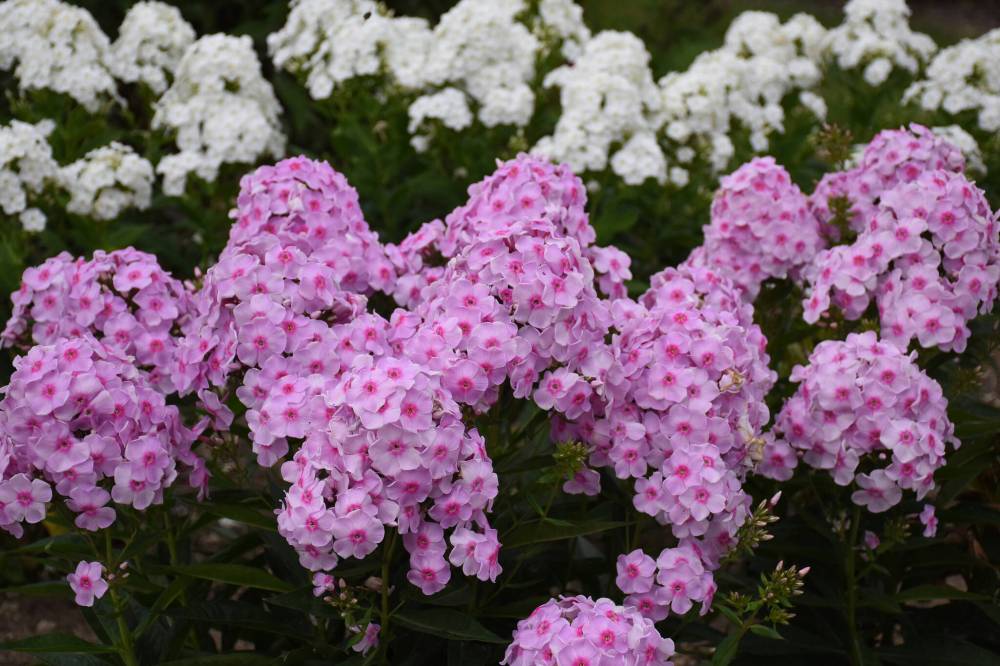
Up until now, Phlox paniculata David, which was selected as the Perennial Plant Association 2002 Plant of the Year, has been the gold standard for garden phlox with its large, pure white flowerheads and superlative disease resistance. Now comes the Luminary collection of tall garden phlox, the new gold standard of powdery mildew resistance. Luminary Opalescence also brings improved performance in heat and humidity. With hydrangea-type flowerheads that are light pink with dark pink eyes and dark green leaves, Opalescence stands tall at 30 to 32 inches. We should also see Luminary Ultraviolet this year, which is slightly taller than Opalescence (32-36 inches). Ultraviolet features very dark, magenta violet flower panicles and bright green foliage.
The newest addition to the series is Luminary Backlight, a tall perennial garden phlox (28-30 inches tall) which has pure white flowers on top of dark green leaves. The Luminary collection is classified as hardy to zone 3. Long blooming, Luminary phlox blooms mid-summer to late summer. Best flowering performance is in full sun.

For something completely different, Phlox paniculata Olympus is an unusual new phlox. The heavily variegated yellow and green foliage displays a cherry-red tip until the fragrant lavender flowers appear. Olympus is a hardy perennial that grows 24-36 inches tall. Look for other tall garden phlox varieties this year such as Flame Pro Baby Doll, Bright Eyes, Fashionably Early series, and many others.
At the other end of the spectrum is Phlox subulata, also known as creeping phlox or moss phlox, which forms a carpet-like mat suitable for flower borders, rock gardens, terraces, or slopes. One lovely example is Eye Caramba which grows only 4 inches tall and has a spread of 18 inches. Hardy to zone 2, Eye Caramba’s rich pink flowers have a red eye. Plant this perennial in full sun. Creeping phlox benefits from shearing after it has finished blooming. Other popular creeping phlox varieties include Candy Stripe, the Spring Bling series, Violet Pinwheels, and more.


Colleen Zacharias
Gardening columnist
Colleen Zacharias writes about many aspects of gardening including trends, plant recommendations, and how-to information that is uniquely relevant to Prairie gardeners. She has written a column for the Free Press since 2010 and pens the monthly newsletter Winnipeg Gardener. Read more about Colleen.
Every piece of reporting Colleen produces is reviewed by an editing team before it is posted online or published in print — part of the Free Press‘s tradition, since 1872, of producing reliable independent journalism. Read more about Free Press’s history and mandate, and learn how our newsroom operates.
Our newsroom depends on a growing audience of readers to power our journalism. If you are not a paid reader, please consider becoming a subscriber.
Our newsroom depends on its audience of readers to power our journalism. Thank you for your support.
Colleen Zacharias
Gardening columnist
Colleen Zacharias writes about many aspects of gardening including trends, plant recommendations, and how-to information that is uniquely relevant to Prairie gardeners. She has written a column for the Free Press since 2010 and pens the monthly newsletter Winnipeg Gardener. Read more about Colleen.
Every piece of reporting Colleen produces is reviewed by an editing team before it is posted online or published in print — part of the Free Press‘s tradition, since 1872, of producing reliable independent journalism. Read more about Free Press’s history and mandate, and learn how our newsroom operates.
Our newsroom depends on a growing audience of readers to power our journalism. If you are not a paid reader, please consider becoming a subscriber.
Our newsroom depends on its audience of readers to power our journalism. Thank you for your support.
Advertisement Advertise With Us
Advertisement Advertise With Us




