Moneyrock: Olympic curlers crunch data to get edge on ice
Advertisement
Read this article for free:
or
Already have an account? Log in here »
To continue reading, please subscribe:

Digital Subscription
One year of digital access for only $205*
- Enjoy unlimited reading on winnipegfreepress.com
- Read the E-Edition, our digital replica newspaper
- Access News Break, our award-winning app
- Play interactive puzzles
*First annual payment billed as $205.00 + GST for one year. This annual subscription will automatically renew at $233.00 + GST every 52 weeks (10% off the regular annual price of $259.35). Offer available to new and qualified returning subscribers only. Cancel any time.
To continue reading, please subscribe:
Add Free Press access to your Brandon Sun subscription for only an additional
$1 for the first 4 weeks*
- Enjoy unlimited reading on winnipegfreepress.com
- Read the E-Edition, our digital replica newspaper
- Access News Break, our award-winning app
- Play interactive puzzles
*Your next Brandon Sun subscription payment will increase by $1.00 and you will be charged $17.95 plus GST for four weeks. After four weeks, your payment will increase to $24.95 plus GST every four weeks.
Read unlimited articles for free today:
or
Already have an account? Log in here »
Hey there, time traveller!
This article was published 17/02/2022 (1660 days ago), so information in it may no longer be current.
BEIJING (AP) — Rocks and ice, meet mobile devices and big data.
The 500-year-old sport of curling is sliding into the digital age at the Winter Olympics, with modern technology helping teams sift through game stats and performance data to maximize their chances at a medal.
Major pro sports like baseball and football are increasingly crunching numbers to identify undervalued players and better inform coaching decisions. Now the trend toward analytics is coming to curling, a sport more often thought of as a pastoral pastime played by amateurs with dad bods and day jobs.
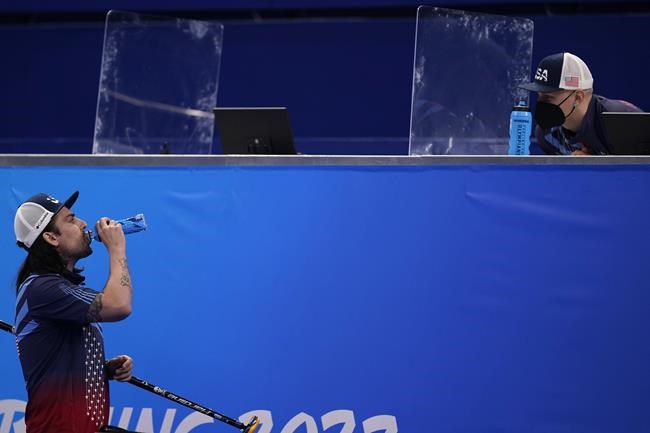
“Data is king,” said Nigel Holl, executive performance director of the British curling team, an early adopter of curling tech.
“The only advantage we can possibly have is: Can we learn quicker and move faster than the opposition and get an advantage in?” Holl said. “And data is a key part of how you can move faster and be ahead of the game.”
In curling, teams take turns sliding 42-pound rocks down a sheet of ice toward a scoring area. Players furiously sweep the ice along the way to help speed up the stone or curl it around an opponent’s on its way to the target.
The intricate strategy — successful teams must plan several throws in advance — has earned the sport the nickname “chess on ice.” And that strategy is now driven by data and technology that gives the players real-time insights into the best shot to take.
During play at Beijing’s Ice Cube Olympic venue, the British coaches punched game stats into their tablets and other devices that have been preloaded with match data for their curlers and the opponents.
The British and U.S. teams also employ performance analysts who sit at the end of the ice sheet filming the action for match intelligence. The goal: to get a better picture of each side’s strengths and weaknesses — information that can be relayed to players during breaks.
“It’s the future,” said U.S.A. curling’s director of coaching, Phill Drobnick. “It’s doing everything you can do to give ourselves that little bit of an edge.”
The U.S. curling team has been filming matches for years, but Drobnick said now it’s wringing more information out of video to help with tactics for each play and to scout out the opposition.
“You’ve got to use the information that’s out there to try to give yourself the best chance to win it,” said American John Shuster, a five-time Olympian and the reigning gold medalist. “I feel like it’s put us in a position where we’ve got some wins.”
Curling powerhouse Canada also uses video and data analytics, team spokesman Kyle Jahns said.
“It’s common for teams (not just Canada) to collect this kind of data not only at the Olympics, but other events in order to create game plans that will be most efficient at international events,” he said by email.
An Olympic curling match has 10 ends, like innings in baseball. Teams throw eight rocks apiece in each round. Much of the in-end strategy involves protecting one’s own rocks from an opponent’s takeout, but the end-game management often centers around the significant advantage of throwing last.
For example, even in a tie game entering the ninth end, it has long been smart strategy to intentionally miss — and score zero points — to hang onto the last-rock advantage, known as the hammer, in the 10th.
Now players have the numbers to back that up, along with more complex decisions.
In Thursday night’s medal round game against Britain, with a fairly easy chance to score one point and tie the game, the United States deliberately threw the ninth-end hammer into the side of the sheet — and gave up a point to fall behind by two — in order to have the last rock in the 10th.
“I know it looks funny and you don’t realize, like, ‘Why did they do it?’” American Matt Hamilton said. “But the sports are analytic now. We know all the numbers, where your armchair curler — who doesn’t watch it year-in and year-out, and all the championships — might not necessarily realize it.”
NFL coaches have become more aggressive about going for it on fourth down, or going for two points after a touchdown, based on similar statistical analysis.
The British team, one of just two to reach the medal round in all three Olympic curling disciplines in Beijing, uses data analytics platform Tableau to present the information in a more easily digested visual form.
It’s got to be “obvious and intuitive” so the coach can relay it to the athletes in as little as one syllable, Holl said.
“They’ve got 20 seconds to get information across to an athlete to influence the game,” Holl said.
Some purists scoff.
“I think there’s a place for it, but I think analytics in a lot of situations, it seems to be trending towards overuse,” said Canadian Brad Gushue, a 2006 Olympic gold medalist.
“We try and use a little bit of it,” Gushue said, “but still go a little old school and use that instinct.” ___
AP Sports Writer Jimmy Golen is in Beijing covering Olympic curling for the third time. Follow him on Twitter at twitter.com/jgolen. AP Business Writer Kelvin Chan writes about technology from London and is covering a range of Olympic stories in Beijing. Follow him on Twitter at twitter.com/chanman.
___
More AP Olympics: https://apnews.com/hub/winter-olympics and https://twitter.com/AP_Sports
Related Articles
Olympics Live: Wind moves cross country race start



Advertisement Advertise With Us
Advertisement Advertise With Us