EU plan aims to help get wheat from Ukraine to the world

Advertisement

Advertise with us

BRUSSELS (AP) — The European Commission proposed helping Ukraine export its wheat and other grains by rail, road and river to get around a Russian blockade of Black Sea ports, which is preventing those critical supplies from reaching parts of the world at risk of food insecurity.

Read this article for free:


or

Already have an account? Log in here »

To continue reading, please subscribe:

Subscribe and receive a limited-edition Free Press branded hat or tote.

Digital Subscription

One year of digital access for only $205*

  • Enjoy unlimited reading on winnipegfreepress.com
  • Read the E-Edition, our digital replica newspaper
  • Access News Break, our award-winning app
  • Play interactive puzzles

*First annual payment billed as $205.00 + GST for one year. This annual subscription will automatically renew at $233.00 + GST every 52 weeks (10% off the regular annual price of $259.35). Offer available to new and qualified returning subscribers only. Cancel any time.

To continue reading, please subscribe:

Add Free Press access to your Brandon Sun subscription for only an additional

$1 for the first 4 weeks*

  • Enjoy unlimited reading on winnipegfreepress.com
  • Read the E-Edition, our digital replica newspaper
  • Access News Break, our award-winning app
  • Play interactive puzzles
Start now

*Your next Brandon Sun subscription payment will increase by $1.00 and you will be charged $17.95 plus GST for four weeks. After four weeks, your payment will increase to $24.95 plus GST every four weeks.

Hey there, time traveller!
This article was published 12/05/2022 (1605 days ago), so information in it may no longer be current.

BRUSSELS (AP) — The European Commission proposed helping Ukraine export its wheat and other grains by rail, road and river to get around a Russian blockade of Black Sea ports, which is preventing those critical supplies from reaching parts of the world at risk of food insecurity.

The European Union’s executive arm said the plan aims to establish alternative routes and ease congestion between borders that also should facilitate getting humanitarian aid and other goods into the war-torn country.

Russia’s invasion of Ukraine has provoked disruptions of global food supplies, with both countries two of the world’s biggest exporters of wheat, barley and sunflower oil. The blockade of Ukrainian ports has been particularly harmful, having accounted for 90% of grain and oilseed exports before the war, the commission said.
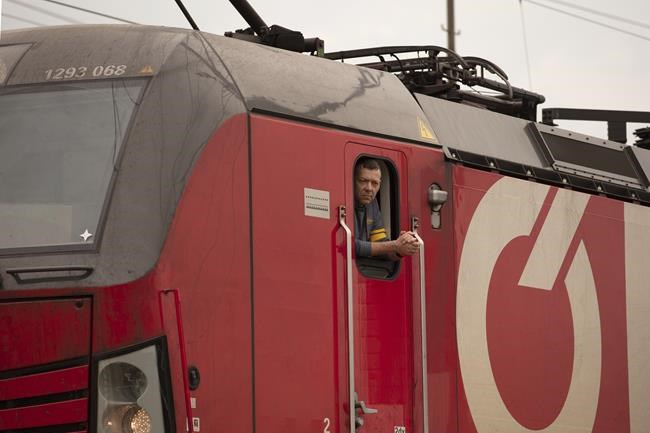
A train driver looks out of his locomotive at the arriving of a Ukrainian freight train with fodder maize, in Vienna, Austria, Friday, May 6, 2022. (AP Photo/Theresa Wey)

“Twenty million tons of grains have to leave Ukraine in less than three months using the EU infrastructure,” said Adina Valean, EU commissioner for transport. “This is a gigantesque challenge, so it is essential to coordinate and optimize the logistic chains, put in place new routes, and avoid, as much as possible, the bottlenecks.”

The potential loss of affordable grain supplies that Africa, the Middle East and parts of Asia rely on has raised the risk of global food shortages and political instability in countries where many people already were not getting enough to eat. The disruptions from the war have further raised food prices, with the high cost of fertilizers — of which Russia is a top exporter — and cooking oils further squeezing the global food chain.

The head of the European Investment Bank said this week that Ukraine is “sitting on 8 billion euros worth of wheat” it can’t export.

In addition to the port blockade, Ukraine’s Foreign Ministry has accused Russia of stealing grain and trying to sell some on global markets. It cited official estimates indicating that Russia already may have stolen 400,000 to 500,000 metric tons of grain that cost over $100 million. It asserted that “practically all ships leaving Sevastopol with a load of grain are carrying the grain stolen from Ukraine,” referring to a major port on the Black Sea.

To get Ukraine’s food supplies to the world, Europe is looking to increase shipments by railroads and trucks. Trains have started carrying loads of grain to Austria and Germany via other EU countries but amount to only a fraction of the Black Sea port capacity.

A key challenge is the diverging rail gauge widths between Ukraine and EU countries. Since Ukrainian railroad cars don’t fit with most of the EU network, goods need to be transferred to trucks or other rail cars adapted to the system.

The EU says the average wait time for the thousands of rail cars at Ukraine’s border with the 27-nation bloc is 16 days, reaching up to 30 days in some places.

To address this congestion, the commission said the most urgent priority is to ensure additional transport vehicles are available to get the grain to EU ports. It said grain-hopper trailers, cargo containers, and barges and vessels “are urgently needed.”
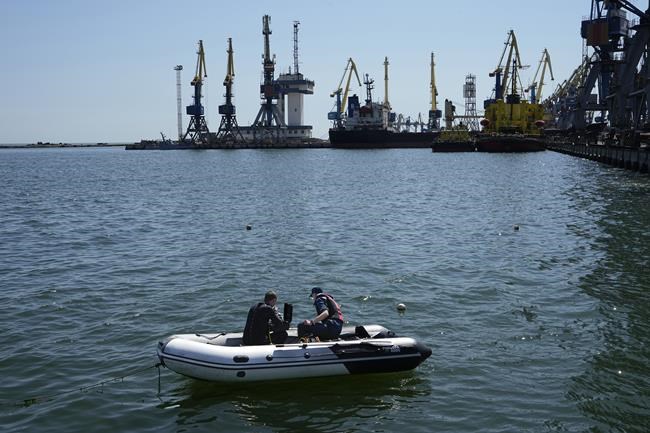
FILE - Servicemen of Donetsk People's Republic Emergency Ministry work to defuse a Ukrainian mine in an area of the Mariupol Sea Port in Mariupol, in territory under the government of the Donetsk People's Republic, eastern Ukraine, on April 29, 2022. This photo was taken during a trip organized by the Russian Ministry of Defense. The European Commission is proposing to help Ukraine move its critical grain supplies to parts of the world at risk of food insecurity. The plan released Thursday, May 12, 2022, by the European Union’s executive arm urges rail, road and river routes to get around a Russian blockade of Black Sea ports. (AP Photo)

With nonmilitary flights grounded in Ukraine, the commission said the new supply routes should be organized mainly via land and river transport, using for instance Ukraine’s ports on the Danube River.

The commission urged member nations to accelerate procedures at border crossing points and increase capacity on EU soil for the temporary storage of Ukrainian exports.

“In the medium to long term, the commission will also work on increasing the infrastructure capacity of new export corridors and on establishing new infrastructure connections,” it said.

The commission’s proposals are nonbinding and mostly intend to facilitate coordination between EU countries, transport operators and equipment suppliers.


Report Error Submit a Tip

More Stories

Nearly four in 10 Manitobans hope Canada restarts trade talks after U.S. midterm elections, poll reveals

Gabrielle Piché 4 minute read Preview

Nearly four in 10 Manitobans hope Canada restarts trade talks after U.S. midterm elections, poll reveals

Gabrielle Piché 4 minute read Yesterday at 7:00 AM CDT

Disorganized — that’s what Marcus Langlois calls recent United States tariffs.

He expects suppliers’ prices to increase — on mugs, pens, hoodies — for his employer, Dreamcatcher Promotions, if the United States–Canada trade war persists.

Still, he’s not pining for a quick trade deal.

“I think it should wait,” said Langlois, Dreamcatcher Promotions’ vice-president. “Let’s hope that it’s later on with proper negotiations happening.”

Read
Yesterday at 7:00 AM CDT

Health minister warns $1.2 billion in annual federal funding set to expire in March

Scott Billeck 4 minute read Preview

Health minister warns $1.2 billion in annual federal funding set to expire in March

Scott Billeck 4 minute read Thursday, Oct. 1, 2026

Manitoba’s health minister is warning of possible cuts to health care with $1.2 billion in annual funding from Ottawa set to expire next year.

“We’re very concerned that what would be the largest cut to health care in a generation is right in front of us,” Health Minister Uzoma Asagwara said Thursday at the Manitoba legislature. “It means that services that Manitobans depend on will be in jeopardy and be at risk.

“Any reductions, any cuts from Canada, will have direct impacts on the health outcomes of Manitobans.”

Asagwara, who serves as the provincial and territorial health minister lead, chaired a virtual meeting Tuesday with provincial and territorial health ministers to discuss federal funding for health care, mental health care and substance use services, which is scheduled to expire March 31, 2027.

Read
Thursday, Oct. 1, 2026

A spiritual vision will help anchor a health civic outlook

John Longhurst 5 minute read 2:01 AM CDT

We have an election coming up. With that in mind, the Free Press asked some of their columnists to write about the challenges ahead and how the city can become better.

For Tom Brodbeck, the main challenge is finances — and how candidates will pay for their many promises for fixing roads, improving public safety and making transit better.

Rebecca Chambers said that the concerns of inner-city residents need to be taken seriously by those who aspire to work at city hall.

Niigaan Sinclair said the most pressing issue in Winnipeg isn’t construction projects, light-rail transit, public safety, taxes or social services. For him, it’s the city’s relationship with Indigenous people.

Khan should’ve taken high road: Goertzen

Carol Sanders 5 minute read Preview

Khan should’ve taken high road: Goertzen

Carol Sanders 5 minute read Yesterday at 6:39 PM CDT

The veteran Progressive Conservative who championed Obby Khan’s leadership bid says the former Blue Bomber dropped the ball by dissing his Tory teammates before he stepped down.

“I wouldn’t recommend it, and I didn’t recommend it,” Kelvin Goertzen (Steinbach) said in an interview Friday.

Khan resigned as PC leader and quit the caucus Monday saying some members were secretly plotting his ouster, even after he won a confidence vote on Sept. 25.

On Tuesday, Khan lashed out in a CJOB interview, naming the alleged plotters, saying constituents deserved to know which of their elected representatives “lacked moral integrity.” Khan told the Free Press he was “deeply emotionally hurt,” and felt stabbed in the back.

Read
Yesterday at 6:39 PM CDT

Manitoba marks end of sending simple workplace problems to doctor’s office

Tory McNally 7 minute read Preview

Manitoba marks end of sending simple workplace problems to doctor’s office

Tory McNally 7 minute read 2:01 AM CDT

There are some changes in the workplace that make you think: “Well, it’s about time.”

This is one of them.

Starting Oct. 1, Manitoba changed the rules around sick notes. I think it is going to be a wonderful change — not just for doctors and patients, but for employers, employees and the way we think about accountability at work.

The change comes from Bill 11, the Employment Standards Code Amendment Act (Sick Notes for Employee Absences), which received royal assent on June 1 and came into force Thursday. Under the new rules, employers generally cannot require a sick note for an illness or injury unless the employee is away for more than one week or has been absent because of illness or injury for more than 10 scheduled workdays in the calendar year.

Read
2:01 AM CDT

Letters, Oct. 3

7 minute read 2:01 AM CDT

A morning in the life …

My very first lesson does not start when I walk into that lecture hall, oh no — it starts long before. It begins when I walk to my car, check the estimated arrival time to the University of Manitoba and hope that Winnipeg traffic agrees with it.

A drive that appears completely manageable changes almost immediately when I’m greeted by a tsunami of orange pylons and a line of cars that appears to go on forever. Traffic moves by the inch, lanes magically disappear and the detour I took yesterday now has a detour of its own. These factors make me do a calculation that I have become all too familiar with. How late can I arrive and still find parking, run to my class across campus and get to class with enough time left to make it worth it?

I have grown used to people saying, “Why not just leave earlier?” I do. But when I’m already leaving for my 8:30 a.m. class at 7 a.m., there’s only so much I can do. This drive that some would think is relaxing is one that feels like an assignment that I didn’t know I had to complete and is due at 8:30 a.m.