Canadian study finds links between air pollution and severity of COVID-19 infection

Advertisement

Advertise with us

An extensive study of thousands of COVID-19 patients in Ontario hospitals found links between the severity of their infections and the levels of common air pollutants they experience.

Read this article for free:


or

Already have an account? Log in here »

To continue reading, please subscribe:

Subscribe and receive a limited-edition Free Press branded hat or tote.

Digital Subscription

One year of digital access for only $205*

  • Enjoy unlimited reading on winnipegfreepress.com
  • Read the E-Edition, our digital replica newspaper
  • Access News Break, our award-winning app
  • Play interactive puzzles

*First annual payment billed as $205.00 + GST for one year. This annual subscription will automatically renew at $233.00 + GST every 52 weeks (10% off the regular annual price of $259.35). Offer available to new and qualified returning subscribers only. Cancel any time.

To continue reading, please subscribe:

Add Free Press access to your Brandon Sun subscription for only an additional

$1 for the first 4 weeks*

  • Enjoy unlimited reading on winnipegfreepress.com
  • Read the E-Edition, our digital replica newspaper
  • Access News Break, our award-winning app
  • Play interactive puzzles
Start now

*Your next Brandon Sun subscription payment will increase by $1.00 and you will be charged $17.95 plus GST for four weeks. After four weeks, your payment will increase to $24.95 plus GST every four weeks.

Hey there, time traveller!
This article was published 23/05/2022 (1590 days ago), so information in it may no longer be current.

An extensive study of thousands of COVID-19 patients in Ontario hospitals found links between the severity of their infections and the levels of common air pollutants they experience.

“This adds to existing evidence that air pollution is a silent killer,” said Chen Chen, an environmental epidemiologist at the University of California and lead author of the study published in the Canadian Medical Association Journal.

The study looked at more than 150,000 COVID-19 cases in Ontario patients in 2020. It broke out how many of those patients were admitted to hospital because of the disease, how many were transferred to intensive care units and how many died.

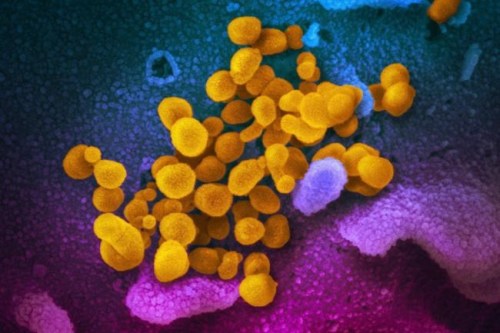
This undated electron microscope image made available by the U.S. National Institutes of Health in February 2020 shows the Novel Coronavirus SARS-CoV-2, yellow, emerging from the surface of cells, blue/pink, cultured in the lab. Also known as 2019-nCoV, the virus causes COVID-19. The sample was isolated from a patient in the U.S. An extensive study of thousands COVID-19 patients in Ontario hospitals has found links between the severity of their infections and the levels of common air pollutants they experience. THE CANADIAN PRESS/AP, NIAID-RML

Researchers then turned to previously developed data that combined air monitoring records with other sources, such as satellite imagery, to model levels across Ontario of three common pollutants — fine particles, nitrogen dioxide and ground-level ozone.

Nitrogen dioxide is emitted in engine exhaust, which then breaks down in the atmosphere into ozone. All three pollutants together create smog.

The scientists then combined the health and pollution data, using statistical methods to weed out the effects of more than 10 different “confounding factors,” such as pre-existing conditions and economic status.

The researchers were able to show that more severe reactions to the virus were associated with higher levels of long-term exposure to air contaminants.

For every 25 per cent increase in fine particles a patient had been exposed to, the chance of being admitted to hospital after being infected with COVID-19 increased by six per cent and the odds of being admitted into an ICU increased nine per cent. The team found no links between death rates and particulate exposure.

The effects were smaller for nitrogen dioxide.

But for ground-level ozone, the study found correlations for every 25 per cent increase in exposure were much higher.

The chances of hospital admission increased 15 per cent. Intensive care admissions increased 30 per cent and death rates went up 18 per cent.

“Of those people who were already infected, we observed some of them who were exposed to higher air pollution levels prior to their infection have a higher probability of worse outcomes,” Chen said.

The study builds on previous research that looked at immediate links between pollution levels and COVID-19 infections. Chen said that approach fails to capture what could be the long-term effects of air pollutants.

“We were looking at long-term pollution levels and their impact on COVID severity.”

Chen cautioned the study doesn’t establish that the three pollutants actually caused the worsening COVID-19 outcomes.

But it wouldn’t be a surprise. Those contaminants are all known to irritate lungs and lung function, and COVID-19 is a pulmonary disease.

“We know this virus attacks our pulmonary system,” she said. “It’s possible that being exposed to more air pollution prior to infection makes you more susceptible.”

Chen said the study opens the door to more detailed research on the variation in COVID-19 outcomes. What is the impact of age, for example, or economic status?

As well, the study doesn’t look for the mechanism of how air pollution might work to worsen the disease.

“This research raises a lot of questions,” said Chen.

This report by The Canadian Press was first published May 24, 2022.

— Follow Bob Weber on Twitter at @row1960

Report Error Submit a Tip

More Stories

Orange Shirt Day project fits students to a tee

Maggie Macintosh 5 minute read Preview

Orange Shirt Day project fits students to a tee

Maggie Macintosh 5 minute read 6:57 PM CDT

On the eve of Orange Shirt Day, hundreds of black T-shirts will be handed out to teenagers at Elmwood High School — and there wasn’t a mixup in the clothing procurement process.

The student-run business behind the initiative wanted to make a statement about “truth and reconciliation” being a year-round activity, said Daniel Concepcion, a Grade 12 student.

Daniel said given that black is a staple in the wardrobe of teenagers, he hopes these shirts won’t sit on hangers for 364 days of the year.

“Every child matters, every part of the day, every day,” the 17-year-old said.

Read
6:57 PM CDT

Four Jets clear waivers to join Moose

Ken Wiebe 3 minute read Preview

Four Jets clear waivers to join Moose

Ken Wiebe 3 minute read Saturday, Sep. 26, 2026

The Winnipeg Jets organizational depth has yet to take a hit on the waiver wire.

On Saturday afternoon, all four players exposed to waivers — defenceman Isaak Phillips and forwards Nikita Chibrikov, Noah Gregor and Parker Ford — cleared, which means they can be assigned to the Manitoba Moose of the American Hockey League.

Owing to injuries to captain Adam Lowry and winger Cole Perfetti, both Chibrikov and Ford started last season on the NHL roster but spent the bulk of last season with the Moose.

Chibrikov, chosen in the second round of the 2021 NHL Draft, has dealt with multiple lower-body injuries during the prior two seasons and is still working his way back to peak form.

Read
Saturday, Sep. 26, 2026

Canadian study finds links between air pollution and severity of COVID-19 infection

Bob Weber, The Canadian Press 4 minute read Preview

Canadian study finds links between air pollution and severity of COVID-19 infection

Bob Weber, The Canadian Press 4 minute read Monday, May. 23, 2022

An extensive study of thousands of COVID-19 patients in Ontario hospitals found links between the severity of their infections and the levels of common air pollutants they experience.

"This adds to existing evidence that air pollution is a silent killer," said Chen Chen, an environmental epidemiologist at the University of California and lead author of the study published in the Canadian Medical Association Journal.

The study looked at more than 150,000 COVID-19 cases in Ontario patients in 2020. It broke out how many of those patients were admitted to hospital because of the disease, how many were transferred to intensive care units and how many died.

Researchers then turned to previously developed data that combined air monitoring records with other sources, such as satellite imagery, to model levels across Ontario of three common pollutants -- fine particles, nitrogen dioxide and ground-level ozone.

Read
Monday, May. 23, 2022

Jets defenceman spent whole summer working on getting to the next level

Ken Wiebe 8 minute read Preview

Jets defenceman spent whole summer working on getting to the next level

Ken Wiebe 8 minute read Updated: 1:57 PM CDT

Tyrel Bauer makes no apologies for the pugilistic piece of his path.

The Winnipeg Jets defenceman is ready to drop the gloves and throw down when the situation calls for it and he takes great pride in protecting his teammates.

It’s a big part of the reason Bauer will be among the 23 players submitted by the Jets on the opening-day roster on Monday.

“I’ve fought and clawed, both metaphorically and literally and now I just want to show that I can play as well,” Bauer said during a chat with the Free Press during training camp. “(Toughness) is always something that I have, it’s always something in my back pocket and something that I take a lot of pride in doing, for my teammates, for the city and the people who invest in this hockey club. That will never change.

Read
Updated: 1:57 PM CDT

Furby Street residents fed up with inaction on drug houses

Carol Sanders 6 minute read Preview

Furby Street residents fed up with inaction on drug houses

Carol Sanders 6 minute read Updated: 8:39 AM CDT

Anxious Furby Street residents contacted the city and their elected officials Friday to — once again — report people coming and going from a boarded-up house they call a dangerous “drug centre” and “den of thieves” that’s just steps away from a house under construction.

Linda Zak, who was holding a yard sale with a group of neighbours Friday morning, described the trouble the home attracts, while a woman slumped on the front steps and a man standing in the yard yelled to someone inside it.

“It is a drug centre,” said Zak, 77. “We know that. A couple of days ago, a person lit the front on fire. Now, as you look at it, you can see where the facade was burning and they were trying to harm people inside.”

“We’re very concerned about it being next to the home this man is building,” she said, pointing to the two-storey that’s nearly completed. The boarded-up house is in the 500 block of Furby.

Read
Updated: 8:39 AM CDT

State of the Nations event to highlight Indigenous mining plans

Gabrielle Piché 3 minute read Preview

State of the Nations event to highlight Indigenous mining plans

Gabrielle Piché 3 minute read 7:37 PM CDT

A first-ever conference aims to connect Indigenous leaders with businesses as local mining ambitions grow.

The Manitoba Prospectors and Developers Association expects to rally a half-dozen chiefs to present on their communities’ mineral development projects.

The Nov. 16 event — called the State of the Nations — comes as the province promises to triple critical mineral production.

“We want to see those minerals being developed and being able to be exported,” said Renée Greyeyes, the prospectors association’s chief executive.

Read
7:37 PM CDT