Native students exercise right to wear regalia at graduation

Advertisement

Advertise with us

CEDAR CITY, Utah (AP) — She walked up a red carpet and crossed a stage to accept her diploma wearing an eagle feather beaded onto her cap that her mother had gifted her.

Read this article for free:


or

Already have an account? Log in here »

To continue reading, please subscribe:

Subscribe and receive a limited-edition Free Press branded hat or tote.

Digital Subscription

One year of digital access for only $205*

  • Enjoy unlimited reading on winnipegfreepress.com
  • Read the E-Edition, our digital replica newspaper
  • Access News Break, our award-winning app
  • Play interactive puzzles

*First annual payment billed as $205.00 + GST for one year. This annual subscription will automatically renew at $233.00 + GST every 52 weeks (10% off the regular annual price of $259.35). Offer available to new and qualified returning subscribers only. Cancel any time.

To continue reading, please subscribe:

Add Free Press access to your Brandon Sun subscription for only an additional

$1 for the first 4 weeks*

  • Enjoy unlimited reading on winnipegfreepress.com
  • Read the E-Edition, our digital replica newspaper
  • Access News Break, our award-winning app
  • Play interactive puzzles
Start now

*Your next Brandon Sun subscription payment will increase by $1.00 and you will be charged $17.95 plus GST for four weeks. After four weeks, your payment will increase to $24.95 plus GST every four weeks.

Hey there, time traveller!
This article was published 26/05/2022 (1572 days ago), so information in it may no longer be current.

CEDAR CITY, Utah (AP) — She walked up a red carpet and crossed a stage to accept her diploma wearing an eagle feather beaded onto her cap that her mother had gifted her.

Amryn Tom graduated this week from southern Utah’s Cedar City High School. Her family cheered.

For the Paiute Indian Tribe of Utah and other Native Americans, eagle feathers of the variety Tom wore are sacred items passed down through generations, used at ceremonies to signify achievement and connection with the community.

Emalyce Kee, a Navajo and Rosebud Sioux, holds her 2021 beaded graduation cap Wednesday, May 25, 2022, in Cedar City, Utah. Kee was told last year at Cedar City High School that she couldn't wear regalia. So she wore a normal cap up until moments before walking across stage to accept her diploma, when she exchanged it for one that her uncle had beaded with a plume. (AP Photo/Rick Bowmer)

“This is from your ancestors,” Tom said her mother, Charie, told her.

One year ago, students in Tom’s school district would have been barred from wearing any form of tribal regalia along with their traditional cardinal-colored caps and gowns.

Not this year.

In March, Utah joined a growing list of states in enshrining Native American students’ rights to wear tribal regalia at their graduation ceremonies.

In Iron County, where the school district tried to bar two graduates from wearing regalia at last year’s ceremonies, Tom and other Native American students savored the hard-won right.

“It’s kind of huge,” said Paiute tribal member Brailyn Jake, an eagle feather and beads dangling from her turquoise cap. Her cousin was one of the students stopped from donning beads last year.

“People don’t understand our culture, the meaning behind it and how, when you’re turned down for something this big, it’s kind of like, wow,” Jake said.

Students across the U.S. often sport flower leis or flashy sashes at graduation with little controversy. But the rules governing tribal regalia at high school graduations have emerged as a legislative issue in several red and blue states after reports of students being prevented from wearing attire like Jake and Tom’s.

Arizona, California, Kansas, Montana, North Dakota, Oklahoma, Oregon, South Dakota and Washington all recently enacted laws that either enshrine students’ rights or bar schools from enforcing dress codes banning tribal regalia. After passing through the legislature, a bill with similar provisions is being sent to Alaska Gov. Mike Dunleavy.

**HOLD AND MOVE WITH STORY**The Canyon View High School graduation is shown Wednesday, May 25, 2022, in Cedar City, Utah. Last year, two school principals in southern Utah's Iron County School District attempted to bar two Native American students from wearing forms of tribal regalia at their graduation ceremonies. One wore it anyway, daring school officials to follow through on the prohibition, while the other reported the incident to the chairwoman of the Paiute Indian Tribe of Utah, who then worked to ensure Native American students had the right to wear tribal regalia at their graduations under state law. (AP Photo/Rick Bowmer)

In Utah, Paiute Chairwoman Corrina Bow brought the issue to state lawmakers after last year’s two Iron County incidents. The district had no formal rules prohibiting Native American students from donning regalia.

Bow noted the graduation rate for Native American and Alaskan Native students was 74% in 2019, the lowest of any demographic group, and told lawmakers that guaranteeing students statewide the right to wear regalia would allow them to “honor their culture, religion and heritage.”

Similar controversies have occurred at schools in Kansas, Oklahoma, Texas, suburban Chicago and elsewhere, with graduates being barred from wearing everything from beadwork and moccasins to sealskin caps. The incidents pit Native American students and their parents against administrators who say they want to maintain uniformity at graduation ceremonies.

Emalyce Kee, who is Navajo and Rosebud Sioux, was one of the two students told not to wear a beaded cap or plumes to her Cedar City High School graduation ceremony last year. She did it anyway.

Before walking across the stage to accept her diploma, Kee switched out her plain cap for one with a plume and beadwork by her uncle. Half a dozen family members in the front row applauded.

“I hadn’t felt that powerful before that moment, standing up with my diploma, with my Native cap on and then shaking my principal’s hand,” Kee said.

At a high school that used “Redmen” as its mascot until 2019, Kee and her mother, Valerie Glass, said it stuck with them how the principal had argued beaded caps would set a precedent to allow all students to decorate their graduation attire.

“It’s not ‘decorative’ regalia. It’s traditional beaded regalia. How can you have the Cedar Redmen for so long and not honor your Native American students?” Glass said.
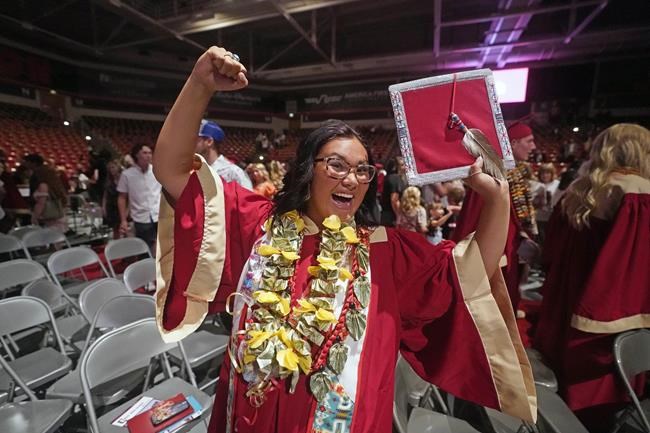
Amryn Tom reacts after graduating from Cedar City High School on Wednesday, May 25, 2022, in Cedar City, Utah. Tom is wearing an eagle feather given to her by her mother and a cap that a family friend beaded. (AP Photo/Rick Bowmer)

Iron County Superintendent Lance Hatch was not available for comment.

Hoksila Lakota gifted his nephew Elijah James Wiggins, who is of Lakota ancestry, an eagle feather in honor of his graduation from Cedar City High School on Wednesday. He said eagle feathers — called wamblii wakan in Lakota — are fundamental to celebrating once-in-a-lifetime achievements, with many believing they hold a connection to God.

“These aren’t something you find on the floor and do whatever with,” he said. “These are sacred items given from grandfather to son or uncle to nephew.”

___

Metz reported from Salt Lake City.

Report Error Submit a Tip

The Free Press acknowledges the financial support it receives from members of the city’s faith community, which makes our coverage of religion possible.

More Stories

The port of Churchill — but done right

Editorial 4 minute read Preview

The port of Churchill — but done right

Editorial 4 minute read Saturday, Sep. 12, 2026

The seagoing grain carrier wasn’t christened with a champagne bottle. There was no confetti or streamers. Nevertheless, the Aug. 31 event marking the first shipment of grain to be loaded at the Port of Churchill since 2020 was celebrated like the launch of a brand new vessel.

The presence of the federal minister of northern and arctic affairs, provincial cabinet ministers and leaders and elders from several northern First Nations signalled that the fast-tracked process of refurbishing and buffing up Manitoba’s deep-water seaport gem is gaining momentum.

For OneNorth, the partnership of 29 First Nations and 12 northern communities which owns the Port of Churchill and the Hudson Bay Railway (both operated by the Arctic Gateway Group) the event heralded a new beginning. It’s been eight years since OneNorth purchased the port and railroad, and six years since grain was moved by rail through Manitoba and then by ship to European markets. Two more grain shipments, plus shipments of potash and critical minerals, will continue through the fall.

When Prime Minister Mark Carney solicited the premiers to suggest “nation-building” projects following his election in 2025, Premier Wab Kinew pitched a Manitoba trade corridor that would move wheat, critical minerals, potash and energy (oil or liquid natural gas) through the Port of Churchill.

Read
Saturday, Sep. 12, 2026

Downtown no place to be after dark, huge majority of Winnipeggers say in survey

Joyanne Pursaga 8 minute read Preview

Downtown no place to be after dark, huge majority of Winnipeggers say in survey

Joyanne Pursaga 8 minute read Friday, Sep. 11, 2026

Most Winnipeggers are afraid to walk alone downtown and believe the city needs more police officers, a new survey finds.

Winnipeg Police Service released its 2026 citizen survey Friday.

Downtown safety appears to remain a major concern, with just 44 per cent saying they feel very or reasonably safe walking alone in the area during the day. The number plummets to eight per cent overall at night, down from nine per cent in 2024, the last time the survey was conducted.

This year, 14 per cent of men felt very or reasonably safe walking alone downtown at night, compared to just three per cent of women.

Read
Friday, Sep. 11, 2026

Treating the disease we simply won’t insure

Rafiq Andani 5 minute read 2:00 AM CDT

There is a condition affecting tens of thousands of Canadians. In 2024, one national measure estimated that almost 120,000 people had the condition. The estimate captures only part of the problem.

Port of Churchill expansion could chase belugas away, U of M researcher says

Nicole Buffie 4 minute read Preview

Port of Churchill expansion could chase belugas away, U of M researcher says

Nicole Buffie 4 minute read Yesterday at 9:07 AM CDT

As plans to expand the Port of Churchill into a four-season trade corridor gathers momentum, a University of Manitoba researcher has published a report on what ship traffic could mean for the beluga whales that gather in the Churchill River estuary each summer.

Veronica Coppolaro said more vessels in the waterways bring a risk that belugas will stop using the estuary for migration, which would impact the ecological landscape, tourism and communities that rely on the animals for food and cultural purposes.

“There are studies showing that (noises) change the way they swim, they change the way (the whales) are vocalizing, they change their main activity, and so this (expansion) can have consequences at different levels,” she said.

The Churchill river estuary is a marine habitat where the Churchill River empties into Hudson Bay. During the summer months belugas gather in the area to feed and give birth.

Read
Yesterday at 9:07 AM CDT

Letters, Sept. 14

7 minute read Preview

Letters, Sept. 14

7 minute read Updated: 8:14 AM CDT

Worth it for who? Our transit system has been undergoing growing pains for the past year, ever since city staff completely messed up the system with their redesign.

Read
Updated: 8:14 AM CDT

Child hospitalized after being hit in Walmart parking lot

1 minute read Saturday, Sep. 12, 2026

Police are investigating after a child was struck by a vehicle in a Walmart parking lot on Kenaston Boulevard Friday evening.

At 9 p.m. officers from the Winnipeg Police Service traffic division attended to a motor vehicle-pedestrian collision in the 1600 block of Kenaston, police said Saturday.

A school-aged child was taken to hospital in unstable condition, police said, but the child was later upgraded to stable condition.

Police said the child sustained minor injuries and an investigation is ongoing.