A deep debt
Breaking bread and rolling through history on the trail south
Advertisement
Read this article for free:
or
Already have an account? Log in here »
To continue reading, please subscribe:
Digital Subscription
One year of digital access for only $1.44 a week*
- Enjoy unlimited reading on winnipegfreepress.com
- Read the E-Edition, our digital replica newspaper
- Access News Break, our award-winning app
- Play interactive puzzles
*Billed as $5.77 plus GST every four weeks. After 52 weeks, price increases to the regular rate of $19.95 plus GST every four weeks. Offer available to new and qualified returning subscribers only. Cancel any time.
To continue reading, please subscribe:
Add Free Press access to your Brandon Sun subscription for only an additional
$1 for the first 4 weeks*
- Enjoy unlimited reading on winnipegfreepress.com
- Read the E-Edition, our digital replica newspaper
- Access News Break, our award-winning app
- Play interactive puzzles
*Your next Brandon Sun subscription payment will increase by $1.00 and you will be charged $17.95 plus GST for four weeks. After four weeks, your payment will increase to $24.95 plus GST every four weeks.
Read unlimited articles for free today:
or
Already have an account? Log in here »
Hey there, time traveller!
This article was published 11/06/2022 (1589 days ago), so information in it may no longer be current.
The paddlewheeler from Minnesota nudged the shore of the Red River at the forks of the Rat River and lowered its gangplank. When my ancestors — the very first of a coming wave of international migrants — stepped onto terra firma, they had no idea of the history of the land on which they walked. They had been offered free land to till — 60 acres per family — and freedom to follow their Mennonite faith. Like their salvation, the land truly was free: free to them. But in both cases, it cost someone else dearly.
The Anishinaabeg were the caretakers of this corner of the country. The Creator of the land, Gitche Manitou from whom our province would get its name, had given The People everything they needed to live here. The rivers were given them to travel and to fish. The bizhiki and waawaashkeshi — buffalo and deer — were given them to hunt. And then, through a treaty that would be repeatedly eroded with time, the Anishinaabeg were told that the land was no longer theirs. Three years before the arrival of the Mennonites, they were told to choose a block of territory equivalent in size to… 60 acres per family. They chose two areas: the Roseau River and the Brokenhead First Nation Reserves.
From time to time in those early days, the Mennonite settlers were visited by hungry Indigenous visitors asking for food. The settlers had no idea that when they offered braut and vota to their guests, they were serving those who had once been lords of the land that bore these gifts; that by so doing, they were serving the One who had been Lord of Heaven, but came down to identify with the brokenhearted.
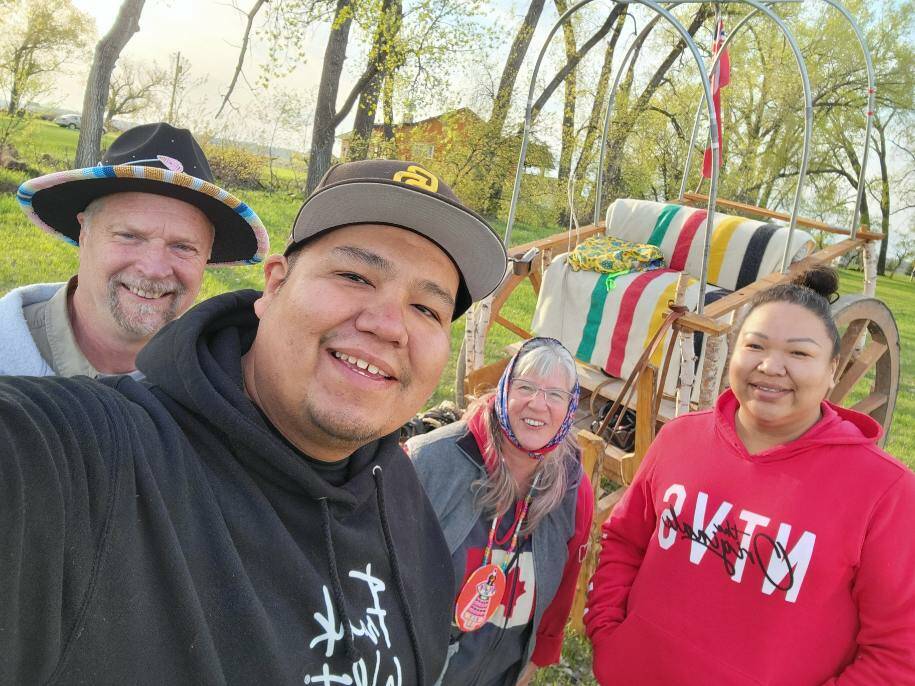
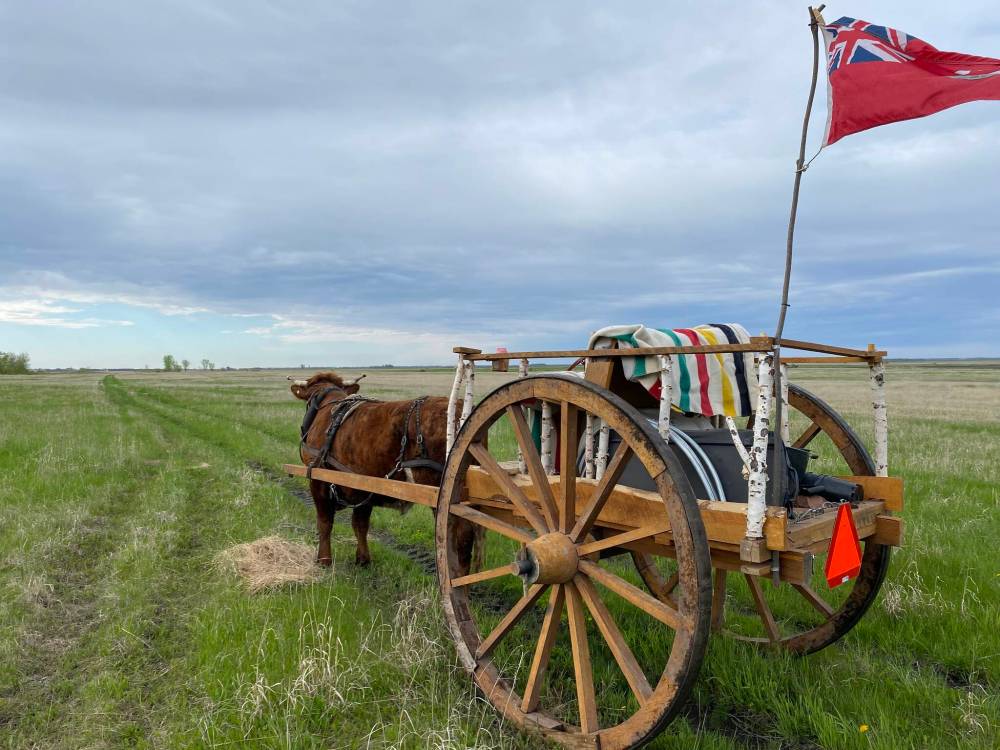
My feelings are deeply mixed. I am so thankful that 146 years after my ancestors landed here, I have a wonderful place I can call my home. Yet I am so sad that my gain came at such a loss to those entrusted by our Creator as stewards of the land. In planning our oxcart trip, I realized that the Red River Trail passed right through Roseau River First Nation. Could this be my opportunity to express my debt and gratitude? About 30 of us outsiders were graciously invited to have a ceremony with some Anishinaabe leaders on a piece of sacred ground right where the old trail crossed. With gifts and faltering words we visitors tried to describe what our hearts felt. Chief Craig Alexander humbly received what we had to offer and showered us with gifts and blessing in return. Afterwards we shared a feast of bannock, forma vorscht and stories. An old wall had started to crumble. Hugs, selfies and new bonds of friendship were filling the gap.
Miigwech to Ogima Craig Alexander for receiving us, Kirby Nelson for organizing the ceremony and Jim and Zongiday Nelson for their prayer, gifts and stories.
Pass the buffalo, hold the pee
…The novel treat of a fresh buffalo-steak served up in the style of the country — that is to say, roasted on a forked stick before the fire; a keen appetite their only sauce, cold water their only beverage.
A mile before the American border, our friends, Nika and Denise, joined us on the trail for this ‘novel treat.’ The ‘country-style’ cooking method was surprisingly easy and successful — the buffalo was delicious. There was only one thing missing from the experience.
I once read in a Louis L’Amour Western of how the hero, who had killed a buffalo, needed some salt for his meat. Cutting a little deeper, he reached the bladder of the animal. This he proceeded to puncture, drizzling the contents over his steak. Sadly for our cookout, we didn’t have a buffalo bladder available and were forced to use the white, iodized alternative.
Al Capone? Not this time
Crossing the international border 12 miles east of Emerson isn’t that unusual. Many people — usually migrants or smugglers — have made use of the old Red River Trail crossing to enter or leave the Canada. In fact, everyone who lives in the area knows that Al Capone used this hidden ‘port of entry’ to bring his bootleg whiskey from Winnipeg into the prohibitionist U.S. A new friend in Minnesota told me his family, living just on the American side, would leave their barn door open for Capone to enter with his wagon. By morning he’d be gone. “Did they just turn a blind eye?” I asked. “Oh no. They were on the take. Times were hard back then.”
In the 1800s, when the Red River Cart drivers used to cross, the whole ‘international border’ concept and location were fairly nebulous. Passports and paperwork were unheard of. Of course that has all changed. But among those who have crossed on the trail within the last century, my attempt would be different. I was trying to do it legally.
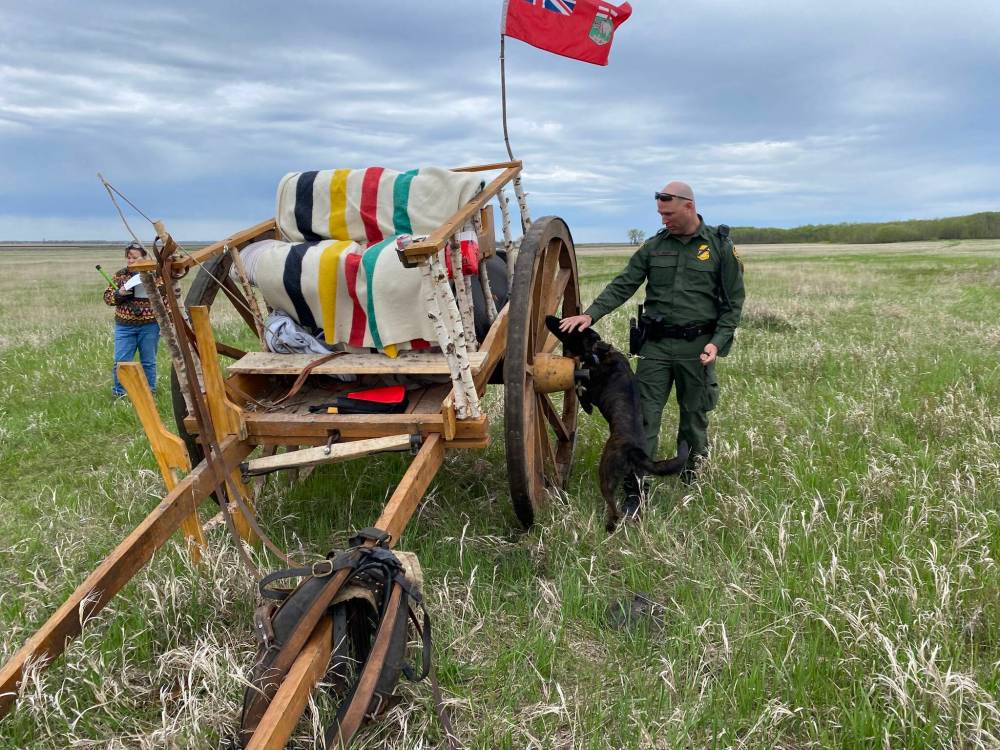
The difficulty was not on account of authorities digging in their heels. Everyone was quite enamoured with the idea. There was just no precedent. But after innumerable phone calls to nine different parties on both sides of the border, it was finally arranged that an American vet, homeland security and border authority would meet Zik and I at the closest accessible road, a half mile south of the border. The border authority even brought a sniffer dog — ostensibly to check for illicit imports, but he hinted he was more interested in a good story to tell at the end of the day.
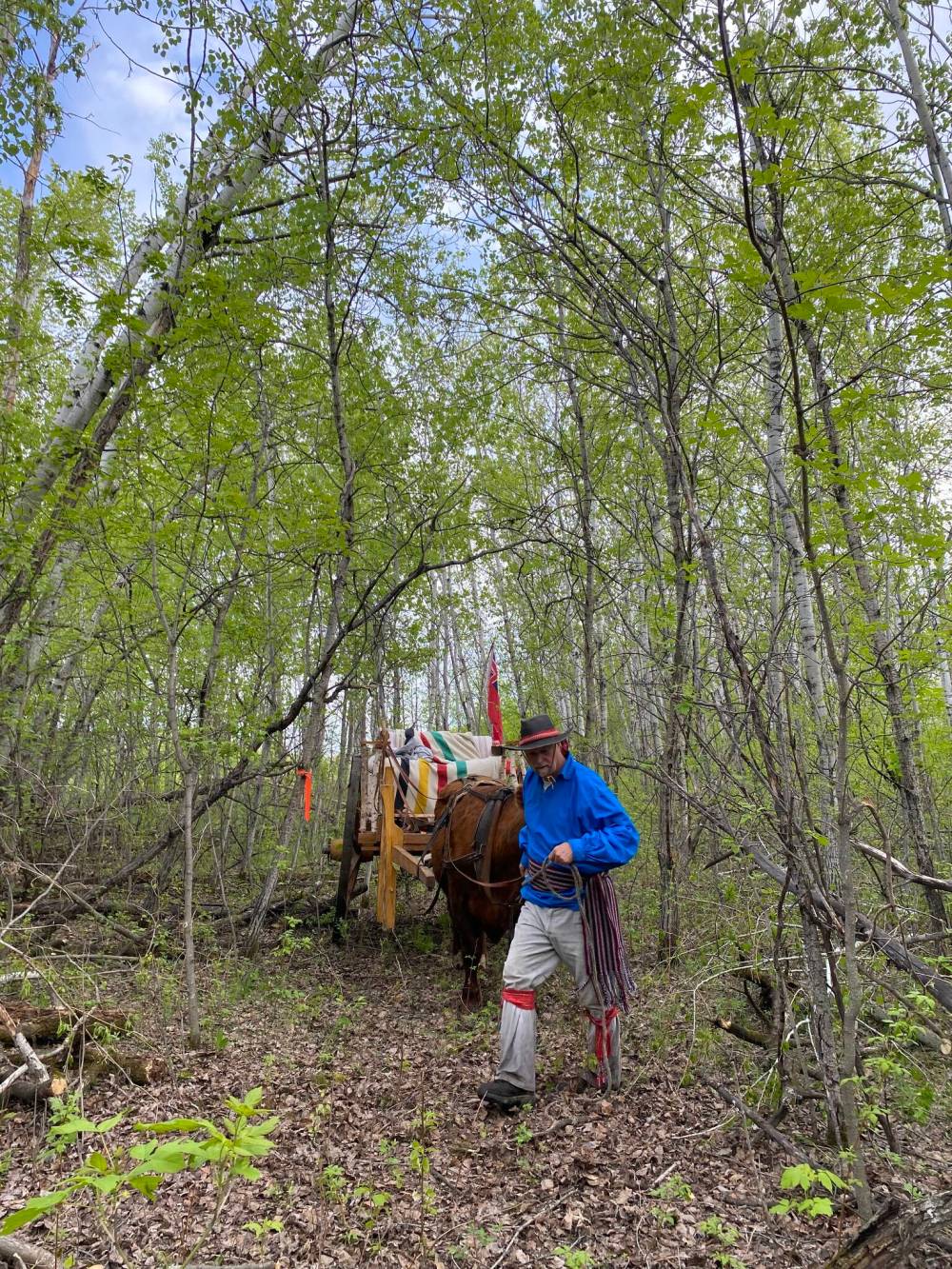
All the humanity in uniforms with their protocols to complete didn’t take away from the fun I had had in the actual crossing. Brent Chubaty, the landowner on the Canadian side, had gone the day before to flag my approach to the border, and cut a path through the new growth of trees. I had a chainsaw along to take out a couple of large trees that had fallen across the much clearer path on the American side. Patty walked with me as far she was allowed (and maybe a little further) to take some pictures. I have to admit it was quite a rush being on unaltered Red River Trail with cart and ox for the first time since 1870.
Our biggest welcome to the United States came after the authorities had left. Terry Kent, the landowner on the American side, came over to see if we needed anything. Then his daughter Danika, a farmer herself, popped by with feed for Zik and some eggs to replace the ones that had been confiscated from Patty. Patty had driven around through the Emerson/Pembina Port of Entry with the RV. She had wisely decided to make a legal border crossing in the more conventional way.
Homing instinct
I have read that Monarch butterflies winter in one specific place in Mexico. In spring, they make their own international migration to, say, our backyard in Winnipeg. There they lay their eggs which transform, through a four-stage miracle, to become airborne as black-and-orange adults. This cycle repeats itself another two or three generations before the end of summer, with Patty taking innumerable photographs of every stage of every generation of Monarchs. And then — and here’s the amazing thing — that last generation of butterflies before winter flutters off and finds its way to that exact spot in Mexico where their great-grandparents had departed in spring.
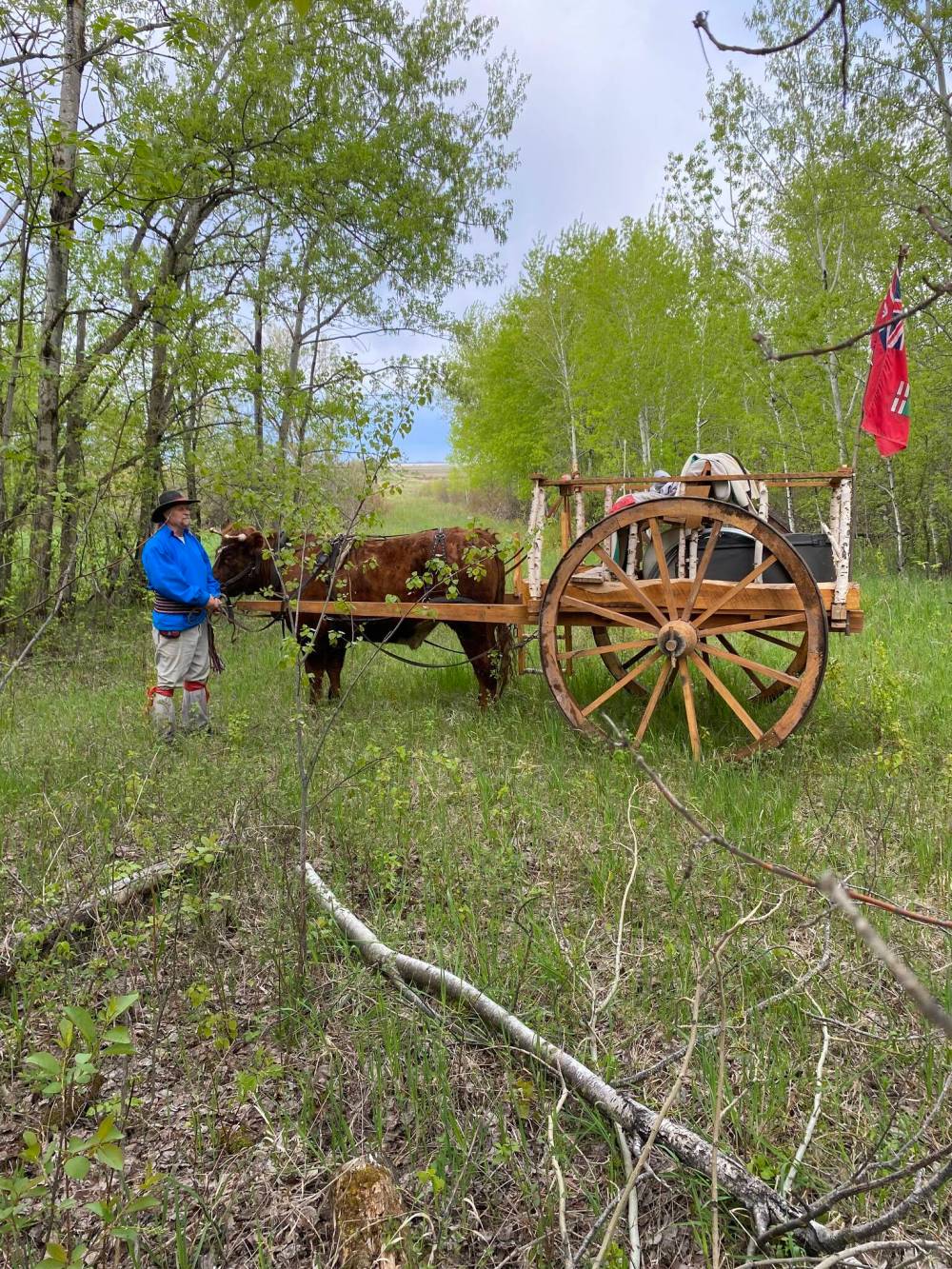
Besides being surely the most photographed Shorthorn ox in the history of the breed, and being roughly the same colour, I’m wondering if Zik shares a third trait with the Monarch. As we crossed the border and were heading to St. Paul, he seemed to be picking up speed. Does Zik have some latent memory of where his great-grandmother came from?
As the story has come to me, a 16-year-old boy named Adam McKenzie was sent by his father on a pretty gutsy mission. He was to go from their home near Portage la Prairie down to St. Paul, Minn., to purchase some Shorthorn cows. Kenneth, the dad, wanted to start a purebred Shorthorn herd with the bull he already had. On his way back home on the Red River Trail, herding his newly purchased cows ahead of him, Adam ran into an Indigenous encampment. If they were tempted to exact some beef as payment for crossing their land, they didn’t. They were so impressed with this courageous teenager that they let him travel on in peace.
As Zik makes his way inexorably homeward, I’ve noticed something else about him. The Shorthorn breed was actually developed in England and there might be a vestige of English propriety about him. It shows up in Zik’s predilection for the left side of the road. Considering his English sensibilities, it’s a good thing our road south is the one less travelled. “And that,” according to the famous poem about English roads, “has made all the difference.”

Advertisement Advertise With Us
Advertisement Advertise With Us