Common-law couples on the rise, Statistics Canada data show

Advertisement

Advertise with us

TORONTO - A new tranche of census data shows the typical Canadian family is diverging further from the nuclear structure that was once the norm, with more couples living in common-law partnerships and without children.

Read this article for free:


or

Already have an account? Log in here »

To continue reading, please subscribe:

Subscribe and receive a limited-edition Free Press branded hat or tote.

Digital Subscription

One year of digital access for only $205*

  • Enjoy unlimited reading on winnipegfreepress.com
  • Read the E-Edition, our digital replica newspaper
  • Access News Break, our award-winning app
  • Play interactive puzzles

*First annual payment billed as $205.00 + GST for one year. This annual subscription will automatically renew at $233.00 + GST every 52 weeks (10% off the regular annual price of $259.35). Offer available to new and qualified returning subscribers only. Cancel any time.

To continue reading, please subscribe:

Add Free Press access to your Brandon Sun subscription for only an additional

$1 for the first 4 weeks*

  • Enjoy unlimited reading on winnipegfreepress.com
  • Read the E-Edition, our digital replica newspaper
  • Access News Break, our award-winning app
  • Play interactive puzzles
Start now

*Your next Brandon Sun subscription payment will increase by $1.00 and you will be charged $17.95 plus GST for four weeks. After four weeks, your payment will increase to $24.95 plus GST every four weeks.

Hey there, time traveller!
This article was published 13/07/2022 (1495 days ago), so information in it may no longer be current.

TORONTO – A new tranche of census data shows the typical Canadian family is diverging further from the nuclear structure that was once the norm, with more couples living in common-law partnerships and without children.

Statistics Canada released results Wednesday from the 2021 national census that show 23 per cent of couples who live together are unmarried — the highest percentage of any G7 nation.

“Since Statistics Canada first began tracking common law couples 40 years ago, in 1981, there’s been enormous growth, both in the number and the proportion of couples that are living common law,” said Nora Galbraith, a senior analyst with Statistics Canada’s centre for demography.

A new tranche of census data shows Canadians are increasingly likely to live in common-law partnerships rather than officially tying the knot.

“The number has actually multiplied over five times in the last 40 years. In comparison, when we look at married couples, the growth has been much more modest.”

Over the same period, the number of married couples grew by just a quarter.

The trend, Galbraith said, could be attributed to a number of things.

“It’s reflecting different societal changes, potentially more secularization within the culture in Canada,” she said.

In many instances, common-law partners are opting for that sort of union after being in a previous relationship, Galbraith added.

“When we look at stepfamilies, the share that are common law is much higher than among couples without children,” she said.

Statistics Canada said the prevalence of common-law partnerships is due in part to the union’s popularity in Quebec, where 43 per cent of Canada’s common-law couples live.

Omitting Quebec, the agency said the share of common-law couples in Canada would have been 17 per cent in 2021.

June 21, 2011 In this June 21, 2011 photo, Anna Noorenberghe plays in the irrigation sprinkler on the family farm in Mt. Brydges, Ont. THE CANADIAN PRESS/Dave Chidley

Meanwhile, the data reveals the percentage of couples with a child at home is on the decline.

On census day in 2021, 50 per cent of couples who lived together had children, compared to 51.1 per cent in 2016. In 1981, the proportion was 64 per cent.

Statistics Canada said that’s because of the “combined trends of population aging and decreasing fertility.”

“As the average age within the population keeps shifting a bit older, that means that people that are in couples are older on average, so they’re less likely to be at that stage of life where they have younger dependent children living at home with them,” Galbraith said.

But at the same time, people are less likely to have children. In 2020, the most recent year for which Statistics Canada has data, there was an average of 1.4 children per woman, Galbraith said — a record low.

“At the same time, the average age of child-bearing has steadily increased over time,” she said. “With these shifts, the result is that fewer young adults that are in a couple have children at home today.”

The census data show the share of single-parent households has stayed relatively steady, but the percentage of children living predominantly with their fathers has risen.

The share in 2021 was 21 per cent, compared to 14 per cent in 1981.
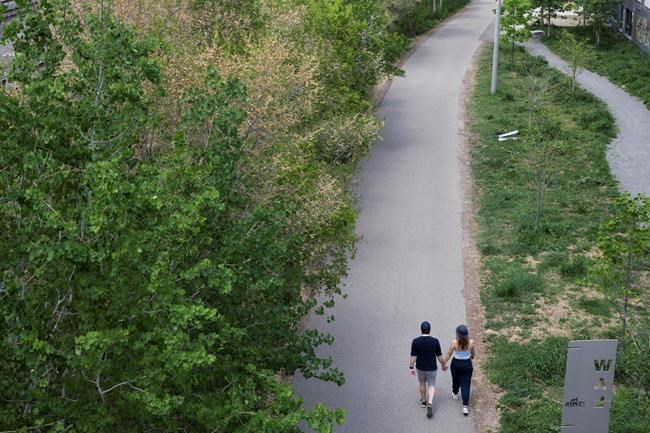
A couple holds hands as they walk along the West Toronto Railpath during Sunday, May 23, 2021. A new tranche of census data shows Canadians are increasingly likely to live in common-law partnerships rather than officially tying the knot. THE CANADIAN PRESS/Tijana Martin

And for the first time, the snapshot of Canadian families also includes more detailed information on gender diversity within families after Statistics Canada amended the census in 2021 to differentiate between sex assigned at birth and gender.

The data show that one in 250 couples includes at least one person who is transgender or non-binary.

Margo Hilbrecht, executive director of the Vanier Institute of the Family, said census releases like this are key to ensuring government policy keeps up with social change.

“This is the first step in motivating policymakers to reassess what they’ve been doing and consider where other changes need to be made,” she said.

This report by The Canadian Press was first published July 13, 2022.

Report Error Submit a Tip

More Stories

Big Loser’s latest a winning mix of country, folk

Ben Waldman 5 minute read Preview

Big Loser’s latest a winning mix of country, folk

Ben Waldman 5 minute read Yesterday at 6:00 AM CDT

The yellow trucker hat for sale on Facebook Marketplace said “Selkirk Lumber,” so Adam Wayne Brown knew he had to hammer home a deal.

Like the other millennial members of Winnipeg folk-country band Big Loser, the bassist has an affinity for the nostalgic, taking every opportunity — through music, through lyrics and through wardrobe — to recall the unique circumstances of growing up in a changing Interlake.

“I remember the matte yellow trucks driving around — the lumber trucks — and so I’ve had this strange memory of something disappearing from my youth and then persisting,” says Brown, who, like the band’s frontman Alex Paradoski, moved to Winnipeg more than a decade ago.

“I have a photo of the Lockport Bridge in my dining room,” chimes in Paradoski, whose first job as a teenager was bunning wieners and chopping fries at Skinner’s, a drive-in mainstay since 1929 along Highway 44.

Read
Yesterday at 6:00 AM CDT

Impaired driving victim honoured

Morgan Modjeski 6 minute read Preview

Impaired driving victim honoured

Morgan Modjeski 6 minute read Yesterday at 6:16 PM CDT

Ten years after he was killed in a collision involving an impaired driver in 2016, Robbie Anderson’s name has been added to MADD Canada’s Manitoba Memorial honouring those killed in drunk and drug-impaired-related crashes.

His older brother Chris Anderson, was one of two dozen people who gathered at the Glen Eden Funeral Home and Cemetery in West St. Paul Saturday to remember their loved ones, 86 victims whose names are etched into the granite monument near the heart of the graveyard.

“It’s heavy,” said Anderson when asked what it was like to be part of the ceremony and see his brother’s name added. “It’s been something I’ve been thinking about for a while.”

Grateful for MADD’s work and its efforts to honour Robbie, who was 27 when he died, Anderson said his brother, represented the “absolute best of us.”

Read
Yesterday at 6:16 PM CDT

Corroded Arlington overpass yields way for new hope of spanning urban chasm

Melissa Martin 6 minute read Preview

Corroded Arlington overpass yields way for new hope of spanning urban chasm

Melissa Martin 6 minute read Yesterday at 2:00 AM CDT

It’s an interesting quirk of timing, perhaps, that the end of two of Winnipeg’s most unlovely features are coming into view in the same few weeks. The rail lines that split the city in half, and the bridge that was built to tie it back together. The original problem, and the solution.

And in the confluence of those two ends, we have an opportunity to dream of what a better Winnipeg can be.

At a news conference on Wednesday, former federal transport minister Lloyd Axworthy laid out a vision for a rail line bypass that would remove more than 120 railway crossings from Winnipeg, route them through Crown and Manitoba Hydro corridor land south of the city, and reclaim 250 acres in the urban core for greenspace and development.

The next step is to focus on how to make it happen. Nothing of this scope comes easy. This new bypass plan emerged from a two-year feasibility study that Premier Wab Kinew had tasked Axworthy with back in 2024. Now, Axworthy will helm a new 90-day feasibility study zooming in on that route specifically.

Read
Yesterday at 2:00 AM CDT

HSC weapons scanners effective, needed at other hospitals: nurses union

Carol Sanders 5 minute read Preview

HSC weapons scanners effective, needed at other hospitals: nurses union

Carol Sanders 5 minute read Yesterday at 9:57 AM CDT

The AI weapons scanners at Health Sciences Centre have detected close to 2,000 items since they were installed at Manitoba’s largest hospital.

From March 6, 2025 to the beginning of this month, a total of 1,973 items had been flagged by the scanners and identified for further review, Shared Health said this week.

Knives, Swiss army knives and other multi-tools, drugs, alcohol, box cutters, syringes and other injection devices were detected, it said. The technology set up at entrances to the adult and children’s emergency rooms and the crisis response centre is designed to identify a wide range of objects that may require review under site safety protocols.

But Manitoba Nurses Union president Darlene Jackson said the technology isn’t available everywhere at HSC, and a sawed-off rifle was discovered in the adult ER earlier this month.

Read
Yesterday at 9:57 AM CDT

WRHA directs three care homes to accommodate surge of hospital patients

Malak Abas 5 minute read Preview

WRHA directs three care homes to accommodate surge of hospital patients

Malak Abas 5 minute read Friday, Aug. 14, 2026

The Winnipeg Regional Health Authority has directed three long-term care centres to make space for hospital patients, citing “exceptionally high demand for care across the health-care system.”

Read
Friday, Aug. 14, 2026

Manitoba family finalist for cattle producers environmental award

Aaron Epp 4 minute read Preview

Manitoba family finalist for cattle producers environmental award

Aaron Epp 4 minute read Yesterday at 2:00 AM CDT

A family in western Manitoba is one of seven finalists for a national environmental award honouring beef cattle producers.

Connor and Kyla English, alongside Connor’s parents, Brian and Leanne English, are nominated for the Canadian Cattle Association’s Environmental Stewardship Award. The 30-year-old award is presented to beef farmers and ranchers who explore innovative ways to protect, preserve and enhance their operations and the environment simultaneously.

This year’s recipient will be announced on Wednesday during a banquet at the Canadian Beef Industry Conference in Winnipeg.

The English family’s roots near Bradwardine — about 265 kilometres west of Winnipeg — date back to 1898. Today, Connor, Kyla, Brian and Leanne manage a herd of about 320 breeding cows on nearly 445 hectares (1,100 acres) of owned and rented pasture and forage land.

Read
Yesterday at 2:00 AM CDT