Many Canadian doctors struggle with burnout, depression and anxiety: survey

Advertisement

Advertise with us

TORONTO - The well-being of physicians across Canada has significantly decreased with many doctors reporting poorer mental health than before the COVID-19 pandemic, a new survey suggests.

Read this article for free:


or

Already have an account? Log in here »

To continue reading, please subscribe:

Subscribe and receive a limited-edition Free Press branded hat or tote.

Digital Subscription

One year of digital access for only $205*

  • Enjoy unlimited reading on winnipegfreepress.com
  • Read the E-Edition, our digital replica newspaper
  • Access News Break, our award-winning app
  • Play interactive puzzles

*First annual payment billed as $205.00 + GST for one year. This annual subscription will automatically renew at $233.00 + GST every 52 weeks (10% off the regular annual price of $259.35). Offer available to new and qualified returning subscribers only. Cancel any time.

To continue reading, please subscribe:

Add Free Press access to your Brandon Sun subscription for only an additional

$1 for the first 4 weeks*

  • Enjoy unlimited reading on winnipegfreepress.com
  • Read the E-Edition, our digital replica newspaper
  • Access News Break, our award-winning app
  • Play interactive puzzles
Start now

*Your next Brandon Sun subscription payment will increase by $1.00 and you will be charged $17.95 plus GST for four weeks. After four weeks, your payment will increase to $24.95 plus GST every four weeks.

Hey there, time traveller!
This article was published 25/08/2022 (1493 days ago), so information in it may no longer be current.

TORONTO – The well-being of physicians across Canada has significantly decreased with many doctors reporting poorer mental health than before the COVID-19 pandemic, a new survey suggests.

The Canadian Medical Association’s national physician health survey, released Thursday, indicates that 53 per cent of respondents reported symptoms of burnout, including emotional exhaustion.

The reported burnout rate among doctors was 1.7 times higher than it was in the association’s previous survey in 2017.
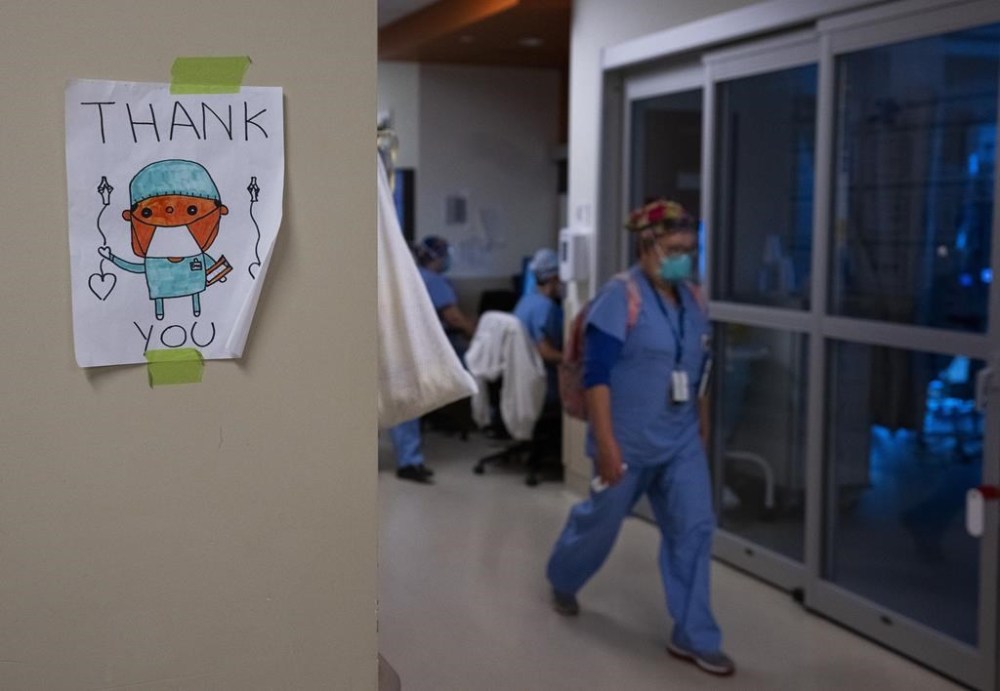
A health-care worker walks past a thank you sign in the intensive care unit at the Humber River Hospital during the COVID-19 pandemic in Toronto on January 25, 2022. A new survey suggests there is a significant decrease in the well-being of physicians across Canada as many doctors say their mental health is worse now than before the COVID-19 pandemic. The Canadian Medical Association's new National Physician Health Survey indicates 53 per cent of respondents report symptoms of burnout including emotional exhaustion and depersonalization. THE CANADIAN PRESS/Nathan Denette

The survey suggests that one-quarter of respondents were experiencing severe or moderate anxiety and almost half of the respondents were struggling with depression.

Forty-nine per cent of physicians who participated in the survey also indicated they were likely to reduce or modify their clinical hours in the next two years.

The association’s president, Dr. Alika Lafontaine, said the participants’ responses “reflect the current state of the health-care system,” adding the COVID 19 pandemic exacerbated many challenges physicians have been facing for years.

“People pulling back full-time clinical practice, people doing different things in order to mitigate burnout, more pervasive negative sentiment towards the direction that the health-care system is going and then just how this is affecting certain types of physicians more … family physicians in particular are really struggling,” he said in a recent interview.

The online survey involved 4,121 physicians, medical residents and medical students who participated between Oct. 13 and Dec. 13, 2021.

Lafontaine, who is a practising anesthesiologist in Grande Prairie, Alta., said doctors are resilient but the stress levels they face are very high.

“We’ve been trained in situations where stress is a normal part of work,” he said. “We know that providing care in the medical system is a stressful job, but that stress has just completely gone out of control.”

The survey suggests 36 per cent of physicians have had thoughts of suicide at some point in their life, compared to 18 per cent of doctors saying they thought about suicide in 2017.

Fifty-seven per cent of all respondents said they always or often feel fatigued at work, and only 36 per cent of respondents saidthey always or often get optimal sleep.

Lafontaine said provincial governments across Canada have had an “obsession with efficiency” over the last two decades, and health-care providers have not received the support they need to make sure their work environments are sustainable.

He said health-care providers, administrators and governments should start working toward pan-Canadian solutions.

“And then make sure that we have the right priorities: focusing on sustainable work environments, making sure that high-quality, high-safety patient care is provided,” he said.

The Ontario government did not respond to a request by deadline asking what the province is doing to support health-care workers’ well-being.

Lafontaine, who was recently elected as the first Indigenous president to the Canadian Medical Association, said the federal government can help by working toward more collaboration in health human resources.

A spokeswoman for Health Canada said the federal government recognizes that healthcare workers are exhausted and it understands the need to sustainably increase the supply of health care workers and create healthier workplaces to support retention and their mental health.

Natalie Mohamed said in a statement the government is working with the provinces and territories to identify solutions to address significant health human resources challenges, such as access to health care services in rural and remote communities.

“(The April budget) provided $26.2 million in funding to increase the forgivable amount of student loans for doctors, nurses and other eligible practitioners who practice in rural and remote communities,” she said.

“(It) also provided $115 million over five years, with $30 million ongoing, to expand the Foreign Credential Recognition Program and help up to 11,000 internationally trained health care professionals per year get their credentials recognized and find work in their field.

Temporary emergency room closures have plagued hospitals across the country, particularly rural ones, throughout the summer as the health system contends with a shortage of nurses and other staff.

Ontario Premier Doug Ford met with the premiers of Nova Scotia, New Brunswick and Prince Edward Island in Moncton, N.B., on Monday to discuss the ongoing challenges in the healthcare system.

The premiers offered few specifics but said Canada’s leaders need to come together to create a plan to reduce the emergency wait times and surgery backlogs.

This report by The Canadian Press was first published Aug. 25, 2022.

Report Error Submit a Tip

More Stories

Sequestered skivvies seem like last straw

Maureen Scurfield 5 minute read Yesterday at 2:00 AM CDT

DEAR MISS LONELYHEARTS: My husband, who earns a hefty income, stayed in the city most of the summer working, except for a few long weekends with the kids and me at the cottage. He has giant work projects that need daily tending.

I work hard, too, with our four kids, two dogs and a cat. But I have to tell you I got a shock last week after coming home to organize my family team for a thorough cleaning of our three-storey home.

You’ll never guess what they found up in the attic — hidden boxes of sexy women’s lingerie that all looks brand-new.

I’ve kept my mouth shut so far, but my mind is spinning.

New series terrific addition to RWB repertoire

Holly Harris 5 minute read Preview

New series terrific addition to RWB repertoire

Holly Harris 5 minute read 2:01 AM CDT

‘See the music, hear the dance,” is a famous quote from quintessential ballet influencer George Balanchine, whose pithy bons mots have defined much of American classical dance since the legendary Russian-born choreographer first blazed a trail with the New York City Ballet.

Local balletomanes were given a golden opportunity to experience both up-close-and-personal Thursday when the Royal Winnipeg Ballet officially kicked off its 87th season with its newly minted Studio Series, which runs until Sunday.

The brainchild of the company’s artistic director, Christopher Stowell, the series features an abridged “concert version” of Balanchine’s seminal Who Cares?, set to a playlist of catchy George Gershwin tunes that make up the backbone of the Great American Songbook.

The Studio Series is the latest initiative taken by Stowell as he settles into his arguably still new position. Some of those endeavours will invariably stumble; others will hit their mark. This venture belongs in the latter category, bringing a 500-plus-year-old art form, often perceived as rarified, to audience members who may be hesitant, shy or just plain intimidated to visit the cavernous Centennial Concert Hall.

Read
2:01 AM CDT

The never-ending, continuing war in Ethiopia

Gwynne Dyer 5 minute read 2:01 AM CDT

Another October coming up, and still the Nobel Peace Prize Committee refuses to give Donald Trump his prize. They even gave one to Barak Obama, who was Black and a Democrat and had only been in office for 20 minutes. Meanwhile, they ignore a man truly worthy of the prize, a man who ended eight wars last year alone. (He said so himself.)

Unfortunately the prize committee has a long record of backing the wrong person.

They gave it to Aung Sang Suu Kyi of Myanmar, who defended the Rohingya genocide: “I don’t think there is ethnic cleansing going on,” she said.

They gave it to former U.S. secretary of state Henry Kissinger, who ordered the secret carpet-bombing of Cambodia: “The illegal we do immediately; the unconstitutional takes a little longer.”

Klein wants city-run, maintained ‘bridge’ space for homeless people

Malak Abas 5 minute read Preview

Klein wants city-run, maintained ‘bridge’ space for homeless people

Malak Abas 5 minute read Thursday, Sep. 24, 2026

Mayoral candidate wants city to set up a 24-hour community space pilot project for homeless Winnipeggers

Read
Thursday, Sep. 24, 2026

Happy email debt forgiveness day

Tory McNally 8 minute read Preview

Happy email debt forgiveness day

Tory McNally 8 minute read 2:01 AM CDT

There are few things more capable of producing an immediate feeling of guilt than opening your inbox and seeing an email you have not answered.

You know the one. It has been sitting there for three days or three months or perhaps long enough that responding now feels less like answering an email and more like reopening a historical case. You read it, think, “I really need to deal with that,” and then close it again.

The next week you see it, feel slightly worse and tell yourself you will answer it when you have more time. A month later, you are considering whether it would be less embarrassing to change your name and move to another province.

Fortunately, there is a solution: Sept. 30 is Email Debt Forgiveness Day, and I think it may be one of the most compassionate holidays we have invented.

Read
2:01 AM CDT

Time for the PUB to review Winnipeg water rates

Editorial 4 minute read Preview

Time for the PUB to review Winnipeg water rates

Editorial 4 minute read 2:01 AM CDT

We take you now to just over a month ago, to the Public Utilities Board and its decision about water and sewer rates for Russell, Binscarth, Angusville, Rossburn and Gambler First Nation.

Why? Just wait.

The area is supplied with water and sewage services by the Russell-Binscarth Water and Wastewater Utility, which has a total of 1,014 customers.

As the PUB noted in an Aug. 27, 2026 order on the utility’s rates, “The [water treatment plant] gets water from two groundwater wells that were upgraded in 2016 and the raw water main was installed in 1984. The water distribution system is primarily cast iron pipe. The raw water line will need to be upgraded in the near future to keep up with demand.”

Read
2:01 AM CDT