Front line farming: Bombs disrupt critical Ukraine industry

Advertisement

Advertise with us

NOVOMYKOLAIVKA, Ukraine (AP) — An unexploded rocket sticks out of a field, and another is embedded in the ground of the farm compound. Workers found a cluster bomb while clearing weeds, and there's a gaping hole in the roof of the shrapnel-scarred livestock barn.

Read this article for free:


or

Already have an account? Log in here »

To continue reading, please subscribe:

Subscribe and receive a limited-edition Free Press branded hat or tote.

Digital Subscription

One year of digital access for only $205*

  • Enjoy unlimited reading on winnipegfreepress.com
  • Read the E-Edition, our digital replica newspaper
  • Access News Break, our award-winning app
  • Play interactive puzzles

*First annual payment billed as $205.00 + GST for one year. This annual subscription will automatically renew at $233.00 + GST every 52 weeks (10% off the regular annual price of $259.35). Offer available to new and qualified returning subscribers only. Cancel any time.

To continue reading, please subscribe:

Add Free Press access to your Brandon Sun subscription for only an additional

$1 for the first 4 weeks*

  • Enjoy unlimited reading on winnipegfreepress.com
  • Read the E-Edition, our digital replica newspaper
  • Access News Break, our award-winning app
  • Play interactive puzzles
Start now

*Your next Brandon Sun subscription payment will increase by $1.00 and you will be charged $17.95 plus GST for four weeks. After four weeks, your payment will increase to $24.95 plus GST every four weeks.

Hey there, time traveller!
This article was published 21/09/2022 (1423 days ago), so information in it may no longer be current.

NOVOMYKOLAIVKA, Ukraine (AP) — An unexploded rocket sticks out of a field, and another is embedded in the ground of the farm compound. Workers found a cluster bomb while clearing weeds, and there’s a gaping hole in the roof of the shrapnel-scarred livestock barn.

All work has halted on this large eastern Ukrainian farm, whose fields and buildings have been hit so many times by mortars, rockets, missiles and cluster bombs that its workers are unable to sow the crater-dotted land or harvest crops like wheat.

Returning to planting and harvesting “will be difficult, very difficult,” said Viktor Lubinets, who handles crop production at the Veres farm. Even if the fighting ends, the fields must first be cleared of unexploded ordnance and shrapnel.
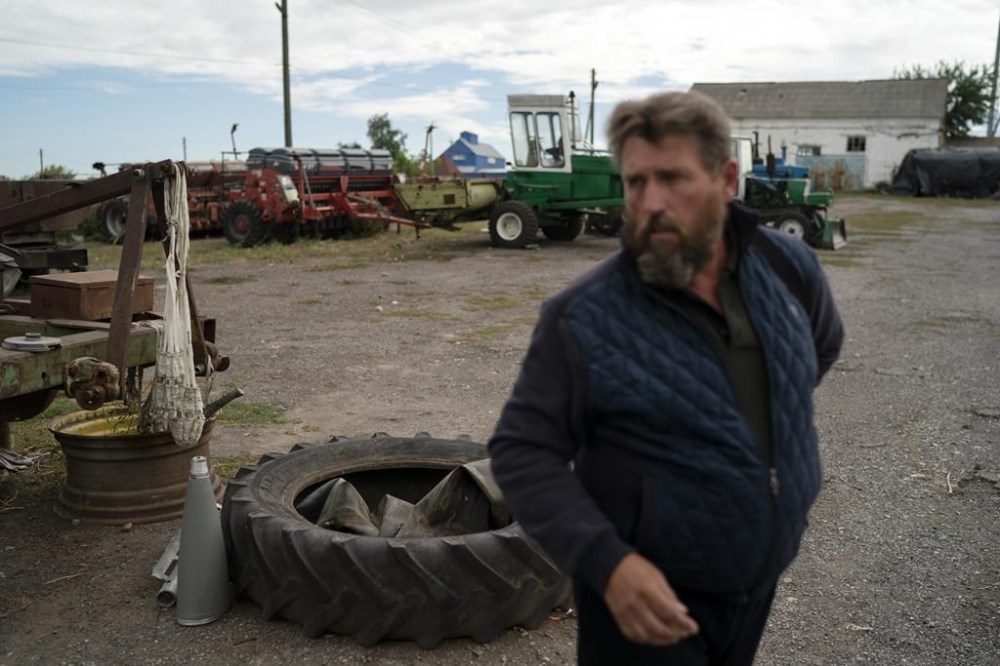
Viktor Lubinets stands next to a part of a rocket that was found on an area at the Veres farm, Novomykolaivka, eastern Ukraine, Saturday, Sept. 10, 2022. Returning to sowing and harvesting
Viktor Lubinets stands next to a part of a rocket that was found on an area at the Veres farm, Novomykolaivka, eastern Ukraine, Saturday, Sept. 10, 2022. Returning to sowing and harvesting "will be difficult, very difficult," said Lubinets, an agronomist at the Veres farm. Even if the fighting ends, the fields must be cleared of unexploded ordinance and shrapnel before they can be worked. (AP Photo/Leo Correa)

And the fighting is far from over. The roar of an incoming projectile fills the air, the nearby detonation shaking the ground and sending a plume of black smoke into the sky. Lubinets barely flinches.

“I’ve got used to it. It was frightening during the first couple of days, but now — a person can get used to anything,” the 55-year-old said, the smoke dissipating behind him. “And we have to work. If we give all this up, we will abandon, other farmers will abandon, what will happen then?”

Agriculture is a critical part of Ukraine’s economy, accounting for about 20% of gross national product and 40% of export revenue before the war, according to the U.N. Food and Agriculture Organization. The country is often described as the breadbasket of Europe and millions rely on its affordable supplies of grain and sunflower oil in Africa, the Middle East and parts of Asia where many already face hunger.

But Russia’s invasion in late February has dealt a heavy blow, damaging farmland, crops, livestock, machinery and storage facilities, as well as severely hampering transport and exports.

The FAO estimated in July that preliminary damage to the industry ranges from $4.3 billion to $6.4 billion — 15% to 22% of the total value of Ukraine’s pre-war agriculture sector, estimated at $29 billion.

The Veres farm is a stark example. Its 5,700 hectares (14,085 acres) of land would usually grow wheat, barley, corn and sunflowers, and it had 1,500 cattle.

But its location made it particularly vulnerable in what has been largely an artillery war. It lies in an almost direct line between the strategic city of Izium, seized by Russian forces in early April and retaken by Ukraine in September, and Kramatorsk, the largest city in the eastern Donetsk region still in Ukrainian hands.

The farm complex has been hit 15 to 20 times, Lubinets says, and he’s lost count of how many times the fields have been struck. The grain storage has been shelled, the electricity generation facility was destroyed, and multiple rockets rained down on the cattle barn — empty since the livestock was sold off as the war started. Of a prewar workforce of 100 employees, most were evacuated and only about 20 remain.

Workers managed to plant wheat, but they didn’t have time to harvest it. The crops burned down during a bombing on July 2.

Lubinets was devastated. As an agronomist, he had been looking forward to examining the results of five new types of wheat they had planted, part of annual research on crop performance.

“All this research work was destroyed,” he said. “You see, how can I feel? How can a person feel if you wanted to do something, but somebody came and ruined it?”

Some farms in the area have been luckier. Nearly 10 kilometers (six miles) to the southwest of Novomykolaivka, a combine harvester moves methodically up and down a field, slicing dried sunflowers from their stalks and pouring their black seeds into waiting trucks.

The war forms a jarring backdrop. The machine is scarred by shrapnel from an exploding rocket, and a nearby field is mined. Helicopters skim over the sunflowers and corn, and fighter jets streak low above the rolling plains.

Farmworkers, breaking for lunch in the field, ignore the booms of distant shelling.
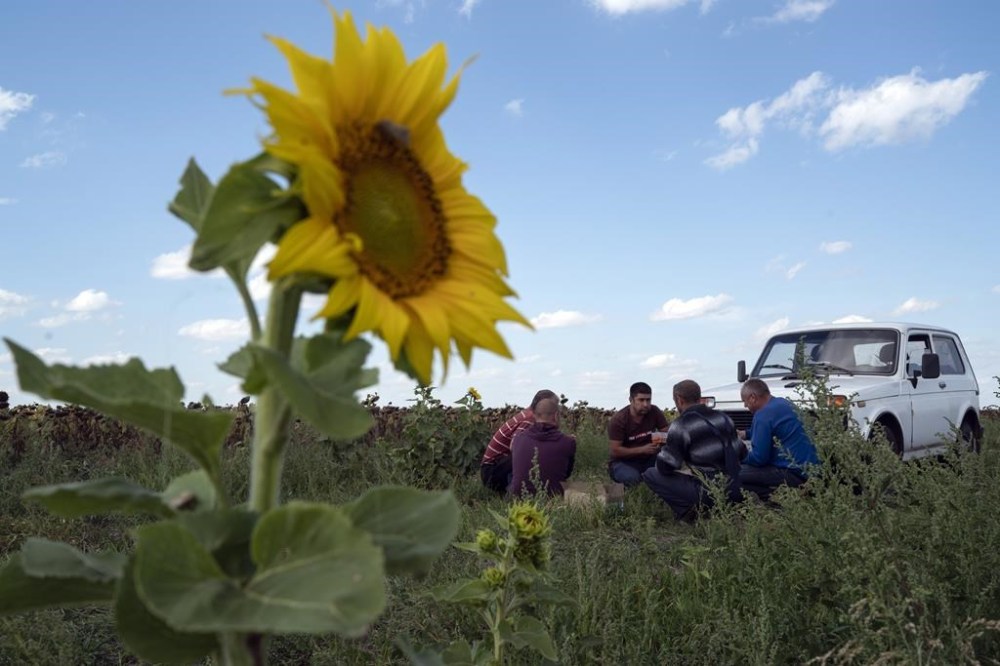
Farm workers take a pause for lunch during the sunflowers harvesting on a field in Donetsk region, eastern Ukraine, Friday, Sept. 9, 2022. Ukrainian farms near the front lines are facing constant shelling that is damaging fields, equipment and buildings and making it difficult to plant and harvest crops. (AP Photo/Leo Correa)

“It became very hard and scary to work during the war, because you don’t know what to expect and where,” said 36-year-old worker Maksim Onyshko. “The war has never brought anything good. Only sorrow and harm.”

Sergiy Kurinnyi, director of the 3,640-hectare KramAgroSvit farm, said it had been risky to plant sunflowers in May without knowing whether the front line would engulf the fields.

“We could see with our naked eyes the military action,” Kurinnyi said. “So there was a risk of whether we could harvest these crops, but we decided to take this risk.”

It paid off, with good weather helping produce a decent yield from the 1,308 hectares of sunflowers. They also planted 1,434 hectares of wheat, 255 hectares of barley, 165 hectares of winter rapeseed and some animal feed crops. They lost 27 hectares of wheat to a fire triggered by bombing but managed to harvest the rest.

A rocket strike killed 38 of the farm’s 1,250 cattle in April, prompting managers to sell off most of the remaining herd, keeping 215 cattle in its dairy production. The next day, a rocket hit the equipment storage area, destroying a grain harvester and damaging other equipment, Kurinnyi said.

Calculating the total loss from the war isn’t easy, Kurinnyi said, but he estimated that about 10 million hryvnias (about $270,000) had been lost from crop production and around 1 million hryvnias ($26,700) for the 38 cattle killed in the strike.

With Ukraine’s counteroffensive pushing the front line further east, he said they were more confident of being able to plant and were starting to prepare the soil for winter crops.

But for the heavily damaged farm where Lubinets works, a return to the fields is still far off.

“We had been living calmly before this war, we had been working, we had … achieved something, had been striving to do something — and now what?” he said. “Everything has been damaged, everything has been destroyed, and we have to rebuild all this, starting from scratch.”

___

Follow AP’s coverage of the Russia-Ukraine war at https://apnews.com/hub/russia-ukraine and the food crisis at https://apnews.com/hub/food-crisis.

Report Error Submit a Tip

More Stories

Front line farming: Bombs disrupt critical Ukraine industry

Elena Becatoros, The Associated Press 6 minute read Preview

Front line farming: Bombs disrupt critical Ukraine industry

Elena Becatoros, The Associated Press 6 minute read Wednesday, Sep. 21, 2022

NOVOMYKOLAIVKA, Ukraine (AP) — An unexploded rocket sticks out of a field, and another is embedded in the ground of the farm compound. Workers found a cluster bomb while clearing weeds, and there's a gaping hole in the roof of the shrapnel-scarred livestock barn.

All work has halted on this large eastern Ukrainian farm, whose fields and buildings have been hit so many times by mortars, rockets, missiles and cluster bombs that its workers are unable to sow the crater-dotted land or harvest crops like wheat.

Returning to planting and harvesting “will be difficult, very difficult,” said Viktor Lubinets, who handles crop production at the Veres farm. Even if the fighting ends, the fields must first be cleared of unexploded ordnance and shrapnel.

And the fighting is far from over. The roar of an incoming projectile fills the air, the nearby detonation shaking the ground and sending a plume of black smoke into the sky. Lubinets barely flinches.

Read
Wednesday, Sep. 21, 2022

PCs say Hutterite colonies singled out by Bill 21

Alex Lambert 4 minute read Preview

PCs say Hutterite colonies singled out by Bill 21

Alex Lambert 4 minute read 2:01 AM CDT

SOURIS — Members of Hutterite colonies in the province took aim at the NDP government’s proposed changes to drinking water legislation during a public meeting Thursday in Souris.

The meeting was hosted by Progressive Conservative MLA Colleen Robbins (Spruce Woods) to hear from rural residents about their concerns over Bill 21, which the government says will improve oversight on wells and other water systems in the province.

“There’s not enough clarity, but I feel that the overreach that this bill will bring is not clearly defined, and it could have a lot of negative consequences,” attendee Gilbert Hofer, a member of Green Acres colony near Wawanesa, said after the meeting, which drew about 20 people.

The legislation would allow public health officers to designate the type of water source based on its intended use, water quality and use duration rather than solely the number of connections it has.

Read
2:01 AM CDT

Unsafe conditions force Sea Bears, Honey Badgers into winner-take-all CEBL final in Winnipeg Saturday

Joshua Frey-Sam 4 minute read Preview

Unsafe conditions force Sea Bears, Honey Badgers into winner-take-all CEBL final in Winnipeg Saturday

Joshua Frey-Sam 4 minute read Updated: Yesterday at 2:49 PM CDT

BRAMPTON — The Canadian Elite Basketball League’s new Finals format lasted one minute and 46 seconds.

And it’s possible even that was too long.

What was supposed to be a historic best-of-three series between the Winnipeg Sea Bears and the Brampton Honey Badgers will now return to the league’s previous format of a single-game elimination. Wednesday’s Game 1 at the CAA Centre in Southern Ontario was cancelled shortly after tip-off due to condensation on the court, which made the playing surface unsafe for competition.

The championship will flip to the Manitoba capital for a single, winner-take-all contest at Canada Life Centre on Saturday (2:30 p.m.).

Read
Updated: Yesterday at 2:49 PM CDT

Fusion pop-up coming to street food festival

Tiago Resko 4 minute read Preview

Fusion pop-up coming to street food festival

Tiago Resko 4 minute read 2:01 AM CDT

After surviving breast cancer and watching her husband live through a brain tumour, Marilyn Magtoto decided it was time to take a chance.

Magtoto left her corporate job as a mortgage specialist in July to start M3 Cravings, a pop-up restaurant that blends the traditional Filipino cuisine she grew up on with Mexican street food.

“To me it was like, how much longer do I want to put on hold this thing I’ve been wanting to do for a while now?” Magtoto says. “People may think I’m crazy for leaving behind a corporate professional career I’ve been doing for 22 years, but you know what — it’s worth it.”

Magtoto will now have the chance to share her food at the Streat Feast Festival at The Forks to Sunday; the event brings together people from a variety of backgrounds to share their culture through food, art and performances.

Read
2:01 AM CDT

It’s one thing to climb aboard rail-relocation train, quite another to pay for the ride

Dan Lett 5 minute read Preview

It’s one thing to climb aboard rail-relocation train, quite another to pay for the ride

Dan Lett 5 minute read Wednesday, Aug. 12, 2026

Anyone who wants a brighter, safer, healthier future for the city of Winnipeg should really want the renewed hopes of rail relocation to finally become reality. And the sooner, the better.

Premier Wab Kinew announced Wednesday the province was going to forge a plan to relocate the Canadian Pacific Kansas City central yards and many of other the lines that run through Winnipeg to a bypass that runs around the city.

This “plan to design a plan” strategy was devised by a task force headed up by former federal MP and cabinet minister Lloyd Axworthy, who in 2024 was given a two-year mandate to find the best way to rid the city of some or all of its rail infrastructure.

For the record, Kinew and Axworthy said a relocation would likely take 20 years to complete, which makes this week’s announcement an important statement of intent, but little more. The sobering reality is that this promising idea has been proposed by political leaders, and then abandoned, for decades.

Read
Wednesday, Aug. 12, 2026

Inmate captured after escape from Manitoba jail

Free Press staff 1 minute read Preview

Inmate captured after escape from Manitoba jail

Free Press staff 1 minute read Updated: Yesterday at 1:46 PM CDT

Manitoba RCMP have arrested an inmate who escaped from Milner Ridge Correctional Centre Wednesday.

Mounties apprehended Justin Paul at about 11 a.m. Thursday near Highway 11 and Minnewawa Street W in Lac du Bonnet.

Court records show Paul was in custody charged with multiple offences, including assault, uttering threats, robbery, theft and numerous weapon offences.

Last April, Paul pleaded guilty to failing to appear in court and was sentenced to six months probation.

Read
Updated: Yesterday at 1:46 PM CDT