Analysis: As Qatar World Cup unfolds, planet keeps spinning

Advertisement

Advertise with us

LONDON (AP) — Soccer — or football, to most of the global billions watching the World Cup this month — is not human society itself, with all its thorny issues. But at times, the game is a reflection of the entire planet — of nations, their disputes, their aspirations and those of a multitude of minority communities.

Read this article for free:

or

Already have an account? Log in here »

To continue reading, please subscribe:

Subscribe and receive a limited-edition Free Press branded hat or tote.

Digital Subscription

One year of digital access for only $205*

  • Enjoy unlimited reading on winnipegfreepress.com
  • Read the E-Edition, our digital replica newspaper
  • Access News Break, our award-winning app
  • Play interactive puzzles

*First annual payment billed as $205.00 + GST for one year. This annual subscription will automatically renew at $233.00 + GST every 52 weeks (10% off the regular annual price of $259.35). Offer available to new and qualified returning subscribers only. Cancel any time.

To continue reading, please subscribe:

Add Free Press access to your Brandon Sun subscription for only an additional

$1 for the first 4 weeks*

  • Enjoy unlimited reading on winnipegfreepress.com
  • Read the E-Edition, our digital replica newspaper
  • Access News Break, our award-winning app
  • Play interactive puzzles
Start now

*Your next Brandon Sun subscription payment will increase by $1.00 and you will be charged $17.95 plus GST for four weeks. After four weeks, your payment will increase to $24.95 plus GST every four weeks.

Hey there, time traveller!
This article was published 29/11/2022 (1342 days ago), so information in it may no longer be current.

LONDON (AP) — Soccer — or football, to most of the global billions watching the World Cup this month — is not human society itself, with all its thorny issues. But at times, the game is a reflection of the entire planet — of nations, their disputes, their aspirations and those of a multitude of minority communities.

In early November, just weeks before the most heavily scrutinized World Cup in the tournament’s history kicked off in Qatar, top FIFA officials sent a letter urging teams to “let football take center stage.”

FIFA president Gianni Infantino followed this up on the eve of the opening match with a one-hour diatribe against all who had criticized the host nation’s human rights record, the conditions that led to thousands of migrant workers dying building the nation’s glittering new stadiums and its stance on LGBTQ issues.
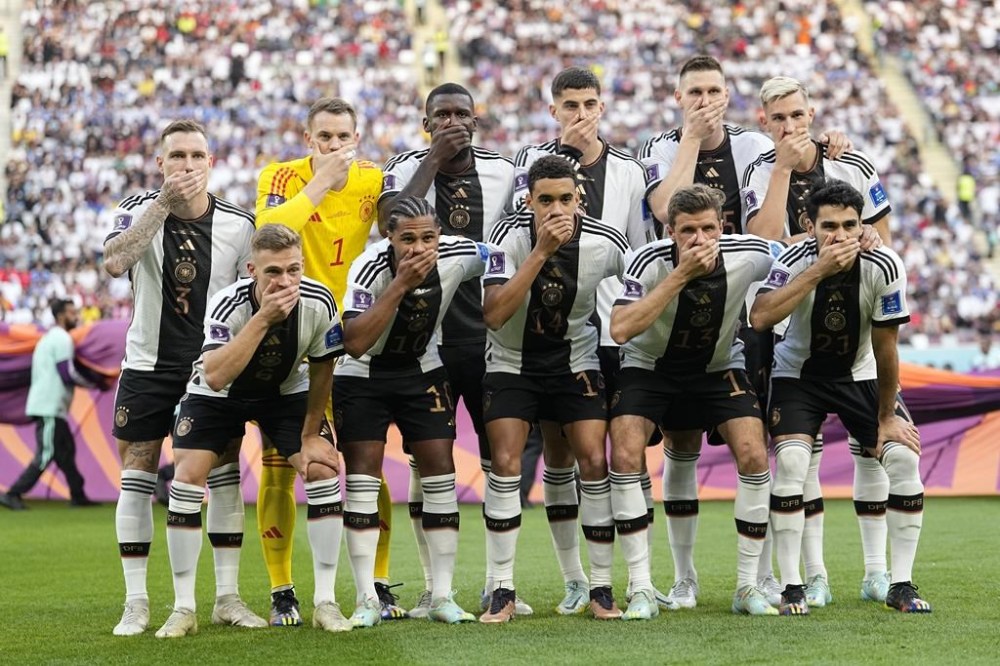
FILE - Players from Germany pose for the team photo as they cover their mouth during the World Cup group E soccer match between Germany and Japan, at the Khalifa International Stadium in Doha, Qatar, Wednesday, Nov. 23, 2022. (AP Photo/Ebrahim Noroozi)

Fans from around the world have a different idea of what that “center stage” should show. Many, but not all, Iranians attending matches in Qatar have wanted to express their support for protesters at home. And they’ve wanted the team to do the same.

Other political issues have been erupting fast and furious on a near-daily basis. And outside the World Cup bubble, the world itself has kept turning in some of its most fractious events, both unsurprising and surprising: Russia’s war in Ukraine, mass shootings in the United States and the sudden eruption of protests in China.

Of the sporting spirit, George Orwell wrote: “I am always amazed when I hear people saying that sport creates goodwill between the nations, and that if only the common peoples of the world could meet one another at football or cricket, they would have no inclination to meet on the battlefield.”

His point stands. Russia was banned from this World Cup after hosting the previous one in 2018, mirroring the isolation the country and its leaders face for the Ukraine invasion. Ukraine itself fell at the last hurdle for qualification, with fans at home likely more concerned about bombardment and survival amid electricity and water shortages than watching matches in Qatar.

Decades of enmity between the United Sates and Iran have been seeping into the buildup before the two nations play a critical World Cup match Tuesday that could see one of the countries progress to the knockout stages. The U.S. Soccer Federation briefly displayed Iran’s national flag on social media without the emblem of the Islamic Republic, saying the move supported protesters inside Iran. The Tehran government reacted by accusing America of removing the name of God from its national flag.

The century-long Israeli-Palestinian conflict, including Israel’s occupation of lands Palestinians want for a future state, has also featured in Qatar, though neither national team is competing. The Palestinian flag and pro-Palestinian fans have been prominent, while Israeli media and fans have been less welcome in an Arab nation that has not normalized relations with Israel.

As Morocco completed a famous victory over the highly-ranked stars of Belgium Sunday, unrest broke out in Belgian cities and also in the Netherlands, where the immigrant North African community has long been marginalized. “Those are not fans; they are rioters. Moroccan fans are there to celebrate,” the mayor of Brussels said.

LGBTQ rights have been at the fore in Qatar as well, with the country under the microscope for its human rights record and laws criminalizing homosexuality.

Germany’s players covered their mouths for the team photo before their opening match to protest against FIFA following the governing body’s clampdown on the “One Love” armband. Sporting rainbow colors, a symbol of LGBTQ rights, has been a key contentious issue. Some European officials have brought those colors to the stands.

Qatari soccer fans responded to Germany’s protest by holding pictures of former Germany playmaker Mesut Özil while covering their mouths. This referenced Ozil, a German-born descendant of Turkish immigrants, quitting the national team after becoming a target of racist abuse and a scapegoat for Germany’s early World Cup exit in 2018. “I am German when we win, but I am an immigrant when we lose,” Özil said at the time.

Keeping the world out of sport, as this tournament and many World Cups and Olympics before have shown, is well nigh impossible. This is especially true in a hyperconnected world, with each word, each gesture, each celebration or outpouring of dismay magnified for a global audience.

Football may indeed claim center stage when these matches are watched and nations’ nervous systems go through the wringer. But day-to-day complex issues are never far from the surface, always ready to burst through and dominate. The rest of the world, it turns out, doesn’t end where the soccer pitch begins.

___

AP World Cup coverage: https://apnews.com/hub/world-cup and https://twitter.com/AP_Sports

___

Tamer Fakahany, deputy director for global news coordination at The Associated Press, has helped direct international coverage for the AP for 20 years. Follow him on Twitter at https://twitter.com/tamerfakahany

Report Error Submit a Tip

More Stories

As wildfire season rages, new book explores the frontlines of battling Canadian blazes

Reviewed by GC Cabana-Coldwell 4 minute read Preview

As wildfire season rages, new book explores the frontlines of battling Canadian blazes

Reviewed by GC Cabana-Coldwell 4 minute read Yesterday at 2:02 AM CDT

Mother Nature’s talking but we haven’t been listening, according to Jesse Winter, author of Wild Fire: Dispatches from a Country Ablaze, a book, released earlier this summer detailing Canada’s wildfire woes.

Currently, almost 1,000 wildfires across Northwestern Ontario, British Columbia, the Prairies, Northwest Territories and eastern provinces are burning in Canada. Forest fires also continue to wreak havoc in France, Spain and other European countries, and in the U.S. states of Oregon, California, Florida and Texas. While 2023 still rates as the world’s worst wildfire season, 2026 is hot on its heels.

Winter, a Vancouver-based, award-winning climate disaster photojournalist, spent more than two years on Wild Fire, his first book. In-depth research included working with firefighting crews and environmentalists as well as talking to researchers, politicians and evacuees. He says we need to rethink our views on wildfires or be prepared to watch more land go up in flames.

Canada, Winter writes, is “a country almost perfectly designed to burn.” At least 70 per cent of boreal forests, which cover one-third of the country, are stuffed with highly flammable spruce, fir, pine and tamarack trees as well as aspen, poplar and birch. With a wealth of available fuel, it’s no surprise, he writes, that an area twice the size of Vancouver Island burns every summer in Canada.

Read
Yesterday at 2:02 AM CDT

Excited Goldeyes fans buzz over Manitoba Mosquitoes’ name change

Grace Penner 4 minute read Preview

Excited Goldeyes fans buzz over Manitoba Mosquitoes’ name change

Grace Penner 4 minute read Friday, Jul. 31, 2026

BITE club has entered the ball park for a single game, filling the stands with mosquitoes — just not in the way you may think.

The Fish are participating an alternate identity takeover, one that many other teams in the minor baseball leagues have been having some fun with. The Winnipeg Goldeyes re-branded to pay homage to the province’s beloved summer creatures, the Manitoba Mosquitoes.

The Fargo-Moorhead RedHawks had some fun with its alternative identity, doing a five-game name change to the Woodchippers, a fun reference to the 1996 film Fargo.

Other honourable mentions are the Chicago Dogs, who switched over to the Chicago Wieners, the Sioux Fall Canaries transformed into the Minnehaha Martians, Milwaukee Milkmen became the Franklin Benjamins, and the Lake Country Dockhounds swapped to the Wisconsin Dive Bars.

Read
Friday, Jul. 31, 2026

Crop storage headaches loom on horizon

Laura Rance-Unger 5 minute read Preview

Crop storage headaches loom on horizon

Laura Rance-Unger 5 minute read Yesterday at 2:01 AM CDT

A sense of calm descends over Prairie fields this time of year — at least on the surface.

Activities become more limited in the weeks leading up to harvest. There’s not much farmers can do now to support this year’s crop, other than monitor and protect it from diseases such as sclerotinia in canola and leaf stripe and fusarium head blight in wheat and barley.

July is when you might see farmers wading into a thick stand of canola, conducting a so-called “wet pants test” to get a low-tech read on how much disease-inducing moisture is lurking in the canopy.

Disease pressure is high in a humid, hot summer like this one and it’s kept aerial applicators busy applying fungicides. Sclerotinia spores live on plant residues in the soil and blossom into a mould that destroys the canola stem, starving the maturing pods.

Read
Yesterday at 2:01 AM CDT

Nemat’s novel chronicles grandmother’s harrowing life in Russia and Iran

Reviewed by Gordon Arnold 4 minute read Preview

Nemat’s novel chronicles grandmother’s harrowing life in Russia and Iran

Reviewed by Gordon Arnold 4 minute read Yesterday at 2:05 AM CDT

Mistress of the Persian Boarding House is the most enjoyable book I have read in the more than 15 years since I began reviewing books for the Free Press.

Author Marina Nemat’s prose, inspired by her paternal grandmother’s life, flows smoothly, like a babbling brook down a mountain.

Nemat is an Iranian-born Canadian writer and human rights activist known for her bestselling memoirs Prisoner of Tehran and After Tehran: A Life Reclaimed. Arrested at 16 for opposing Iran’s post-revolution regime, she endured torture and forced marriage in Evin Prison before emigrating to Canada in 1991.

Nemat’s grandmothers were both Russian, and she was brought up in a Russian Orthodox Christian family in Tehran. With their Iranian husbands, whom they had married before the Russian Revolution of 1917, both grandmothers fled from Russia to Iran as part of a massive wave of migration.

Read
Yesterday at 2:05 AM CDT

Hydro scrambling to restore power to remaining 4,500 customers after storm; some outages will continue into Saturday

Chris Kitching 5 minute read Preview

Hydro scrambling to restore power to remaining 4,500 customers after storm; some outages will continue into Saturday

Chris Kitching 5 minute read Friday, Jul. 31, 2026

Power outages could stretch into a third day for some Manitobans — mainly in and around Winnipeg — while crews continued to repair widespread damage caused by powerful thunderstorms.

About 4,500 Manitoba Hydro customers were still without electricity at 2:30 p.m. Friday, after more than 30,000 lost power while powerful winds brought down trees and power lines Wednesday night and early Thursday.

The Crown corporation said it is aiming to have all outages with greater numbers of customers restored by Friday night, but some customers may remain without power into Saturday.

“The challenge is just the sheer scale of this thing — hundreds of different outages spread across a large part of the city,” Hydro spokesman Peter Chura said. “Just getting to all of them in a timely fashion is very difficult.”

Read
Friday, Jul. 31, 2026

Downtown Keg closes… to reopen nearby

Free Press staff 2 minute read Preview

Downtown Keg closes… to reopen nearby

Free Press staff 2 minute read Friday, Jul. 31, 2026

Downtown Winnipeg is without a Keg restaurant — for a couple of months, anyways.

The Keg Steakhouse and Bar vacated 115 Garry St. on Wednesday, after more than five decades at the location. It will open in a new Donald Street apartment tower this fall.

Its move comes after years of waiting. The DSM, at 185 Donald St., sat as a partially started apartment block after its developer stopped operating and sought creditor protection in April 2023. The developer began the project in 2019.

Carrington Real Estate took over in 2024. Part of the 14-storey site’s initial plans — pre-Carrington — was for the Keg to occupy the main floor.

Read
Friday, Jul. 31, 2026