Care, ‘magic’ help DC’s cherry blossom trees defy age
Advertisement
Read this article for free:
or
Already have an account? Log in here »
To continue reading, please subscribe:

Digital Subscription
One year of digital access for only $205*
- Enjoy unlimited reading on winnipegfreepress.com
- Read the E-Edition, our digital replica newspaper
- Access News Break, our award-winning app
- Play interactive puzzles
*First annual payment billed as $205.00 + GST for one year. This annual subscription will automatically renew at $233.00 + GST every 52 weeks (10% off the regular annual price of $259.35). Offer available to new and qualified returning subscribers only. Cancel any time.
To continue reading, please subscribe:
Add Free Press access to your Brandon Sun subscription for only an additional
$1 for the first 4 weeks*
- Enjoy unlimited reading on winnipegfreepress.com
- Read the E-Edition, our digital replica newspaper
- Access News Break, our award-winning app
- Play interactive puzzles
*Your next Brandon Sun subscription payment will increase by $1.00 and you will be charged $17.95 plus GST for four weeks. After four weeks, your payment will increase to $24.95 plus GST every four weeks.
Read unlimited articles for free today:
or
Already have an account? Log in here »
Hey there, time traveller!
This article was published 28/03/2023 (1268 days ago), so information in it may no longer be current.
Peak bloom has arrived for the thousands of Japanese cherry blossom trees at the National Mall in Washington, and the area is awash in magnificent pink and white.
Predicting the timing of peak bloom — defined as when 70% of the blossoms have opened — has been getting harder. In the 1920s, the average peak bloom was April 5. That moved up to March 31 in recent years, and the 2023 peak arrived yet a week earlier, according to the National Park Service on Thursday.
“I’m feeling like this is going to be the trend” due to climate change, said Matthew Morrison, the park service’s urban forester charged with overseeing the trees’ care.
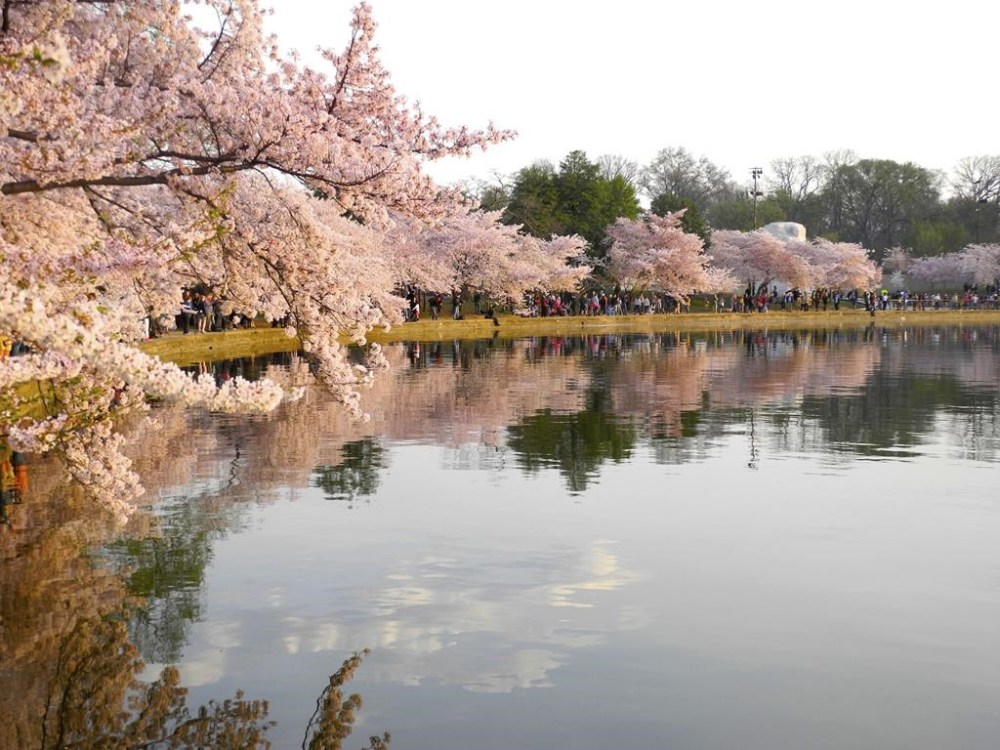
The annual National Cherry Blossom Festival, which runs through April 16, celebrates Japan’s 1912 gift of 3,020 cherry trees to the city of Washington.
Two of those trees were planted by First Lady Helen Herron Taft and Viscountess Chinda, wife of the Japanese Ambassador to the United States, with just a few onlookers present. That small gathering became the origin of the festival, which officially launched 23 years later, in 1934.
The average lifespan of a Japanese cherry tree falls roughly between 30 and 40 years, depending on variety, yet the two trees planted by Taft and Chinda and a handful of other trees are still standing 111 years later.
“That defies science,” said Morrison, who attributes the anomaly to “a little bit of magic tied to this wonderful gift,” and the attentive, year-round care his team provides.
Many of the 3,700 trees blooming at the 146-acre park today are offspring of the originals, cultivated from clippings, Morrison said. Others are regularly donated by the Casey Trees philanthropic group of Washington.
Morrison oversees a team of just three arborists charged with caring for the cherry trees, and keeps a “personal health record” for each.
The arborists, armed with climbing gear, ladders and chippers, visit each tree to provide pruning and other care. They record their findings in a database.
Three years ago, Morrison introduced the practice of mulching the trees with “copious amounts of wood chips” to create the most beneficial growing conditions possible. As the chips decompose, he said, they release beneficial fungi and bacteria that connect the trees’ root systems and “allow them to communicate with one another and transport nutrients to each other, so now they function as one super-organism.”
The wood chips also serve as a physical barrier between the lawn and the trees, eliminating the mower and string-trimmer injuries that have plagued their lower trunks for years.
Morrison recommends the same practice for homeowners growing trees in their own yards. When wood chips are applied over the root zones, he said, “you can pretty much turn your back on the tree,” adding that “it would never need any fertilizer, amendments” or supplemental water.
“Even on the hottest days of summer when it hasn’t rained, I dig down in the wood chips and find moisture,” he said.
For best results, Morrison advises adding 6 inches of fresh wood chips around trees. “That 6 inches will compress to 3 1/2 or 4 inches, and that’s a good level to maintain,” he said, adding that the chips will smother grass and weeds so can be applied right over them.
More tips from Morrison:
— Keep wood chips at least 3-4 inches away from tree trunks. Ideally, extend them as far over the soil as the branches reach overhead, but, if necessary, a smaller application can be made on smaller properties to avoid mulching the entire yard.
— If grass grows through the wood chips, use a metal rake to fluff them up or cover the breakthrough growth with more chips.
— Finally, learn proper pruning techniques, and prune away dead or diseased wood every winter while the tree is dormant.
Morrison also recommends the Yoshino cultivar (that of most of the National Mall’s cherry blossom trees) to homeowners.
“It’s one of the best growers and the best to flower,” he said. “Kwanzan cherry also is a good grower and gets a little bigger than Yoshino.”
Before selecting a tree to grow at home, however, Morrison recommends finding your local plant hardiness zone and researching which types will grow best in your region.
As for the National Cherry Blossom Festival, it spans five weekends and includes a roster of events throughout Washington and its suburbs, including a Japanese street festival, 5K and 10-mile runs, fireworks, food fairs and more. If you can’t make it, peep the trees live via the Trust for the National Mall’s Bloom Cam.
——
Jessica Damiano writes regular gardening columns for The Associated Press. She publishes the award-winning Weekly Dirt Newsletter. Sign up here for weekly gardening tips and advice.
___
For more AP gardening stories, go to https://apnews.com/hub/gardening.