A college in upheaval: War on ‘woke’ sparks fear in Florida
Advertisement
Read this article for free:
or
Already have an account? Log in here »
To continue reading, please subscribe:
Digital Subscription
One year of digital access for only $1.44 a week*
- Enjoy unlimited reading on winnipegfreepress.com
- Read the E-Edition, our digital replica newspaper
- Access News Break, our award-winning app
- Play interactive puzzles
*Billed as $5.77 plus GST every four weeks. After 52 weeks, price increases to the regular rate of $19.95 plus GST every four weeks. Offer available to new and qualified returning subscribers only. Cancel any time.
To continue reading, please subscribe:
Add Free Press access to your Brandon Sun subscription for only an additional
$1 for the first 4 weeks*
- Enjoy unlimited reading on winnipegfreepress.com
- Read the E-Edition, our digital replica newspaper
- Access News Break, our award-winning app
- Play interactive puzzles
*Your next Brandon Sun subscription payment will increase by $1.00 and you will be charged $17.95 plus GST for four weeks. After four weeks, your payment will increase to $24.95 plus GST every four weeks.
Read unlimited articles for free today:
or
Already have an account? Log in here »
Hey there, time traveller!
This article was published 30/03/2023 (1296 days ago), so information in it may no longer be current.
SARASOTA, Fla. (AP) — Professors at the New College of Florida are using personal email because they’re afraid of being subpoenaed.
Students are concerned, too. Some fear for their physical safety. Many worry their teachers will be fired en masse and their courses and books will be policed. It’s increasingly hard to focus on their studies.
For years, students have come to this public liberal arts college on the western coast of Florida because they were self-described free thinkers. Now they find themselves caught in the crosshairs of America’s culture war.
Republican Gov. Ron DeSantis has targeted the tiny school on the shores of Sarasota Bay as a staging ground for his war on “woke.” The governor and his allies say New College, a progressive school with a prominent LGBTQ+ community, is indoctrinating students with leftist ideology and should be revamped into a more conservative institution.
Students and faculty say America should take note because the transformation at New College could become a blueprint with national implications as DeSantis gears up for a likely presidential bid.
“I’m sorry, but this isn’t an indoctrination facility. This isn’t a factory that pumps out, you know, non-binary communists,” says Viv Cargille, 20, a marine biology major from Miami. She is passionate about researching dolphin acoustics but finds it mentally exhausting to focus on classes in a climate she describes as turbulent, volatile and anxiety-inducing.
Her roommate Olivia Pare, a second-year biology major, wishes the politicians would leave their school alone. “My biggest frustration is the way it is impacting my education. I am here to learn. I am not here to be more woke — whatever that is,” Pare said. When she does research in the organic chemistry lab, “we’re not talking about organic chemistry anymore — we’re talking about whether my professor will get her tenure approved.”
In January, DeSantis and his allies overhauled the 13-member Board of Trustees and installed a majority of conservative figures. The new trustees promptly fired the college president and replaced her with a Republican politician, the first of several administrators to lose their jobs. Next, they dismantled the office of diversity and equity. They have not revealed future plans but trustees have posted vague warnings on social media like: “You will see changes in 120 days.”
Changes so far have come in tandem with a new bill DeSantis unveiled Jan. 31 aimed at overhauling higher education in Florida. The bill would ban gender studies majors and minors, eliminate diversity programs and any hiring based on diversity, weaken tenure protections and put all hiring decisions in the hands of each university’s board of trustees.
The effect at New College has been chilling and disruptive. Students and faculty compare the upheaval to a “hostile takeover” that feels even more jarring because of what the school has represented to so many students for so many years: a haven of open-mindedness and acceptance in a place of idyllic beauty, with palm-tree-lined paths along a stretch of white-sand coast.
“It felt very much like New College was a little bubble in Florida,” said Willem Aspinall, 19, an environmental studies major who grew up in a Chicago suburb. “Now it feels like that has kind of been burst. The campus feels a lot less safe now.”
Students and faculty are afraid of one thing most of all: The extinction of New College as they know it.
They are not wrong to worry.
One of the new trustees is Christopher Rufo, a fellow at the conservative Manhattan Institute and architect of the right-wing outrage against critical race theory, a legal term that has come to represent teaching about the ongoing effects of slavery. Rufo actively posts on social media about his vision for the future of New College, often in militaristic terms. He has referred to new trustees at the public institution as the “landing team,” saying, “We got over the wall,” and referencing an operation to “recapture” the college.
New College has its problems. The college performs poorly in certain state metrics, including a decline in enrollment until last year. Students complain of mold in dorms, broken elevators and other delayed maintenance because of years of underfunding. Some students say they would welcome more conservative students to balance the left-leaning student body. DeSantis and the new trustees cite the challenges as justification for the state intervention.
“We will be shutting down low-performing, ideologically-captured academic departments and hiring new faculty,” Rufo said in one tweet. “The student body will be recomposed over time: some current students will self-select out, others will graduate; we’ll recruit new students who are mission-aligned.” He and others have posted plans to “redesign the curriculum” with a goal of making the school more politically conservative.
Some students are fleeing, for schools that feel safer. Many on campus have voiced a concern that the politically charged spotlight on their school could invite danger. Several professors who asked not to be named are sending out resumes. Trustee meetings have become a focal point of student protests, and the only source of information on the school’s fate.
New College has long been an anomaly in a state filled with large public universities. It has barely 700 students, no fraternities or sororities and no football team. It is Florida’s designated honors college and produces an impressive number of the state’s Fulbright scholars. It has a uniquely self-directed curriculum that allows students to design individualized majors. The average class size is 11 students. There are no letter grades; students get detailed “narrative evaluations” as part of a pass-fail system.
The academic freedom is mirrored by a student body that feels free to express itself, say students and faculty, who describe New College as a haven for brainy kids who are high-achieving and intellectually curious. Some were the quiet kids in high school, or were bullied for being queer or different, or struggled socially because of autism or other disabilities. Some were homeschooled or come from alternative educational backgrounds that led them to be self-directed in their schooling. They arrived at New College and felt welcome in a way they never had before, say parents, students and faculty.
There is a long table in the center of the New College dining hall that epitomizes the school’s culture of acceptance, according to several students. People sitting there invite newcomers to come join them. Anyone walking in knows they never need to eat alone.
“It is one of the most unique places I think that exists in American higher education,” says Elizabeth C. Leininger, a neuroscientist and associate biology professor, who knows all her students by name. She compares an education at New College to small, private liberal arts schools at a fraction of the cost. In-state tuition at New College is $7,000 and out-of-state is $30,000, but many students get scholarships that cut tuition by at least half.
For the first time in her academic career, Leininger is wondering if some of her courses, like “Sex, Gender, Mind and Brain,” will court trouble.
“I would have to think very carefully about how I am going to teach that class now,” said Leininger, a graduate of Swarthmore College who did her Ph.D. at Columbia University, where she also taught. Like other faculty, Leininger is using personal email or encrypted messaging platforms when discussing the upheaval, fearing school email accounts will be subpoenaed. “There is very much a policing of ideas.”
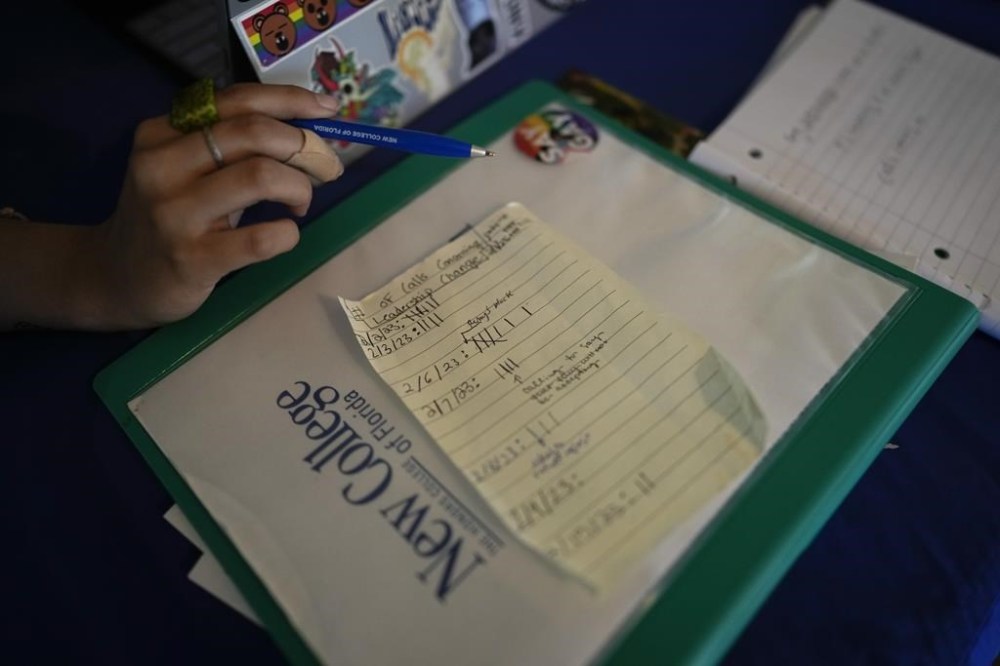
Students, too, have shifted conversations on organizing protests to encrypted platforms like Signal and Slack to ensure privacy, says Gaby Batista, 19, an anthropology major who has taken personal precautions as well. “I’ve made my Instagram private and took off my pronouns.”
For parents who have felt the intense heartache of watching their child struggle and then the deep relief of seeing them thrive, the upheaval at New College is making them relive a painful past.
Psychologist Joyce White calls the experience “devastating” and “destabilizing” for the parents and students, particularly those who endured childhood bullying only to find themselves again feeling targeted. White’s daughter, Lola, is a third-year biology major at New College with plans to be a veterinarian. Lola is autistic, has ADHD and “lives in a constant state of anxiety,” her mother said. Ever since she was a child, Lola excelled at school but found it very stressful. She has difficulty adapting to change and feeling like she belongs. Until fifth grade, Lola threw up every day on the way to school, her mother said. The pandemic wreaked havoc on her mental health and disrupted Lola’s college plans. She attended community college online for two years, before transferring in the fall of 2022 to New College.
“We found this little school that was perfect for Lola,” said White, who moved her family from Minnesota to Sarasota to ease Lola into college. It wasn’t easy at first, adjusting to the Florida heat and to in-person classes, but Lola was settling in. She loved her small classes at New College and the ability to meet professors one-on-one. Her confidence was growing, which made her less introverted. She felt safe, and one day she joked with another student that she had no friends. The student responded, “You’re our friend,” and invited Lola to study with her group at the library.
“I felt like I could connect to the people here. The kids are accepting – of anyone. There is no judgment,” said Lola. She was amazed at the resources the school offered to help students who were struggling. She was assigned an academic adviser, a career coach and a special adviser for transfer students. “When I told them I was struggling, they reached out even more. No one has ever done that for me before in education,” Lola said, seated beside her mother at sunset on a recent evening along the school’s private beach.
“It’s been such a long road, and I finally felt like I could see light at the end of the tunnel,” said White, who recognizes in herself feelings of anxiety and depression as she worries if Lola will find her path again. “Now it feels like everything has blown up.” She adds, “I’m trying to put on a brave face for her.”
Two of Lola’s friends are transferring out of New College. Lola has struggled lately with panic attacks, stress and difficulty concentrating on schoolwork. But for now, she plans to stay. “I can do it, but there will be repercussions on my mental health.”

Meanwhile, students and faculty are noticing new restrictions they worry are aimed at curtailing freedom of expression. Faculty received a memo recently with new recommended guidelines for email signatures: They “should only include” name, title, college address, logo and phone number, which faculty see as a ruling that disallows pronouns. An event known as V.I.P. Weekend that was organized by the diversity and equity office to host prospective students overnight was also abruptly canceled. And maintenance crews recently were instructed to wash away chalk drawings and messages that covered a campus overpass, part of a longstanding tradition of eclectic artwork and expression. Many of the chalk messages voiced outrage at DeSantis and the new trustees or carried messages of support, such as: “Diversity is our strength.”
Faculty are advising students to concentrate on schoolwork and block out the noise, but it’s hard to shake the feeling that the worst is yet to come, said Aspinall, the environmental studies major.
“I’m concerned they’re going to take a school that does not indoctrinate students and turn it into a school that does.”
___
The Associated Press education team receives support from the Carnegie Corporation of New York. The AP is solely responsible for all content.