Dinosaur species laid eggs like reptiles, brooded like birds, new study finds
Advertisement
Read this article for free:
or
Already have an account? Log in here »
To continue reading, please subscribe:

Digital Subscription
One year of digital access for only $205*
- Enjoy unlimited reading on winnipegfreepress.com
- Read the E-Edition, our digital replica newspaper
- Access News Break, our award-winning app
- Play interactive puzzles
*First annual payment billed as $205.00 + GST for one year. This annual subscription will automatically renew at $233.00 + GST every 52 weeks (10% off the regular annual price of $259.35). Offer available to new and qualified returning subscribers only. Cancel any time.
To continue reading, please subscribe:
Add Free Press access to your Brandon Sun subscription for only an additional
$1 for the first 4 weeks*
- Enjoy unlimited reading on winnipegfreepress.com
- Read the E-Edition, our digital replica newspaper
- Access News Break, our award-winning app
- Play interactive puzzles
*Your next Brandon Sun subscription payment will increase by $1.00 and you will be charged $17.95 plus GST for four weeks. After four weeks, your payment will increase to $24.95 plus GST every four weeks.
Read unlimited articles for free today:
or
Already have an account? Log in here »
Hey there, time traveller!
This article was published 03/04/2023 (1267 days ago), so information in it may no longer be current.
EDMONTON – The birds we see today are the descendants of a dinosaur that learned to fly and survived mass extinction 66 million years ago, but little is known about their transition.
While they were the only species to survive the Cretaceous period, there also wasn’t much known about how similar the dinosaurs and modern-day birds could be.
A tiny piece of a dinosaur eggshell, about the size of a fingernail, was central in an international study published Monday in the Proceedings of the National Academy of Sciences journal, helping reconstruct the prehistoric creature’s reproductive system and establish its physiology, metabolism and body temperature.
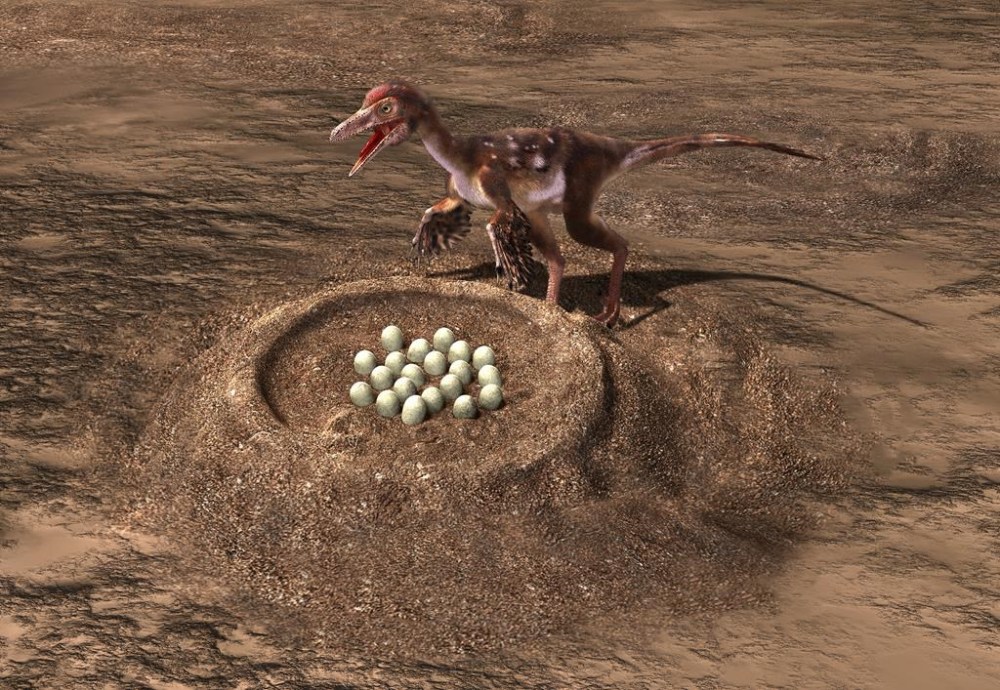
The Troodon, believed to be a meter-long meat-eating dinosaur, is considered to have given rise to birds, said François Therrien, a paleontologist at the Royal Tyrrell Museum in Drumheller, Alta., who is one the authors of the study.
The study, he said, “can give us a lot of information about what occurred during that transformation from a typical meat-eating dinosaur to a bird, (like) answering questions about whether the birds really inherit most of the characteristics from meat-eating dinosaurs.”
Therrien added the transition was a gradual one, something researchers found by looking at similarities the dinosaur had to modern-day reptiles and birds.
The study found that Troodons were warm-blooded animals with a reproductive system similar to today’s reptiles, but they also had the ability to moderate their body temperature similar to birds.
While Troodon eggs resembled a bird’s egg in shape and surface, the female dinosaurshad two ovaries and could lay two eggs at a time, like that of reptiles.
This also means a female Troodon could lay four to six eggs per clutch, said Darla Zelenitsky, a dinosaur paleobiology professor at the University of Calgary.
“We were able to figure out the dinosaur produced its eggs very slowly, which is typical of modern reptiles,” said Zelenitsky, who also is one of the authors of the study.
Female birds have one ovary and can lay an egg every one or two days. Researchers aren’t clear if the evolutionary loss of an ovary happened among non-avian dinosaurs or after the transition into birds.
The study used a technique called dual clumpedisotope thermometry to measure the heavier varieties of oxygen and carbonin the eggshell fossils to determine the body temperatures of Troodons and to better understand the dinosaur’s reproductive system.
The findings were then matched with eggshells of modern-day reptiles, such as crocodiles, alligators and certain species of a turtle, as well as birds like chickens, sparrows, wrens and ostriches.
The dinosaur nestlings, some found at two sites in southern Alberta, had up to 24 eggs, suggesting female Troodons laid eggs in communal nests, which is seen among birds including ostriches.
“It’s possible that some (Troodon) mothers congregated together to build communal nests and lay all their eggs, and then share duties of guarding and brooding all the eggs in turns,” Therrien said.
The nests also reflected intelligence among the Troodons, Therrien and Zelenitsky said. The dinosaurs buried the eggs in the nest vertically with the pointy down and the blunt side up, which could have improved incubation.
The eggshell fossils, which are stored at the Royal Tyrrell Museum, helped scientists reconstruct the Earth’s surface temperature to understand better the body temperature of the dinosaur and the mineralization processes of the fossils.
The isotope clumping of oxygen and carbon crystallization, which depends on temperature, also revealed the body temperature of the species.
Troodon dinosaurs were believed to lay eggs at between 30 C and42 C. The species had a resting body temperature of 42 C, which could be lowered to 30 C, depending on their environment, similar to birds.
Scientists are now looking into whether Troodons could have survived in humid areas in different parts of the world, as opposed to the semi-arid regions where the eggs were first discovered.
“Most people think that you need to find complete dinosaur skeletons to be able to say something about its biology and the animals when they were alive,” Therrien said.

“With the study, we truly can go into how an animal functioned by studying the isotopic composition of the eggshell that you can’t obtain from the study of bones alone.”
Researchers are now looking into Troodon eggs from different sites and from periods to see if the patterns found in this study continue to be consistent with other eggs.
This report by The Canadian Press was first published April 3, 2023.
—
This story was produced with the financial assistance of the Meta and Canadian Press News Fellowship.