Are robot waiters the future? Some restaurants think so

Advertisement

Advertise with us

MADISON HEIGHTS, Mich. (AP) — You may have already seen them in restaurants: waist-high machines that can greet guests, lead them to their tables, deliver food and drinks and ferry dirty dishes to the kitchen. Some have cat-like faces and even purr when you scratch their heads.

Read this article for free:


or

Already have an account? Log in here »

To continue reading, please subscribe:

Subscribe and receive a limited-edition Free Press branded hat or tote.

Digital Subscription

One year of digital access for only $205*

  • Enjoy unlimited reading on winnipegfreepress.com
  • Read the E-Edition, our digital replica newspaper
  • Access News Break, our award-winning app
  • Play interactive puzzles

*First annual payment billed as $205.00 + GST for one year. This annual subscription will automatically renew at $233.00 + GST every 52 weeks (10% off the regular annual price of $259.35). Offer available to new and qualified returning subscribers only. Cancel any time.

To continue reading, please subscribe:

Add Free Press access to your Brandon Sun subscription for only an additional

$1 for the first 4 weeks*

  • Enjoy unlimited reading on winnipegfreepress.com
  • Read the E-Edition, our digital replica newspaper
  • Access News Break, our award-winning app
  • Play interactive puzzles
Start now

*Your next Brandon Sun subscription payment will increase by $1.00 and you will be charged $17.95 plus GST for four weeks. After four weeks, your payment will increase to $24.95 plus GST every four weeks.

Hey there, time traveller!
This article was published 05/04/2023 (1257 days ago), so information in it may no longer be current.

MADISON HEIGHTS, Mich. (AP) — You may have already seen them in restaurants: waist-high machines that can greet guests, lead them to their tables, deliver food and drinks and ferry dirty dishes to the kitchen. Some have cat-like faces and even purr when you scratch their heads.

But are robot waiters the future? It’s a question the restaurant industry is increasingly trying to answer.

Many think robot waiters are the solution to the industry’s labor shortages. Sales of them have been growing rapidly in recent years, with tens of thousands now gliding through dining rooms worldwide.
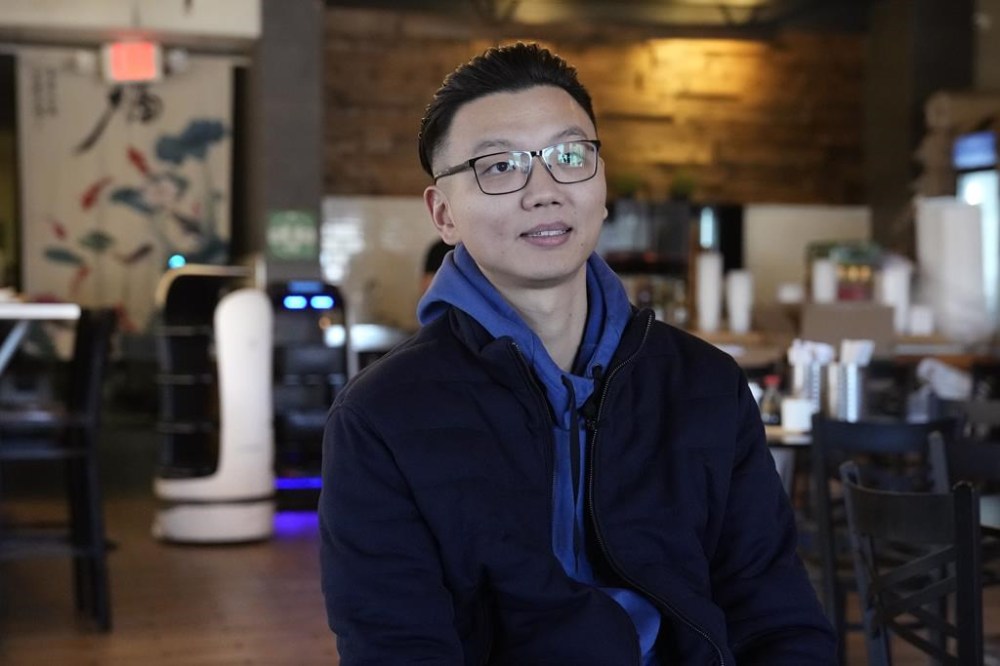
Li Zhai of the Noodle Topia restaurant is interviewed, Monday, March 20, 2023 in Madison Heights, Mich. Zhai was having trouble finding staff for the restaurant in the summer of 2021, so he bought a robot which was so successful he added two more. With the robots, Zhai only needs three workers to do the same volume of business that five or six people used to handle. (AP Photo/Carlos Osorio)

“There’s no doubt in my mind that this is where the world is going,” said Dennis Reynolds, dean of the Hilton College of Global Hospitality Leadership at the University of Houston. The school’s restaurant began using a robot in December, and Reynolds says it has eased the workload for human staff and made service more efficient.

But others say robot waiters aren’t much more than a gimmick that have a long way to go before they can replace humans. They can’t take orders, and many restaurants have steps, outdoor patios and other physical challenges they can’t adapt to.

“Restaurants are pretty chaotic places, so it’s very hard to insert automation in a way that is really productive,” said Craig Le Clair, a vice president with the consulting company Forrester who studies automation.

Still, the robots are proliferating. Redwood City, California-based Bear Robotics introduced its Servi robot in 2021 and expects to have 10,000 deployed by the end of this year in 44 U.S. states and overseas. Shenzen, China-based Pudu Robotics, which was founded in 2016, has deployed more than 56,000 robots worldwide.

“Every restaurant chain is looking toward as much automation as possible,” said Phil Zheng of Richtech Robotics, an Austin-based maker of robot servers. “People are going to see these everywhere in the next year or two.”

Li Zhai was having trouble finding staff for Noodle Topia, his Madison Heights, Michigan, restaurant, in the summer of 2021, so he bought a BellaBot from Pudu Robotics. The robot was so successful he added two more; now, one robot leads diners to their seats while another delivers bowls of steaming noodles to tables. Employees pile dirty dishes onto a third robot to shuttle back to the kitchen.

Now, Zhai only needs three people to do the same volume of business that five or six people used to handle. And they save him money. A robot costs around $15,000, he said, but a person costs $5,000 to $6,000 per month.

Zhai said the robots give human servers more time to mingle with customers, which increases tips. And customers often post videos of the robots on social media that entice others to visit.

“Besides saving labor, the robots generate business,” he said.

Interactions with human servers can vary. Betzy Giron Reynosa, who works with a BellaBot at The Sushi Factory in West Melbourne, Florida, said the robot can be a pain.

“You can’t really tell it to move or anything,” she said. She has also had customers who don’t want to interact with it.
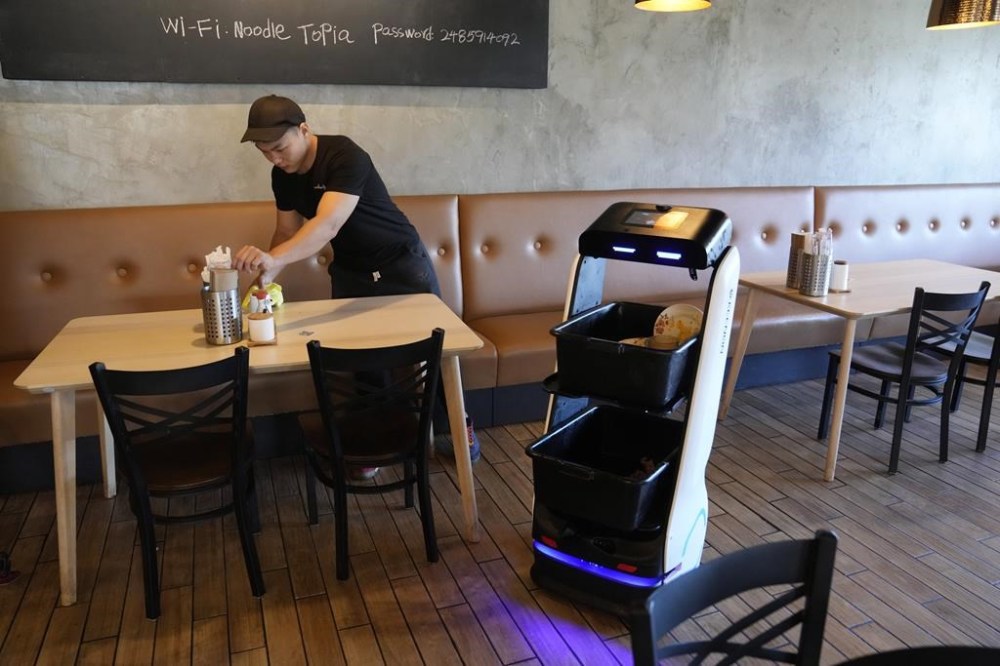
A BellaBot robot at the Noodle Topia restaurant heads back to the kitchen after a table is cleared on Monday, March 20, 2023, in Madison Heights, Mich. Sales of robot servers have been growing rapidly in recent years, and tens of thousands of robots are now gliding through dining rooms worldwide. (AP Photo/Carlos Osorio)

But overall the robot is a plus, she said. It saves her trips back and forth to the kitchen and gives her more time with customers.

Labor shortages accelerated the adoption of robots globally, Le Clair said. In the U.S., the restaurant industry employed 15 million people at the end of last year, but that was still 400,000 fewer than before the pandemic, according to the National Restaurant Association. In a recent survey, 62% of restaurant operators told the association they don’t have enough employees to meet customer demand.

Pandemic-era concerns about hygiene and adoption of new technology like QR code menus also laid the ground for robots, said Karthik Namasivayam, director of The School of Hospitality Business at Michigan State University’s Broad College of Business.

“Once an operator begins to understand and work with one technology, other technologies become less daunting and will be much more readily accepted as we go forward,” he said.

Namasivayam notes that public acceptance of robot servers is already high in Asia. Pizza Hut has robot servers in 1,000 restaurants in China, for example.

The U.S. was slower to adopt robots, but some chains are now testing them. Chick-fil-A is trying them at multiple U.S. locations, and says it’s found that the robots give human employees more time to refresh drinks, clear tables and greet guests.

Marcus Merritt was surprised to see a robot server at a Chick-fil-A in Atlanta recently. The robot didn’t seem to be replacing staff, he said; he counted 13 employees in the store, and workers told him the robot helps service move a little faster. He was delighted that the robot told him to have a great day, and expects he’ll see more robots when he goes out to eat.

“I think technology is part of our normal everyday now. Everybody has a cell phone, everybody uses some form of computer,” said Merritt, who owns a marketing business. “It’s a natural progression.”

But not all chains have had success with robots.

Chili’s introduced a robot server named Rita in 2020 and expanded the test to 61 U.S. restaurants before abruptly halting it last August. The chain found that Rita moved too slowly and got in the way of human servers. And 58% of guests surveyed said Rita didn’t improve their overall experience.

Haidilao, a hot pot chain in China, began using robots a year ago to deliver food to diners’ tables. But managers at several outlets said the robots haven’t proved as reliable or cost-effective as human servers.
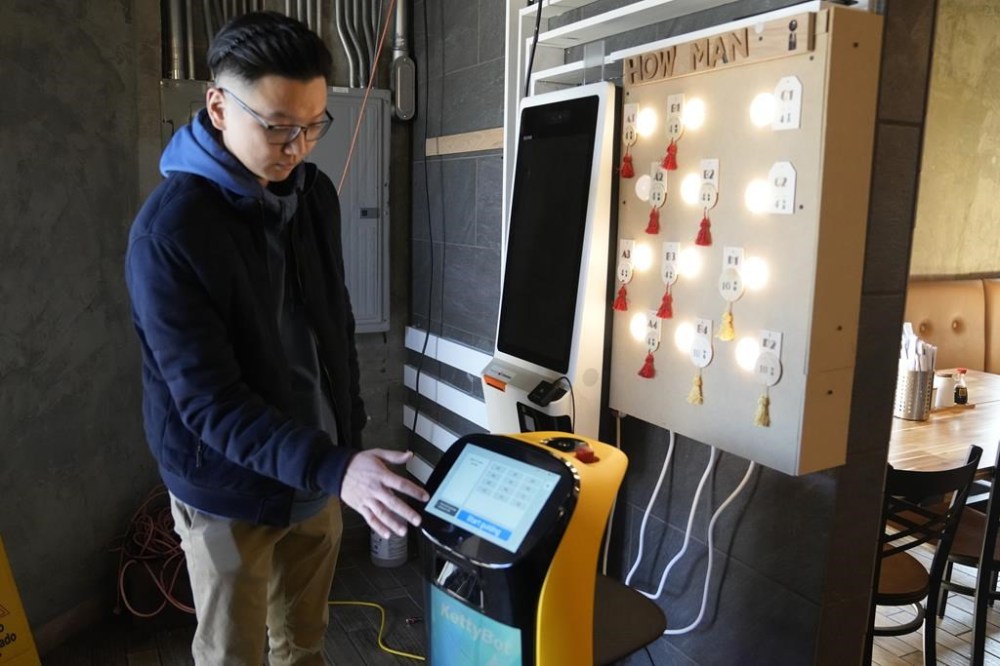
Li Zhai of the Noodle Topia restaurant points out features on his BellaBot robot, Monday, March 20, 2023 in Madison Heights, Mich. Zhai was having trouble finding staff for the restaurant in the summer of 2021, so he bought a robot which was so successful he added two more. With the robots, Zhai only needs three workers to do the same volume of business that five or six people used to handle. (AP Photo/Carlos Osorio)

Wang Long, the manager of a Beijing outlet, said his two robots have both have broken down.

“We only used them now and then,” Wang said. “It is a sort of concept thing and the machine can never replace humans.”

Eventually, Namasivayam expects that a certain percentage of restaurants — maybe 30% — will continue to have human servers and be considered more luxurious, while the rest will lean more heavily on robots in the kitchen and in dining rooms. Economics are on the side of robots, he said; the cost of human labor will continue to rise, but technology costs will fall.

But that’s not a future everyone wants to see. Saru Jayaraman, who advocates for higher pay for restaurant workers as president of One Fair Wage, said restaurants could easily solve their labor shortages if they just paid workers more.

“Humans don’t go to a full-service restaurant to be served by technology,” she said. “They go for the experience of themselves and the people they care about being served by a human.”

___

AP researcher Yu Bing contributed from Beijing.

Report Error Submit a Tip

More Stories

Highway-safety upgrades in progress after tragic Interlake crash

Chris Kitching 5 minute read Preview

Highway-safety upgrades in progress after tragic Interlake crash

Chris Kitching 5 minute read Friday, Sep. 11, 2026

Provincial workers have started to update or install safety measures at a rural Interlake intersection where four teenage friends died in a crash on Labour Day weekend.

Pavement markings were repainted at Highway 8 and Provincial Road 229, just west of Winnipeg Beach, ahead of work to refresh worn-down rumble strips, starting Monday, and install flashing lights atop two stop signs, following an assessment earlier this week.

“They will also need to incorporate any information from the RCMP report that might be helpful if we were to consider any additional safety measures at this intersection,” Transportation and Infrastructure Minister Lisa Naylor said of department staff.

“The most important thing is safety, and any kinds of changes we make at any intersection actually have to make it safer.”

Read
Friday, Sep. 11, 2026

Bombers exact revenge in Banjo Bowl, lose Collaros to injury

Taylor Allen 7 minute read Preview

Bombers exact revenge in Banjo Bowl, lose Collaros to injury

Taylor Allen 7 minute read Yesterday at 9:20 PM CDT

Redha Kramdi downplayed the significance of his return for the Winnipeg Blue Bombers.

“I don’t think I have that big of an impact,” said Kramdi on Tuesday, who watched the club go 2-4 while he was sidelined with a cast on his left hand.

It sounded silly at the time, and it’s even sillier now considering how exceptional the 29-year-old safety from Montreal was in Saturday’s 22nd edition of the Banjo Bowl.

Kramdi caused two turnovers — a forced fumble and an interception — to lead the Bombers to a 19-6 victory over the Saskatchewan Roughriders in front of a sell-out crowd at Princess Auto Stadium.

Read
Yesterday at 9:20 PM CDT

Fallis’s comic thriller infiltrates book club

Ben Sigurdson 3 minute read Preview

Fallis’s comic thriller infiltrates book club

Ben Sigurdson 3 minute read Yesterday at 6:00 AM CDT

The Free Press Book Club and McNally Robinson Booksellers are pleased to welcome Toronto author Terry Fallis to the next virtual meeting on Tuesday, September 29 at 7 p.m. to read from and discuss his novel The Marionette.

Fallis, a former lawyer, bureaucrat and political consultant, is the author of 10 bestselling novels and the two-time winner of the Stephen Leacock Medal for Humour (in 2015 for No Relation and in 2008 for The Best Laid Plans, which also won CBC’s Canada Reads in 2011).

His 11th novel, An End In Itself, will be published in November by McClelland & Stewart, who also published The Marionette in October 2025 (and which was also longlisted for the Leacock medal).

The Marionette follows James Norval, bestselling author of a series of thrillers featuring fictional CIA agent Hunter Chase. While in Tajikistan researching his next Hunter Chase novel, Norval is detained by local officials and subsequently freed and ferried away by the Canadian Security Intelligence Service (CSIS).

Read
Yesterday at 6:00 AM CDT

The port of Churchill — but done right

Editorial 4 minute read Preview

The port of Churchill — but done right

Editorial 4 minute read Yesterday at 2:00 AM CDT

The seagoing grain carrier wasn’t christened with a champagne bottle. There was no confetti or streamers. Nevertheless, the Aug. 31 event marking the first shipment of grain to be loaded at the Port of Churchill since 2020 was celebrated like the launch of a brand new vessel.

The presence of the federal minister of northern and arctic affairs, provincial cabinet ministers and leaders and elders from several northern First Nations signalled that the fast-tracked process of refurbishing and buffing up Manitoba’s deep-water seaport gem is gaining momentum.

For OneNorth, the partnership of 29 First Nations and 12 northern communities which owns the Port of Churchill and the Hudson Bay Railway (both operated by the Arctic Gateway Group) the event heralded a new beginning. It’s been eight years since OneNorth purchased the port and railroad, and six years since grain was moved by rail through Manitoba and then by ship to European markets. Two more grain shipments, plus shipments of potash and critical minerals, will continue through the fall.

When Prime Minister Mark Carney solicited the premiers to suggest “nation-building” projects following his election in 2025, Premier Wab Kinew pitched a Manitoba trade corridor that would move wheat, critical minerals, potash and energy (oil or liquid natural gas) through the Port of Churchill.

Read
Yesterday at 2:00 AM CDT

Drug recovery centre opens office in ‘heart of the city’

Morgan Modjeski 4 minute read Preview

Drug recovery centre opens office in ‘heart of the city’

Morgan Modjeski 4 minute read Yesterday at 3:38 PM CDT

Richard Halverson found his freedom from addiction through Adult & Teen Challenge and, six years later, he hopes a new Winnipeg location will bring hope to the city.

Dozens gathered Saturday morning to mark the grand opening of the recovery centre’s community services office on Main Street.

Located inside the former Wojcik funeral home, the bright-white building — which was also formerly a liquor store — will serve as an access point for people fighting drug addiction. That includes connecting them to addictions support, housing and training.

“For me, I always start with: ‘What’s your story?’” said Halverson, who now works for the faith-based organization.

Read
Yesterday at 3:38 PM CDT

Downtown no place to be after dark, huge majority of Winnipeggers say in survey

Joyanne Pursaga 8 minute read Preview

Downtown no place to be after dark, huge majority of Winnipeggers say in survey

Joyanne Pursaga 8 minute read Friday, Sep. 11, 2026

Most Winnipeggers are afraid to walk alone downtown and believe the city needs more police officers, a new survey finds.

Winnipeg Police Service released its 2026 citizen survey Friday.

Downtown safety appears to remain a major concern, with just 44 per cent saying they feel very or reasonably safe walking alone in the area during the day. The number plummets to eight per cent overall at night, down from nine per cent in 2024, the last time the survey was conducted.

This year, 14 per cent of men felt very or reasonably safe walking alone downtown at night, compared to just three per cent of women.

Read
Friday, Sep. 11, 2026