Long after heyday, soda fountain pharmacies still got fizz
Advertisement
Read this article for free:
or
Already have an account? Log in here »
To continue reading, please subscribe:

Digital Subscription
One year of digital access for only $205*
- Enjoy unlimited reading on winnipegfreepress.com
- Read the E-Edition, our digital replica newspaper
- Access News Break, our award-winning app
- Play interactive puzzles
*First annual payment billed as $205.00 + GST for one year. This annual subscription will automatically renew at $233.00 + GST every 52 weeks (10% off the regular annual price of $259.35). Offer available to new and qualified returning subscribers only. Cancel any time.
To continue reading, please subscribe:
Add Free Press access to your Brandon Sun subscription for only an additional
$1 for the first 4 weeks*
- Enjoy unlimited reading on winnipegfreepress.com
- Read the E-Edition, our digital replica newspaper
- Access News Break, our award-winning app
- Play interactive puzzles
*Your next Brandon Sun subscription payment will increase by $1.00 and you will be charged $17.95 plus GST for four weeks. After four weeks, your payment will increase to $24.95 plus GST every four weeks.
Read unlimited articles for free today:
or
Already have an account? Log in here »
Hey there, time traveller!
This article was published 19/04/2023 (1260 days ago), so information in it may no longer be current.
KENOVA, W.Va. (AP) — The jukebox plays Chubby Checker’s “The Twist” as Malli Jarrett and Nathaniel Fornash take turns at the Griffith & Feil Drug food counter preparing old-fashioned, soda-fountain phosphate drinks.
Soda fountains like this were hugely popular a century ago. Often located in pharmacies, they were a gathering spot during Prohibition when bars shut down. But over the past half century, their numbers fizzled, relegating soda fountains to the scrapbooks of U.S. history.
In West Virginia, Ric Griffith is keeping the tradition going. His 131-year-old business is a Norman Rockwell scene and time-travel tourism all wrapped into one.
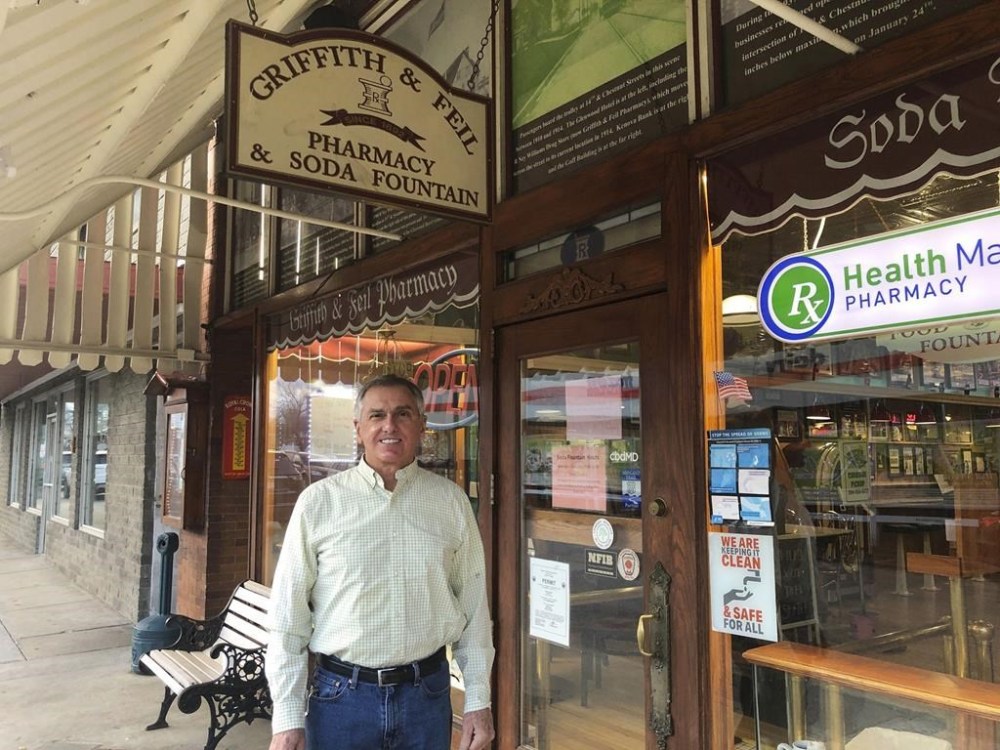
“When you had a soda fountain, people would stay longer, they’d sit down and they’d share stories,” Griffith said. “It would not become the place where you grabbed lunch. It was a place where you had an experience.”
Griffith and his daughter, Heidi, are pharmacists whose pharmacy staff works in the back. Up front, the restaurant offers daily lunch and dinner specials. Customers soak in the ambience: the jukebox, neon-pink signs, black-and-white photos of local landmarks, marbled counters, retro padded stools and a metal-tiled ceiling.
And, of course, those tart-and-sweet phosphate drinks.
Griffith leaves the dispensing to soda jerks like Jarrett and Fornash (they’re not really jerks — the term describes the motion used to pull the handle of the soda water dispenser).
“It’s fun working at a place like this, watching all the customers come in, looking around, taking a step back in time and telling me about how a lot of them used to work here when they were younger,” Jarrett said.
The first U.S. patent for dispensing carbonated water through a soda fountain spigot dates to the early 1800s. Acid phosphate drinks were developed decades later as pharmacists mixed tonics for customers who sought cures for ailments. As soda fountain manufacturing and efficiency improved, so did the recipes and flavors. The drinks were given names like Green River or Black Cow.
Food menus were added, and customers ate while waiting for prescriptions to be filled.
In Oregon, the Grants Pass Pharmacy has served phosphate drinks since opening in 1933. Those were the years when soda-fountain pharmacies skyrocketed; under Prohibition, the manufacture and sale of alcohol was banned from 1920 to 1933.
Pharmacist-owner Michele Belcher was a soda jerk starting in middle school after her parents bought the Grants Pass Pharmacy from the original owner in 1973. Part of the challenge, she said, is updating old equipment while preserving some of the character of the original soda fountain.
“Many times people will make the effort to come back and touch base with me or leave a note that they appreciated that it was still here in our community,” Belcher said.
By the late 1950s, pharmacists were reviewing their business models to make the most of tight spaces, including replacing the soda fountain with shelves stocked with home staples. Mom-and-pop drug stores eventually couldn’t keep up with tightening government regulations or competition from mall food courts, chain pharmacies and fast-food restaurants.
Some stayed open but closed either the pharmacy or soda fountain sides. Others morphed into side businesses such as gift shops and ice cream parlors.
The past decade has been especially rough. The Highland Park Soda Fountain in Dallas, which celebrated its 100th anniversary in 2012, shut down in 2018. The Central Drug Store in Bessemer City, North Carolina, open 94 years, closed in 2021. Borroum’s Drug Store in Corinth, Mississippi, also closed its pharmacy that year after more than 150 years in business, but keeps its soda fountain going.
Now, a new generation of owners is emerging — literally out of the ashes in the case of the Phoenix Pharmacy and Fountain in Knoxville, Tennessee. It opened in 2016 in a century-old building that had seen two devastating fires.
The Phoenix “is not about resurrecting your grandfather’s neighborhood pharmacy; it is about reintroducing the attitude of it,” its website says.
Also in 2016, Rhode Island pharmacist Christina Procaccianti founded the Green Line Apothecary, a full-service pharmacy and soda fountain in two locations.
At Griffith & Feil, in West Virginia, Ric Griffith, 74, is proud of his collection of 41 presidential signatures and other memorabilia and is always ready to explain them on cue.
What he can’t share are memories of the soda fountain as a child. His father removed it in 1957. Griffith reinstalled one in 2004 after three years of painstaking prep work. “I always yearned for that myself,” he said.
After the reopening, Griffith recalled, a man sitting in a booth with his granddaughter was sharing stories of his youth. Decades before, the man said, he would arrive in the same booths after school and order a cherry Coke. Griffith listened to the conversation, “and the look on his granddaughter’s face was wonderful,” he said. “She’d never thought of her grandfather as ever having been young. He was always her grandfather.”
It solidified Griffith’s hope that people can still partake in what once was a common tradition in little towns across America: sharing meals and stories rather than choosing the easy route of a fast-food drive-thru.
“And so when we preserve history, we’re not just preserving actifacts,” Griffith said. “We’re preserving a style of living, a way of interacting. That soda fountain has blessed me in many ways.”