Cosmetic to critical: Blue states help trans health coverage
Advertisement
Read this article for free:
or
Already have an account? Log in here »
To continue reading, please subscribe:

Digital Subscription
One year of digital access for only $205*
- Enjoy unlimited reading on winnipegfreepress.com
- Read the E-Edition, our digital replica newspaper
- Access News Break, our award-winning app
- Play interactive puzzles
*First annual payment billed as $205.00 + GST for one year. This annual subscription will automatically renew at $233.00 + GST every 52 weeks (10% off the regular annual price of $259.35). Offer available to new and qualified returning subscribers only. Cancel any time.
To continue reading, please subscribe:
Add Free Press access to your Brandon Sun subscription for only an additional
$1 for the first 4 weeks*
- Enjoy unlimited reading on winnipegfreepress.com
- Read the E-Edition, our digital replica newspaper
- Access News Break, our award-winning app
- Play interactive puzzles
*Your next Brandon Sun subscription payment will increase by $1.00 and you will be charged $17.95 plus GST for four weeks. After four weeks, your payment will increase to $24.95 plus GST every four weeks.
Read unlimited articles for free today:
or
Already have an account? Log in here »
Hey there, time traveller!
This article was published 26/04/2023 (1256 days ago), so information in it may no longer be current.
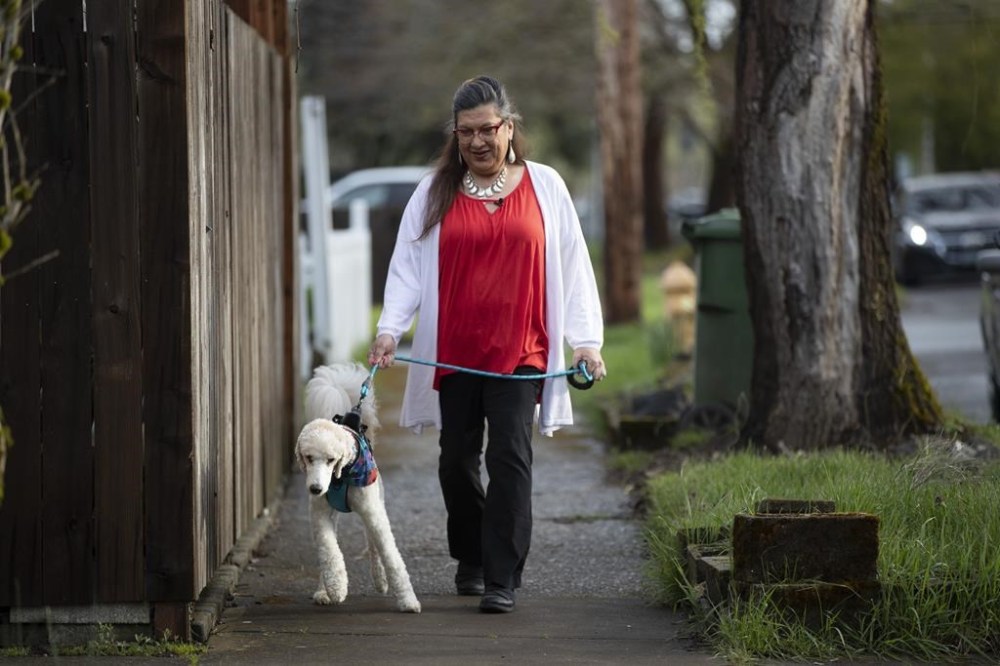
PORTLAND, Ore. (AP) — For most of her life in New Mexico, Christina Wood felt like she had to hide her identity as a transgender woman. So six years ago she moved to Oregon, where she had readier access to the gender-affirming health care she needed to live as her authentic self.
Once there, Wood, 49, was able to receive certain surgeries that helped her transition, but electrolysis, or permanent hair removal, wasn’t fully covered under the state’s Medicaid plan for low-income residents. Paying out-of-pocket ate up nearly half her monthly income, but it was critical for Wood’s mental health.
“Having this facial hair or this body hair, it doesn’t make me feel feminine. I still look in the mirror and I see that masculine person,” she said. “It’s stressful. It causes anxiety and PTSD when you’re having to live in this body that you don’t feel like you should be in.”

That is likely about to change. Oregon lawmakers are expected to pass a bill that would further expand insurance coverage for gender-affirming care to include things like facial hair removal and Adam’s apple reduction surgery, procedures currently considered cosmetic by insurers but seen as critical to the mental health of transitioning women.
The wide-ranging bill is part of a wave of legislation this year in Democratic-led states intended to carve out safe havens amid a conservative movement that seeks to ban or limit gender-affirming care elsewhere, eliminate some rights and protections for transgender people and even bar discussion of their existence in settings such as classrooms.
More than a half-dozen states, from New Jersey to Vermont to Colorado, have passed or are considering bills or executive orders around transgender health care, civil rights and other legal protections. In Michigan, for example, Democratic Gov. Gretchen Whitmer last month signed a bill outlawing discrimination on the basis of gender identity and sexual orientation for the first time in her state.
“Trans people are just being used as a political punching bag,” said Rose Saxe, deputy director of the American Civil Liberties Union’s LGBT and HIV Project. “Denying this health care doesn’t make them not trans. It just makes their lives much harder.”
Gender-affirming care includes a wide range of social and medical interventions, such as hormone treatments, counseling, puberty blockers and surgery.
Oregon’s bill would bar insurers and the state’s Medicaid plan from defining procedures like electrolysis as cosmetic when they are prescribed as medically necessary for treating gender dysphoria. It also would shield providers and patients from lawsuits originating in states where such procedures are restricted.
“We’re actually very committed to accessibility of coverage. Because you can say something is legal, but if it’s not truly affordable or accessible, that is not a full promise,” said Democratic state Rep. Andrea Valderrama, the bill’s chief sponsor.
Access to procedures such as electrolysis is also necessary as a matter of public safety, said Blair Stenvick, communications manager for the LGBTQ+ advocacy group Basic Rights Oregon.
“Facial hair can be a trigger for harassment,” Stenvick said, and being able to present as a woman “helps folks to not get targeted and identified as a trans person and then attacked.”
The bill has sparked fervent debate, with hundreds of people submitting written testimony both for and against it and an emotionally charged public hearing at the Capitol in Salem last month that went on for several hours. The Democratic-controlled House is expected to vote on the bill Monday over Republican opposition before it heads to the Senate, which is also dominated by Democrats.
Oregon’s measure mirrors a nationwide trend in Democratic-led states.
Shield protections similar to what is being proposed in Oregon have been enacted this year in Colorado, Illinois, New Jersey and New Mexico, and other bills are awaiting the signatures of Govs. Jay Inslee in Washington and Tim Walz in Minnesota. California, Massachusetts and Connecticut passed their own measures last year. They largely bar authorities from complying with subpoenas, arrest warrants or extradition requests from states that have banned gender-affirming treatments.
Meanwhile a measure passed last month by lawmakers in Maryland would expand the list of procedures covered by Medicaid, and Democratic Gov. Wes Moore has said he plans to sign it.
And lawmakers in Nevada’s Democratic-held Legislature are also pushing to expand gender-affirming health care and develop policies regarding the treatment of transgender prisoners, among other things.
The series of bills face an uncertain fate under Republican Gov. Joe Lombardo, who has shied away from the anti-transgender rhetoric and policy proposals that fellow GOP officeholders and candidates across the country have embraced. Lawmakers have just over a month to vote on them before the legislative session ends in June. But regardless of their outcome, an open debate over transgender health care protections in the important swing state promises to further heighten national attention on the issue.
“They know that this is not a political stunt,” state Sen. Melanie Scheible, the bill’s sponsor and member of Nevada’s newly formed LGBTQ+ Caucus, said of the governor’s office. “I’m not trying to give them a bill to veto just so I can complain about it later.”
Some opponents of gender-affirming health care say they’re concerned that young people may undergo certain physical transition procedures that are irreversible or transition socially in settings such as schools without their parents’ knowledge.
Advocates for gender-affirming health procedures counter that they can be, literally, a matter of life or death.
Kevin Wang, medical director for the LGBTQI+ Program at Swedish Health Services in Seattle, said such care alleviates the depression, anxiety and self-harm seen in patients with gender dysphoria. Studies show that transgender people, particularly youth, consider and attempt suicide at higher rates than the general population.
“These are not aesthetic procedures,” Wang said. “Accessing these services can be absolutely life-saving because we’re preventing future harm.”
Some legal experts, however, warn that laws that protect gender-affirming care but lack strong enforcement mechanisms or funding to investigate violations may not result in meaningful change.
For example, Oregon already bars insurance companies from discrimination on the basis of gender identity. And the state agency overseeing health insurance rules already requires companies to cover procedures deemed medically necessary by a doctor to treat gender dysphoria and bars them from defining them as cosmetic.
But insurers have rarely faced major consequences for violations, said Ezra Young, a civil rights attorney and visiting assistant professor of law at Cornell Law School.
“Where’s the task force that’s going to enforce the law?” Young said. “Where are the lawyers that are going to do this? Where is the funding to educate insurance adjusters that they can’t do this?”
“If you’re leaving it to relatively poor transgender people to litigate a case in court … that’s not a meaningful remedy.”
Christina Wood, the transplant to Oregon, said she was lucky to have had the resources and ability to move to a state where she could more easily complete her transition, compared with other states that have fewer protections.
“It’s scary to live in this world right now. But … I’m not going to back down, and I’m going to advocate for people in my situation,” Wood said.
“I never had a voice when I was younger. Christopher never had a voice. Christina has a voice. And so that’s what I plan to do.”
___
Associated Press writers Gabe Stern in Carson City, Nevada, Joey Cappellitti in Lansing, Michigan, and Brian Witte in Baltimore contributed to this report.
___
Rush and Stern are corps members for the Associated Press/Report for America Statehouse News Initiative. Report for America is a nonprofit national service program that places journalists in local newsrooms to report on undercovered issues.