Figuring out Texas: From guns to immigration, here’s how one state’s challenges echo the country’s
Advertisement
Read this article for free:
or
Already have an account? Log in here »
To continue reading, please subscribe:
Digital Subscription
One year of digital access for only $1.44 a week*
- Enjoy unlimited reading on winnipegfreepress.com
- Read the E-Edition, our digital replica newspaper
- Access News Break, our award-winning app
- Play interactive puzzles
*Billed as $5.77 plus GST every four weeks. After 52 weeks, price increases to the regular rate of $19.95 plus GST every four weeks. Offer available to new and qualified returning subscribers only. Cancel any time.
To continue reading, please subscribe:
Add Free Press access to your Brandon Sun subscription for only an additional
$1 for the first 4 weeks*
- Enjoy unlimited reading on winnipegfreepress.com
- Read the E-Edition, our digital replica newspaper
- Access News Break, our award-winning app
- Play interactive puzzles
*Your next Brandon Sun subscription payment will increase by $1.00 and you will be charged $17.95 plus GST for four weeks. After four weeks, your payment will increase to $24.95 plus GST every four weeks.
Read unlimited articles for free today:
or
Already have an account? Log in here »
Hey there, time traveller!
This article was published 10/05/2023 (1260 days ago), so information in it may no longer be current.
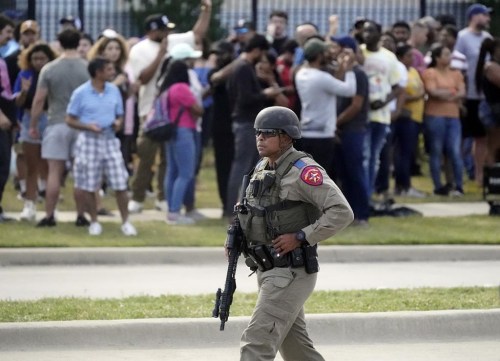
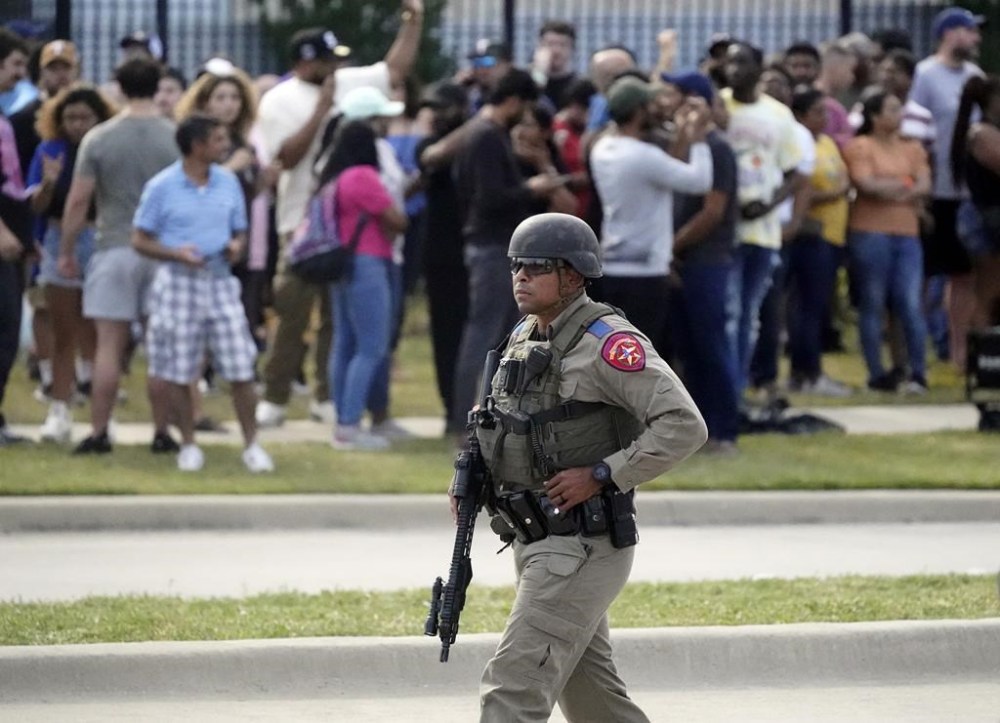
HOUSTON (AP) — Thirteen people dead in two mass shootings. Eight immigrants killed when an SUV slams into a crowded bus stop. The likely approval of legislation that would let the Republican governor overturn elections in the most populous county, a Democratic stronghold. All in the past two weeks.
These issues and the forces behind them — anger and guns, immigration turmoil, deep political divisions about what democracy means — are playing out across American life in various ways. But in Texas, with its immense size and a population that grows by more than 1,000 people a day, the stage is far bigger — and often louder.
It’s enough to make even the proudest Texan wrestle with how he sees the state.
“This is out of control right now,” said Jay Leeson, an illustrator and cartoonist who lives in Lubbock, a city in the Texas High Plains. He describes himself as a “conservative West Texan” whose kids “know how to handle guns, know how to ride horses, know how to do all the Texas things.”
The “Texas things.” Texans have heard this all before. They’ve been hearing it for generations. That everyone is armed. That it’s a wildly conservative place full of oil roughnecks and cowboys and brash braggarts. That it’s nothing like the rest of the country, really.
Many Texans will tell you there’s some truth to this. But Texas is also far more nuanced than a collection of clichés that consider the state through the narrowest of lenses.
Yet lately, things here have felt unrelenting. And what troubles some Texans is not how outsiders see the state, but whether those living here can navigate the divisive political climate — and overcome a complicated and sometimes violent past.
EVEN THOSE WHO SUPPORT GUNS FRET ABOUT THEM
Leeson is furious at how immigration has become a political battleground. He’s furious at how Republicans “bleed every vote they can out of West Texas” to overcome growing populations in the state’s heavily Democratic urban centers, from Houston to Dallas, Austin to San Antonio. The Texas Legislature is currently debating various bills that are targeting how Democratic Harris County, the state’s most populous, runs its elections.
He’s especially furious that his 9-year-old son is so worried about school shootings that he checked all the windows in his classroom to see which would open in case of an attack.
“I just think the whole thing is a damn mess,” Leeson said.
Mass killings have a deep history in Texas. Arguably the first modern American mass shooting happened here in 1966, when an engineering student opened fire from a building observation deck at the University of Texas. He killed 14 people and wounded dozens more.
But the state’s strict gun laws didn’t begin to crack until a few years after another mass shooting — this one in 1991, when a gunman drove his pickup truck through the window of a central Texas cafeteria and killed 23 people. By then, decades of Democratic control were giving way to Republicans who saw gun rights as a key issue.
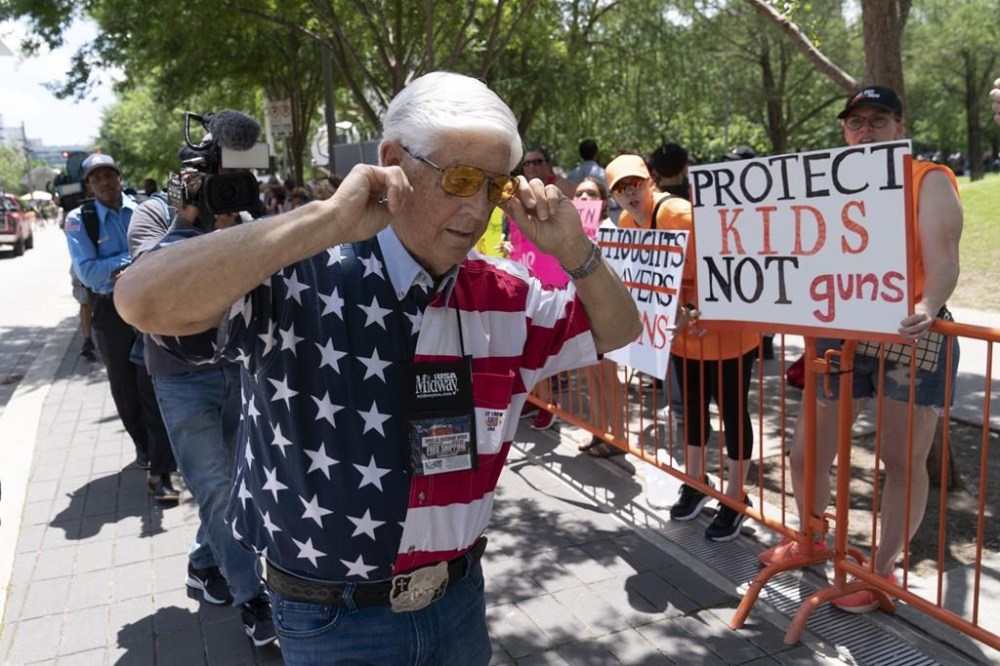
In 1995, then-Gov. George W. Bush signed legislation that allowed Texans to carry concealed guns. Today, Texans can carry weapons openly. Some do — passionately.
Chad Hasty, a well-known conservative talk radio host based in Lubbock, mourns the latest killings — “I don’t want to get to a time where we’re not shocked by a mass shooting” — but is adamant that gun rights be protected. He rarely leaves home without his Sig Sauer P365, a small firearm designed for everyday carrying and one of the best-selling pistols in America.
He dismisses the idea that Texas is particularly prone to violence.
“I don’t view it as a uniquely Texas thing,” he said. Instead, the number of mass shootings is simply a matter of size: “We’re a huge state — millions and millions of people.”
IT’S A STATE FAR MORE DIVERSE THAN THE CLICHÉS
The litany of Texas’ mass killings in just the last few years is staggering: Sutherland Springs, 26 killed in 2017; Santa Fe, 10 killed in 2018; El Paso, 23 killed in 2019; Midland-Odessa, seven killed in 2019; Uvalde, 21 killed in 2022; Cleveland, five killed on April 28; Allen, eight killed on May 6.
Guns have long been a part of Texas culture — both in the state’s mythology and in reality. But to equate the number of guns with the number of people killed by guns strikes some as a false equivalence.
“You’ll never get people to give up their guns, nor do I believe you should,” said Vanesa Brashier, the editor and publisher of Bluebonnet News, a site that covers rural areas north of Houston, including the town of Cleveland, where five immigrants were killed in a mass shooting on April 28.
She was deeply shaken by the killings, particularly by how some of the women died shielding their children from gunfire. But she considers herself pro-Second Amendment: “I want to be able to defend myself if someone comes calling that shouldn’t be at my property.”
Like so much in Texas, her politics are complex. Brashier, who calls herself a political independent, sees immigration as a good thing — “I just think we need to figure out a better way to do it.”
Just two weeks ago she created a Spanish language news site to better inform the area’s growing Latino population. She named the site “El Amanecer Texas” or Texas Sunrise, “because I wanted it to be hopeful.”
“These residents who have moved here deserve to be informed about what’s going on around them,” she said. But the influx of immigrants has faced backlash from some residents, who feel “like there’s been an invasion,” Brashier said.
This week, Texas and other border states were preparing for the end of a policy that allowed the government to quickly expel migrants to Mexico. Gov. Greg Abbott has deployed more Texas National Guard troops in response to the end of the rule. The goal, Abbott said this week: to “secure the Texas border.”
Texas’ border cities have tended to be more welcoming to immigrants than other parts of the state, since many in these areas have long seen themselves and their Mexican neighbors as a big, blended community that transcends governments’ political borders. In El Paso, for instance, more than 80 percent of nearly 700,000 residents are Latino. Many residents have family just across the border in Ciudad Juarez, Mexico.
This situation at the border has created a welcoming community that reacts differently to various issues, including immigration, said Richard Pineda, director of the Sam Donaldson Center for Communication Studies at the University of Texas at El Paso. For Texas, he says, it’s an outlier — a “fluid culture that goes back and forth.”
BIG CHANGES IN THE STATE CAN LEAD TO TENSION
Texas can feel like a study in contrasts. Famed for its oil industry, but the producer of a quarter of the country’s wind energy and a leader in solar power. Known for its open, undeveloped landscapes but home to some of the largest, fastest-growing cities in the land. Epitomized by the cowboy, but with some of the largest immigrant populations in America.
With more than 30 million people, Texas has long been a destination for outsiders from other U.S. states and abroad. Since 2010, it has gained nearly 4 million residents — more than any other state, according to U.S. Census figures. In 2020, Latino residents accounted for half the population growth, and many demographers believe Latinos will soon surpass whites as the state’s largest ethnic group.
But it’s not just Latinos. Texas has large populations of immigrants from India, China, the Philippines, Vietnam and elsewhere. Allen, where a gunman killed eight people at a mall on May 6, is among the Dallas-Fort Worth area’s most diverse suburbs.
For nearly a century, Texas has had a one-word state motto: “Friendship.” But many see that easygoing connection changing.
“I always thought of Texas as a friendly place. But to be honest, this last decade, it just feels meaner,” said Chris Tomlinson, a fifth-generation Texan and a business columnist with the Houston Chronicle. He has written two best-sellers about Texas history, including “Forget the Alamo: The Rise and Fall of an American Myth.”
Tomlinson notes that more than 70 percent of Texans over age 60 are non-Hispanic whites, while more than 70 percent of Texans under age 30 are people of color.
“That creates the tension that you see around voting rights and cultural issues like critical race theory and LGBTQ issues,” he said. “When you have that level of demographic change, there is going to be tension.”
Texas is among the states, for example, where drag shows have been targeted by right-wing activists and politicians, and Republican lawmakers have proposed restrictions on the shows.
At times, it can seem that the Texas population is shifting faster on many issues than the state’s politics, which remain solidly conservative and Republican. A Democrat hasn’t been elected to statewide office since 1994. Yet Tomlinson notes that polling indicates Texans aren’t that different from the rest of the country when it comes to many issues, from abortion to immigration.

Then there are the guns — a reputation that, for better and worse, follows Texas everywhere. A survey last year by the University of Houston and Texas Southern University showed “overwhelming support” for at least some level of gun control. Yet few expect to see that in Texas anytime soon.
Gary Mauro, a longtime commissioner of the Texas Land Office who ran for governor in 1998, is one of those last statewide Democrats. Though he reserves most of his criticism for Republicans, he blames extremists in both parties for focusing on the political fringes — and amplifying some of the very clichés with which Texas continues to struggle.
“I keep thinking it’s going to get better,” he said of Texas politics. “And it keeps getting worse.”
___
Houston-based Associated Press journalist Juan A. Lozano has been covering Texas since 1994. Tim Sullivan, an AP national writer, reported from Minneapolis. Follow Lozano on Twitter at http://twitter.com/juanlozano70 and Sullivan at http://twitter.com/ByTimSullivan