Rural rock star Stone by stone, transforming the bane of farmers’ fields into a riverside mosaic
Read this article for free:
or
Already have an account? Log in here »
To continue reading, please subscribe:

Digital Subscription
One year of digital access for only $205*
- Enjoy unlimited reading on winnipegfreepress.com
- Read the E-Edition, our digital replica newspaper
- Access News Break, our award-winning app
- Play interactive puzzles
*First annual payment billed as $205.00 + GST for one year. This annual subscription will automatically renew at $233.00 + GST every 52 weeks (10% off the regular annual price of $259.35). Offer available to new and qualified returning subscribers only. Cancel any time.
To continue reading, please subscribe:
Add Free Press access to your Brandon Sun subscription for only an additional
$1 for the first 4 weeks*
- Enjoy unlimited reading on winnipegfreepress.com
- Read the E-Edition, our digital replica newspaper
- Access News Break, our award-winning app
- Play interactive puzzles
*Your next Brandon Sun subscription payment will increase by $1.00 and you will be charged $17.95 plus GST for four weeks. After four weeks, your payment will increase to $24.95 plus GST every four weeks.
Read unlimited articles for free today:
or
Already have an account? Log in here »
Hey there, time traveller!
This article was published 08/07/2023 (1169 days ago), so information in it may no longer be current.
ST. ANDREWS — Rock-strewn fields have long been a thorn in farmers’ sides, given the damage large rocks and stones can wreak on equipment during seeding and harvesting.
A recent article in an agricultural trade magazine recommended ways to effectively pry rocks from the ground, such as utilizing a crowbar or a long flat board. The writer of the piece failed to mention a less strenuous solution: give Lorna Doolan a call.
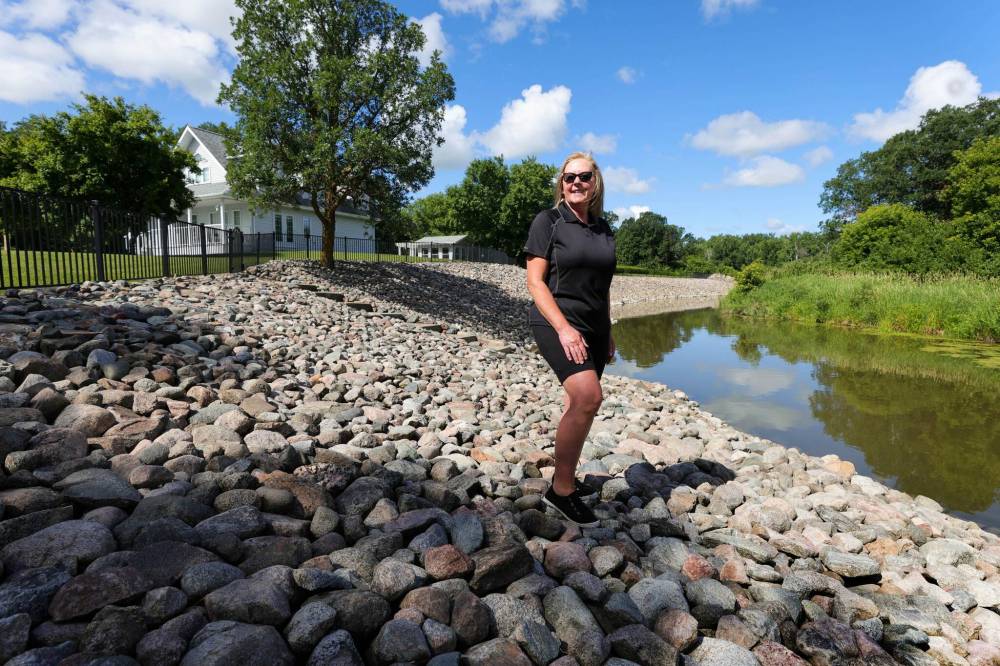
Lorna and her husband Dave live on a rural acreage in the municipality of St. Andrews. Directly behind the two-storey home they share with two dogs and two cats is a 120-metre-long by 10-metre-wide riverbank bordering a picturesque section of Netley Creek. Every square inch of the 30-degree slope is adorned with rocks Lorna personally removed from neighbouring farmers’ fields, and placed along the bank one by one by one, over the course of the last 30 years.
RUTH BONNEVILLE / WINNIPEG FREE PRESS
Lorna Doolan shows off the incredible rock array she built by hand over the last 30 years on her property along the bank of Netley Creek.
Some people who see the array, properly referred to as a riprap, assume it’s natural, and comment how fortunate the couple was to luck into such a lovely setting. Others ask where the thousands upon thousands of rocks armouring the shoreline came from. When Lorna tells them the story of how she got down on her hands and knees and dug them out of the dirt, they often chuckle, thinking she’s pulling their leg.
Funnily enough, despite the fact she grew up on a farm herself, Lorna doesn’t recall extracting a single stone from her father’s grain fields. As a kid she milked cows and weeded her mom’s garden but if anybody was pulling up rocks, it wasn’t her, she says.
“I guess you could say I’m making up for lost time.”
The Doolans purchased their present-day property, situated three kilometres west of Petersfield, in 1993.
While they were waiting for a new house to be built, Lorna asked a neighbour what she should do about the riverbank 20 metres from where their back door was slated to be. She was concerned about erosion, first and foremost, but portions of the bank were also unsightly, having been littered with tree stumps, barbed wire and chunks of cement.
If it was his, he’d cover it with rocks, came the fellow’s answer. That sounded like a perfect solution, Lorna agreed. A few days later, she and Dave had two truckloads of rocks delivered, priced at $300 per load. She shakes her head, describing what was dropped off as being almost as bad as the detritus already lining the slope. There were rocks, sure, but mixed in with them was soil, twigs… you name it, to the point she barely knew where to start.
RUTH BONNEVILLE / WINNIPEG FREE PRESS
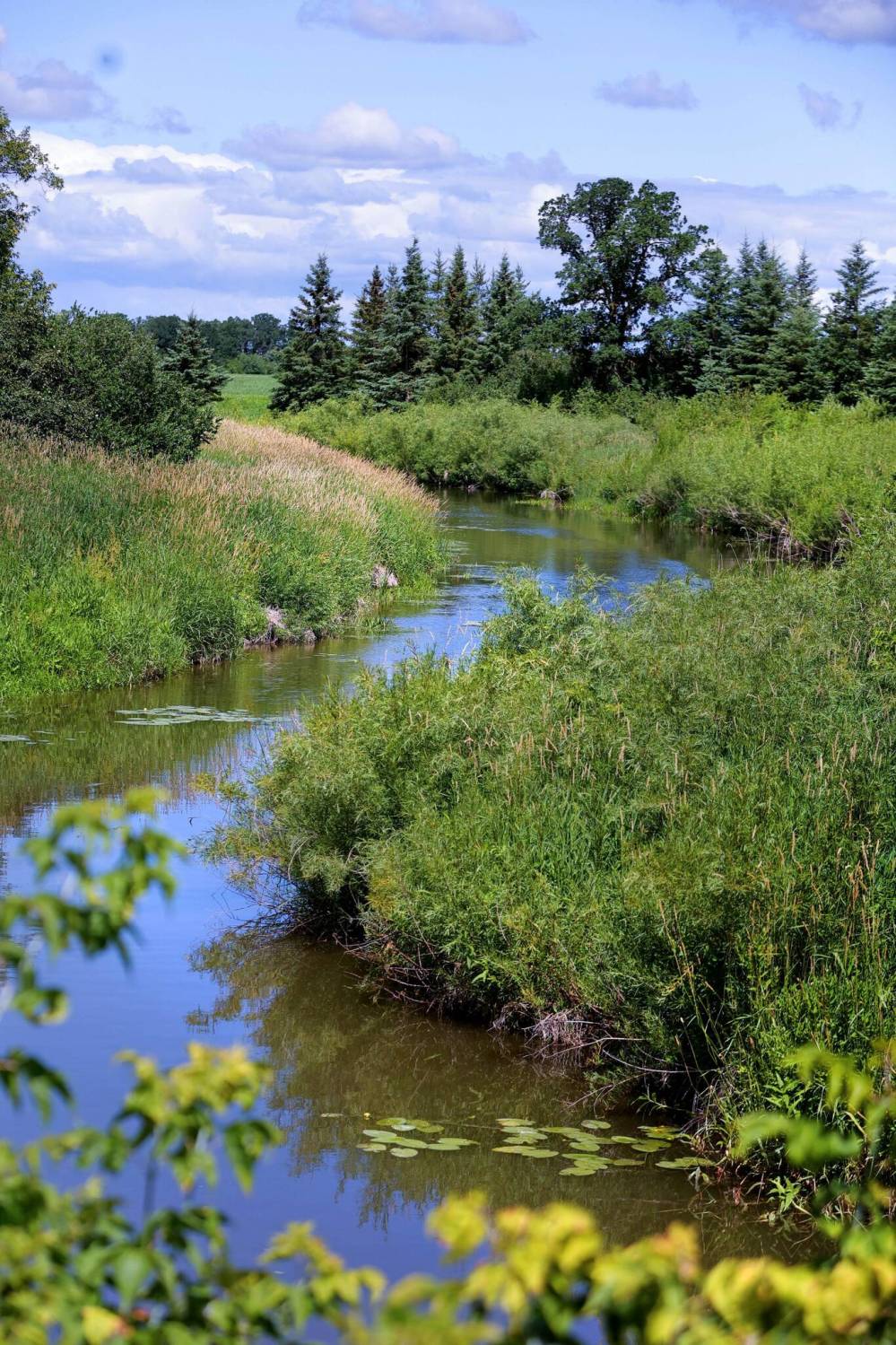
The Doolans purchased their property, which is situated three kilometres west of Petersfield on Netley Creek, in 1993.
That’s when it hit her: Why not save themselves a big headache, not to mention a ton of money, by going out and gathering rocks herself? How long could it possibly take, she wondered?
“In the beginning, if I was driving to work or wherever and saw a rock pile by the side of the road or at the edge of a field, I’d find out who owned the land and give them a call to ask if they wanted to get rid of them, which they always did,” says Lorna, who was a human resources officer for the Winnipeg Regional Health Authority before her retirement in 2016.
It was only after she’d finished picking through umpteen piles that she began to approach area farmers to see if they’d mind her venturing out onto their fields to gather even more rocks. Once again their answer was a universal, hey, knock yourself out. (Dave, who bought a 1940 Chevy one-ton truck expressly to haul rocks, may refer to himself as an “unwilling participant,” but Lorna pooh-poohs that assertion, stressing he’s been a tremendous help.)
It took a few years to complete an initial 900-square-foot stretch directly behind the house. After all, it wasn’t simply a matter of filling a wheelbarrow with rocks and tipping it over onto the bank, she explains. First, she would carefully lay out landscaping fabric to deter weeds. That was followed by a thick layer of limestone, followed by two to three layers of primarily granite rocks, of all shapes and sizes.
Some days they would load and unload the truck three or four times. Weeks also passed when they didn’t lift a single stone, Lorna points out.
“We still managed to go on vacations, camping … I don’t want to be portrayed as only doing rocks in the summer,” she says with a wink.
Photots by RUTH BONNEVILLE / WINNIPEG FREE PRESS
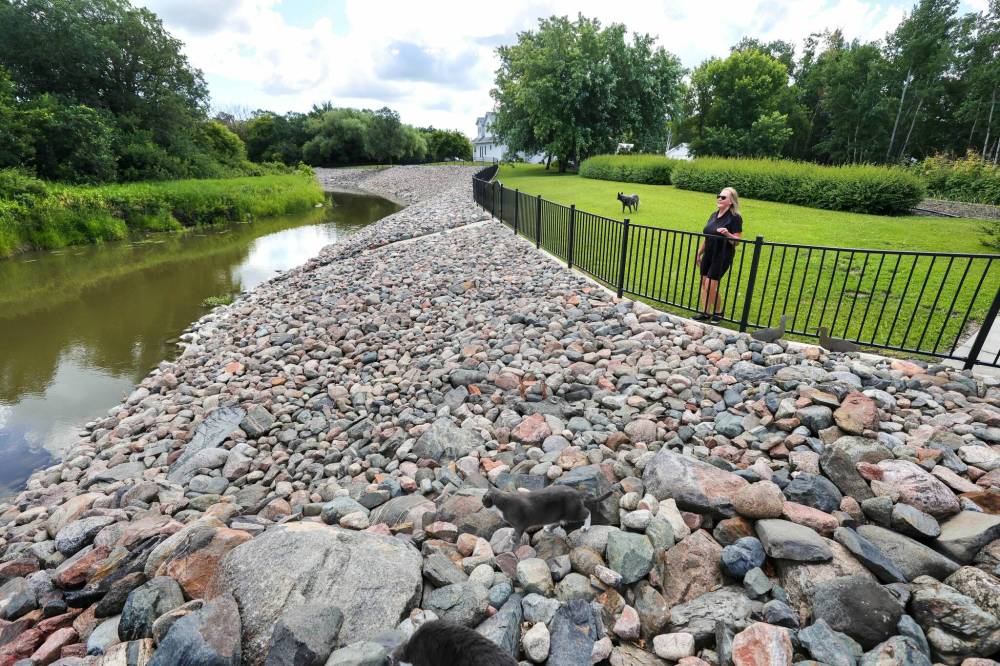
Every square inch of the 120-metre-long by 10-metre-wide riverbank is adorned by rocks Lorna Doolan personally removed from neighbouring farmers’ fields. Doolan says she can remember where practically every last one came from and adds new rocks annually as ice carries some away.
Lorna estimates what’s currently in place, close to a metre thick in spots, would equal in the neighbourhood of 150 semi-truck loads of rocks and stones. Out of curiosity, she’s looked up how much it would cost to buy an equivalent number of landscaping rocks, with the price tag being a tick over 100 grand.
Referring to herself as a “bit of a mountain goat,” she is pleased to report she hasn’t suffered a single injury along the way, by either dropping a rock on her fingers or catching a foot in a crevice. Then again, she has had to learn to ignore the “millions” of spiders that now call the accumulation home.
Speaking of critters, pop by on the right day and you’re likely to observe a bale of painted turtles sunning themselves on rocks by the water’s edge, she says. Dave mentions there is an eagle’s nest atop a towering oak tree to our right. Every once in a while, its resident will pluck a fish out of the creek and deposit it onto a rock to see if something more appetizing — a muskrat or an otter — swims over to nab it, he says.
While Lorna and Dave agree the decades-long project is esthetically pleasing, they stress its purpose is more practical than prepossessing. There have been years when the spring run-off from fields to the west of them was so voluminous they strongly felt they would no longer have a lawn, let alone a house, were it not for the rocks deflecting the water and ice.
“As more erosion was taking place, we just kept adding more rocks,” Lorna points out. “I believe there are four major drains now coming onto our land and the water keeps getting higher every year. Last spring the water stayed up for six weeks… you couldn’t see a single rock. We contacted the province to ask if they could help us and the person who came out to take a look said ‘you’re doing a pretty good job yourself, keep at it.’” (Here she rolls her eyes, as if to say “that’s the government for you.”)
Before we depart, Dave jokingly comments that he’d like us to ask Lorna “for the record” if the rock wall is officially complete or not. Yes and no, she contends. While her foraging days are definitely behind her there is one particularly oversized specimen still waiting for its rightful place amidst the hoard.
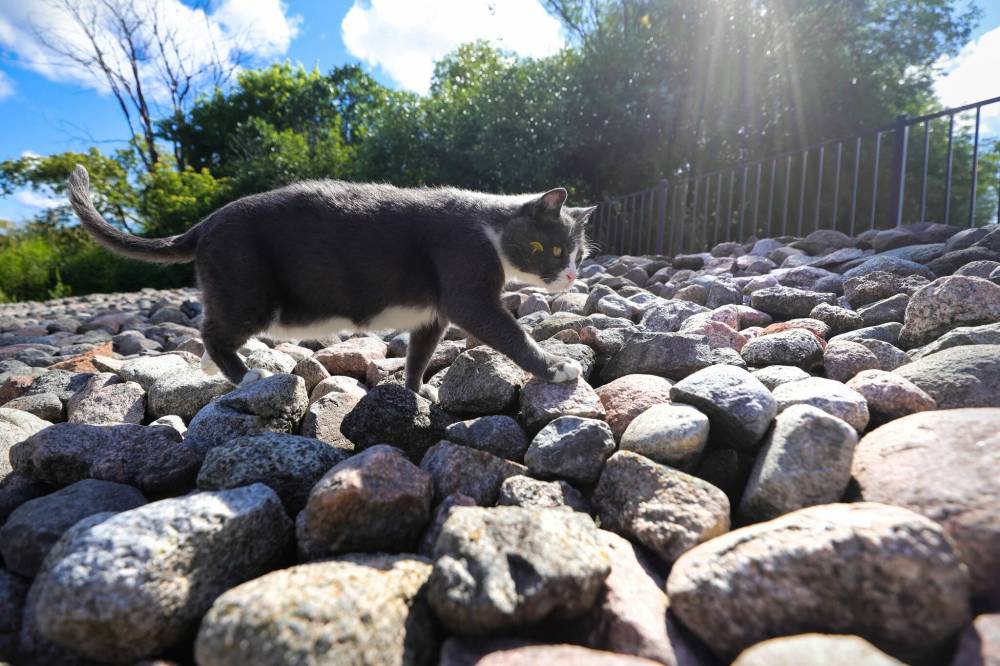
RUTH BONNEVILLE / WINNIPEG FREE PRESS
INTERSECTION - rock wall Photo of Lenny walking on the rock wall.
She celebrated her 60th birthday two years ago. People who were invited to the shindig pestered her for gift ideas. There was absolutely nothing she needed, she assured them, but if anybody wanted to bring along a rock, that would put a smile on her face.
“Wouldn’t you know it? One of our friends came up the drive with this giant boulder loaded onto a trailer, with a big bow around it,” she says, pointing out the monolith, currently weighing down a wooden pallet near the garage. “‘You wanted a rock? We brought you a rock,’ he said. Now I just have to figure out what to do with it.”
david.sanderson@freepress.mb.ca
Dave Sanderson was born in Regina but please, don’t hold that against him.
Our newsroom depends on a growing audience of readers to power our journalism. If you are not a paid reader, please consider becoming a subscriber.
Our newsroom depends on its audience of readers to power our journalism. Thank you for your support.