Black porters’ union stood for those who excluded them

Advertisement

Advertise with us

AS hosts of the One Great History podcast, Sabrina Janke and Alex Judge love exploring Winnipeg’s past. With Winnipeg’s sesquicentennial approaching, the two have produced a podcast series that explores the city’s colourful history. The series is presented through the lens of 15 historical figures, focusing on critical events surrounding their lives and their impact on Winnipeg. The series will conclude Nov. 9, the day when Winnipeg became a city 150 years ago. Summaries from each podcast will be republished in the Free Press. The podcast can be found on Apple Podcasts, Spotify and through the One Great History website — onegreathistory.wordpress.com

Read this article for free:


or

Already have an account? Log in here »

To continue reading, please subscribe:

Subscribe and receive a limited-edition Free Press branded hat or tote.

Digital Subscription

One year of digital access for only $205*

  • Enjoy unlimited reading on winnipegfreepress.com
  • Read the E-Edition, our digital replica newspaper
  • Access News Break, our award-winning app
  • Play interactive puzzles

*First annual payment billed as $205.00 + GST for one year. This annual subscription will automatically renew at $233.00 + GST every 52 weeks (10% off the regular annual price of $259.35). Offer available to new and qualified returning subscribers only. Cancel any time.

To continue reading, please subscribe:

Add Free Press access to your Brandon Sun subscription for only an additional

$1 for the first 4 weeks*

  • Enjoy unlimited reading on winnipegfreepress.com
  • Read the E-Edition, our digital replica newspaper
  • Access News Break, our award-winning app
  • Play interactive puzzles
Start now

*Your next Brandon Sun subscription payment will increase by $1.00 and you will be charged $17.95 plus GST for four weeks. After four weeks, your payment will increase to $24.95 plus GST every four weeks.

Hey there, time traveller!
This article was published 29/07/2023 (1155 days ago), so information in it may no longer be current.

AS hosts of the One Great History podcast, Sabrina Janke and Alex Judge love exploring Winnipeg’s past. With Winnipeg’s sesquicentennial approaching, the two have produced a podcast series that explores the city’s colourful history. The series is presented through the lens of 15 historical figures, focusing on critical events surrounding their lives and their impact on Winnipeg. The series will conclude Nov. 9, the day when Winnipeg became a city 150 years ago. Summaries from each podcast will be republished in the Free Press. The podcast can be found on Apple Podcasts, Spotify and through the One Great History website — onegreathistory.wordpress.com

On May 20, 1919, John A. Robinson made his way to Union Station to let his bosses know the members of his union would not be reporting to work that day. Robinson and his cohort were not alone — the Winnipeg General Strike had kicked off five days earlier, and tens of thousands of workers had already walked off their jobs. But for the Order of Sleeping Car Porters, one of the first Black-led unions in North America, the decision to walk in solidarity could not have been an easy one.

The role of a porter was an intense one. Porters had to show up hours early — unpaid — to make sure the cars were clean and polished, and the train was loaded with either wood or ice, depending on the season. A porter was fully in charge of his passengers’ experience: greeting and loading their luggage, serving food and drink, and even watching passengers’ unruly children.
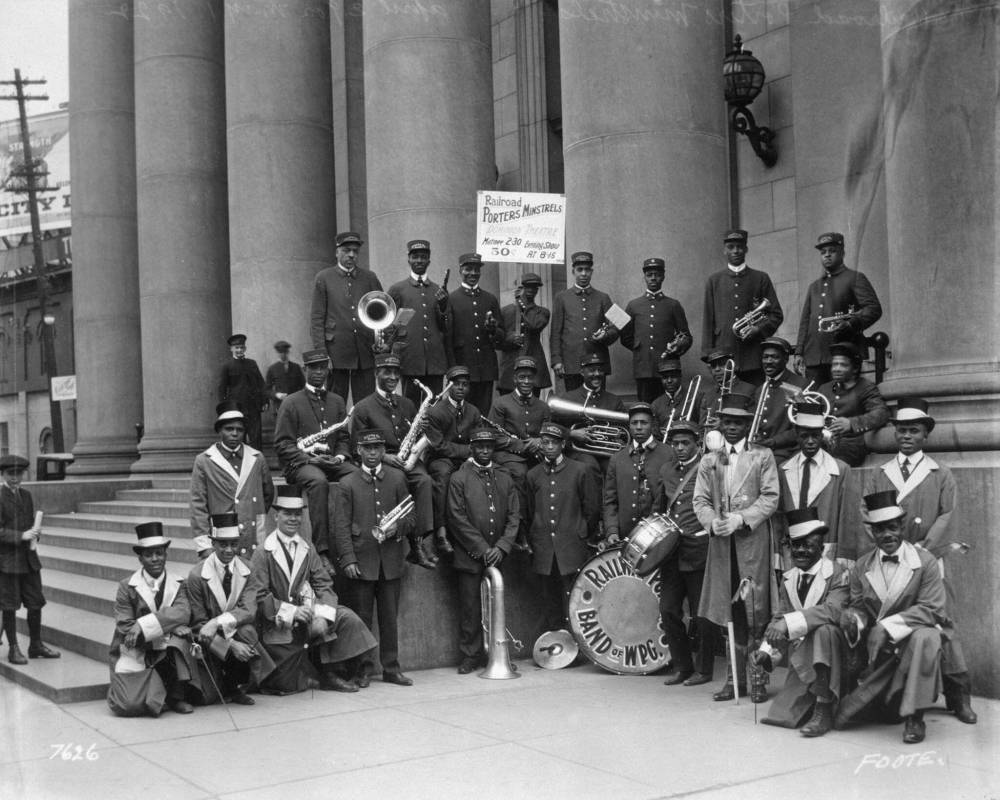
L.B. Foote / Province of Manitoba Archives
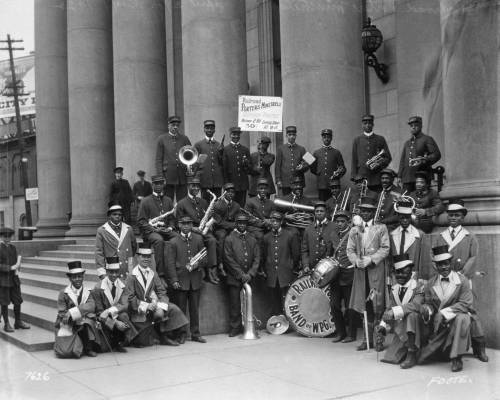
                                Members of the Railway Porters Union Band of Winnipeg pose in front of the Bank of Montreal. Founded in 1917, the Order of Sleeping Car Porters was one of the first Black-led unions in North America.

L.B. Foote / Province of Manitoba Archives

Members of the Railway Porters Union Band of Winnipeg pose in front of the Bank of Montreal. Founded in 1917, the Order of Sleeping Car Porters was one of the first Black-led unions in North America.

It was also emotionally demanding: porters were frequently dismissed and mistreated, and many passengers called all porters “porter,” “boy” or most commonly “George.” Stanley Grizzle, a porter and author, wrote: “Some porters were a study in controlled anger during their work shifts, always angry. And they would simmer during those shifts — for this was a job where, every day, you were made to feel that you were beneath the passengers.”

The job did, however, have some cachet: porters got to travel, engage in conversations with people from across the country, and bring new books and fashions back home with them. Many porters used the steady wages of their work to open their own businesses. Porters created and shaped Black communities across North America, including in Winnipeg where many settled in the North End.

The status of sleeping-car porters changed for the worse with the advent of railway unions like the Canadian Brotherhood of Railway Employees, which established whites-only membership clauses and excluded porters from their newly bargained contracts.

Worried that Black workers would demand their own contracts, railway companies began recruiting African-Americans and men from the West Indies, whom they believed would be more compliant than Black Canadians as a result of experiencing either Jim Crow or colonial rule. One such recruit was John A. Robinson, who came to Winnipeg with his wife and daughter to work for the Canadian Pacific Railway in 1908. He would prove the companies’ assumptions about their “compliant” new recruits had been incorrect.

In 1916, Robinson and three other Black railway workers began meeting in secret to discuss the creation of a new union: the Order of Sleeping Car Porters. The following year, OSCP members went to the annual convention of the CBRE to force the issue of Black membership onto the agenda. After a fierce debate that nearly derailed the convention entirely, white union members dismissed the matter — and proceeded to a minstrel show for their evening’s entertainment.

So, at the onset of the Winnipeg General Strike in 1919, Robinson and his cohort must have asked themselves whether this was their fight. In the past, the successes of white labour unions had not translated into progress for Black workers. Would they march alongside those who had actively excluded them, and who continued to do so? In the end, they did: the OSCP had been advocating since its creation for greater inclusion and solidarity, and in this spirit they threw in their lot with the strikers. There were reasons to be optimistic: the strike’s new brand of labour leaders were advocating for ideas like the One Big Union, which would include all workers.

Regarding the strike, Robinson wrote to the president of the CBRE that he and his fellow porters were “Men, knowing what we want, and capable of defending the benefits which should be obtained.”

This stand did not pay off for the leaders of the OSCP: porters lost their jobs, and the railway companies seemed particularly to target the leaders of the union. But even while the strike proceeded, Robinson was trying a new tack in front of the Board of Conciliation, arguing CP Rail was breaking rules on pay set by the Department of Labour. And the following year, he was once again at the CBRE’s annual convention arguing for Black inclusion — which they ultimately agreed to on a lesser, auxiliary basis. Black workers continued to be kept out of supervisory roles until the 1960s.

Though the strike itself may have been a blip in the history of the Order of Sleeping Car Porters, it is worth examining how stories like that of Robinson complicate narratives of the strike. White labour leaders are seen as heroes, and in many ways they were, but their successes often came at the expense of those were excluded until all too recently.

Report Error Submit a Tip

More Stories

Portage Avenue stabbing victim staggered into nearby store for help

Morgan Modjeski and Malak Abas 4 minute read Preview

Portage Avenue stabbing victim staggered into nearby store for help

Morgan Modjeski and Malak Abas 4 minute read Updated: 5:09 PM CDT

A 46-year-old man stabbed on Portage Avenue Wednesday afternoon is in hospital after staggering, bloodied, into a nearby dollar store.

Police said the man was confronted by several people on the 300 block of Portage shortly before 6 p.m. and was stabbed with an unknown weapon. He was helped by people inside the store until police and paramedics arrived.

The man was rushed to hospital in unstable condition but was later upgraded to stable, the Winnipeg Police Service said.

WPS Const. Claude Chancy said Friday that police were still attempting to speak with the victim, and it was not yet clear if the attack was random. No arrests have been made.

Read
Updated: 5:09 PM CDT

Black porters’ union stood for those who excluded them

Alex Judge 5 minute read Preview

Black porters’ union stood for those who excluded them

Alex Judge 5 minute read Saturday, Jul. 29, 2023

AS hosts of the One Great History podcast, Sabrina Janke and Alex Judge love exploring Winnipeg’s past. With Winnipeg’s sesquicentennial approaching, the two have produced a podcast series that explores the city’s colourful history. The series is presented through the lens of 15 historical figures, focusing on critical events surrounding their lives and their impact on Winnipeg. The series will conclude Nov. 9, the day when Winnipeg became a city 150 years ago. Summaries from each podcast will be republished in the Free Press. The podcast can be found on Apple Podcasts, Spotify and through the One Great History website — onegreathistory.wordpress.com

On May 20, 1919, John A. Robinson made his way to Union Station to let his bosses know the members of his union would not be reporting to work that day. Robinson and his cohort were not alone — the Winnipeg General Strike had kicked off five days earlier, and tens of thousands of workers had already walked off their jobs. But for the Order of Sleeping Car Porters, one of the first Black-led unions in North America, the decision to walk in solidarity could not have been an easy one.

The role of a porter was an intense one. Porters had to show up hours early — unpaid — to make sure the cars were clean and polished, and the train was loaded with either wood or ice, depending on the season. A porter was fully in charge of his passengers’ experience: greeting and loading their luggage, serving food and drink, and even watching passengers’ unruly children.

It was also emotionally demanding: porters were frequently dismissed and mistreated, and many passengers called all porters “porter,” “boy” or most commonly “George.” Stanley Grizzle, a porter and author, wrote: “Some porters were a study in controlled anger during their work shifts, always angry. And they would simmer during those shifts — for this was a job where, every day, you were made to feel that you were beneath the passengers.”

Read
Saturday, Jul. 29, 2023

Relief, reproach from law school staff after disgraced ex-dean’s arrest in France

Maggie Macintosh 5 minute read Preview

Relief, reproach from law school staff after disgraced ex-dean’s arrest in France

Maggie Macintosh 5 minute read Wednesday, Sep. 23, 2026

The overseas arrest of a disgraced former law dean who defrauded the University of Manitoba out of more than $600,000 is being met both with relief and renewed frustration in the local legal community.

Read
Wednesday, Sep. 23, 2026

Ledohowski among new entrants to Manitoba Business Hall of Fame

Gabrielle Piché 3 minute read Preview

Ledohowski among new entrants to Manitoba Business Hall of Fame

Gabrielle Piché 3 minute read 6:00 PM CDT

The late Canad Inns founder will join the ranks of Manitoba Business Hall of Fame members next year.

Leo Ledohowski is one of three honourees to receive the prestigious title. Mark Evans, the executive chair of Conquest Planning, and Michael Pyle, Exchange Income Corporation’s chief executive, are also slated to be inducted next year.

“Each of their stories is very unique,” said Greg Leipsic, president of JA Manitoba.

The non-profit oversees the hall of fame; its board chooses new faces annually. The incoming businessmen will be honoured at an April 6 gala at the Victoria Inn Hotel.

Read
6:00 PM CDT

No more Jets 1.0 or 2.0: League announces all eras of Winnipeg’s club to be merged

Ken Wiebe 6 minute read Preview

No more Jets 1.0 or 2.0: League announces all eras of Winnipeg’s club to be merged

Ken Wiebe 6 minute read Updated: Yesterday at 5:47 PM CDT

Mark Scheifele’s goal was always to chase down his mentor and former Barrie Colts head coach Dale Hawerchuk, no matter what the official record book said.

So when the NHL and the Winnipeg Jets announced on Thursday morning that they were consolidating the franchise history to include the 1.0 and 2.0 eras (including the Atlanta Thrashers chapter of the club), Scheifele was among those to give the move two thumbs up.

“Yeah, it clarifies it for you guys more, not as much (for) me,” said Scheifele. “It’s really cool to bring in the old Jets records, and especially Dale. Chasing him down was always on my mind. So, it’s cool to do it actually in the record books.”

Scheifele remains the franchise leader in games played (961) and he’s likely to eclipse Hawerchuk in goals (Scheifele has 372 to Hawerchuk’s 379) and points (Scheifele has 907 to Hawerchuk’s 929) this season. He now has Thomas Steen’s 553 assists in his sights after amassing 535 heading into 2026-27.

Read
Updated: Yesterday at 5:47 PM CDT

Firefighter admits to conditional sentence breach

Dean Pritchard 4 minute read Preview

Firefighter admits to conditional sentence breach

Dean Pritchard 4 minute read Yesterday at 2:01 AM CDT

A Winnipeg firefighter previously jailed for criminally harassing two different women has been released from custody after admitting to breaching a conditional sentence order.

Christopher Goethals, 59, was arrested July 21 after an alert from his ankle monitor six days earlier showed he had driven within 400 metres of the workplace of a former girlfriend he had been ordered to have no contact with.

Goethals pleaded guilty Wednesday to not being in possession of a copy of his conditional sentence order, a requirement of his sentence.

Crown attorney Amanda Heslop withdrew a breach charge related to Goethals’ electronic monitoring conditions and stayed a third charge of disobeying a court order.

Read
Yesterday at 2:01 AM CDT