Where flooding has become more frequent, here’s how gardeners can respond

Advertisement

Advertise with us

Water is essential to plant life, but what happens when there’s too much of a good thing, as has been the case in many parts of the country and the world this summer?

Read this article for free:


or

Already have an account? Log in here »

To continue reading, please subscribe:

Subscribe and receive a limited-edition Free Press branded hat or tote.

Digital Subscription

One year of digital access for only $205*

  • Enjoy unlimited reading on winnipegfreepress.com
  • Read the E-Edition, our digital replica newspaper
  • Access News Break, our award-winning app
  • Play interactive puzzles

*First annual payment billed as $205.00 + GST for one year. This annual subscription will automatically renew at $233.00 + GST every 52 weeks (10% off the regular annual price of $259.35). Offer available to new and qualified returning subscribers only. Cancel any time.

To continue reading, please subscribe:

Add Free Press access to your Brandon Sun subscription for only an additional

$1 for the first 4 weeks*

  • Enjoy unlimited reading on winnipegfreepress.com
  • Read the E-Edition, our digital replica newspaper
  • Access News Break, our award-winning app
  • Play interactive puzzles
Start now

*Your next Brandon Sun subscription payment will increase by $1.00 and you will be charged $17.95 plus GST for four weeks. After four weeks, your payment will increase to $24.95 plus GST every four weeks.

Hey there, time traveller!
This article was published 01/08/2023 (1153 days ago), so information in it may no longer be current.

Water is essential to plant life, but what happens when there’s too much of a good thing, as has been the case in many parts of the country and the world this summer?

Extreme rainfall is more frequent now, atmospheric scientists say, as storms form in an atmosphere made warmer by climate change.

In the garden, too much water can have fatal consequences, says Nick Goltz, director of the UConn Plant Diagnostic Laboratory at the University of Connecticut in Storrs, Connecticut. “ Flooding deprives roots of oxygen, which leads to root-rot diseases, and then plants can’t pull water up (and) through their leaves and vascular tissue.”
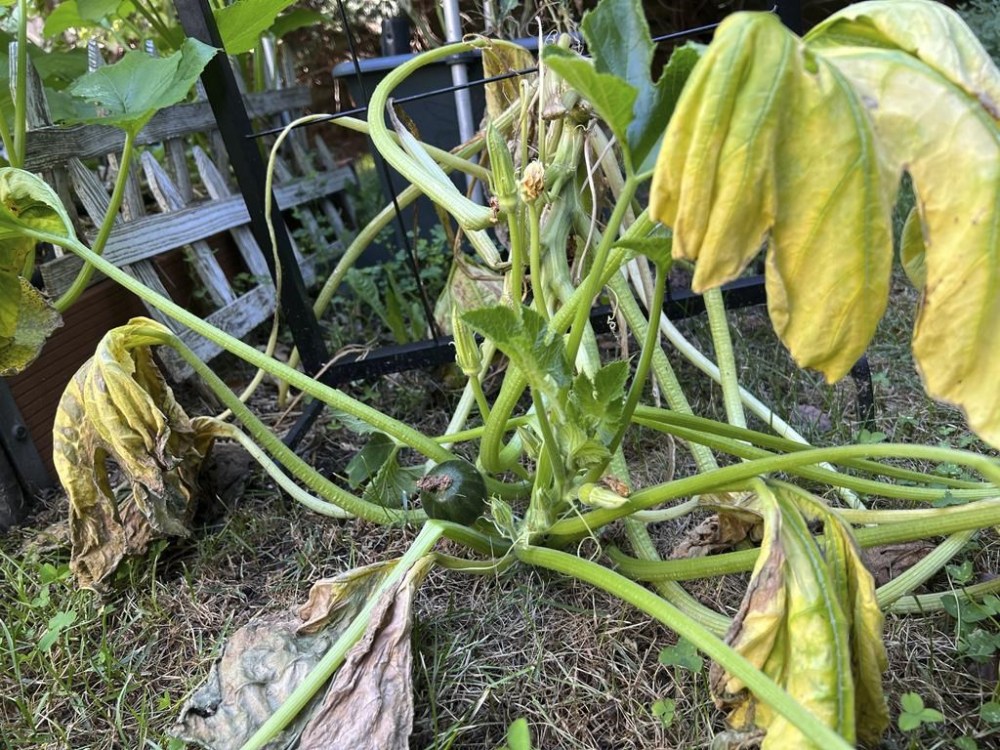
This July 31, 2023, image provided by Jessica Damiano shows a squash plant with yellow, wilted foliage — symptoms that present after both flood and drought — on Long Island in New York. Crops that have been touched by flood water should not be eaten. (Jessica Damiano via AP)

In an ironic case of “water, water everywhere and not a drop to drink,” flooded plants become parched.

The result is yellow, wilting foliage, which ordinarily would signal a plant’s need for water. But after flooding, those same drought symptoms mean that waterlogged roots can’t function in soggy conditions.

WHAT YOU CAN DO

Avoid walking on mud if your garden has been affected by flooding, and wait until the soil has mostly dried before assessing the damage. Applying any weight or pressure to wet soil can lead to compaction and press out even more oxygen from around struggling roots.

A plant with just a few symptomatic leaves may bounce back, but one that’s wholly wilted probably won’t, Goltz said, adding that plants with strong, deep roots – like trees and some perennials – have the best odds of recovery.

Annuals, which have shallower roots, don’t stand much of a chance, he said, so they should be removed if they look unhealthy.

Plants weakened or stressed by flood water are more susceptible to pests and diseases, so keep an eye on them and treat problems as they arise, which could be months later.

Broken tree limbs should be removed immediately, but save major pruning for when conditions improve to avoid further weakening an already stressed tree.

ARE FRUITS AND VEGETABLES SAFE TO EAT?

Flooded fruits, vegetables and herbs should be considered contaminated and not eaten.

“If the part you’re eating touches the water, then it’s unsafe” — even if washed or cooked — “because in addition to bacteria from standing water, runoff from nearby yards, pesticides, sewage and chemical contaminants” could be present, Goltz said.

However, if your garden was flooded but the above-ground edible portion of a plant was not, “then it can be eaten,” Goltz said. “It’s generally safe to eat an untouched tomato growing on a vine… (but not) a melon sitting on the ground. And even then, it’s best to err on the side of caution by washing and cooking the tomato instead of eating it raw.”

If you’re mourning your lost vegetable garden, Goltz says that “in most cases, it’s fine to plant a short crop in soil that has been flooded.” Quick-growing plants like beans and peas will likely deliver before the end of the growing season. “Or you can plant a cover crop, like clover, which will control erosion and also fix nitrogen into the (likely depleted) soil.”
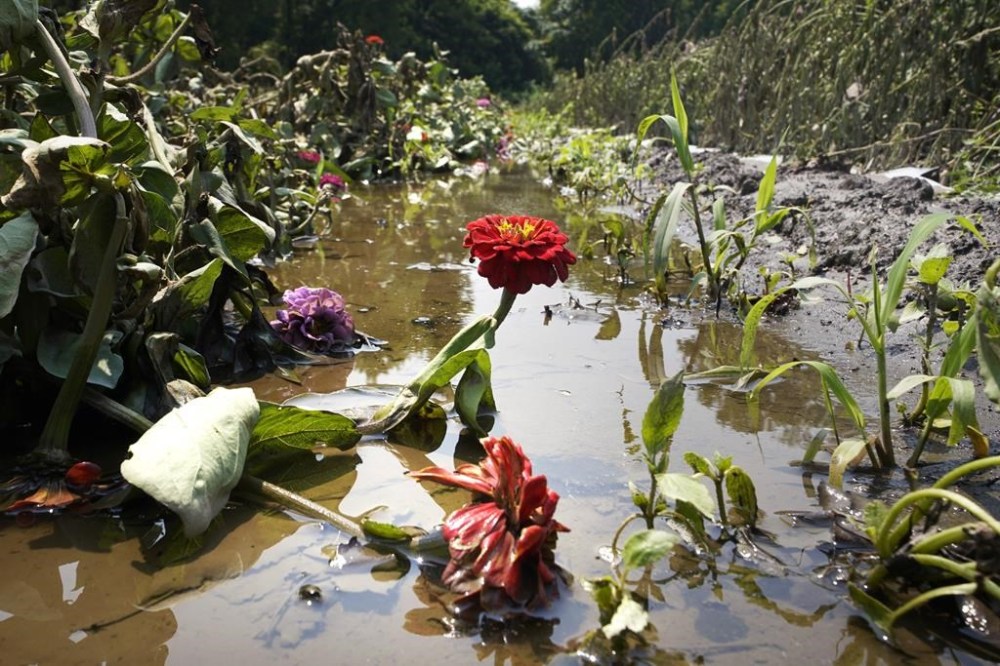
FILE - A zinnia flower stem rises from the flood waters, which destroyed crops, at the Intervale Community Farm, Monday, July 17, 2023, in Burlington, Vt. (AP Photo/Charles Krupa, File)

REPAIRING THE SOIL

After addressing your plants’ needs, turn your attention to the flooded soil, which will also need some TLC. Flooding leaches out nutrients and can disrupt drainage. Mixing in compost will help on both counts, and sand will improve drainage, as well.

Goltz recommends bringing or sending a soil sample to your local cooperative extension service or Land Grant university to test which nutrients or amendments should be replenished, and whether the soil’s pH needs adjusting. They can also test for heavy metal and other contaminants if you have reason to be concerned.

PREPARING FOR THE NEXT FLOOD

If you live in an area prone to flooding, there are steps you can take to avoid or at least minimize future damage, such as growing vegetables at higher elevations or in raised beds. Goltz also recommends digging ditches or installing French drains to direct water away from the plants you care about most.

—-

Jessica Damiano writes the award-winning Weekly Dirt Newsletter and regular gardening columns for The AP. Sign up here to get weekly gardening tips and advice delivered to your inbox.

—-

For more AP gardening stories, go to https://apnews.com/search?q=gardening#nt=navsearch

Report Error Submit a Tip

More Stories

Special teams woes hurt Bombers in loss to Argos

Ken Wiebe 7 minute read Preview

Special teams woes hurt Bombers in loss to Argos

Ken Wiebe 7 minute read Yesterday at 8:06 PM CDT

THEY’VE been the most consistent of the three phases in the Winnipeg Blue Bombers arsenal this season.

A port in the proverbial storm, throughout this topsy-turvy campaign of ups-and-downs, the special-teams units have been supplying strength to a group that is still searching for consistency with only four games left in the regular season.

That’s what made this momentary lapse so costly in a 30-28 loss to the Toronto Argonauts on Friday at Princess Auto Stadium.

“We didn’t keep up our end of the bargain. And that hurts our football team, hurts our chances of winning games,” said Blue Bombers special teams ace Tanner Cadwallader. “And if we want to win close games. we’ve got to be a whole lot better than that. And we will. We’re going to come in (on Saturday for the film session) and go through it with a fine-tooth comb and just work a little bit harder.”

Read
Yesterday at 8:06 PM CDT

WSO season kicks off with two fateful fifths

Holly Harris 5 minute read Preview

WSO season kicks off with two fateful fifths

Holly Harris 5 minute read 3:57 PM CDT

Saturday night’s Masterworks program, titled Beethoven 5 and Tchaikovsky 5 and led by Daniel Raiskin, also officially introduced the WSO’s new composer-in-residence, Kelly-Marie Murphy, to the weekend crowd of 1,720. She was met with enthusiastic applause and cheers upon taking the stage.

Read
3:57 PM CDT

Winnipeg a character all its own onscreen

Jen Zoratti 4 minute read Preview

Winnipeg a character all its own onscreen

Jen Zoratti 4 minute read Yesterday at 2:01 AM CDT

Watch something shot in Winnipeg with a Winnipegger, and you will be treated to a live running commentary. We can’t help playing “spot the location.”

When we recognize that field/statue/mall/intersection/theatre, we have to say it. It’s practically civically mandated.

A friend told me she was at a film screening at which people literally applauded footage of the Mint. (That likely would have been 2005’s The Constant Gardener.)

Being excited about seeing Portage Place Mall at Christmastime in the trailer for Violent Night 2 — and then exclaiming, to your husband, “Oh, look, it’s Portage Place Mall at Christmastime!” — is not, I will admit, particularly cosmopolitan behaviour. In fact, I could be accused of suffering from a mild case of Podunkitis.

Read
Yesterday at 2:01 AM CDT

Four Jets clear waivers to join Moose

Ken Wiebe 3 minute read Preview

Four Jets clear waivers to join Moose

Ken Wiebe 3 minute read Yesterday at 2:28 PM CDT

The Winnipeg Jets organizational depth has yet to take a hit on the waiver wire.

On Saturday afternoon, all four players exposed to waivers — defenceman Isaak Phillips and forwards Nikita Chibrikov, Noah Gregor and Parker Ford — cleared, which means they can be assigned to the Manitoba Moose of the American Hockey League.

Owing to injuries to captain Adam Lowry and winger Cole Perfetti, both Chibrikov and Ford started last season on the NHL roster but spent the bulk of last season with the Moose.

Chibrikov, chosen in the second round of the 2021 NHL Draft, has dealt with multiple lower-body injuries during the prior two seasons and is still working his way back to peak form.

Read
Yesterday at 2:28 PM CDT

The wheels on the bus burned down, down, down…

Russell Wangersky 7 minute read Preview

The wheels on the bus burned down, down, down…

Russell Wangersky 7 minute read Yesterday at 2:00 AM CDT

Up on the high ground, a year after the big forest fire in Newfoundland’s Conception Bay North, and the bare rock is startling.

It’s ghostly. The little birds flit and chirp from the naked silver bare-wood branches, and a solitary northern flicker makes its call from — somewhere. But mostly, it’s still, and silent. With the underbrush gone, you can see how little animal life is here right now.

But the most astounding thing is underfoot. On the high rock behind Adam’s Cove and away from the sea, not only are the trees and low brush gone, but much of the soil has burned away as well.

It burned very, very hot.

Read
Yesterday at 2:00 AM CDT

‘In Normandy, we remember’

Aaron Epp 4 minute read Preview

‘In Normandy, we remember’

Aaron Epp 4 minute read Yesterday at 6:23 PM CDT

Travelling nearly 7,000 km from his home in France to Winnipeg gave Gabriel Zaranski a new perspective on warfare.

“It’s very different to speak about war in school (than) to speak with real people who (have fought) in a war,” he said. “We can feel the emotion when they speak … The testimony has more impact when it’s real soldiers.”

Zaranski is one of 14 Grade 12 students from Bayeux, a town in France’s Normandy region, in Winnipeg this week for a learning tour.

The students, who attend Lycée Arcisse de Caumont high school, met on Saturday with veterans from the Queen’s Own Cameron Highlanders of Canada, a local military regiment, to discuss their studies and the regiment’s role in the Second World War.

Read
Yesterday at 6:23 PM CDT