Swaths of the US are living through a brutal summer. It’s a climate wake-up call for many
Advertisement
Read this article for free:
or
Already have an account? Log in here »
To continue reading, please subscribe:

Digital Subscription
One year of digital access for only $205*
- Enjoy unlimited reading on winnipegfreepress.com
- Read the E-Edition, our digital replica newspaper
- Access News Break, our award-winning app
- Play interactive puzzles
*First annual payment billed as $205.00 + GST for one year. This annual subscription will automatically renew at $233.00 + GST every 52 weeks (10% off the regular annual price of $259.35). Offer available to new and qualified returning subscribers only. Cancel any time.
To continue reading, please subscribe:
Add Free Press access to your Brandon Sun subscription for only an additional
$1 for the first 4 weeks*
- Enjoy unlimited reading on winnipegfreepress.com
- Read the E-Edition, our digital replica newspaper
- Access News Break, our award-winning app
- Play interactive puzzles
*Your next Brandon Sun subscription payment will increase by $1.00 and you will be charged $17.95 plus GST for four weeks. After four weeks, your payment will increase to $24.95 plus GST every four weeks.
Read unlimited articles for free today:
or
Already have an account? Log in here »
Hey there, time traveller!
This article was published 03/08/2023 (1159 days ago), so information in it may no longer be current.
Veronica Iordanova remembers Octobers growing up in Arizona when it was too cold to trick-or-treat in a short-sleeved Halloween costume. She can’t imagine that anymore.
The summer heat lasts longer and feels more intense now, and she knows that is a result of human-caused global warming. She worries about her and her family’s future.
“We need to realistically look at the situation and realize it’s not going to get better,” said Iordanova, who lives in Tempe.
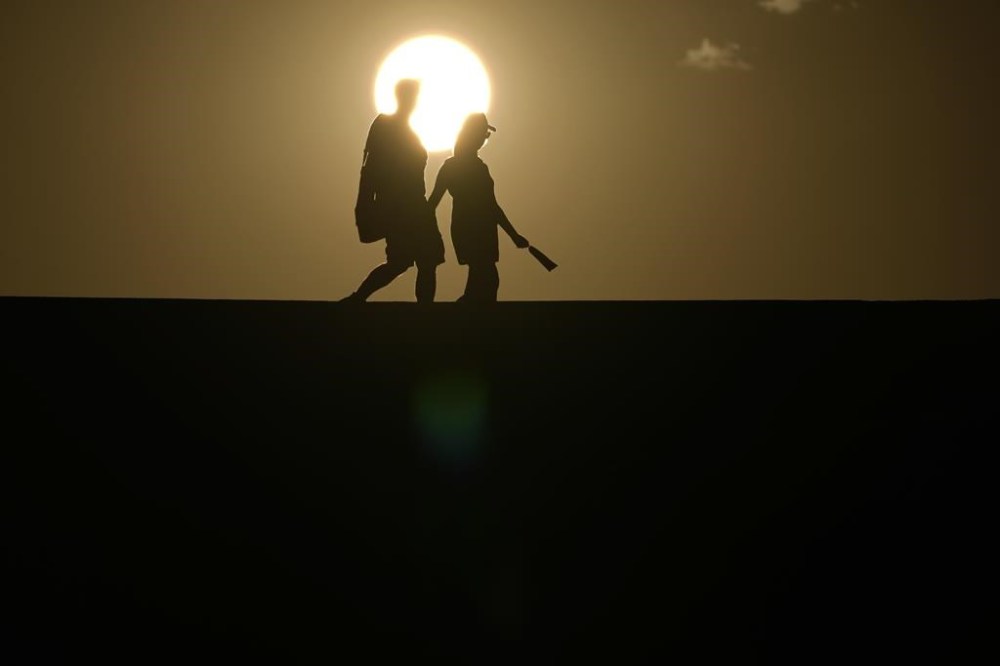
Across the U.S., many people are living through one of the most brutal summers of their lives. And some psychologists believe the attention on a cascade of record-shattering heat, wildfire smoke, extreme flooding and Jacuzzi-hot ocean water could be “another turning point” in efforts to raise awareness about the everyday impact of climate change, as Cornell University climate scientist Natalie Mahowald put it. That’s a crucial step to prompt collective action on global warming.
The recognition that human-caused climate change is already contributing extreme weather has been gaining traction for a few years now among Americans.
“This definitely feels like we’re in that point of no return that people have talked about for a long time,” said Stephen Escudero of Miami, who says this has been the worst summer he’s ever seen in his 38 years living there.
For years, Anthony Leiserowitz, the director of the Yale Program on Climate Change Communication, was unable to see any sign in the data that extreme weather was influencing Americans to think differently about climate change. That started changing around 2016, he said, when more people started connecting their experiences of extreme heat and drought with broader climate patterns.
A majority of people in the U.S. understand that climate change is real and caused at least in part by human activity. Over half of the general public say extreme weather that they’ve experienced was at least partly a result of climate change, according to an AP-NORC Center for Public Affairs Research poll. Yale’s polling asks about personal experiences using a different measure and finds that 44% of people say they have personally experienced global warming.
Leiserowitz notes that an extremely small yet vocal climate-denying minority can tend to dominate the discourse — Iordanova and Escudero expressed that they feel alone in their beliefs about climate change even though they’re in the majority, and public sentiment has been gradually moving in their direction over time.
However, “there’s still a long ways to go before Americans have fully understood what’s happening here” with climate change, Leiserowitz said.
Sometimes personal experiences end up being a more compelling measure than peer-reviewed research.
“Back then I was like, oh, my gosh, you know, climate change, that’s horrible,” said Paul Bowyer, who grew up in Arizona and now alternates his time between Northern California and Costa Rica. He said that he used to be interested in the messages coming from political figures like Al Gore, but over time, the urgency faded away and left him feeling like he hadn’t seen too much difference in the weather.
“The thing is, nothing has changed,” he said. Though he acknowledged that this year brought the worst snowstorm he’s ever seen after years of drought — 5 feet of snow on his deck was “not normal,” he said — he interpreted that as an act of Mother Nature to “replenish” things rather than as anything too concerning.
Still, some researchers think as more people experience extreme weather, more will change their minds in the opposite direction of Bowyer. Leiserowitz pointed out that extreme heat is powerful because it’s easier to connect with the concept of “global warming,” even though that warming also contributes to less intuitively-connected events like stronger hurricanes, more intense rainfall and other wacky weather.
And highly visible events in places where they’re not normally expected — like heat waves in places without air conditioning infrastructure, or wildfire smoke on the East Coast and in the Midwest — can be more noticeable to people. When threatened by natural disasters, “even for people who aren’t willing to call it climate change, they’re willing to say like, ‘there’s a problem and I want to protect my home,’” said Kaitlin Raimi, an associate professor of public policy at the University of Michigan who teaches a course on the psychology of climate change.
Mahowald noted that boilerplate scientific methods are now allowing researchers to more quickly and reliably connect short-term extreme weather events and long-term climate patterns. But minds won’t change overnight, because beliefs about climate change can be deeply tied to long-held notions of personal identity.
“What I keep hoping to see is a more nuanced understanding of how difficult it is to change beliefs and a way to help people make that bridge, to close that gap,” said Barbara Hofer, a professor emerita of psychology at Middlebury College.
Monica Castellanos, a student in Miami, said that she feels sad when she thinks about people who aren’t open to accepting climate science. “More of the older generations are just like, ‘ah no, it’s just hot.’ Like no, the planet’s dying,” she said. “A lot of people don’t seem to take it seriously.”
But Gale Sinatra, a professor of education and psychology at the University of Southern California who co-wrote a book on science denial with Hofer, highlighted the fact that many people have been exposed to climate change misinformation for a long time.
“It isn’t really individuals’ faults if they hear climate change is a hoax, they hear it’s a conspiracy,” Sinatra said. “They’ve been sort of introduced to those views systemically by bad actors who are specifically trying to obfuscate the problem, usually for financial or sometimes political gain.”
The real psychological test for the coming decades will be to see whether personal experiences cause people not only embrace the science of climate change but also to take action in addressing it.
“Emotions can be a barrier because we want to disconnect from things that make us uncomfortable,” she said, but they can also “be leveraged to in a more positive way, get us engaged in activities that are motivating us towards solutions.”
___
Seth Borenstein Washington, D.C., Thomas Machowicz in Phoenix, Brittany Peterson in Denver, Daniel Kozin in Miami and Joshua Bickel in Cincinnati, Ohio, contributed to this report.
___
Follow Melina Walling on Twitter @MelinaWalling.
___
Associated Press climate and environmental coverage receives support from several private foundations. See more about AP’s climate initiative here. The AP is solely responsible for all content.
Related Articles
Adams Lake fire is new challenge for B.C. crews
Advertisement Advertise With Us
Advertisement Advertise With Us