Racing in his blood Horse-training is a lifelong hobby for Mustard, a fixture at Assiniboia Downs from Day 1, where he caught the thoroughbred bug working by his father’s side
Read this article for free:
or
Already have an account? Log in here »
To continue reading, please subscribe:

Digital Subscription
One year of digital access for only $205*
- Enjoy unlimited reading on winnipegfreepress.com
- Read the E-Edition, our digital replica newspaper
- Access News Break, our award-winning app
- Play interactive puzzles
*First annual payment billed as $205.00 + GST for one year. This annual subscription will automatically renew at $233.00 + GST every 52 weeks (10% off the regular annual price of $259.35). Offer available to new and qualified returning subscribers only. Cancel any time.
To continue reading, please subscribe:
Add Free Press access to your Brandon Sun subscription for only an additional
$1 for the first 4 weeks*
- Enjoy unlimited reading on winnipegfreepress.com
- Read the E-Edition, our digital replica newspaper
- Access News Break, our award-winning app
- Play interactive puzzles
*Your next Brandon Sun subscription payment will increase by $1.00 and you will be charged $17.95 plus GST for four weeks. After four weeks, your payment will increase to $24.95 plus GST every four weeks.
Read unlimited articles for free today:
or
Already have an account? Log in here »
Hey there, time traveller!
This article was published 11/08/2023 (1151 days ago), so information in it may no longer be current.
With a slight hitch in his own gait, horse trainer Doug Mustard takes his newest thoroughbred out for a morning stroll around Assiniboia Downs on a recent Tuesday.
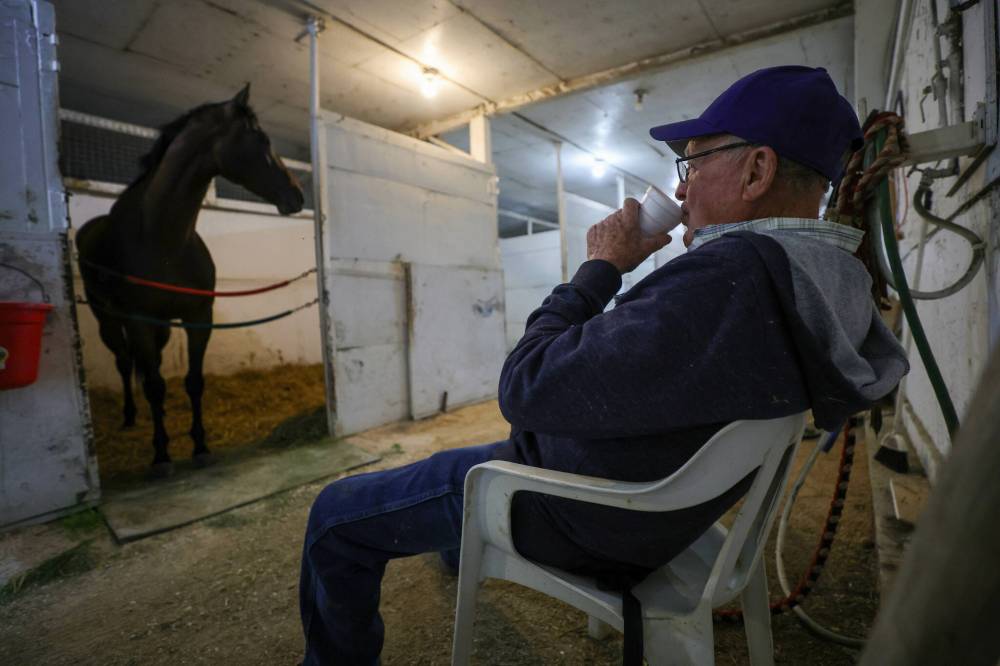
“Come on now,” Mustard, 80, whispers to Himelstein, a six-year-old with a chocolate-brown coat. Over Himelstein’s face, he gently laces the bridle, leading the gelding out of the barn and toward the walker, rotating counterclockwise at an ambling pace.
“Don’t ask me what his name means,” Mustard says. “I’ve only had him for about 12 hours.”
The night before, Himelstein came in dead-last during a claiming race, but Mustard, a retired Hydro lineman who’s been training horses since 1983, saw something in the loser.
“He ran real well until he didn’t,” he says.
He ponied up $5,500, plus GST. “You got yourself a project,” a fellow trainer told him, sipping a morning cup of coffee outside the Mustard tack room.
Himelstein doesn’t quite take to the walking machine, so Mustard, with his left knee buckling, walks alongside his newest horse; it isn’t always clear who is leading whom.
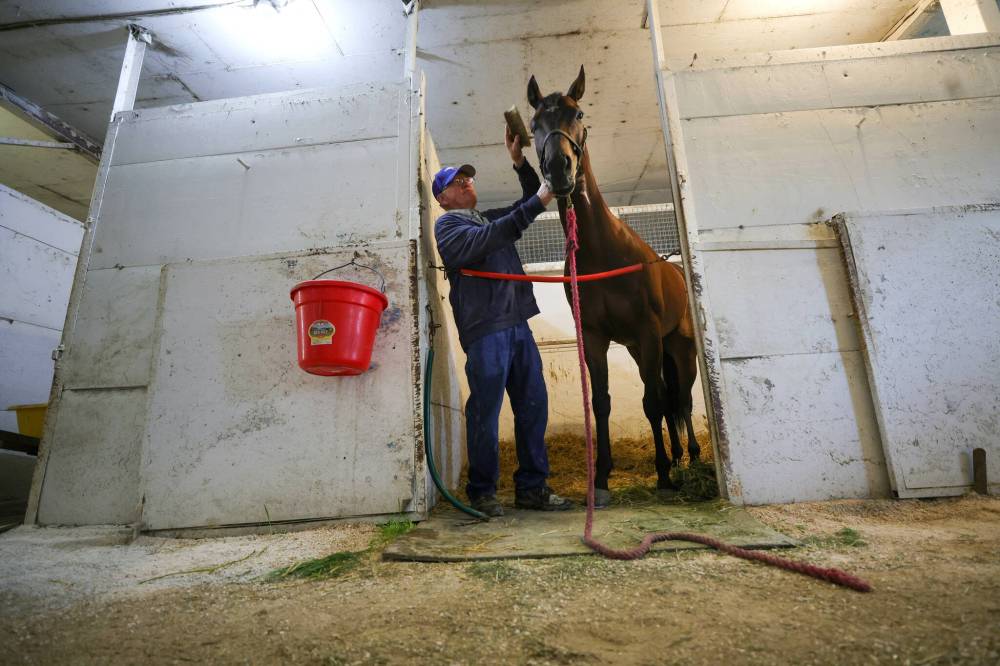
Ever since Assiniboia Downs opened in the spring of 1958, Mustard has been there. His father, Wendell, raised and bred horses at the family farm in Gladstone, and raced his horses at the old Polo Park before shifting to the Downs.
Doug’s brother, also named Wendell, was a Downs mainstay, too. Judy Mustard, Doug’s wife and a retired nurse, is an integral part of the training operation, as is their son, Carman.
Mud-stained jeans are in the Mustard family genes.
During the racing season, the Mustards live in a trailer on the Downs grounds, rising every morning at six to head to their tack room, where they keep their feed, a mini- refrigerator, a coffee-maker and a spot on the shelf reserved for Judy’s homemade gingersnaps.
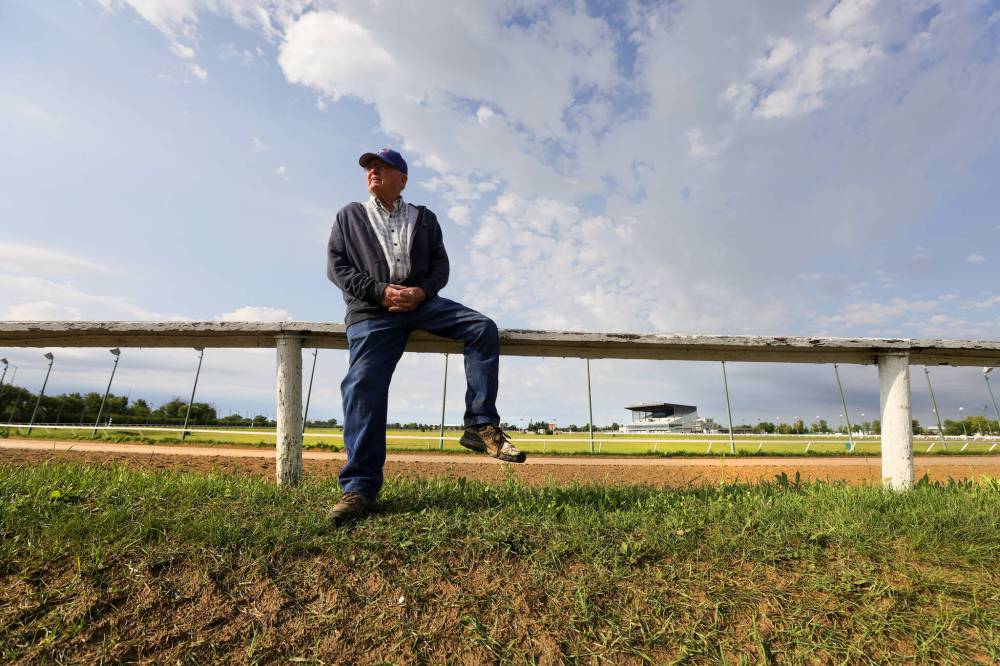
Throughout the day, fellow trainers and jockeys, including 29-year-old Shavon Belle, make frequent stops to visit the Mustards, and to grab a gingersnap or two. “This is the only place you can get cookies,” Belle smiles.
Horse-training is a lifelong hobby for Mustard, who had no interest in retiring to golf, go to the lake, or watch too much television. “I’d rather be here at the track doing nothing than doing the same on the chesterfield,” he says.
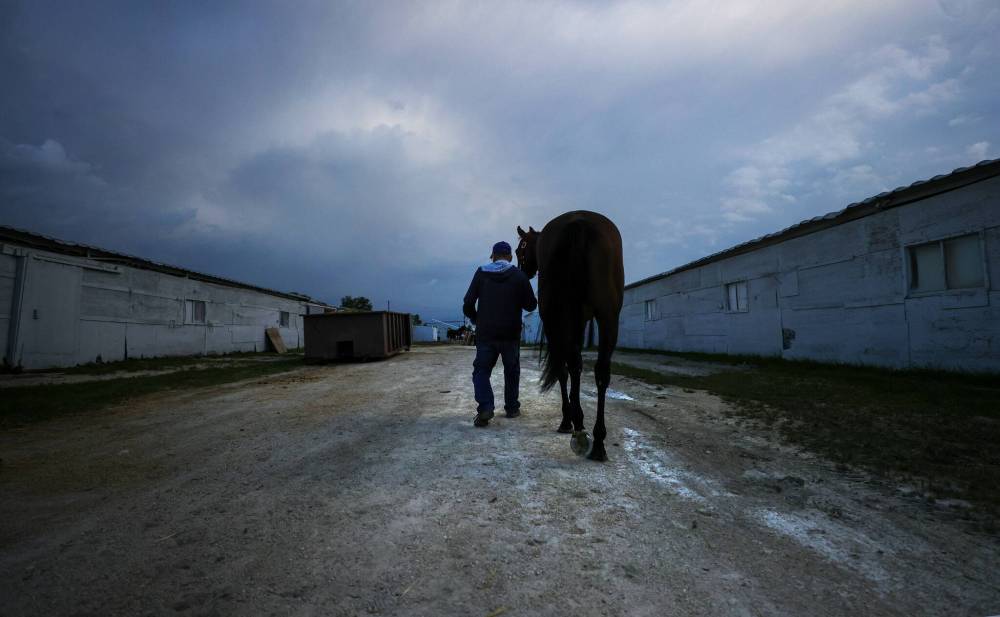
He loves his gig, and not once has he regretted going to the barn, he says. Although he has had his share of bad days at the track.
“I remember Fonzarello,” he says, referring to a horse who collapsed and died very suddenly six years ago. He also remembers when a brood mare of his died during foaling, a moment which brings tears to his eyes, the only time a foal died during his career.
“You hate to see life gone,” he says. “That’s the reason I stopped hunting.”
“You fall in love with these bastards,” he adds.
Only a few hours into their relationship, Doug and Judy Mustard are starting to feel affection for Himelstein, their only horse at the track, who wouldn’t be racing for at least two weeks.
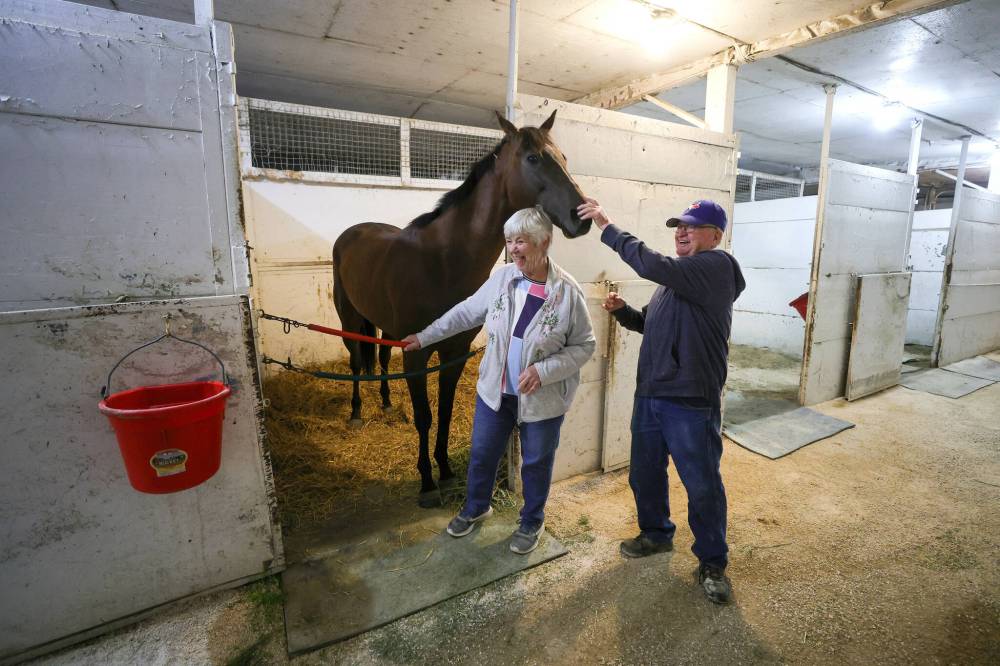
Judy feeds the horse carrots. Not all horses like them, she says. But Himelstein snacks away. And as it starts raining outside, he has his first bowel movement of the morning — a sign of health, says Mustard, and a reason for celebration.
“You don’t eat, you don’t poop,” he says. “You don’t poop, you die.”
Over the next few weeks, Mustard will continue to ready Himelstein for the track, hiring jockeys to take the horse on practice runs before, hopefully, earning the Mustards a win or at least a portion of a race purse.
“Of course we want to win,” Doug Mustard says. “It’s a lot more fun than losing. They win, you win. You’re part of them, they’re part of you.”
But to get that result requires patience and humanity, he says. “Be kind to them, don’t curse at them. Horses don’t like mean people; nobody does.”
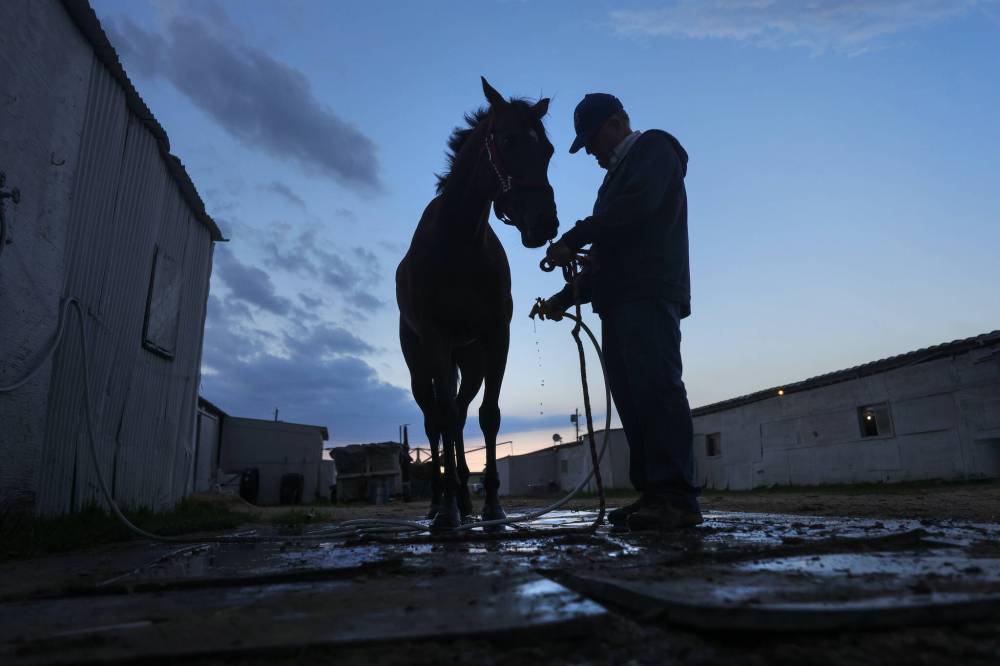
The reward of training horses is often more holistic than financial, Mustard says as the rain slows down.
“A famous trainer in the United States, though I don’t remember his name, had a terrific quote,” he says. “The outside of the horse is good for the inside of a man.”
He smiles at Himelstein.
“Nothing makes a guy feel better than a new horse.”
ben.waldman@winnipegfreepress.com

Ben Waldman is a National Newspaper Award-nominated reporter on the Arts & Life desk at the Free Press. Born and raised in Winnipeg, Ben completed three internships with the Free Press while earning his degree at Ryerson University’s (now Toronto Metropolitan University’s) School of Journalism before joining the newsroom full-time in 2019. Read more about Ben.
Every piece of reporting Ben produces is reviewed by an editing team before it is posted online or published in print — part of the Free Press‘s tradition, since 1872, of producing reliable independent journalism. Read more about Free Press’s history and mandate, and learn how our newsroom operates.
Our newsroom depends on a growing audience of readers to power our journalism. If you are not a paid reader, please consider becoming a subscriber.
Our newsroom depends on its audience of readers to power our journalism. Thank you for your support.