Citing sustainability, Starbucks wants to overhaul its iconic cup. Will customers go along?
Advertisement
Read this article for free:
or
Already have an account? Log in here »
To continue reading, please subscribe:

Digital Subscription
One year of digital access for only $205*
- Enjoy unlimited reading on winnipegfreepress.com
- Read the E-Edition, our digital replica newspaper
- Access News Break, our award-winning app
- Play interactive puzzles
*First annual payment billed as $205.00 + GST for one year. This annual subscription will automatically renew at $233.00 + GST every 52 weeks (10% off the regular annual price of $259.35). Offer available to new and qualified returning subscribers only. Cancel any time.
To continue reading, please subscribe:
Add Free Press access to your Brandon Sun subscription for only an additional
$1 for the first 4 weeks*
- Enjoy unlimited reading on winnipegfreepress.com
- Read the E-Edition, our digital replica newspaper
- Access News Break, our award-winning app
- Play interactive puzzles
*Your next Brandon Sun subscription payment will increase by $1.00 and you will be charged $17.95 plus GST for four weeks. After four weeks, your payment will increase to $24.95 plus GST every four weeks.
Read unlimited articles for free today:
or
Already have an account? Log in here »
Hey there, time traveller!
This article was published 15/09/2023 (1107 days ago), so information in it may no longer be current.
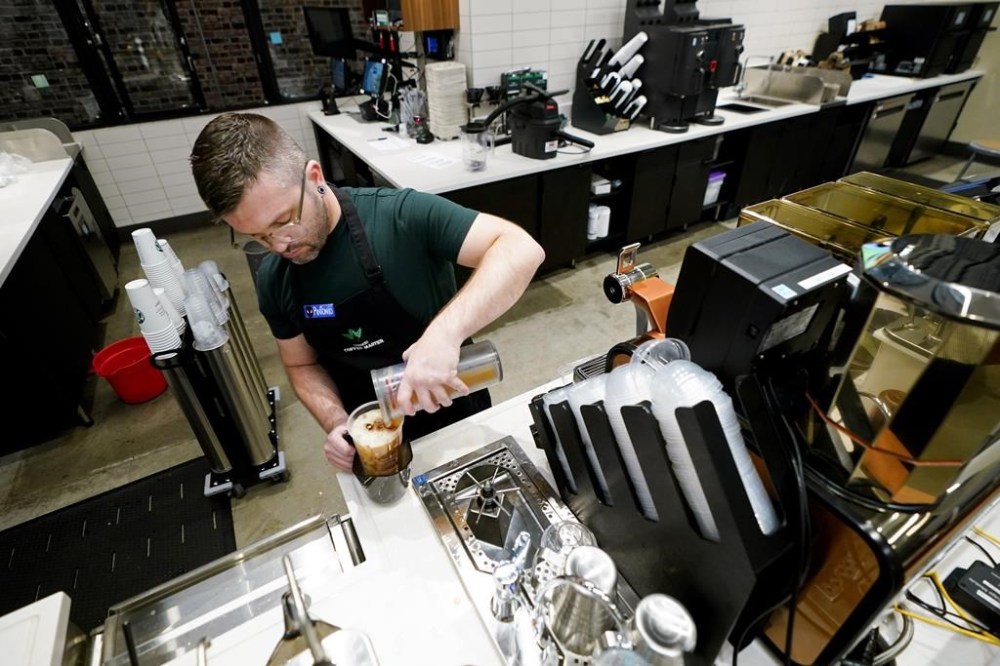
TEMPE, Ariz. (AP) — Bethany Patton steps up to the counter and places her pink mug into a shoebox-sized dishwasher. It spins. It whirs. Water splashes inside. After 90 seconds, the door opens and steam emerges. A barista grabs the mug, dries it and prepares Patton’s order — a 16-ounce Starbucks double espresso on ice.
For bringing her own cup, Patton gets $1 off her drink.
“Saving the environment is important and all, but I probably come here more in knowing that I’m going to get a dollar off,” says Patton, 27, a cancer researcher at Arizona State University. Two friends who came on the afternoon coffee run nod in assent as they hold the cups that they, too, brought along.
Just as noteworthy as what they’re carrying is what they are not: the disposable Starbucks cup, an icon in a world where the word is overused.
For a generation and more, it has been a cornerstone of consumer society, first in the United States and then globally — the throwaway cup with the emerald logo depicting a longhaired siren with locks like ocean waves. Ubiquitous to the point of being an accessory, it has carried a message: I am drinking coffee from the world’s most recognizable coffee company.
Now, in an era where concern for the environment and sustainability can be good business, the Starbucks disposable cup may be on its way to extinction thanks to an unlikely force: Starbucks itself.
By 2030, Starbucks wants to move away completely from disposable cups, which represent big portions of the company’s overall waste and greenhouse gas emissions.
The stated reason is that it’s the right thing to do for the environment, and Starbucks has a long history of lofty sustainability goals around many aspects of their global operations. Some have been met, such as new stores being certified for energy efficiency, while others have been scrapped or revised along the way. For example, in 2008 the company said that by 2015 it wanted 100% of its cups to be recyclable or reusable, which it’s far from achieving even today.
Today’s drive to completely overhaul the cup arguably comes with a business imperative, as extreme weather events and other manifestations of climate change make waste like disposable cups more notable, and by extension increased expectations from customers for the company to be part of the solution.
At the Arizona State location where Patton gets her coffee, Starbucks already doesn’t serve any coffee in disposable paper or plastic cups. Customers who don’t bring their own are given a reusable plastic one that can be dropped off in bins around campus. It’s one of two dozen pilots over the last two years, all aimed at fundamentally changing how the world’s largest coffee maker serves its java.
The goal: to cut the company’s waste, water use and carbon emissions in half by 2030. Pulling that off will be tricky, is fraught with risks and provides a window into what companies must do to go from ambitious sustainability targets to meeting those goals.
“Our vision for the cup of the future — and our Holy Grail, if you will — is that the cup still has the iconic symbol on it,” says Michael Kobori, head of sustainability at Starbucks. “It’s just as a reusable cup.”
Starbucks is not the first company to push toward a reusable cup.
But as the largest coffee company in the world, with more than 37,000 stores in 86 countries and revenues of $32 billion last year, Starbucks could force change across the industry.
Overhauling how coffee is served means doing two major things in parallel that are seemingly in conflict: Move toward only reusable cups while developing disposable cups that use less material and are more recyclable.
At the Arizona State store, if customers don’t bring their own cup, they are given a reusable plastic one with a Starbucks logo. If they bring it back, they get $1 off, just like customers who bring their own. And if they don’t want to hold onto it? There are bins around campus, and the cups are washed by the university — part of a partnership with Starbucks — and returned to the store.
For several years, Starbucks has been increasing the amount of recycled material in disposable paper cups. In some markets last year, Starbucks began using single-use paper cups made with 30% recycled material, an increase from 10%. The plan is to have all cups at 30% recycled material in the U.S. starting in early 2025.
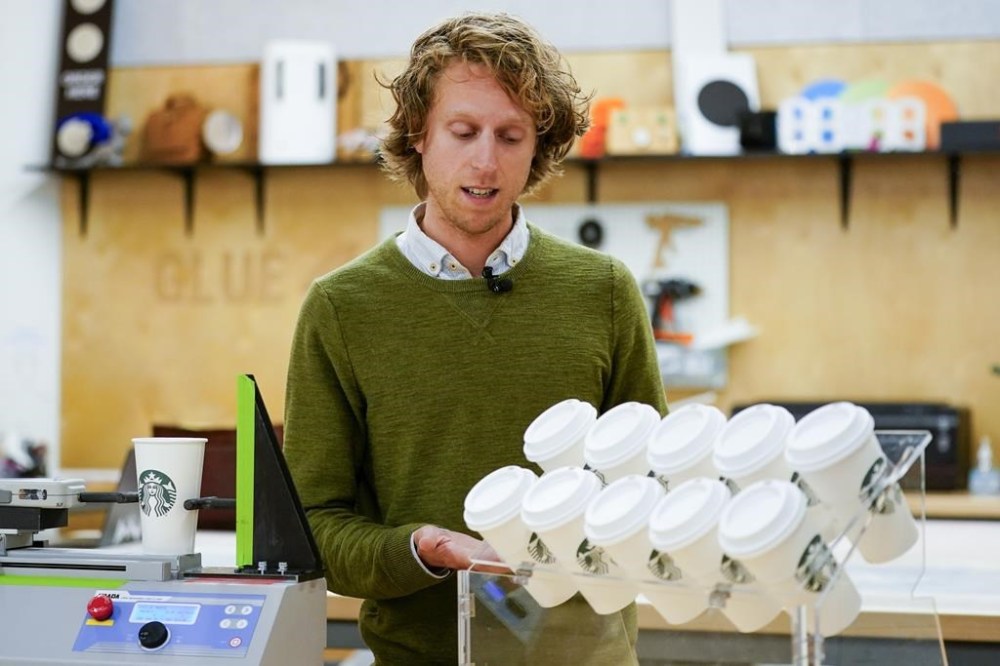
A similar testing and refining process is happening with disposable plastic cups used for cold drinks. At an innovation lab in Starbucks’ Seattle headquarters, drinks with ice in plastic cups are placed in holders attached to a platform. It then shakes as technicians look for leaks and flaws.
By the end of 2023, the goal is to reduce by 15% the amount of material in each cup. To do that, technicians examine different parts of the cup to see where less material may be used without weakening the cup.
Then, “if it passes tests with baristas, then we would put it in the stores,” says Kyle Walker, a packaging engineer on Starbucks’ research and development team.
Eventually, the goal is to get rid of single-use cups. That’s because no matter the tests or technological innovations, there are limits to how much waste can be reduced with disposable paper and plastic cups. Long-term reductions in waste will come from reusable cups.
The company has a long way to go. Since the reintroduction of reusable cups in some stores in July 2021 — reusable cups were not used during much of the pandemic — only 1.2% of worldwide sales in fiscal year 2022 came from reusables. Starbucks wouldn’t provide data on how many disposable cups they use or the costs.
Valencia Villanueva, a barista at the Arizona State store, has noted a growing level of consciousness among customers about the cup-washing machine on the counter and the “borrowed” cup program. That gives her confidence that reusable cups are the future.

“Nobody,” she says, “has complained and said they wanted a single-use cup.”
___
Peter Prengaman is news director of The Associated Press’ climate and environment team and can be followed here. Video journalist Manuel Valdes in Seattle contributed to this report.
___
AP climate and environmental coverage receives support from several private foundations. See more about AP’s climate initiative here. The AP is solely responsible for all content.