London’s historic blue plaques seek more diversity as 1,000th marker is unveiled

Advertisement

Advertise with us

LONDON (AP) — A resounding thump breaks the silence as Julia Land drops a lump of grey-brown clay onto the slab roller before Ned Heywood cranks it through the machine once, twice, three times, creating a rectangle about an inch thick.

Read this article for free:


or

Already have an account? Log in here »

To continue reading, please subscribe:

Subscribe and receive a limited-edition Free Press branded hat or tote.

Digital Subscription

One year of digital access for only $205*

  • Enjoy unlimited reading on winnipegfreepress.com
  • Read the E-Edition, our digital replica newspaper
  • Access News Break, our award-winning app
  • Play interactive puzzles

*First annual payment billed as $205.00 + GST for one year. This annual subscription will automatically renew at $233.00 + GST every 52 weeks (10% off the regular annual price of $259.35). Offer available to new and qualified returning subscribers only. Cancel any time.

To continue reading, please subscribe:

Add Free Press access to your Brandon Sun subscription for only an additional

$1 for the first 4 weeks*

  • Enjoy unlimited reading on winnipegfreepress.com
  • Read the E-Edition, our digital replica newspaper
  • Access News Break, our award-winning app
  • Play interactive puzzles
Start now

*Your next Brandon Sun subscription payment will increase by $1.00 and you will be charged $17.95 plus GST for four weeks. After four weeks, your payment will increase to $24.95 plus GST every four weeks.

Hey there, time traveller!
This article was published 19/09/2023 (1095 days ago), so information in it may no longer be current.

LONDON (AP) — A resounding thump breaks the silence as Julia Land drops a lump of grey-brown clay onto the slab roller before Ned Heywood cranks it through the machine once, twice, three times, creating a rectangle about an inch thick.

Laying a pattern on top of the slab, Heywood slices through the clay to create a disc the size of an extra-large pizza that will become one of the blue plaques that dot the walls of buildings throughout London, marking the places where scientists, artists, politicians and activists have made history.

As English Heritage unveiled its 1,000th blue plaque on Tuesday, the charity was working to broaden the program to include more women, people from minority ethnic backgrounds and community groups so that it better reflects the diversity of the capital.
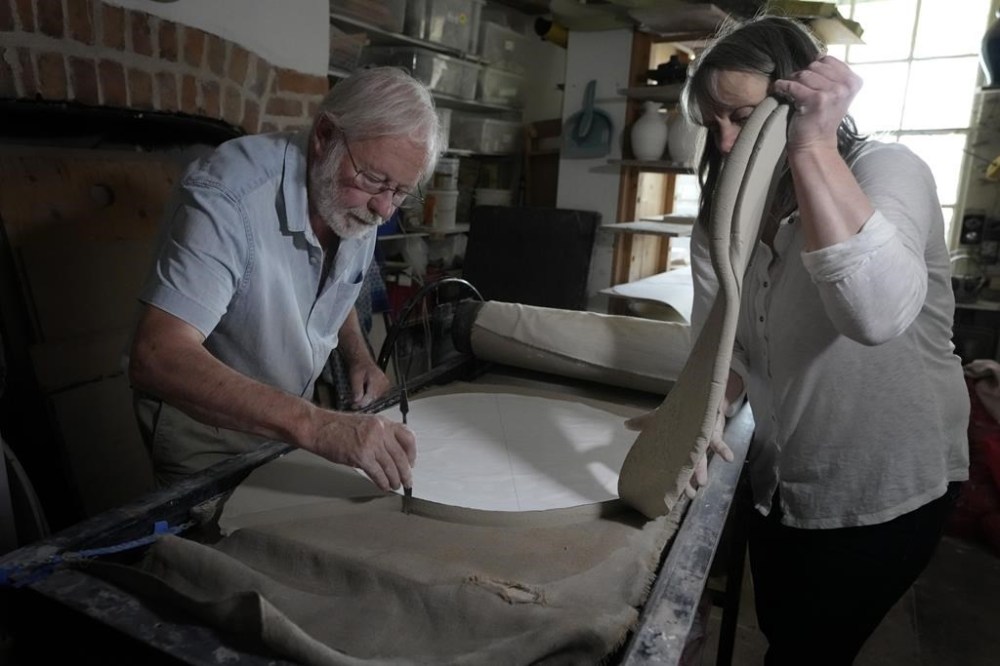
Ned Heywood cuts out the initial shape from a rolled slab of clay as Julia Land takes away the excess during the making of an English Heritage Blue Plaque, at Heritage Ceramics, The Workshop Gallery in Chepstow, Wales Wednesday, Sept. 6, 2023. English Heritage is preparing to unveil its 1,000th blue plaque, the famous discs that dot the walls of buildings throughout London, marking the places where scientists, artists, politicians and activists have made history. The charity is working to broaden the program to include more women, people from minority ethnic backgrounds and community groups so that it better reflects the diversity of the capital. (AP Photo/Kirsty Wigglesworth)

The latest installation marks the offices where the Women’s Freedom League “campaigned for women’s equality” in the early 20th century, satisfying at least two of those goals.

“The names are no longer just English names, which is significant because, you know, the people who’ve come to this country from all over the world have made a disproportionately large contribution,” Heywood said at his workshop, a converted 18th century pub in the Welsh town of Chepstow, 110 miles (180 kilometers) west of London. “It’s changing now, which is very much for the good.”

The blue plaque program, which began in 1866 and is believed to be the first of its kind, provides an informal historical walking tour of London that commemorates notable people and their accomplishments by highlighting the places where they lived and worked.

The honorees include famous figures from wartime Prime Minister Winston Churchill to communist pioneer Karl Marx, as well as lesser known figures like theatrical wigmaker Willy Clarkson and civil engineer William Lindley, who built water and sewage systems around the world. There are also plaques honoring foreigners like India’s first prime minister, Jawaharlal Nehru, and American rock star Jimi Hendrix, who lived in London only briefly.

But English Heritage, which has sponsored the program since 1986, is concerned that past honorees were overwhelmingly white and male. Just 15% of the plaques honor women and less than 5% celebrate people from Black and Asian backgrounds.

The charity, which manages some 400 monuments, medieval castles, Roman forts and country houses around England, is trying to encourage more nominations of women and people from minority ethnic groups, while retaining high standards for entry into the exclusive club, said Anna Eavis, the curatorial director.

Plaques unveiled recently include Princess Sophia Duleep Singh, a suffragette and critic of British rule in India; Ottobah Cugoano, a native of present-day Ghana who was enslaved in Grenada and campaigned against slavery after gaining his freedom; and Ada Salter, the first woman to be elected mayor of a London borough.

“London is hugely diverse and it has always been, hasn’t it?” Eavis said. “And so it is important to ensure that we’re reflecting that diversity, that richness of contribution on London streets.”

Diana Yeh, a senior lecturer in sociology at City University of London, said broadening the reach of programs like the blue plaques is “an essential part of remembering invisible histories.” But heritage organizations must do more to discuss the “troubling aspects” of English history, including slavery and colonialism, she added.

“In a way it’s very easy to celebrate well-known figures who are marginalized, but it’s much harder to do that difficult work of acknowledging Britain’s difficult past,” said Yeh, whose work focuses on race, racism and cultural politics. “But this needs to be done for the benefit of future generations.”
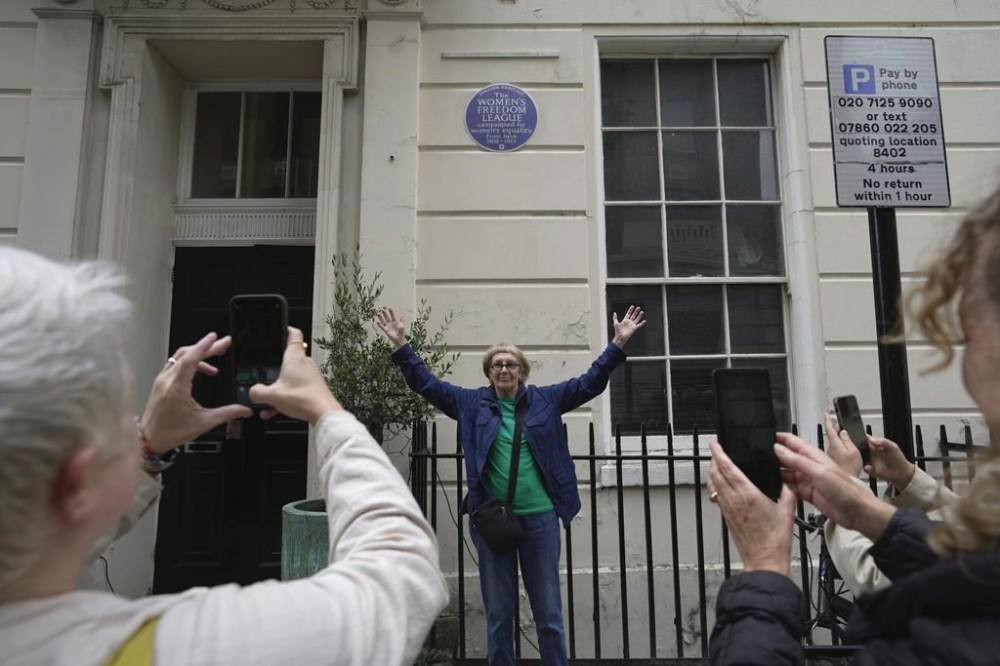
Guests pose for a photograph in front of the new unveiled plaque number 1,000 to honour the Women's Freedom League, a suffragist organisation that used 1 Robert Street in central London as its base of operations during its most active period, in London, Tuesday, Sept. 19, 2023. As English Heritage unveiled its 1,000th blue plaque on Tuesday, the charity is working to broaden the program to include more women, people from minority ethnic backgrounds and community groups so that it better reflects the diversity of the capital. (AP Photo/Kin Cheung)

English Heritage installs a dozen blue plaques each year, selected from about 100 nominations. A committee reviews the nominees to decide which ones warrant commemoration and to ensure there is a real connection between each honoree and the site where the plaque is to be installed.

Once a decision is made, the order goes out to Heywood’s studio, which has been making plaques for English Heritage since 2016.

Over a period of six weeks, Heywood and Land roll and cut the clay, inscribe the disc with the honoree’s name and accomplishments, then apply the characteristic blue glaze and fire it in a kiln. It’s a process that creates an almost indestructible monument that should last as long as the building to which it’s attached — as long as the plaques don’t crack when they’re baked at 1,300 degrees Celsius (2,370 Fahrenheit).

“We pray to gods of the kiln,” Heywood said.

While the first plaque, honoring the poet Lord Byron, was destroyed when the building it adorned was demolished, the second, installed in 1867, still marks the house where Napoleon III, the last French emperor, lived in exile.

Plaque number 1,000 honors the Women’s Freedom League, a suffragist organization that used 1 Robert Street in central London as its base of operations during its most active period.

The league was formed in 1907 by campaigners who broke away from the more famous Women’s Social and Political Union because of disagreements with its leader, Emmeline Pankhurst.

The group, which had the motto “Dare to be free,” aimed for total emancipation for women. It advocated non-payment of taxes and backed a boycott of the 1911 census as ways to pressure the government to allow women to vote. In 1909, when women’s suffrage was omitted from the King’s Speech outlining the government’s legislative program, the league hired an airship to drop pamphlets over the capital.

Heywood and Land feel the responsibility of the blue plaques intensely. To get in the right mindset, they sometimes try to channel the honorees.

Land listened to recordings of violinist Yehudi Menuhin as she did the lettering on his plaque.
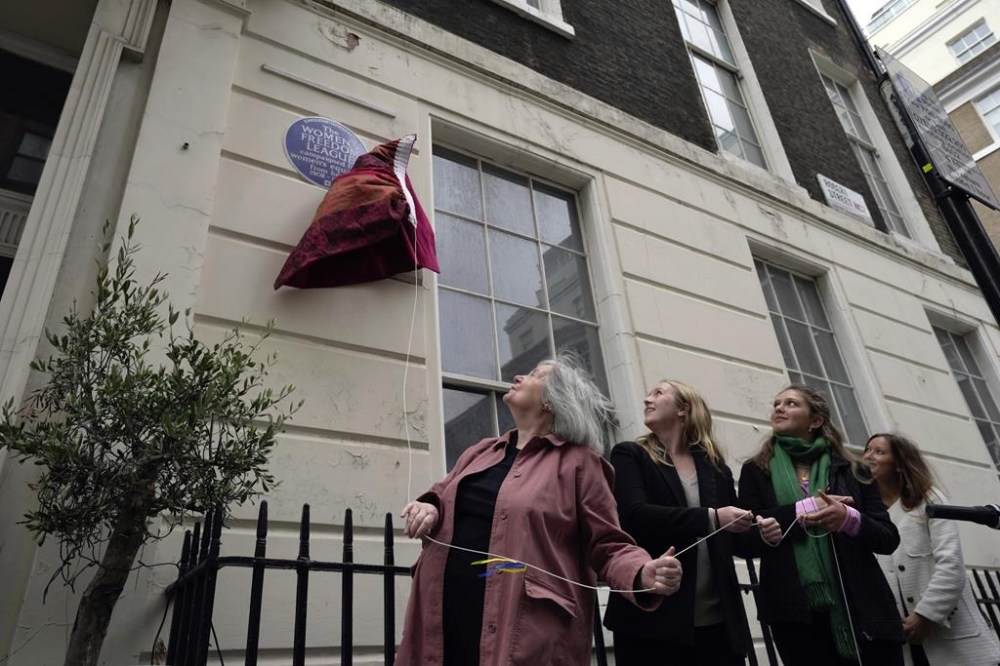
Officials unveil the plaque number 1,000 to honour the Women's Freedom League, a suffragist organisation that used 1 Robert Street in central London as its base of operations during its most active period, in London, Tuesday, Sept. 19, 2023. As English Heritage unveiled its 1,000th blue plaque on Tuesday, the charity is working to broaden the program to include more women, people from minority ethnic backgrounds and community groups so that it better reflects the diversity of the capital. (AP Photo/Kin Cheung)

Heywood researched electrical engineer Tommy Flowers before working on the marker that commemorates his work on Colossus, the pioneering computer used to decipher German codes during World War II.

“He was a very significant person in the whole of the World War II effort,’’ Heywood said. “And he’s at last being recognized for the astonishing job that he did.’’

Heywood has a soft spot for scientists, who he says are the real heroes in improving people’s lives. Politicians? Not so much. They come and go.

But being the plaque maker, he gets to put his stamp on things, one disc at a time.

“I’m very aware of the history of this town, the country, and aware of the changes that individuals have brought within society,” Heywood said, surrounded by his tools, clay and dust.

“Blue plaques are carefully considered, the people are thoroughly researched, and the plaques are there for a reason,” he added. “And will be there forever.”
Report Error Submit a Tip

More Stories

Northern First Nation calls for voluntary ban of moose hunting as numbers dwindle

Eva Wasney 5 minute read Preview

Northern First Nation calls for voluntary ban of moose hunting as numbers dwindle

Eva Wasney 5 minute read Updated: 4:19 PM CDT

A northern Manitoba First Nation is calling for a voluntary closure of moose hunting in its traditional territory to protect the declining population and respond to what it sees is a lack of provincial intervention.

On Friday, Misipawistik Cree Nation issued a plea urging hunters to abstain from harvesting moose in provincial Game Hunting Area 10 — a 10,000-square-kilometre region of boreal forest north of Grand Rapids. The request applies to this year’s moose-hunting seasons, which open Monday.

According to the province’s 2025 aerial big-game survey, an estimated 281 moose reside in the area, roughly 60 of which are bull moose. That’s down from an estimated 346 moose in 2013, which the survey describes as a “relatively stable population” over the past decade.

This year, 124 licences and 62 bull moose tags were made available in the region during Manitoba’s annual hunting draw.

Read
Updated: 4:19 PM CDT

Canada-U.S. trade relationship is broken, but the damage can — and will — be repaired

Tom Brodbeck 5 minute read Preview

Canada-U.S. trade relationship is broken, but the damage can — and will — be repaired

Tom Brodbeck 5 minute read Yesterday at 1:35 PM CDT

Canada needs to get serious about diversifying its trade beyond the United States. But at the same time, Canadians should expect relations with the U.S. to normalize after Donald Trump is no longer in the White House.

For generations, Canada-U.S. trade was considered almost a fact of geography. The two countries share the world’s longest undefended border, deeply integrated supply chains and a century of commercial relationships.

Canadian manufacturers depend on American customers. American manufacturers depend on Canadian suppliers. Energy, agriculture, automotive production and countless other industries operate across the border as though it barely exists.

That isn’t going to change dramatically, even in the midst of a bitter trade war unleashed by the U.S. president.

Read
Yesterday at 1:35 PM CDT

‘A new future’: city dentist Cholakis donates $2M to school of dental hygiene

Melissa Martin 3 minute read Preview

‘A new future’: city dentist Cholakis donates $2M to school of dental hygiene

Melissa Martin 3 minute read Updated: Yesterday at 3:25 PM CDT

Dental hygienist training in Manitoba is getting a big boost, after a major gift from a local dentist.

On Thursday, the dental hygiene school at the University of Manitoba’s Dr. Gerald Niznick College of Dentistry unveiled a new $2-million donation from Dr. Ernest Cholakis. It’s the largest gift the program has ever received, and in honour of the funding, the school will be named the Cholakis School of Dental Hygiene.

The gift was unveiled at a ceremony Thursday morning at the U of M’s Brodie Centre in the Health Sciences Centre complex. The benefactor and other dignitaries, including Premier Wab Kinew, were in attendance, as well as the three-year program’s current students.

Cholakis, who graduated from the U of M’s dentistry school in 1982, had high praise for the dental hygiene profession.

Read
Updated: Yesterday at 3:25 PM CDT

Klein launches mayoral campaign with pledge to make Winnipeg safest city in Canada

Joyanne Pursaga 2 minute read Preview

Klein launches mayoral campaign with pledge to make Winnipeg safest city in Canada

Joyanne Pursaga 2 minute read 12:47 PM CDT

Mayoral candidate Kevin Klein says he would make Winnipeg the safest city in Canada by the end of his four-year term, if elected.

“Crime is happening all over the city and we have to take steps to address it,” Klein said at his first campaign announcement Friday morning.

He promised to hire 100 to 110 more police officers, which he believes would cost between $9 million and $11 million.

“Our (officer) numbers are way down. We need to fix that now,” he said, not offering a timeline to fulfil that goal.

Read
12:47 PM CDT

Former Bombers linebacker Gauthier enjoying career as electrician

Taylor Allen 7 minute read Preview

Former Bombers linebacker Gauthier enjoying career as electrician

Taylor Allen 7 minute read 12:44 PM CDT

Most professional football players don’t ride off into the sunset on their own terms.

Shayne Gauthier was well aware of that, but it didn’t make it sting any less when the Winnipeg Blue Bombers informed the veteran linebacker that they weren’t bringing him back for 2026.

“I was really hoping to play one more (season) because it would have been my 10th season, so, I’d say it didn’t really end the way I wanted,” Gauthier recently told the Free Press.

“It left a little sour taste in my mouth, but that’s part of pro sports. If everybody got the ending that they wanted, then it wouldn’t really work.”

Read
12:44 PM CDT

United Way, other charities fight for dollars as donor base shrinks

Scott Billeck 8 minute read Preview

United Way, other charities fight for dollars as donor base shrinks

Scott Billeck 8 minute read 2:00 AM CDT

Winnipeg’s charitable sector is being squeezed from both sides: demand for help is growing while the pool of donors to meet that need is shrinking.

The imbalance is increasingly being carried by a relatively small group of deep-pocketed donors. Last year, 600 people — about three per cent of United Way Winnipeg’s individual donors — accounted for roughly $8 million, or 55 per cent of individual donations.

The fundraising pitch isn’t getting any easier.

Homelessness and public drug use have become increasingly visible, household budgets remain strained and the problems charities are trying to address can seem so entrenched that donors may reasonably wonder what difference another contribution can make.

Read
2:00 AM CDT