Opioid overdoses among homeless people rose dramatically: Ontario study
Advertisement
Read this article for free:
or
Already have an account? Log in here »
To continue reading, please subscribe:

Digital Subscription
One year of digital access for only $205*
- Enjoy unlimited reading on winnipegfreepress.com
- Read the E-Edition, our digital replica newspaper
- Access News Break, our award-winning app
- Play interactive puzzles
*First annual payment billed as $205.00 + GST for one year. This annual subscription will automatically renew at $233.00 + GST every 52 weeks (10% off the regular annual price of $259.35). Offer available to new and qualified returning subscribers only. Cancel any time.
To continue reading, please subscribe:
Add Free Press access to your Brandon Sun subscription for only an additional
$1 for the first 4 weeks*
- Enjoy unlimited reading on winnipegfreepress.com
- Read the E-Edition, our digital replica newspaper
- Access News Break, our award-winning app
- Play interactive puzzles
*Your next Brandon Sun subscription payment will increase by $1.00 and you will be charged $17.95 plus GST for four weeks. After four weeks, your payment will increase to $24.95 plus GST every four weeks.
Read unlimited articles for free today:
or
Already have an account? Log in here »
Hey there, time traveller!
This article was published 17/10/2023 (1058 days ago), so information in it may no longer be current.
Opioid overdoses are killing a growing proportion of people experiencing homelessness in Ontario, a new study suggested Tuesday.
Researchers from the Institute for Clinical Evaluative Sciences found about one in six people who died from opioid overdoses in 2021 were homeless, compared to one in 14 people back in 2017.
“(It’s) something that even shocked us as researchers when we first derived some of these numbers,” said Richard Booth, lead author of the study that was published in the journal Addiction.
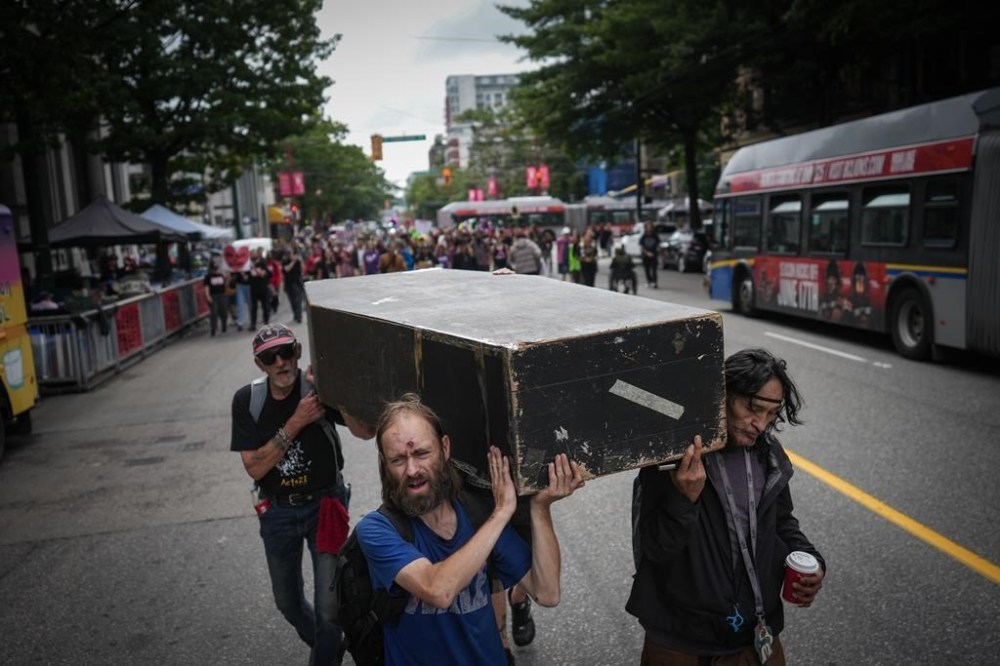
“That is a massive increase, you know, spanning the pandemic where accidental opioid-related overdoses became a much more significant element in the lives of people experiencing homelessness,” said Booth, an associate professor of nursing at Western University in London, Ont.
The researchers examined coroner’s data and health records for 6,644 people who died from opioid overdose deaths in the province between July 2017 and June 2021.
During the first few months of that time period, 7.2 per cent of those who died were homeless. That percentage rose to 16.8 per cent in the last few months.
During the first few months of that time period, 7.2 per cent of those who died — or 26 out of 359 people — were homeless. That percentage rose to 16.8 per cent — or 97 out of 578 people — in the last few months.
Although the study results show what happened, the numbers don’t explain why, the researchers noted.
But the disproportionate percentage of overdoses among those who are homeless clearly shows that housing is a “protective” factor, Booth said.
“Housing as a social intervention is very important,” he said.
The increasing toxicity of the drug supply over the last few years led to more overdose deaths, added Dr. Stephen Hwang, a physician-researcher at the MAP Centre for Urban Health Solutions at Unity Health Toronto who was a co-author of the study.
The COVID-19 pandemic’s impact on health and social services was also likely a factor for marginalized people, he said.
“The disruption caused by the lockdown and by the real lack of availability of services caused people to change where they spend time and thus where they use drugs,” Hwang said.
“I think that contributed to people using in higher risk situations that would more likely result in death,” he said.
The study findings highlight the importance of outreach to marginalized people using drugs, Hwang said.
“We need to bring harm reduction and treatment options to people where they are on the street or in the community rather than waiting for them to come to us in clinics or hospitals,” he said.
The Ontario findings are in keeping with the harsh reality of overdose deaths in British Columbia and other parts of Canada, said Jade Boyd, a research scientist with the BC Centre on Substance Use who was not involved in the study.
“We are dealing with an overdose crisis with a poisoned toxic drug supply,” Boyd said.
She pointed to current Health Canada data, which says there is an average of 21 opioid toxicity deaths every day in this country.
Although the agency doesn’t have statistics on what percentage of people who died were homeless, Boyd said the impact is greater on marginalized people due to “lack of resources, stigma and discrimination.”
“There’s an urgent need right now to expand access to low-barrier harm reduction services,” she said. “That can be safe consumption sites, treatment options, drug checking (and) regulated drug supplies or safe supplies throughout Canada,” she said.
Preventing homelessness in the first place is another critical part of the solution, Boyd said.
That means addressing poverty, stigma around drug use and the “giant affordability issue around housing in Canada,” she said.
Increasing access to “low-barrier” housing is vital, both Boyd and Hwang said.
That means supportive housing where abstinence from substance use isn’t required to move in and an end to the practice of evicting people if they use drugs in their homes, they said.

Boyd said the fact that people are dying every day from preventable overdoses is “devastating” and “impacts all of us.”
“The toxic drug supply … is intersecting with issues of poverty, stigma and housing affordability,” she said.
“We need to remember this impacts all Canadians — even those who are housed or may be at risk of losing their housing and security.”
This report by The Canadian Press was first published Oct. 17, 2023.
Canadian Press health coverage receives support through a partnership with the Canadian Medical Association. CP is solely responsible for this content.