First vaccine against serious bacterial infection in bees approved for use in Canada

Advertisement

Advertise with us

The first vaccine for bees has been approved for use in Canada.

Read this article for free:


or

Already have an account? Log in here »

To continue reading, please subscribe:

Subscribe and receive a limited-edition Free Press branded hat or tote.

Digital Subscription

One year of digital access for only $205*

  • Enjoy unlimited reading on winnipegfreepress.com
  • Read the E-Edition, our digital replica newspaper
  • Access News Break, our award-winning app
  • Play interactive puzzles

*First annual payment billed as $205.00 + GST for one year. This annual subscription will automatically renew at $233.00 + GST every 52 weeks (10% off the regular annual price of $259.35). Offer available to new and qualified returning subscribers only. Cancel any time.

To continue reading, please subscribe:

Add Free Press access to your Brandon Sun subscription for only an additional

$1 for the first 4 weeks*

  • Enjoy unlimited reading on winnipegfreepress.com
  • Read the E-Edition, our digital replica newspaper
  • Access News Break, our award-winning app
  • Play interactive puzzles
Start now

*Your next Brandon Sun subscription payment will increase by $1.00 and you will be charged $17.95 plus GST for four weeks. After four weeks, your payment will increase to $24.95 plus GST every four weeks.

Hey there, time traveller!
This article was published 20/10/2023 (1064 days ago), so information in it may no longer be current.

The first vaccine for bees has been approved for use in Canada.

The Canadian Food Inspection Agency has conditionally licensed an oral vaccine to protect honey bees against a disease called American foulbrood, which can wipe out entire colonies if not treated.

The manufacturer, U.S.-based Dalan Animal Health, announced the Canadian approval in a news release on Oct. 16.
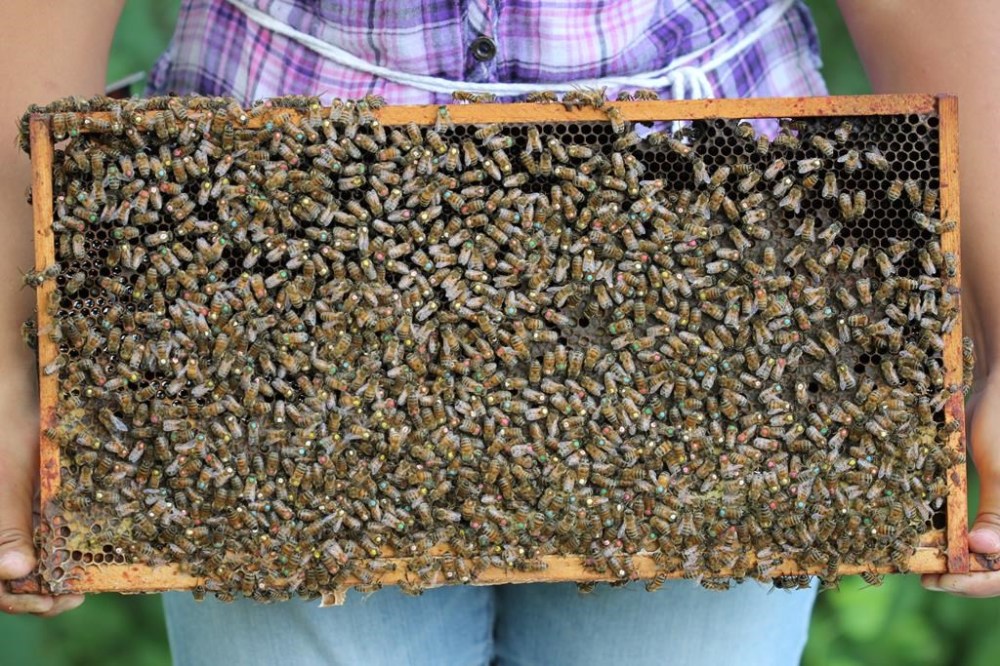
The Canadian Food Inspection Agency has conditionally licensed an oral vaccine to protect honey bees against a disease called American foulbrood, which can wipe out entire colonies if not treated. THE CANADIAN PRESS/HO-Alvaro De la Mora-University of Guelph *MANDATORY CREDIT*

The vaccine can be used in Canada “under veterinary supervision,” the food inspection agency said in an email.

American foulbrood is caused by the Paenibacillus larvae bacterium which produce spores that are resistant to the environment and can last for years in a hive, said Ernesto Guzman, director of the Honey Bee Research Centre at the University of Guelph.

Worker bees in the hive can transport the spores and spread the disease, Guzman said, but it’s the bees in the larval stage that show clinical symptoms of infection.

“If they ingest enough of those spores, they will typically break down and putrify in the hive,” added Stephen Pernal, national lead for honey bee research with Agriculture and Agri-Food Canada.

“When they do that, the bacteria multiplies and produces billions of more spores. And those spores can in fact infect other developing bees,” said Pernal, who is also the officer-in-charge of the Beaverlodge Research Farm in northern Alberta.

The decomposing larvae turn dark in colour and have a fishy smell, he said.

American foulbrood disease is often treated “very judiciously” with antibiotics in North America, but there are cases where hives containing tens of thousands of bees have to be burned, Pernal said.

Having a vaccine is “another tool in our tool box” to combat the disease, he said.

Protecting honey bees from disease is “extremely important” for human food production, Guzman said.

“It is estimated that one-third of the food that we consume in western societies is produced thanks to the pollination services of bees,” he said.

If the vaccine is effective, it can reduce the use of antibiotics, which “lessens the possibility that (an) antibiotic may be carried over into honey and enter the human food chain,” Pernal added.

“Honey certainly is a product that is tested for various things including antibiotics, but anytime you lessen that input in the system — whether it’s honey bees or the production of other livestock in Canada — that’s a desirable thing,” he said.

The vaccine contains dead Paenibacillus larvae bacteria and works by getting the queen bee, which lays the eggs, to ingest it. The immunity protection from the vaccine is passed along to the developing larval bees.

The vaccine is mixed into a powdered sugar and glucose syrup paste that the worker bees eat and their secretions are fed to the queen bee.

Research trials funded by Dalan Animal Health showed a 30 to 50 per cent decrease in American foulbrood infection among honey bee larvae whose queen bee received the vaccine compared to placebo hives.

The key, both Guzman and Pernal said, will be to see if the vaccine has the same effect in the real world, noting that the trials were conducted in lab-controlled environments.

“If it ends up working when more trials are conducted at the field levels, it will be a great tool to control that particular disease,” Guzman said.

“(It) also may pave the way to develop other vaccines that could be useful in beekeeping and in the insect industry,” he said.

The vaccine is expected to be “distributed on a limited basis to commercial beekeepers in Canada … starting in Spring 2024,” Dalan Animal Health said in a news release.

The Canadian Food Inspection Agency approved the vaccine in late September, a company spokesperson said in an email.

This report by The Canadian Press was first published Oct. 20, 2023.

Canadian Press health coverage receives support through a partnership with the Canadian Medical Association. CP is solely responsible for this content.
Report Error Submit a Tip

More Stories

Former Bombers linebacker Gauthier enjoying career as electrician

Taylor Allen 6 minute read Preview

Former Bombers linebacker Gauthier enjoying career as electrician

Taylor Allen 6 minute read 12:44 PM CDT

Most professional football players don’t ride off into the sunset on their own terms.

Shayne Gauthier was well aware of that, but it didn’t make it sting any less when the Winnipeg Blue Bombers informed the veteran linebacker that they weren’t bringing him back for 2026.

“I was really hoping to play one more (season) because it would have been my 10th season, so, I’d say it didn’t really end the way I wanted,” Gauthier recently told the Free Press.

“It left a little sour taste in my mouth, but that’s part of pro sports. If everybody got the ending that they wanted, then it wouldn’t really work.”

Read
12:44 PM CDT

‘A new future’: city dentist Cholakis donates $2M to school of dental hygiene

Melissa Martin 3 minute read Preview

‘A new future’: city dentist Cholakis donates $2M to school of dental hygiene

Melissa Martin 3 minute read Updated: Yesterday at 3:25 PM CDT

Dental hygienist training in Manitoba is getting a big boost, after a major gift from a local dentist.

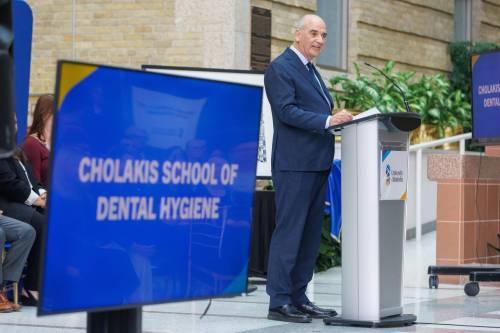
On Thursday, the dental hygiene school at the University of Manitoba’s Dr. Gerald Niznick College of Dentistry unveiled a new $2-million donation from Dr. Ernest Cholakis. It’s the largest gift the program has ever received, and in honour of the funding, the school will be named the Cholakis School of Dental Hygiene.

The gift was unveiled at a ceremony Thursday morning at the U of M’s Brodie Centre in the Health Sciences Centre complex. The benefactor and other dignitaries, including Premier Wab Kinew, were in attendance, as well as the three-year program’s current students.

Cholakis, who graduated from the U of M’s dentistry school in 1982, had high praise for the dental hygiene profession.

Read
Updated: Yesterday at 3:25 PM CDT

Sex sounds in stereo a sad score for singleton

Maureen Scurfield 5 minute read Yesterday at 2:00 AM CDT

DEAR MISS LONELYHEARTS: I just moved into a big old house with two buddies who curl and play hockey with me. They have girlfriends, but I don’t.

I thought they’d be staying at their girlfriends’ places on nights they were “sleeping” together, but oh no!

So now I get to listen to the duelling sex noises of two couples, on weekends and some weeknights as well.

Do I have any rights here? I really don’t want to admit defeat and move back in with my parents, when feels like I just moved out. But it’s really uncomfortable to be the only guy with no sex life in this household, and then having to hear it, while it’s happening.

United Way, other charities fight for dollars as donor base shrinks

Scott Billeck 7 minute read Preview

United Way, other charities fight for dollars as donor base shrinks

Scott Billeck 7 minute read 2:00 AM CDT

Winnipeg’s charitable sector is being squeezed from both sides: demand for help is growing while the pool of donors to meet that need is shrinking.

The imbalance is increasingly being carried by a relatively small group of deep-pocketed donors. Last year, 600 people — about three per cent of United Way Winnipeg’s individual donors — accounted for roughly $8 million, or 55 per cent of individual donations.

The fundraising pitch isn’t getting any easier.

Homelessness and public drug use have become increasingly visible, household budgets remain strained and the problems charities are trying to address can seem so entrenched that donors may reasonably wonder what difference another contribution can make.

Read
2:00 AM CDT

‘Parental rights’ issue resurfaces

Maggie Macintosh 5 minute read Preview

‘Parental rights’ issue resurfaces

Maggie Macintosh 5 minute read Yesterday at 2:00 AM CDT

Trustee campaign material that condemns rainbow flags is being met with outrage of all kinds, written complaints and, in one case, a cease-and-desist order.

“Parental rights,” including questions about classroom diversity, equity and inclusion policies, are resurfacing heading into school board elections across Manitoba.

“People are trying to advance their politics and their issues while simultaneously calling teachers ideologues and brainwashers,” said Shannon Moore, an associate professor at the University of Manitoba who studies sexual health education. “And I find that rich.”

Moore said parents have a right to choose independent school or homeschool, but they do not have a right to dictate curriculum that is currently developed using research and mainstream morals.

Read
Yesterday at 2:00 AM CDT

Canada-U.S. trade relationship is broken, but the damage can — and will — be repaired

Tom Brodbeck 5 minute read Preview

Canada-U.S. trade relationship is broken, but the damage can — and will — be repaired

Tom Brodbeck 5 minute read Yesterday at 1:35 PM CDT

Canada needs to get serious about diversifying its trade beyond the United States. But at the same time, Canadians should expect relations with the U.S. to normalize after Donald Trump is no longer in the White House.

For generations, Canada-U.S. trade was considered almost a fact of geography. The two countries share the world’s longest undefended border, deeply integrated supply chains and a century of commercial relationships.

Canadian manufacturers depend on American customers. American manufacturers depend on Canadian suppliers. Energy, agriculture, automotive production and countless other industries operate across the border as though it barely exists.

That isn’t going to change dramatically, even in the midst of a bitter trade war unleashed by the U.S. president.

Read
Yesterday at 1:35 PM CDT