Convent-made delicacies, a Christmas favorite, help monks and nuns win fans and pay the bills
Advertisement
Read this article for free:
or
Already have an account? Log in here »
To continue reading, please subscribe:

Digital Subscription
One year of digital access for only $205*
- Enjoy unlimited reading on winnipegfreepress.com
- Read the E-Edition, our digital replica newspaper
- Access News Break, our award-winning app
- Play interactive puzzles
*First annual payment billed as $205.00 + GST for one year. This annual subscription will automatically renew at $233.00 + GST every 52 weeks (10% off the regular annual price of $259.35). Offer available to new and qualified returning subscribers only. Cancel any time.
To continue reading, please subscribe:
Add Free Press access to your Brandon Sun subscription for only an additional
$1 for the first 4 weeks*
- Enjoy unlimited reading on winnipegfreepress.com
- Read the E-Edition, our digital replica newspaper
- Access News Break, our award-winning app
- Play interactive puzzles
*Your next Brandon Sun subscription payment will increase by $1.00 and you will be charged $17.95 plus GST for four weeks. After four weeks, your payment will increase to $24.95 plus GST every four weeks.
Read unlimited articles for free today:
or
Already have an account? Log in here »
Hey there, time traveller!
This article was published 17/12/2023 (1024 days ago), so information in it may no longer be current.
MEXICO CITY (AP) — It’s the fortnight before Christmas and all through the world’s Catholic convents, nuns and monks are extra busy preparing the traditional delicacies they sell to a loyal fan base even in rapidly secularizing countries.
For many monastic communities, especially those devoted to contemplative life and with vows of poverty, producing cookies, fruitcakes, even beer for sale is the only means to keep the lights on.
But it’s also an enticing way to strengthen their ties with lay people who flock to their doors — and in some cases their websites — in the holiday season.
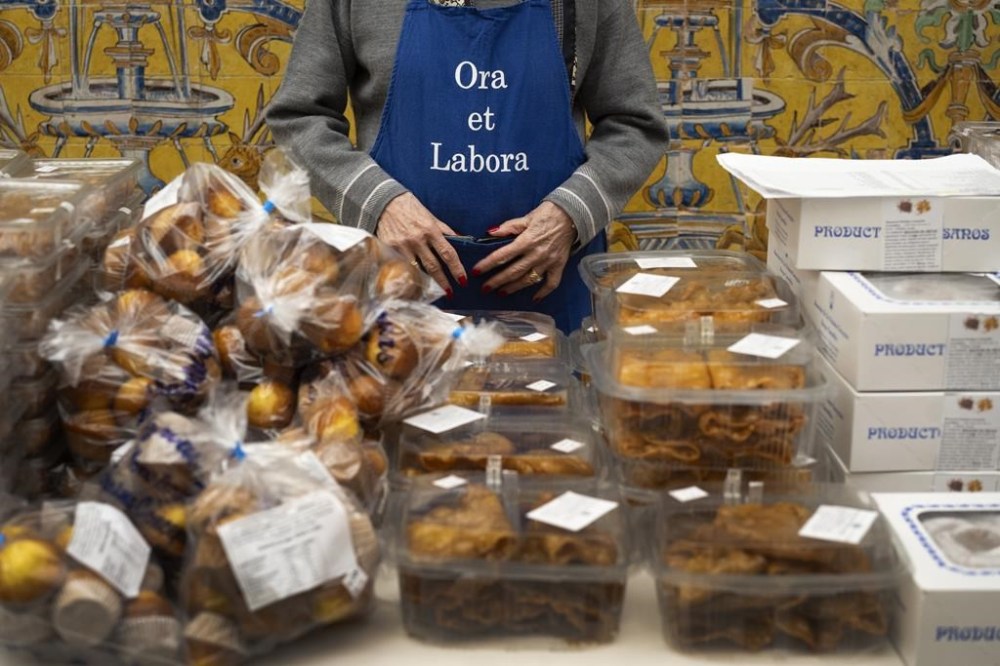
“Our kitchen is a witness to God’s love to those outside,” said Sister Abigail, one of the 10 cloistered nuns of the Perpetual Adorers of the Most Blessed Sacrament in Mexico City.
“We are in the Lord’s presence, and we’re always thinking that it will make someone happy, the person who will eat this, or they will gift it and someone will receive it with joy,” added the sister, whose convent makes sweets, eggnog and its bestseller, tamales.
Most monasteries have to be financially self-sufficient. Many in countries like Spain have to maintain not only an aging, shrinking cohort of monks and nuns, but also monumental, centuries-old buildings, said Fermín Labarga, a professor of church history at the University of Navarra in Pamplona.
Since the small-scale farming with which they supported themselves for centuries stopped being profitable decades ago, most have turned to crafts, including the wildly popular gourmet food production that uses only homemade ingredients and recipes passed down generations.
“An immense majority of people goes to buy the nuns’ sweets,” said Pipa Algarra, who in her 90 years in the southern Spanish city of Granada has come to know each of the dozens of convents’ specialties. Among the oldest is alfajor, a cookie with roots dating back more than a thousand years when this region was a Muslim kingdom, while this year’s novelty is sushi rolls introduced by Filipino sisters.
“The nuns, aside from supporting themselves with this, make really good sweets. And the prayer that comes with it is priceless,” added Algarra, who remembers as a child going to convents with her friends to get dough trimmings from the Communion wafers the nuns also produced.
As a cloistered order, the 14 Poor Clares sisters in Carmona, Spain, have to work to earn their daily bread — in their case, making some 300 “English cakes” and 20 other kinds of sweets a month to sell at their 15th-century convent turnstile, said the abbess, Veronicah Nzula.
There’s a summer slowdown when southern Spain is so sweltering nobody takes coffee breaks with cookies, Nzula quipped. But the production revs up for Christmas as the sweets are also sold at a special market devoted to convent products in nearby Seville.
“While we work, we pray the rosary and we think of the people who will eat each sweet,” said Nzula. She learned the recipes from older sisters after arriving more than 20 years ago from Kenya, like all but one of the current sisters.
Most nuns and monks involved in preparing the delicacies are quick to point out that their main mission is to pray, not to cook — and that doing both involves finding a delicate balance.
“We brew to live, we don’t live to brew,” said Brother Joris, who supervises the brewery at Saint-Sixtus Abbey in Westvleteren, Belgium. “There needs to be equilibrium between monastic life and economic life. We don’t want to end up as a brewery with a little abbey on the side.”
For that reason, production remains limited even though the beer brings the monks’ only income — and it’s considered by connoisseurs one of the choicest brews in the world, especially popular as a Christmas and Father’s Day gift.
Monks started making it in the 1830s to supply lay workers building the abbey with the daily pint their contract guaranteed. Aficionados still need to come to the abbey or its cafe to get their crate, giving the contemplative order a chance to bear witness too.
“By simply existing, we remind people ‘they’re still here,’” Brother Joris said.
A fellow Trappist at the Abbey of Gethsemani in Kentucky — where the renowned monk and author Thomas Merton once lived — similarly said that producing their bourbon-infused delicacies is just a part of the “ora et labora” (work and pray) commitment under St. Benedict’s rule.
“Our ideal is to pray always,” said Brother Paul Quenon, who joined the abbey in the late 1950s when the bourbon fruitcake was already being produced, and has worked on the more recently introduced bourbon fudge.
The abbey now makes some 60,000 pounds per year of each, most sold between Thanksgiving and Christmas — when the bakery is so busy that silent prayer becomes a challenge.
To also strike a balance, the two dozen Benedictine sisters at the 15th-century Monastery of San Paio de Antealtares in Santiago de Compostela, one of Europe’s top pilgrimage cities, only work on sweets in the morning.
“It’s not the purpose of our life, lest we break the equilibrium — rather, it’s to turn work into prayer,” said the abbess, Almudena Vilariño. “When I’m working, I pray that these sweets may be catalysts of union and peace in the house or office where they will go.”
Following the same recipe dating from the late 1700s, the nuns make their signature almond cake known as tarta de Santiago. A few decades ago, local women would bring ingredients to the convent so the nuns could bake cakes in their wooden oven. Today, pilgrims from around the world who have finished their “camino” in the magnificent cathedral across the square are among the crowds ringing the bell by the nuns’ simple wooden turnstile.
“The turnstile puts in touch the interior world with the exterior. They’re not disconnected,” Labarga said.
Back in Mexico City, the sisters preparing their popular Christmas buñuelos — a sort of flat donut made with flour, water and cinnamon — also connect their community labor with their faith. During the Advent season, they pray thousands of Hail Marys as they roll the dough or cover the sweets with sugar.

“This is how we live the liturgy,” Sister Abigail said. “This is the objective in our work, and work for people outside the convent — that we feed them, and they help us so we can eat.”
___
Dell’Orto reported from Miami Beach, Florida.
___
Associated Press religion coverage receives support through the AP’s collaboration with The Conversation US, with funding from Lilly Endowment Inc. The AP is solely responsible for this content.
The Free Press acknowledges the financial support it receives from members of the city’s faith community, which makes our coverage of religion possible.