Brain wave-powered tech allows Canadian kids ‘trapped in their own bodies’ to play
Advertisement
Read this article for free:
or
Already have an account? Log in here »
To continue reading, please subscribe:

Digital Subscription
One year of digital access for only $205*
- Enjoy unlimited reading on winnipegfreepress.com
- Read the E-Edition, our digital replica newspaper
- Access News Break, our award-winning app
- Play interactive puzzles
*First annual payment billed as $205.00 + GST for one year. This annual subscription will automatically renew at $233.00 + GST every 52 weeks (10% off the regular annual price of $259.35). Offer available to new and qualified returning subscribers only. Cancel any time.
To continue reading, please subscribe:
Add Free Press access to your Brandon Sun subscription for only an additional
$1 for the first 4 weeks*
- Enjoy unlimited reading on winnipegfreepress.com
- Read the E-Edition, our digital replica newspaper
- Access News Break, our award-winning app
- Play interactive puzzles
*Your next Brandon Sun subscription payment will increase by $1.00 and you will be charged $17.95 plus GST for four weeks. After four weeks, your payment will increase to $24.95 plus GST every four weeks.
Read unlimited articles for free today:
or
Already have an account? Log in here »
Hey there, time traveller!
This article was published 20/02/2024 (952 days ago), so information in it may no longer be current.
TORONTO – Eight-year-old Giselle Alnaser wants the Elmo stuffed toy sitting on a stool across the room, and she’s going to use her brain waves to get it.
As her mother encourages her with calls of, “Let’s go, let’s go, let’s go!” Giselle concentrates asthe platform beneath her wheelchair appears to roll by itself toward Elmo. She smiles when she reaches the stool and an occupational therapist hands her the toy.
Giselle was diagnosed with a CAMK2b gene mutation when she was a toddler. It affects her brain’s ability to communicate with her muscles — meaning she can’t walk or move her arms much — and she’s not able to speak.
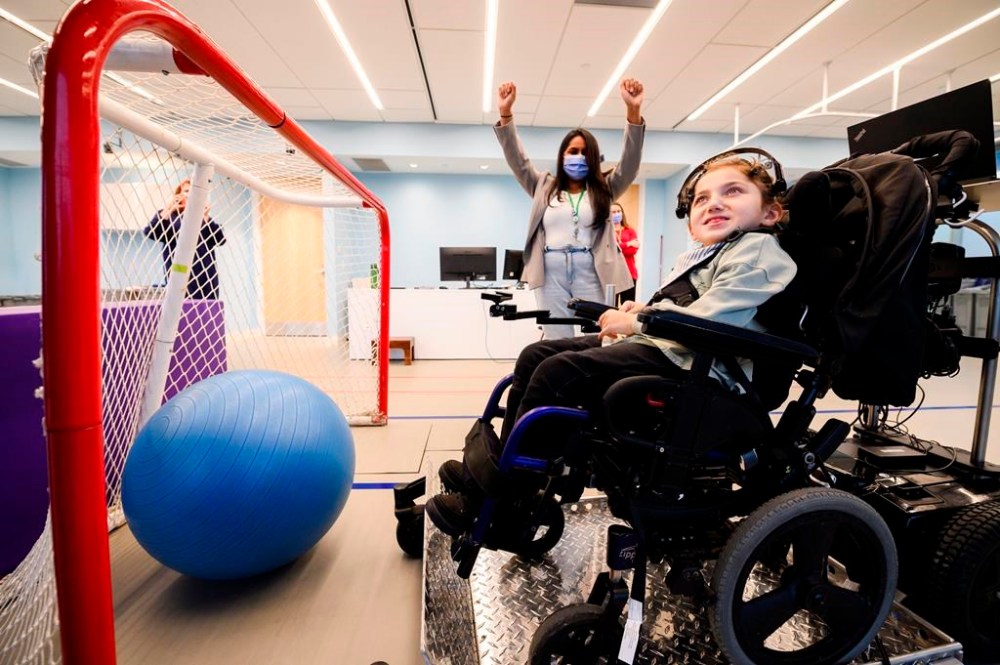
The Brain Computer Interface program at Holland Bloorview Kids Rehabilitation Hospital in Toronto develops technology that allows Giselle and dozens of other physically disabled children to use their minds to move and play.
“(These are) children who are not able to move themselves in space, (who) don’t have reliable movement and don’t have verbal communication or have difficulty with verbal communication. So really their only way of interacting with the environment is through their thoughts,” said Susannah Van Damme, an occupational therapist and team lead for the hospital’s clinical BCI program.
The brain computer interface works like an on-off switch triggered by electrical patterns in the brain. While wearing a headset with EEG electrodes, the child is asked to think about something specific that will serve as a “command” thought. The child is then asked to relax and put their mind in a quiet, passive state, which serves as the “stop” thought.
The electrodes transmit those electrical signals to a computer, where they are saved. The computer is trained through artificial intelligence to recognize those specific brain patterns when it sees them again and start or stop whatever device it’s connected to — such as Giselle’s rolling wheelchair platform.
“As long as an individual can generate activity in the brain you can kind of flick the switch and control the activity,” said Tom Chau, senior scientist and head of Holland Bloorview’s Paediatric Rehabilitation Intelligent Systems Multidisciplinary lab.
Giselle generates a “command” thought bythinking about moving fast in her wheelchair, or focusing on the phrase “go, go, go.”
But any thought will do. The key is for the child to concentrate on it while the computer records the electrical brain pattern it creates.
Then when the child wants to make something happen, they think the same thought again, generating the same brain pattern that the computer now recognizes.
“(When a child) sends that “go” signal, the computer interprets that just as a command to start, to activate whatever it is that it’s attached to,” Van Damme said.
For another activity, the team attaches the computer to a bubble maker. The same command thoughts that allow Giselle to move her wheelchair now allow her to make bubbles appear.
In agame of “freeze,” the computer is programmed to play music when she thinks her command thought. As the Barney dance song plays, Giselle turns the music on and off as her mom and hospital staff dance around her. When she stops the music to make them freeze in position, Giselle smiles with delight.
“Someone who has not been able to turn on their favourite music or play a video game because of a physical disability, they can use their brain power to do that,” Van Damme said.
Giselle’s parents, Samah Darwish and Naser Alnaser, said watching their daughter use BCI technology has been “amazing.”
“Like any parent, you want some independence for the kids to do their own things … to move, to play, to learn and everything,” said Alnaser.
“To be herself. To be a kid.”
Although BCI research has occurredin various parts of the world for decades, a Canadian network comprised of Holland Bloorview, Alberta Children’s Hospital in Calgary and Glenrose Rehabilitation Hospital in Edmonton has taken the lead in recent years in bringing the technology to children and youth with disabilities.
“One thing that we noticed as a group of clinicians who see children and their families was that although those BCI technologies are rapidly advancing, the pediatric population were really neglected,” said Dr. John Andersen, a University of Alberta associate professor of pediatrics who leads the BCI program at Glenrose.
“We wanted to see how we can make this accessible to children and learn from them and their families to kind of co-develop how this emerging technology can be accessible in its current form and how we can develop the technology and expertise around it in the future,” said Andersen, noting that Chau at Holland Bloorview has been the trailblazer for the group.
Although the on-off switch activities help children and youth with neuromotor disabilities gain more control in their lives, the researchers say developing BCI technology to help non-verbal children communicate is the next major step — and a priority requested by their parents.
“We’ve been doing research in communication for, you know, two decades now. But we’re finally getting it to the point where you’re going to be able to translate it,” said Chau.

The hope is that in the near future, children will be able to use BCI to convey wants and needs using their minds, he said.
“(That would) really unlock huge potential for kids who’ve been basically trapped in their own bodies,” Chau said.
“They have so much that they want to express. And there’s just never been the means.”
This report by The Canadian Press was first published Feb. 20, 2024.
Canadian Press health coverage receives support through a partnership with the Canadian Medical Association. CP is solely responsible for this content.