‘Trying not to die’: Tourism operators face heavy debt, even as business roars back
Advertisement
Read this article for free:
or
Already have an account? Log in here »
To continue reading, please subscribe:

Digital Subscription
One year of digital access for only $205*
- Enjoy unlimited reading on winnipegfreepress.com
- Read the E-Edition, our digital replica newspaper
- Access News Break, our award-winning app
- Play interactive puzzles
*First annual payment billed as $205.00 + GST for one year. This annual subscription will automatically renew at $233.00 + GST every 52 weeks (10% off the regular annual price of $259.35). Offer available to new and qualified returning subscribers only. Cancel any time.
To continue reading, please subscribe:
Add Free Press access to your Brandon Sun subscription for only an additional
$1 for the first 4 weeks*
- Enjoy unlimited reading on winnipegfreepress.com
- Read the E-Edition, our digital replica newspaper
- Access News Break, our award-winning app
- Play interactive puzzles
*Your next Brandon Sun subscription payment will increase by $1.00 and you will be charged $17.95 plus GST for four weeks. After four weeks, your payment will increase to $24.95 plus GST every four weeks.
Read unlimited articles for free today:
or
Already have an account? Log in here »
Hey there, time traveller!
This article was published 23/04/2024 (894 days ago), so information in it may no longer be current.
Maureen Gordon has weathered hard times before.
She and her husband began running ecotourism outfit Maple Leaf Adventures out of Vancouver about a month before the 9/11 terrorist attacks devastated international travel in 2001.
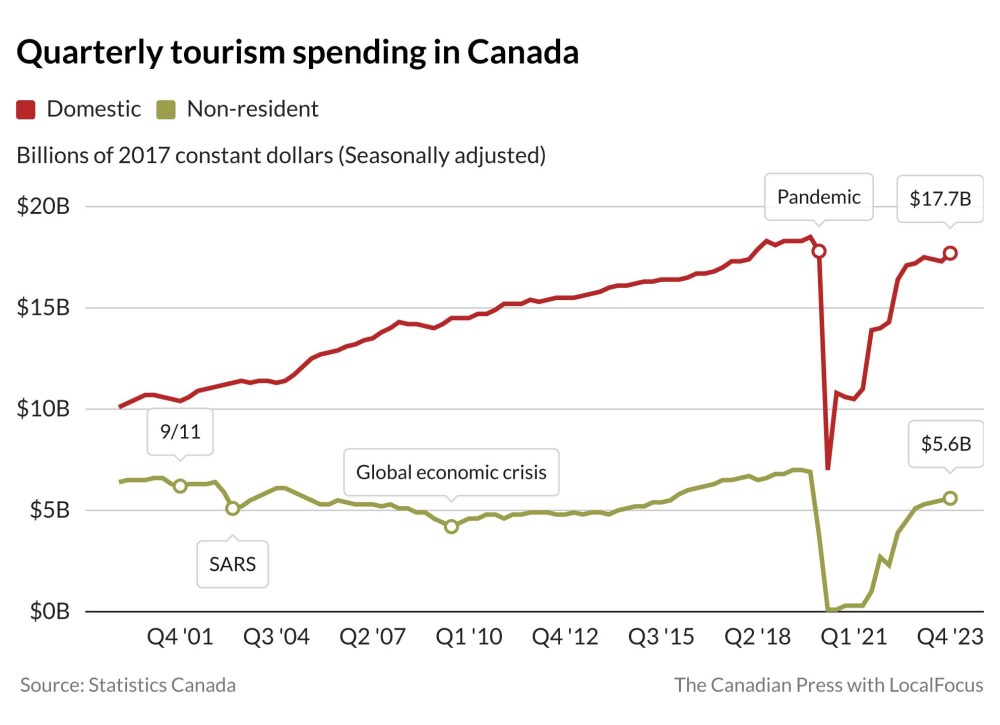
The rebound was relatively quick. Fallout from COVID-19 has proven much more prolonged.
“The pandemic of course was incredibly tumultuous and scary, as it was, I think, for most tour businesses in Canada,” said Gordon, who runs week-long sojourns on a schooner, converted tug boat and catamaran along the Pacific coast.
“It was a really traumatic time. We couldn’t operate at all through various government shutdowns,” she recalled. “We were scared, our bank was scared.”
While 2022 was “incredible,” as Canadians looking to expend pent-up energy surged back to domestic travel, 2023 saw a “hiccup” amid rising interest rates that dampened some sojourners’ spirits.
“Although the tourism industry — in terms of interest in travel and booking — is recovering, the businesses are really hurting,” Gordon said. “I think all of us are carrying the highest debt loads we’ve ever had. Certainly we are.
“We crossed the ocean out of our wrecked boat, and now … we’re all just trying not to die on the beach.”
Tourism has come roaring back from pandemic lows, but operators say the sector has yet to reach pre-COVID levels and debt remains a hefty burden for thousands of small businesses across the country.
International visitor numbers remained down from four years earlier, with tourists from the U.S. at 85 per cent of 2019 levels and those from further afield at 78 per cent, according to Crown corporation Destination Canada.
The industry brought in more than $109 billion in revenue last year, about four per cent more than in 2019 but significantly less in real terms after accounting for inflation, according to the Tourism Industry Association of Canada.
Beth Potter, who heads the association, has called on the federal government to create a new low-interest loan program and temporary foreign worker stream, both specific to the tourism industry.
“We have not had any kind of indication that we’re going to see these,” she noted. In fact, the government aims to reduce temporary residents’ share of Canada’s population over the next three years.
The impact won’t be “as extreme” in tourism as in agriculture or food processing, she said. But it will hit ski resorts as well as tourism-dependent areas such as Northern Canada and Niagara Falls, Ont.
Travel, hospitality and recreation offerings are effectively a perishable commodity, which means it’s especially hard to make back lost earnings.
“If you don’t book the hotel room tonight, you can’t book that hotel room two times tomorrow night,” said Potter.
The sector’s recovery continues to trail that of the broader business world. The number of active tourism-linked businesses sat slightly below pre-pandemic levels as of December, while the number of businesses overall surpassed 2019 figures, data from Destination Canada showed.
Across all sectors, two in three small- and medium-sized enterprises still held pandemic debt at the end of last year, with an average of $107,700, according to a Canadian Federation of Independent Business survey of 3,148 members. Out of 14 sectors surveyed, operators in hospitality and transportation were among the most pessimistic about the coming year. Only retail scored worse.
Ski operations and tourist hotspots such as the Okanagan Valley have had a particularly rough year.
“We had winters that weren’t winters for us,” said Tourism Minister Soraya Martinez Ferrada in a phone interview.
“We were really impacted last year with climate change in terms, fire, drought, floods,” she continued. “People were actually cancelling their travels to Canada because they were thinking that the whole country was on fire. Remember the smoke in New York?”
While some tourism statistics for Canada’s four largest cities — Toronto, Montreal, Vancouver and Calgary — are now on track to overtake 2019 numbers, farther-flung parts of the country continue to struggle.
“Regions a bit further away from those very big hubs had more difficulty to regain the momentum,” the minister said. Business travel and conventions also continue to lag, she added.
Regional transport has failed to bounce back as well, with domestic seat capacity at 84 per cent of 2019 levels as of the fourth quarter of 2023, according to Destination Canada. That can dent domestic travel and leisure markets.
“If people want to go between Prince Edward Island and Newfoundland in the wintertime, when the ferry is not running, you’d have to fly to Toronto,” said Potter, pointing to the deterrent.
The minister cited pledges laid out in the federal budget to support tourism. The government has vowed to provide new funding to replace Via Rail’s aging fleet on routes outside the corridor running between Quebec City and Windsor, Ont. — an amount has not yet been specified due to an upcoming procurement process.
Martinez Ferrada also highlighted $124 million for Atlantic ferry operations as well as investments in development opportunities in the North and for Indigenous tourism operations announced last year.
While no new sector-specific loans are on the horizon, she framed the $2.5 billion in carbon rebates slated to land in small- and medium-sized businesses’ bank accounts in the coming months as a financial buoy.

Back in Vancouver, Gordon said the year looks promising, with some caveats.
“Most people aren’t 100 per cent confident in their projections,” she said. “It’s not a straight-line recovery … We all feel that the market is really unpredictable right now.
“People in our industry are pretty passionate about what they do and pretty determined. It’s not a doom-and-gloom story,” she reflected.
“But it is a story of huge struggle — and maybe some of it’s unnecessary struggle — and burden on a key industry that brings so much benefit to Canada and promotes our brand in the world.”
This report by The Canadian Press was first published April 23, 2024.
Related Articles
Tourism Award winners honoured Tourism Industry Association of Manitoba develops its speaking voice
Advertisement Advertise With Us
Advertisement Advertise With Us
History
Updated on Tuesday, April 23, 2024 9:51 AM CDT: Adds graphic