Tick season has arrived. Protect yourself with these tips
Advertisement
Read this article for free:
or
Already have an account? Log in here »
To continue reading, please subscribe:

Digital Subscription
One year of digital access for only $205*
- Enjoy unlimited reading on winnipegfreepress.com
- Read the E-Edition, our digital replica newspaper
- Access News Break, our award-winning app
- Play interactive puzzles
*First annual payment billed as $205.00 + GST for one year. This annual subscription will automatically renew at $233.00 + GST every 52 weeks (10% off the regular annual price of $259.35). Offer available to new and qualified returning subscribers only. Cancel any time.
To continue reading, please subscribe:
Add Free Press access to your Brandon Sun subscription for only an additional
$1 for the first 4 weeks*
- Enjoy unlimited reading on winnipegfreepress.com
- Read the E-Edition, our digital replica newspaper
- Access News Break, our award-winning app
- Play interactive puzzles
*Your next Brandon Sun subscription payment will increase by $1.00 and you will be charged $17.95 plus GST for four weeks. After four weeks, your payment will increase to $24.95 plus GST every four weeks.
Read unlimited articles for free today:
or
Already have an account? Log in here »
Hey there, time traveller!
This article was published 17/05/2024 (826 days ago), so information in it may no longer be current.
FORT COLLINS, Colorado (AP) — Tick season is starting across the U.S., and experts are warning the bloodsuckers may be as plentiful as ever.
Another mild winter and other favorable factors likely means the 2024 tick population will be equal to last year or larger, some researchers say.
“It’s very bad and has only been getting worse,” said Susanna Visser of the Centers for Disease Control and Prevention.

An increasing variety of ticks are pushing into new geographical areas, bringing unusual diseases. Exotic southern species like the Gulf Coast tick and the lone star tick are being detected in New York and other northern states, for example.
But the tick that experts warn of the most is a common blacklegged tick, which is found mainly in forests and spreads Lyme disease. Infection rates begin to peak in May, and U.S. health officials estimate nearly half a million Lyme disease infections happen annually.
Here’s a look at what’s expected this year and how you can protect yourself.
TICK FACTS
Ticks are small, eight-legged bloodsucking parasites — arachnids, not insects — that feed on animals and sometimes people. Some ticks are infected with germs that can cause illness, and they spread those germs when they bite.
There is no widely accepted estimate of how many ticks there are from one year to the next, but there is a scientific consensus that they are an increasingly common health hazard in large portions of the United States.
Blacklegged ticks — also known as deer ticks, since they feed on deer — are among the most common ticks in the eastern half of the U.S. They were plentiful centuries ago, then diminished when forests were cut down and deer were hunted, and rebounded alongside deer and wooded suburbs. The ticks have spread out from pockets in New England and the Midwest over a wider range, into the South and the Great Plains.
Tick populations cycle through the year and their numbers depend on a few factors. They like warm, humid weather, and more can be seen after a mild winter. The more deer and mice available to feed matters, too.
Overall, the blacklegged tick population has been expanding for at least four decades, researchers say.
“This is an epidemic in slow motion,” said Rebecca Eisen, a CDC research biologist and tick expert.
2024 TICK SEASON FORECAST
Weather can play a role in the severity of a tick season.
Very cold, dry winters can whittle down tick populations, but recent winters have been mild — a trend some attribute to climate change.
As Scott Williams, a tick researcher at the Connecticut Agricultural Experiment Station, said: “Winters are no longer limiting the tick population.”
Ticks can withstand the heat but tend to almost hibernate when it’s a dry summer. That happened in Maine in 2020 through 2022, said Chuck Lubelczyk, a vector ecologist at the MaineHealth Institute for Research.
But last year was a very wet year, and tick activity multiplied in Maine — the state with the highest incidence of Lyme disease in the country. Weather service predictions call for higher temperatures and precipitation, so “on paper, at least, it could be a very good year for the ticks,” Lubelczyk said.
In Wisconsin, adult ticks were out longer than usual due to a mild winter. The tick nymphs are starting to emerge, and a wet spring is setting the stage for the possibility that the population will be robust, said Xia Lee, an entomologist at the Wisconsin Department of Health Services.
Ditto New York.
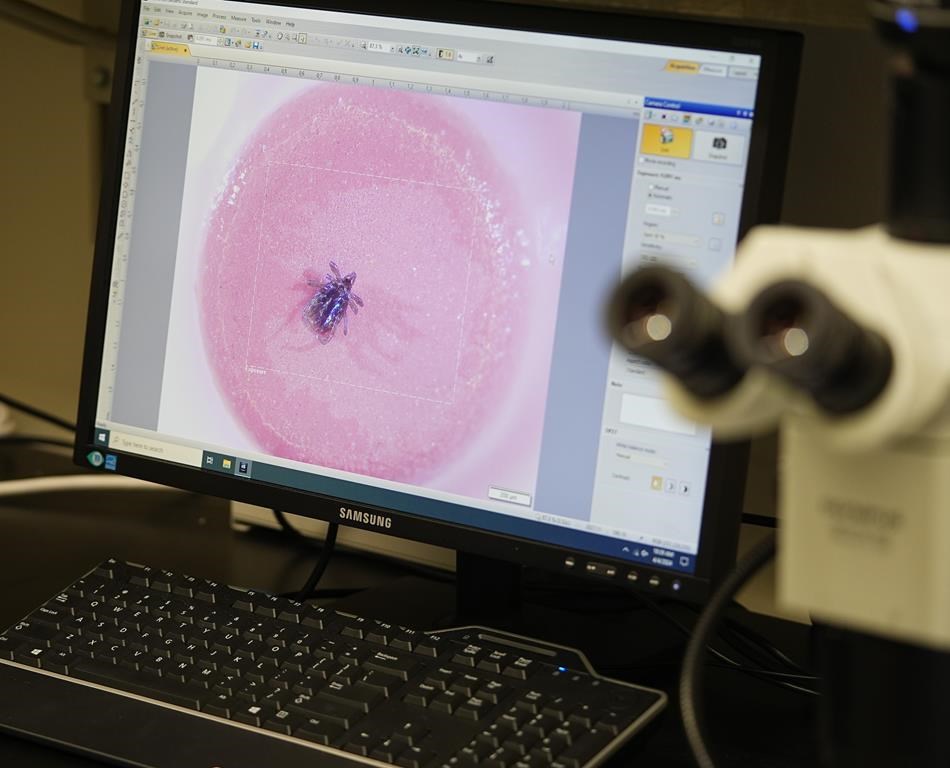
“It will be as bad as last year, or worse,” said Saravanan Thangamani, who studies ticks and tickborne diseases at SUNY Upstate Medical University in Syracuse.
WHAT IS LYME DISEASE?
Not all ticks are infected with disease-causing germs — about 20% to 30% of the blacklegged tick nymphs that emerge in the Northeast and Midwest this spring and into summer will be carrying the bacteria that causes Lyme disease, experts estimate.
Lyme disease symptoms tend to start between three and 30 days after a bite occurs and can include fever, headache, fatigue and a bull’s-eye-like rash. If you get bitten and develop symptoms, see a doctor to get treated with antibiotics.
HOW TO KEEP TICKS OFF OF YOU
Experts say the best thing to do is take steps to avoid a tick bite in the first place.
If you go outdoors, make noted of wooded areas and where grassy properties start bleeding into wooded areas. Ticks tend to perch on ankle-level vegetation with their upper legs outstretched, waiting to latch on to an unsuspecting dog or human.
Try to walk in the middle of paths, wear light-colored and permethrin-treated clothing and use Environmental Protection Agency (EPA)-registered insect repellents.
HOW TO CHECK FOR TICKS

When you come inside, check for ticks. They can be found anywhere on the human body, but common spots include around the waist, behind the knees, between fingers and toes, on underarms, in the belly button and around the neck or hairline.
They are harder to see when they are young, so look carefully and immediately pull them off with tweezers.
The CDC does not recommend sending individual ticks to testing services for analysis, because a person might get more than one tick bite and the results from the tested tick may not be sufficient information.
___
The Associated Press Health and Science Department receives support from the Howard Hughes Medical Institute’s Science and Educational Media Group. The AP is solely responsible for all content.