What to do when facing extended summer power outages

Advertisement

Advertise with us

Texas officials say power outages could last weeks in parts of Houston after thunderstorms with hurricane-force winds tore through the city and killed at least four people.

Read this article for free:


or

Already have an account? Log in here »

To continue reading, please subscribe:

Subscribe and receive a limited-edition Free Press branded hat or tote.

Digital Subscription

One year of digital access for only $205*

  • Enjoy unlimited reading on winnipegfreepress.com
  • Read the E-Edition, our digital replica newspaper
  • Access News Break, our award-winning app
  • Play interactive puzzles

*First annual payment billed as $205.00 + GST for one year. This annual subscription will automatically renew at $233.00 + GST every 52 weeks (10% off the regular annual price of $259.35). Offer available to new and qualified returning subscribers only. Cancel any time.

To continue reading, please subscribe:

Add Free Press access to your Brandon Sun subscription for only an additional

$1 for the first 4 weeks*

  • Enjoy unlimited reading on winnipegfreepress.com
  • Read the E-Edition, our digital replica newspaper
  • Access News Break, our award-winning app
  • Play interactive puzzles
Start now

*Your next Brandon Sun subscription payment will increase by $1.00 and you will be charged $17.95 plus GST for four weeks. After four weeks, your payment will increase to $24.95 plus GST every four weeks.

Hey there, time traveller!
This article was published 17/05/2024 (822 days ago), so information in it may no longer be current.

Texas officials say power outages could last weeks in parts of Houston after thunderstorms with hurricane-force winds tore through the city and killed at least four people.

The storm knocked out electricity to nearly 1 million homes and businesses in the region as temperatures hover around 90 degrees Fahrenheit (32.2 Celsius). Multiple transmission towers were downed, and thousands of utility workers have headed to the area, said Harris County Judge Lina Hidalgo, the county’s top elected official.

What should you do to stay cool and safe at home when summer power outages prevent you from using fans and air conditioners? Emergency response and medical experts share their tips.
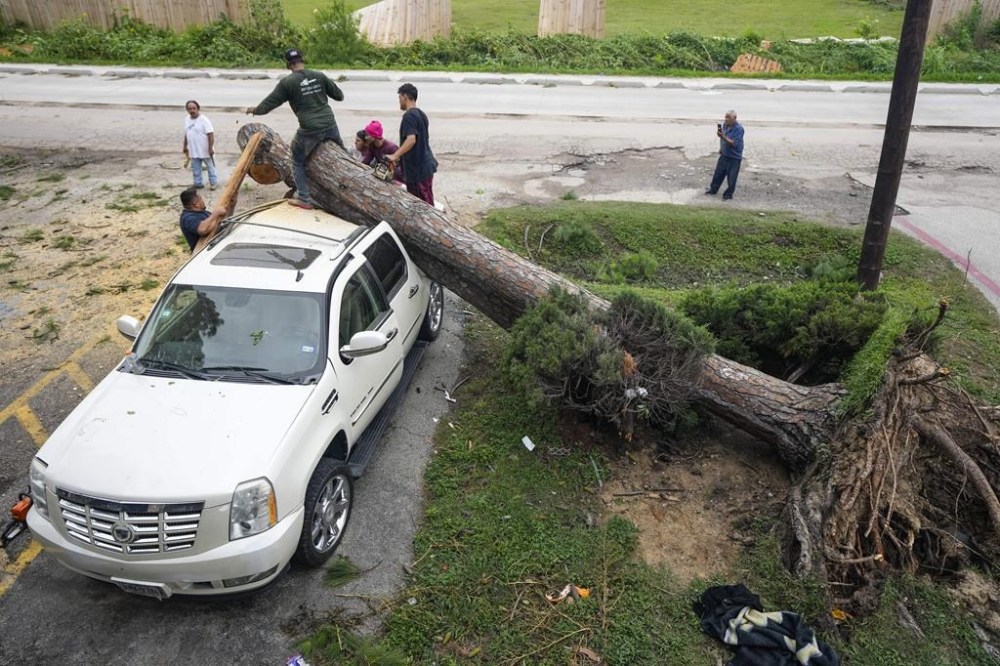
Tree service crews climb atop an SUV to cut apart a tree that fell on it at an apartment complex in the 4600 block of Sherwood in the aftermath of a severe storm on Friday, May 17, 2024, in Houston. Fast-moving thunderstorms pummeled southeastern Texas for the second time this month, killing at least four people, blowing out windows in high-rise buildings, downing trees and knocking out power to more than 900,000 homes and businesses in the Houston area. (Brett Coomer/Houston Chronicle via AP)

HOW TO STAY COOL

To avoid overheating, it’s key to stay hydrated. If your home is without water during a power outage, be sure to stock up on bottled water.

It’s also important to refrain from exertion, if possible. Avoid the sun, especially during the hottest part of the day, and stay in the shade when outside.

When it’s hot, the body cools off by sweating. Soaking T-shirts or other clothing with water, or frequently spraying your skin with water, can help boost this effect, said Zachary McKenna, post-doctoral fellow in the department of internal medicine at the University of Texas Southwestern.

“That does two things that are pretty beneficial: One, you have the potential for all of that water to evaporate off the skin and actually cool the body. And two, it lowers the need for your own body to produce that sweat,” he said.

McKenna says such strategies could be particularly helpful for older people because our bodies produce less sweat as we age.

If the temperature inside your house during the day is the same, or warmer, than it is outside, you can open windows to increase air flow — but make sure to keep curtains closed, especially if windows are receiving direct sunlight, he added. At night, if temperatures drop, open windows help increase the flow of cooler air.

FOOD SAFETY

If the power goes out, the food that’s in your refrigerator can keep cold for about four hours, and what’s in your freezer can keep cold for up to two days, according to the Federal Emergency Management Agency.

You can transfer food to a cooler. But make sure there is enough ice and cold packs to keep the cooler temperature below 40 degrees (4.4 C), says the U.S. Department of Agriculture. Add more ice as it melts.

If food that must be kept cold has been exposed to temperatures of at least 40 degrees (4.4 C) for longer than four or 48 hours, depending on whether it was refrigerated or frozen, it should be thrown away so that you don’t give yourself food poisoning, according to FEMA. If food in your fridge starts to have an unusual odor, texture or color, it should also be tossed.

People should seek out nonperishable foods, such as canned goods, that don’t require refrigeration.

If using camp stoves or charcoal barbecues to cook, make sure to use them outside and at least 20 feet away from windows, FEMA says.

HOW TO CHARGE PHONES AND DEVICES

One way to preserve your cellphone’s battery is to limit calling, texting and app use. Dimming the brightness of the display screen, or putting a phone in low power mode, can also help. Turning it off can also help save battery.

A number of vendors offer affordable solar-powered chargers for phones and other devices.
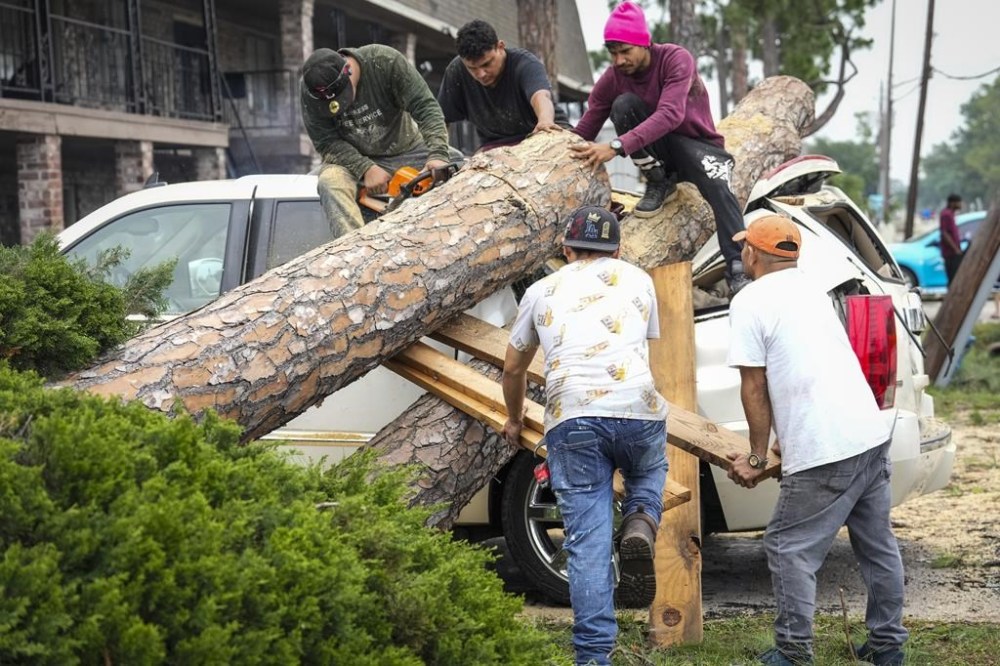
Tree service crews climb atop an SUV to cut apart a tree that fell on it at an apartment complex in the 4600 block of Sherwood in the aftermath of a severe storm on Friday, May 17, 2024, in Houston. Fast-moving thunderstorms pummeled southeastern Texas for the second time this month, killing at least four people, blowing out windows in high-rise buildings, downing trees and knocking out power to more than 900,000 homes and businesses in the Houston area. (Brett Coomer/Houston Chronicle via AP)

You can also charge your phone in your car. But FEMA warns that you should always run your car outside, and not in an enclosed space like a garage, to avoid carbon monoxide poisoning.

Generators, which are largely fueled by gasoline and diesel, can be used as an external power source during an outage. But it is essential to know how to use one safely.

Generators should always be used outdoors, at least 20 feet away from windows, doors and garages, according to FEMA.

Those who use generators should install battery-powered carbon monoxide alarms inside their home, FEMA says, as the gas is odorless and colorless. Carbon monoxide poisoning can be deadly.

Generators should be kept dry and protected from rain or flooding, as FEMA warns that touching a wet generator can cause electrical shock. Before refueling, make sure they have cooled down.

Heavy-duty extension cords should be used to connect appliances or devices to generators. And extra precaution should be taken when hooking up a generator to a home power source, as doing so could cause a dangerous surge in electricity, according to FEMA.

“You don’t want to hook your generator into your system without having an isolation switch to keep it from charging the power lines going out from your house,” said Kenneth Gray, a senior lecturer at the University of New Haven. “Because you may, as a result, electrocute people working in the area,” such as crews restoring downed power lines, he said.

Generator transfer switches and any other necessary equipment should be installed by an electrician, per FEMA recommendations.

OTHER SAFETY TIPS

Officials recommend unplugging electronics in your home so as to avoid damage from electrical surges. And battery-powered flashlights and lanterns should be used for lighting instead of candles, which can be a fire hazard.

It’s also important to check in on older people and those with disabilities or living alone when you can, McKenna said.

“Make sure that they know the strategies and that they have somebody that they can reach out to and if they need help,” he said.

Report Error Submit a Tip

More Stories

Could renewed interest in strategically critical rare earth elements finally make sub-sector profitable?

Joel Schlesinger 6 minute read Preview

Could renewed interest in strategically critical rare earth elements finally make sub-sector profitable?

Joel Schlesinger 6 minute read Saturday, Aug. 15, 2026

Rare earth elements are among the most critical of mined resources for modern economies.

They’re essential in manufacturing specialized magnets used in a host of technologies from wind turbines and electric vehicles to hard drives, smartphones, television screens, and fibre optics. Most notably, however, rare earth minerals are increasingly vital to the defence industry.

These 17 elements — closely related chemically and usually found all together in mineral deposits — have indeed been growing in geopolitical importance as the United States, Canada and other Western nations recognize their dependence on production from China.

It is the world’s largest producer and processor of rare earths, including the most in-demand elements neodymium and praseodymium used to manufacture very light and powerful magnets for an array of technologies, including the most advanced weapons of modern warfare.

Read
Saturday, Aug. 15, 2026

West Kildonan Industrial residents call for speed bumps after child hit by truck

Morgan Modjeski 3 minute read Preview

West Kildonan Industrial residents call for speed bumps after child hit by truck

Morgan Modjeski 3 minute read Saturday, Aug. 15, 2026

Residents in the West Kildonan Industrial neighbourhood are calling on the city to install speed bumps in their area after a child was hit and dragged by a vehicle Thursday.

Katelyn Bemister lives near the area where the child — who was hospitalized as a result of the incident and has been upgraded to stable condition — was struck. She says people frequently speed in the area.

“They’re going really fast, and they’re not really paying attention at all to the pedestrians in the area,” says Bemister.

In video supplied to the Free Press by a resident, the child can be seen riding a bike down a sidewalk along the 500 block of North Point Boulevard.

Read
Saturday, Aug. 15, 2026

Impaired driving victim honoured

Morgan Modjeski 5 minute read Preview

Impaired driving victim honoured

Morgan Modjeski 5 minute read Saturday, Aug. 15, 2026

Ten years after he was killed in a collision involving an impaired driver in 2016, Robbie Anderson’s name has been added to MADD Canada’s Manitoba Memorial honouring those killed in drunk and drug-impaired-related crashes.

His older brother Chris Anderson, was one of two dozen people who gathered at the Glen Eden Funeral Home and Cemetery in West St. Paul Saturday to remember their loved ones, 86 victims whose names are etched into the granite monument near the heart of the graveyard.

“It’s heavy,” said Anderson when asked what it was like to be part of the ceremony and see his brother’s name added. “It’s been something I’ve been thinking about for a while.”

Grateful for MADD’s work and its efforts to honour Robbie, who was 27 when he died, Anderson said his brother, represented the “absolute best of us.”

Read
Saturday, Aug. 15, 2026

Manitoba man lied about abduction: N.D. police

Scott Billeck 2 minute read 3:17 PM CDT

U.S. authorities say a Manitoba man falsely claimed he had been kidnapped and taken across the Canada-U.S. border over the weekend.

Roderick Garson, 37, is being held in a county jail near Alexandria, Minn., after he was arrested and charged with falsely reporting a crime.

The arrest stems from a report police received Saturday that a man had been abducted with a weapon in Manitoba and taken across the border into the United States.

The investigation led U.S. authorities to Alexandria, about two hours northwest of Minneapolis, where police located the reported victim and suspect after the latter ran into a local store claiming he had escaped from his 31-year-old unnamed captor.

Manitoba family finalist for cattle producers environmental award

Aaron Epp 4 minute read Preview

Manitoba family finalist for cattle producers environmental award

Aaron Epp 4 minute read Saturday, Aug. 15, 2026

A family in western Manitoba is one of seven finalists for a national environmental award honouring beef cattle producers.

Connor and Kyla English, alongside Connor’s parents, Brian and Leanne English, are nominated for the Canadian Cattle Association’s Environmental Stewardship Award. The 30-year-old award is presented to beef farmers and ranchers who explore innovative ways to protect, preserve and enhance their operations and the environment simultaneously.

This year’s recipient will be announced on Wednesday during a banquet at the Canadian Beef Industry Conference in Winnipeg.

The English family’s roots near Bradwardine — about 265 kilometres west of Winnipeg — date back to 1898. Today, Connor, Kyla, Brian and Leanne manage a herd of about 320 breeding cows on nearly 445 hectares (1,100 acres) of owned and rented pasture and forage land.

Read
Saturday, Aug. 15, 2026

Sea Bears finish on top

Joshua Frey-Sam 6 minute read Preview

Sea Bears finish on top

Joshua Frey-Sam 6 minute read Saturday, Aug. 15, 2026

Beauty. Bliss. Ecstasy.

That is how Aug. 15, 2026 will be remembered in Winnipeg.

What was once a pipe dream in the city’s hoops community became an epic reality on Saturday, when Simon Hildebrandt, who grew up playing on the courts of this very town, made good on a three-pointer from the wing to crown the Winnipeg Sea Bears Canadian Elite Basketball League champions.

A storybook ending to a 98-84 victory over the Brampton Honey Badgers sent a CEBL attendance record of 12,519 fans into pandemonium at Canada Life Centre and capped a Finals run for the ages — one that was fraught with injury, impromptu player exits and unprecedented circumstances.

Read
Saturday, Aug. 15, 2026